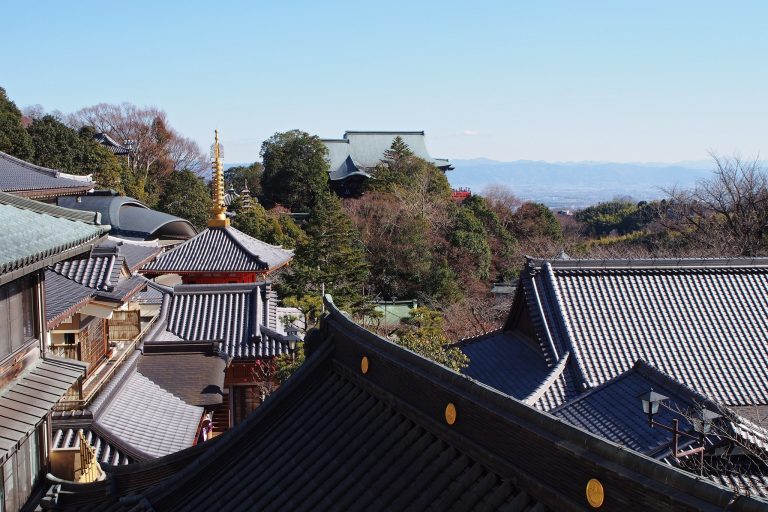
Hiraoka Shrine: A Historic Shinto Shrine in Higashiōsaka


Site at a Glance
- Rating
- 4.4
- Popularity
- Medium
- Country
- Japan
- Primary era
- Early Modern
- External website
- Open
- Eras represented
- Early Modern, Modern
- Civilizations
- Japanese, Tokugawa, Toyotomi regime
- Site type
- Religious
- Remains
- Sanctuary
On this page14 sections
History
Hiraoka Shrine is a Shinto shrine in Higashiōsaka, Japan, built and developed through the religious traditions of ancient Japan at the western foot of the Ikoma Mountains. Facing west, it grew from mountain worship associated with Kamitsutake, the peak behind the shrine, and is traditionally regarded as the tutelary shrine of the Nakatomi clan, an ancient aristocratic lineage associated with court ritual.
Origins and clan tradition
A foundation tradition places the shrine’s origin three years before the accession of Emperor Jimmu, the legendary first emperor in the traditional Japanese imperial genealogy. It states that Ame-no-Taneko, acting under imperial command during the eastern expedition, enshrined Ame-no-Koyane and Hime-gami on Kamitsutake. The tradition further holds that the Hiraoka clan moved the shrine from the mountain to its present location in 650.
The historical basis of this account is uncertain. Other interpretations connect Hiraoka’s beginnings with an earlier Kofun-period mountain cult or place its origins broadly in the seventh century. The Hiraoka clan was an ancient local lineage associated with the Nakatomi group and is traditionally considered to have conducted the shrine’s rites. Ame-no-Koyane was worshipped as the ancestral deity of the Nakatomi clan and, through it, of the Fujiwara clan, which emerged from the Nakatomi and became one of Japan’s most powerful court families.
Hiraoka Shrine’s name appears in historical records in two different character forms, although both are romanized Hiraoka. The two forms continued in use from antiquity into the early modern period, and the variant survives on stone markers and lanterns at the shrine.
Relationship with Kasuga and the four kami
When the Fujiwara established Kasuga Taisha in Nara, they transferred sacred manifestations, or bunrei, of Ame-no-Koyane and Hime-gami from Hiraoka. A bunrei is a transferred manifestation of a kami, allowing the same sacred presence to be enshrined at another shrine. This relationship gave Hiraoka the name Moto-Kasuga, meaning “Former Kasuga.”
Futsunushi and Takemikazuchi were later added to the shrine’s worship, apparently between the establishment of Kasuga Taisha in 768 and the first documentary record of Hiraoka’s four deities in 865. Shrine tradition dates their enshrinement to 778. Futsunushi and Takemikazuchi are martial kami especially associated with Katori Jingu and Kashima Shrine, respectively, and both were incorporated into the religious complex associated with Kasuga Taisha.
The four enshrined kami are Ame-no-Koyane, Hime-gami, Futsunushi, and Takemikazuchi. Ame-no-Koyane and Hime-gami appear together in records from 836, while the four-deity arrangement is first recorded in 865. A shrine tradition identifies Hime-gami specifically as Ame-no-Mizutama-teru-hime, although her precise identity is not established in the written records. One interpretation connects Futsunushi and Takemikazuchi with two deities recorded for Kawachi Province in 860, but that identification remains uncertain.
Court recognition and provincial status
In 806, Hiraoka Shrine received sixty shrine households, four in Kawachi Province and fifty-six in Tanba Province. Ninth-century records describe repeated court recognition, ritual offerings, prayers for rain, and increases in the rank of the shrine’s kami. By 859, Ame-no-Koyane had reached Senior First Rank and Hime-gami Junior Third Rank, with the corresponding honorific distinctions.
The Engishiki, compiled in 927, listed Hiraoka as four seats in the Myojin-taisha class in Kawachi District. This was a high-ranking category for shrines whose kami received major court recognition. The shrine participated in the imperial Tsukinami-sai, Ainame-sai, and Niiname-sai offerings and was also among the shrines designated for rainmaking and major kami rites.
Hiraoka was selected with Onji Shrine for the great imperial offerings associated with the emperor’s accession in 1017. From the late Heian period, it was revered as the Ichinomiya of Kawachi Province, a title meaning the leading shrine of a historical province, although explicit medieval documentary evidence for this title is limited.
Medieval worship, decline, and destruction
The shrine’s medieval history included both decline and renewal. Earlier records refer to fires or removals of the sanctuary in 1056, 1091, 1247, and 1330. In 1275, the Buddhist monk Eison of Saidai-ji led more than one hundred monks to Hiraoka, where they recited and expounded the Great Perfection of Wisdom Sutra as prayers against the Mongol invasions.
Parishioners reportedly revived the shrine in 1475 after periods of decline. During the conflicts of the 1570s, a dispute involving the shrine official Mizuhashi Aritada and forces commanded by Oda Nobunaga led to the burning of the shrine complex. The main sanctuary and seventeen associated shrines were destroyed in the conflagration.
Reconstruction and Edo-period administration
Toyotomi Hideyori sponsored reconstruction from 1602 to 1605. The main sanctuary was rebuilt in 1602, and the Daimyojin Bridge was restored in the same year. A hanging lantern was dedicated in 1603, while estates and mountain lands were contributed for reconstruction in 1605. During the Osaka campaign in 1614, Tokugawa authorities issued a three-clause prohibition concerning the shrine.
In the Edo period, Toyoura Village provided an annual estate income of 5.95 koku, a premodern measure of agricultural yield conventionally associated with the rice needed to support one person for a year. A shogunal charter issued in 1648 prohibited the cutting of trees and bamboo in the shrine forests and exempted Hiraoka from various services and levies, although overall shogunal support remained limited.
Hiraoka’s ancient priestly office was associated with the Hiraoka clan and later with the Onakatomi lineage. In the medieval period, the hereditary Mizuhashi family served as chief priests, while members of the Torii family served as negi priests, who assist with shrine rites. The Mizuhashi family claimed descent from the Hiraoka lineage and developed from shrine officials into local landed warriors before continuing in shrine service until the end of the Edo period.
Religious reorganization and modern status
Six Buddhist temple institutions formerly functioned as shrine temples, including Jingoji and Hiraokadera, whose origins were considered medieval. Jingoji was abolished in 1873 after the separation of Shinto and Buddhism. In the same period of religious reorganization, shrine administration in 1872 combined nineteen, or possibly fifteen, subsidiary shrines within the precinct and more than twenty shrines from nearby villages into Tenjin Chigi Shrine. Some of the merged shrines were later restored separately.
Following the Meiji Restoration, Hiraoka was ranked a Kanpei-taisha in 1871. This was the highest class in the modern imperial shrine system established after the restoration. The shrine became a Beppyo shrine of the Association of Shinto Shrines in 1948.
The shrine continues rites with long historical associations. The January rice-divination ceremony uses cooked rice and tied plant stems to forecast future harvest conditions, while the December renewal of the shimenawa, a sacred rope marking a consecrated boundary, is also called the “Laughing Ceremony.” The rice-divination practice is associated with customs dating to the thirteenth century. Osaka Prefecture selected the ceremony as an Intangible Folk Cultural Property in 1978, together with a one-volume record of its proceedings. The shimenawa ceremony was designated an Intangible Folk Cultural Property of Higashiōsaka in 1974. The Autumn Festival takes place in October and is accompanied by approximately twenty taiko drums. It is described as the most important festival in Osaka Prefecture.
The four buildings of the main sanctuary became tangible cultural properties of Higashiōsaka in 1974, and eight copper hanging lanterns were added to the designation in 1995. Other municipal cultural-property or scenic designations cover the shrine’s copper bridge finial, copper hanging lantern, historical precinct painting, shimenawa ceremony, and Plum Grove. In 2002, Hiraoka was included among Japan’s “100 Fragrant Landscapes” because of the variety of trees in its immediate surroundings, including camphors, cedars, and cherry trees.
Remains
Main sanctuary and worship buildings
The main sanctuary is formed by four independent buildings arranged in a north-south row facing the approach. A middle gate and a transparent fence enclose them. From south to north, the order is the Second, First, Fourth, and Third sanctuaries. All four were rebuilt in 1826 in the distinctive four-linked Hiraoka style, a local development related to Kasuga-zukuri. This style uses a compact sanctuary with a projecting front porch and a gabled roof, while the Hiraoka form adapts it into a row of four separate sanctuaries rather than a single connected building.
The First Sanctuary houses Ame-no-Koyane, the Second houses Hime-gami, the Third houses Futsunushi, and the Fourth houses Takemikazuchi. Each has a cypress-bark roof. The First and Second retain substantial quantities of older timber, including bracket supports, transverse beams, and projecting nose-like wooden members with characteristics of the late Edo period. Restoration and rebuilding from the Heisei into the Reiwa period aimed to recover the appearance of the late-Edo sanctuary for which reliable surviving documentation exists. The resulting arrangement is presented as the distinctive Kasuga four-linked Hiraoka style.
The worship hall was rebuilt in 1879 to correspond to the shrine’s former Kanpei-taisha rank. Its roof is covered with copper sheet and was formerly covered with cypress bark. A plaque bears the name Hiraoka Shrine in the hand of Sanjo Sanetomi, a nineteenth-century court noble and statesman. Other precinct buildings include the Kamado Hall, the Keimei Hall, which serves as the shrine office, an assembly hall, and a ritual purification hall. Built in 1936 as an office, the purification hall is now used for ritual purification.
Approach, mountain shrine, and historic landscape
Kamitsutake Main Shrine stands on the mountain behind and east of the present precinct, at the traditional place where the shrine’s worship began. A stone monument marked the former restricted area in 1981, followed by a stone shrine in 1993. The mountain sanctuary preserves the physical connection between the present shrine and the Kamitsutake worship associated with its origin tradition.
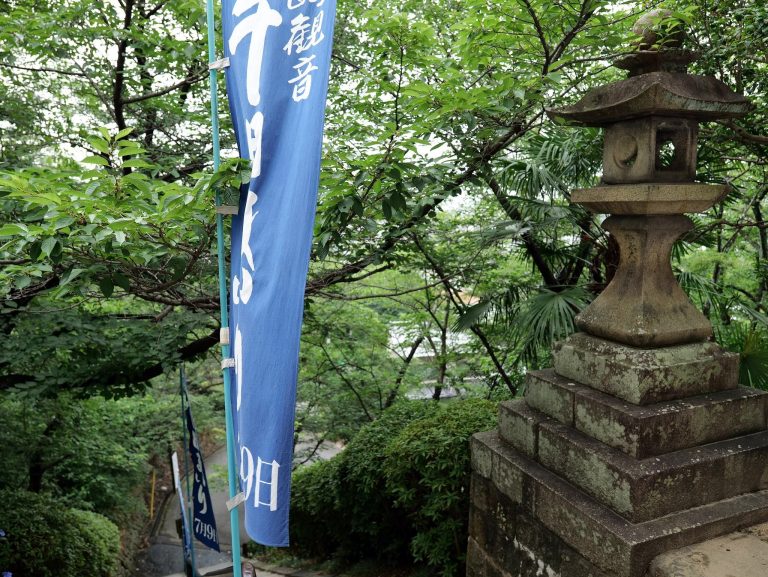
The First Grand Torii stands about 800 meters west of the Second Torii along the Higashi-Koya Highway. The approach between them is called Matsu no Baba and faces toward Kamitsutake. A nearby stone lantern bears an inscription dated 1685, making it the oldest such lantern identified in Higashiōsaka. Both the torii and Matsu no Baba appear on a 1776 map of Kawachi Province.
The former site of Jingoji is now Hiraoka Plum Grove. After the temple was abolished in 1873, volunteers from Toyoura Village planted plum trees and established a moon-viewing platform. The grove was expanded during the early Taisho period and again in the early Showa period. A juniper that once stood within the precinct was designated a natural monument of Osaka Prefecture in 1938. Typhoon Muroto damaged it in 1961, and it was felled during the 1960s or 1970s.
Subsidiary shrines
Wakamiya Shrine
Wakamiya Shrine is dedicated to Ame-no-Oshikumone, regarded as the child of Ame-no-Koyane. Behind the building is a well called Izumoi, which has been proposed as the source of the place-name Izumoi-cho.
Tenjin Chigi Shrine
Tenjin Chigi Shrine enshrines the heavenly and earthly kami. Its present identity derives from the nineteenth-century consolidation of numerous local shrines. Some of the shrines incorporated into that arrangement were subsequently restored elsewhere.
Historic objects and religious interpretation
The copper finial from the bridge restored in 1602 is 36.5 centimeters high and carries an inscription on its body. The copper hanging lantern dedicated by Toyotomi Hideyori in 1603 is hexagonal, measures 48.5 centimeters in height, and has inscriptions on four sides of its lantern chamber.
A colored silk painting of Hiraoka Shrine was made by Kano Hachirobei in 1656. Measuring 196.5 by 88.5 centimeters, it includes an inscription explaining that the image depicts the precinct before the deterioration visible at the time. The painting therefore preserves a record of the shrine’s earlier layout and buildings.
The shrine’s principal deity also has a Buddhist honji, or Buddhist counterpart, identified as Ksitigarbha Bodhisattva. The honji belongs to the medieval theory of combined Buddhist and Shinto worship, in which a kami could be understood as a manifestation of a Buddhist figure.