Manju-ji Temple: A Rinzai Zen Temple in Oita, Japan


Site at a Glance
- Rating
- 4.3
- Popularity
- Very Low
- Country
- Japan
- Primary era
- Early Modern
- External website
- Open
- Eras represented
- Early Modern
- Civilizations
- Tokugawa
- Site type
- Religious
- Remains
- Monastery
On this page10 sections
History
Manju-ji Temple is a Rinzai Zen temple in Oita, Japan, established in 1306 by Otomo Sadachika, the fifth head of the Otomo clan. Rinzai is one of Japan’s major Zen Buddhist traditions, and the temple belongs to the Myoshinji branch, a major institutional lineage centered on Myoshinji in Kyoto. Sadachika invited Chokuō Chikan, the son of Ashikaga Yasu-uji and abbot of Jotenji in Hakata, to become the founding monk. The foundation may instead have involved the revival of an already dilapidated temple.
Legend and medieval foundation
A tradition places the temple’s origin in the early Heian period. It tells of Manju-hime, the daughter of a retainer, who was drowned in Makomogaike as a substitute for the consort of the local notable Yuriwaka Daijin while he was away during a rebellion. According to the legend, the temple was established to conduct memorial rites for her. Makomogaike is a pond associated with makomo, an aquatic grass, and tradition connects its name with the temple’s mountain name, Shōzan, also read Makomo-san. The temple is also called Manju Kōshō Zenji.
By the early Muromachi period, Manju-ji had entered the Ten Monasteries, a ranking category for especially prominent Zen institutions under the medieval shogunate. During the rule of Otomo Sadamune, the monks Sesson Yubai, Tenkyō Reichi, and Chugan Engetsu visited the temple. In the fourteenth-century Nanbokucho period, when rival Northern and Southern imperial courts contested political authority, forces of the Southern Court, including the Kikuchi clan, used Manju-ji as their headquarters while attacking Northern Court forces based at Takasaki Castle.
Warfare and destruction
Warfare and fire repeatedly damaged the temple. Major recorded fires occurred in 1486, 1492, 1514, and 1586. The 1586 destruction came during the Shimazu invasion of Bungo in the Bungo-Satsuma War, when the temple was destroyed along with much of Funai. Manju-ji then remained without rebuilding for a long period.
An Edo-period war chronicle, regarded as less reliable, claims that Otomo Yoshishige, also known as Sorin, ordered the temple burned in 1570 because it sheltered an Otomo retainer under suspicion. Another chronicle attributes the destruction to Yoshishige’s order to burn major Buddhist temples and Shinto shrines after his conversion to Christianity. These accounts preserve competing explanations for a wartime episode, while the recorded fires and the 1586 Shimazu invasion establish the broader pattern of destruction.
Edo-period revival
During the Edo period, the monk Gyokuei received permission from Takenaka Shigetoshi, the first lord of Funai Domain, to establish a hermitage at the temple’s present location. Gyokuei’s successor, Tanzan, rebuilt the buildings during the Kan’ei period, from 1624 to 1644, with assistance from Takenaka Shigeyoshi, the second lord of the domain. Tanzan is regarded as the temple’s reviver. The present complex in Kanaikecho continues to occupy this Edo-period location.
Archaeology and later developments
The former Manju-ji site in present-day Motomachi and the nearby Otomo clan residence site have helped establish the location of the medieval center of Funai. In 2005, the former temple site was added to the already designated Otomo clan residence historic site, and the combined designation was renamed the Otomo Clan Ruins.
Manju-ji formerly contained the grave and memorial monument of the composer Taki Rentaro. At the request of the Taki family, both were moved in March 2011 to Ryusenji in Hiji, where the family cemetery is located.
A Manju-ji branch was established at the foot of Mount Takasaki in 1936 by Kurauchi Jirobei, a businessman from Kitakyushu and a lay member of the temple. He owned land there and donated the branch to Manju-ji. In 1952, the branch monk Onishi Shinno worked with Oita mayor Ueda Tamotsu to begin feeding Japanese macaques on the grounds. This initiative led to the opening of Takasaki Mountain Natural Zoological Park on March 15, 1953.
In 1954, the branch requested that the monkey-feeding area be moved so that a main hall could be built. Negotiations retained the feeding area and established an agreement under which the branch would receive a donation equal to 20 percent of the park’s annual gross revenue. In 1958, Ueda asked the architect Isozaki Arata to design the branch’s main hall, but the proposal was not realized.
Remains
Manju-ji’s surviving places reflect two stages of its history. The former site in Motomachi forms part of the archaeological remains of medieval Funai, while the active temple complex stands in Kanaikecho at the location established during the Edo-period revival. The temple’s principal image is a Shaka triad, a Buddhist group centered on Shakyamuni, the historical Buddha, with accompanying figures.
Former medieval site
Excavations at the former Manju-ji site have produced rare ceramics that illuminate the material culture of medieval Funai. Finds include a red-ground bowl with gold-brocade decoration and a stylized hosoge floral motif, a Buddhist design widely used in East Asian decorative arts. It was the first example of its kind excavated in Japan. A brown-glazed ceramic ewer from the site was the second example of its kind excavated in Japan. Together with the nearby Otomo clan residence site, the remains define an archaeological area associated with Funai’s medieval center.
Present temple complex
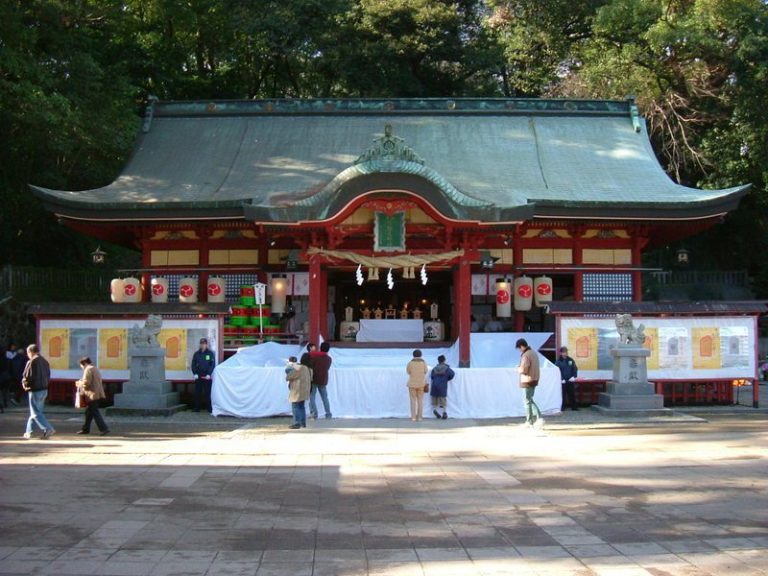
The present complex occupies the Edo-period location in Kanaikecho. Its formal main gate provides the principal architectural entrance, and the temple buildings were rebuilt during the Kan’ei period after Gyokuei’s hermitage had been established. The Shaka triad serves as the principal image of the temple, linking the present religious complex with its Rinzai Zen identity.
Makomogaike
Makomogaike is the pond associated with the foundation story of Manju-hime. It also provides the traditional explanation for the temple’s mountain name, Shōzan, or Makomo-san, preserving a physical and linguistic connection between the legend and the temple’s identity.
Takasaki Mountain branch
The branch precinct lies at the foot of Mount Takasaki. A branch building was constructed there in 1936, and the grounds later contained the monkey-feeding area connected with the development of Takasaki Mountain Natural Zoological Park. The former grave and memorial monument of Taki Rentaro were relocated from the temple cemetery to Ryusenji in Hiji in 2011.