Tōdai-ji Daibutsu: Japan’s Great Buddha of Nara


Site at a Glance
- Rating
- 4.7
- Popularity
- Medium
- Country
- Japan
- Primary era
- Classical
- External website
- Open
- Eras represented
- Classical, Early Modern
- Civilizations
- Tokugawa
- Site type
- Religious
On this page11 sections
History
Tōdai-ji Daibutsu is a monumental seated copper image of Locana Buddha in Nara, Japan, created during the eighth-century Nara period under Emperor Shōmu. Locana, also called Vairocana, is the cosmic Buddha of the Flower Garland tradition, representing the totality of the universe. The image formed the spiritual centre of a state-sponsored religious program intended to respond to political unrest, epidemic disease, famine, drought, an earthquake, and the rebellion of Fujiwara no Hirotsugu.
Shōmu’s Religious Program
In 740, Shōmu is said to have worshipped a Locana Buddha at Chishiki-ji in Kawachi Province and resolved to create a similar image. The following year he ordered the establishment of provincial monasteries and convents, state-supported religious institutions intended to secure protection and stability throughout Japan. Tōdai-ji became the provincial monastery of Yamato and the central provincial monastery of the country, giving the temple a nationwide institutional role.
Shōmu issued the edict for the Great Buddha on November 5, 743, at Shigaraki Palace. The decree called for the use of the country’s copper and invited voluntary participation so that people could attain Buddhahood and share in the prosperity of the land. It also instructed officials not to force people to donate. The undertaking was supported by chishiki, religious communities united by shared faith, including groups led by the monk Gyōki. In 745, Gyōki was appointed Grand Prelate.
From Shigaraki to Tōdai-ji
The first plan placed the image at Kōka-dera near Shigaraki Palace, in present-day Kōka, Shiga Prefecture. A pillar forming the core of the planned statue was erected there in 744. Repeated mountain fires and other ominous events led to the abandonment of that plan. After the capital returned to Heijō-kyō, work began at the present Tōdai-ji site on September 23, 745.
Kinshōji, an earlier name associated with Tōdai-ji, belonged to the temple’s early development. It had begun as a temple connected with the commemoration of Shōmu’s deceased son and was later raised to the status of Yamato’s provincial monastery. A scholarly interpretation holds that political and religious conflict contributed to the abandonment of the Shigaraki project, with Empress Kōmyō and Fujiwara no Nakamaro helping redirect the enterprise to Tōdai-ji as a state undertaking. This remains an interpretation rather than an established fact.
Creation and Consecration
Preparation of the image began in 745. The model was probably complete by November 23, 746, when Shōmu performed a lamp-offering ceremony at Kinshōji. Casting began on November 6, 747, and concluded on December 8, 749, in stages rising from the bottom of the statue to the top. The chief sculptor was Kuninaka no Kimimaro, while Takechi no Okuni and Takechi no Mamaro served as casters. Gyōki and the religious communities associated with him also supported the work.
About 2.6 million people are estimated to have taken part in constructing the image and the Great Buddha Hall. The original project is estimated to have cost approximately 465.7 billion yen in 2010 values. Gold for the statue’s gilding was difficult to obtain in Japan, but its discovery at Wakuya in Mutsu Province in 749 was regarded by Shōmu as a miraculous sign connected with the Buddha. The discovery prompted a change of era name, and Kudara no Kyōfuku, governor of Mutsu, presented about 13 kilograms of gold.
The eye-opening ceremony took place on May 26, 752. An eye-opening ceremony is a Buddhist consecration ritual that symbolically gives a newly made image its spiritual presence. The Indian monk Bodhisena led the rite, attended by the retired Emperor Shōmu, Empress Kōmyō, Empress Kōken, high officials, monks, and other dignitaries. Tens of thousands of people were present, and a surviving register confirms the exceptionally large attendance.
The image was still unfinished at the time of the ceremony. Repairs and finishing continued until 755, gilding was completed in 757, and the halo was made between 763 and 771. The ceremony may have been timed to coincide with the traditionally calculated two-hundredth anniversary of Buddhism’s arrival in Japan. Its postponement by one day remains unexplained, although weather has been suggested. Construction of the original Great Buddha Hall began after the principal casting of the statue and was completed in 758.
Damage, Reconstruction, and Survival
The scale of the Tōdai-ji project placed heavy pressure on the state, increased burdens on farmers, and worsened fiscal conditions. During the 757 rebellion of Tachibana no Naramaro, the construction of Tōdai-ji and other state projects was identified as a cause of popular suffering. The image itself developed cracks and began to lean within decades of completion.
An earthquake in 855 caused the head to fall. Prince Takaoka, also known as Shinnyo-hōshinnō, became supervisor of the Great Buddha Office, and repairs were completed under officials and craftsmen including Inbe no Fumiyama. A court ceremony marking the completion of the repairs took place in 861.
In 1180, fighting between Taira no Shigehira and the warrior monks of Tōdai-ji and Kōfuku-ji caused a fire that destroyed principal parts of the temple complex and damaged the image. Chōgen led the revival as chief fundraising monk. A chief fundraising monk, or kanjin, collected donations for major religious construction and restoration projects. Chōgen received support from Minamoto no Yoritomo and assistance from the Song Chinese caster Chen Heqing and others. An eye-opening ceremony for the restored image was held in 1185, and the rebuilt hall was dedicated in 1195 in the presence of Emperor Go-Toba, Yoritomo, and Hōjō Masako.
The statue and hall burned again in 1567 during fighting involving Matsunaga Hisahide and the Miyoshi Triumvirate. The cause of this fire is uncertain. Explanations have included a deliberate attack, an accidental fire during a night assault, and arson by a Christian in the Miyoshi camp.
A temporary hall was erected, but it collapsed in a gale in 1610. The head was then covered only by temporary copper plates and remained exposed to the weather for several decades. In 1685, Kōkei obtained permission from the Edo shogunate to raise funds for reconstruction. The present image was completed in 1691 and dedicated in 1692, while the present Great Buddha Hall was completed in 1709. The surviving statue is therefore largely the result of repeated reconstruction and repair. Its head dates from the Edo period, while substantial earlier material survives in parts of the pedestal, right flank, arms and sleeves, and thighs. The precise division between original and later material differs among studies.
On February 8, 1958, the image was designated a National Treasure of Japan as the copper seated image of Locana Buddha enshrined in the Main Hall.
Remains
The surviving monument consists of the seated copper Buddha, its lotus pedestal and halo, and the timber Great Buddha Hall that houses it with smaller Buddhist images. The statue is approximately 14.7 metres high, and its pedestal has a circumference of about 70 metres. Its raised right hand is associated with encouraging reflection, while its left hand is associated with granting requests and distributing gifts.
The Copper Buddha
Lotus Pedestal
The Buddha sits on a lotus pedestal made of an upper lotus and an inverted lotus. Together they contain 28 petals, arranged as 14 large and 14 small petals. The pedestal preserves a relatively large proportion of eighth-century material. Each upper petal carries engraved imagery cut with a chisel. The composition includes Shakyamuni Buddha and bodhisattvas above, a great seven-petaled lotus below, and a tiered representation of the Buddhist cosmos between them.
Engraved Cosmic Imagery
The engravings include 22 bodhisattvas, 25 horizontal cosmic tiers, pavilions and bodhisattva heads, and seven lower divisions corresponding to the seven petals of the great lotus. Together they represent the Lotus Treasury World and, in their complete arrangement, the Buddhist Three Realms. The Flower Garland Sutra presents the Lotus Treasury World as a vast cosmos of interlinked worlds and Buddha lands, an idea that explains the imagery beneath the statue. Interpretation of the petals has also connected them with the Brahma Net Sutra and the Treatise on the Great Perfection of Wisdom. The prevailing interpretation is that elements from several Buddhist texts were combined.
The petals repeat the same general design but vary slightly in their detailed measurements. This suggests that each was drawn freehand from a common model rather than mechanically copied. The engraved lotus imagery is an important surviving example of Nara-period pictorial art, and much of it endured the two major war fires even though the statue as a whole underwent extensive later replacement and repair.
Structure and Materials
The image was cast in eight successive sections from the bottom upward rather than in a single operation. Craftsmen built a framework of wood and rope, formed a clay core and outer clay mold, removed and fired the mold, and shaved the core to establish the thickness of the copper. They then reassembled the sections with metal supports and poured molten copper through channels. Records state that 3,350 metal mold supports were made, each approximately four sun square and one sun thick. A sun was a traditional Japanese length of about three centimetres.
After casting, workers filled voids, strengthened the surface with copper plates, removed excess metal, joined the sectional seams, attached the curled hair, smoothed the surface, applied gilding, and constructed the halo. Approximately 500 tons of copper were used. Most probably came from mines in and around Nagato Province, including the Naganobori mine. The arsenic content of surviving original areas, excavated copper lumps, and ore from that mine shows a strong similarity.
Cinnabar and mercury were used for gilding. A temple record gives approximately 820 kilograms of mercury. Gold was dissolved in mercury, the resulting amalgam was applied to the statue, and the surface was heated until the mercury evaporated. The curled hair was traditionally counted as 966 coils, but laser analysis established a total of 492, of which nine are incomplete. On the original pedestal, a stone lotus structure is thought to have stood beneath the copper lotus. A depiction made before the 1180 fire also shows this two-level arrangement, while the order in which the copper pedestal and main image were cast remains unresolved.
Great Buddha Hall and Halo
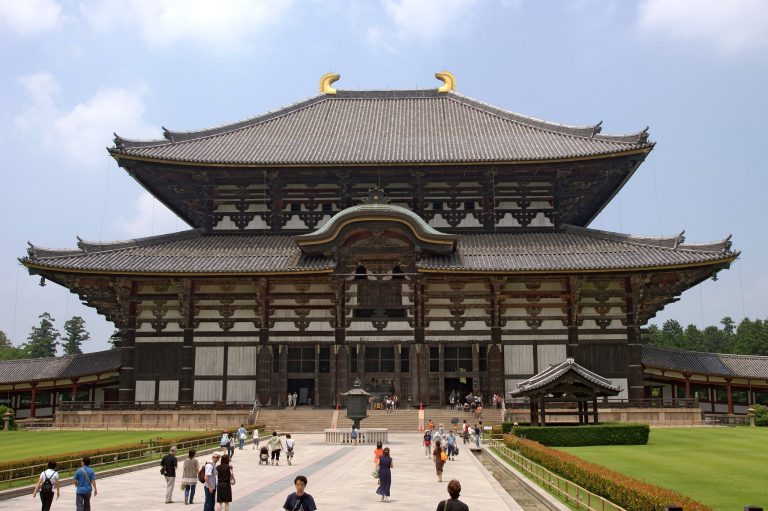
The present Great Buddha Hall is a large timber-frame building measuring approximately 57.5 metres across, 50.5 metres deep, and 49.1 metres high to the ridge. Its depth and height are close to those of the original hall, while its width is about two-thirds of the original approximately 86-metre span. The current structure belongs to the reconstruction completed in 1709 after the hall was destroyed in 1180 and 1567.
A gilded wooden halo rises behind the statue and contains 16 figures representing manifestations of Buddha. Behind the image, a wooden column has an opening through which pilgrims traditionally crawl. Legend associates passing through it with entry into Paradise.