Herten Castle: A Historic Moated Castle in North Rhine-Westphalia, Germany
Visitor Information
Google Rating: 4.7
Popularity: Low
Official Website: schloss-gastro.de
Country: Germany
Civilization: Early Modern, Medieval European, Modern
Site type: Military
Remains: Castle
History
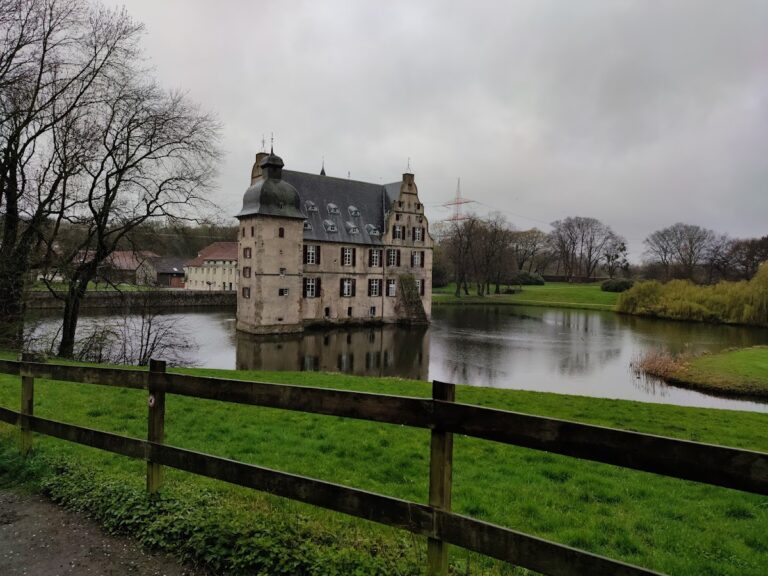
Herten Castle is located in the town of Herten, within the Recklinghausen district of North Rhine-Westphalia, Germany. It stands on the western edge of the town center, surrounded by a moat. The castle was first recorded in 1376 as a fief under the Imperial Abbey of Werden, a religious institution that held significant territorial influence in the region during the Middle Ages.
The initial construction dates back to the early 14th century when the von Herten family, vassals of Werden Abbey, built a stone residential tower. This medieval tower formed the core of the castle and established its defensive and residential function. Ownership shifted through marriage in the mid-14th century to the von Galen family, and later in 1488 to the von Stecke family. In 1529, the castle passed to the von Nesselrode family through Anna von Stecke’s marriage to Bertram I von Nesselrode, who held important administrative roles including hereditary chamberlain of the duchies of Jülich and Berg and governor of the Electorate of Cologne’s Vest Recklinghausen from 1539 to 1556.
Under the von Nesselrode family, the castle underwent significant expansion beginning around 1520. Commissioned initially by Sophie von Morrien, widow of Heinrich von Stecke, and continued by Bertram I von Nesselrode, the castle was transformed into a late Gothic four-winged complex with bastions and fortifications. These defenses successfully resisted a two-year siege during the Cologne War between 1583 and 1585. The von Nesselrode family maintained possession for nearly three centuries, with Franz von Nesselrode-Reichenstein elevated to Imperial Count by Emperor Leopold I in 1702.
A devastating fire in 1687 destroyed large parts of the north and west wings and much of the castle’s valuable library. Reconstruction followed swiftly, completed by 1702 in the Baroque style. This included the addition of an ornate west portal and the creation of a French-style Baroque garden featuring fountains and statues. The castle’s prominence continued until the death of Johann Franz Joseph von Nesselrode-Reichenstein in 1824, after which ownership passed to the von Droste zu Vischering family through his daughter Maria Caroline. This family also received the Imperial Count title in the same year.
The castle remained inhabited until shortly after World War I. From 1920, the family moved to Schloss Merten, leaving Herten Castle abandoned. During the Ruhr occupation from 1923 to 1925, French troops were stationed in the castle, leaving it heavily damaged. The castle suffered further deterioration due to mining subsidence, which caused structural damage and the drying up of its moat.
In 1974, the Landschaftsverband Westfalen-Lippe (LWL), a regional cultural authority, acquired the castle and its park. They undertook extensive restoration work from 1974 to 1989, replacing vulnerable wooden structures with reinforced concrete to stabilize the foundations. Since 2008, the city of Herten has owned the castle complex, which now serves cultural and therapeutic functions.
Remains
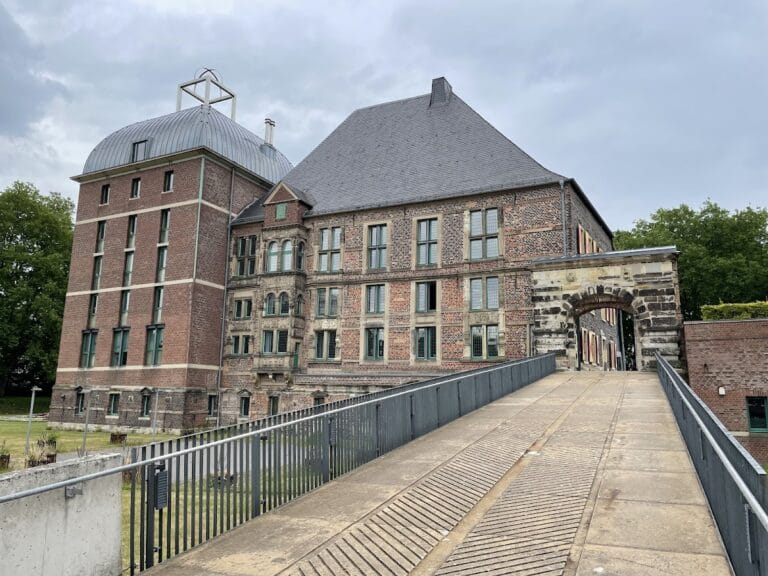
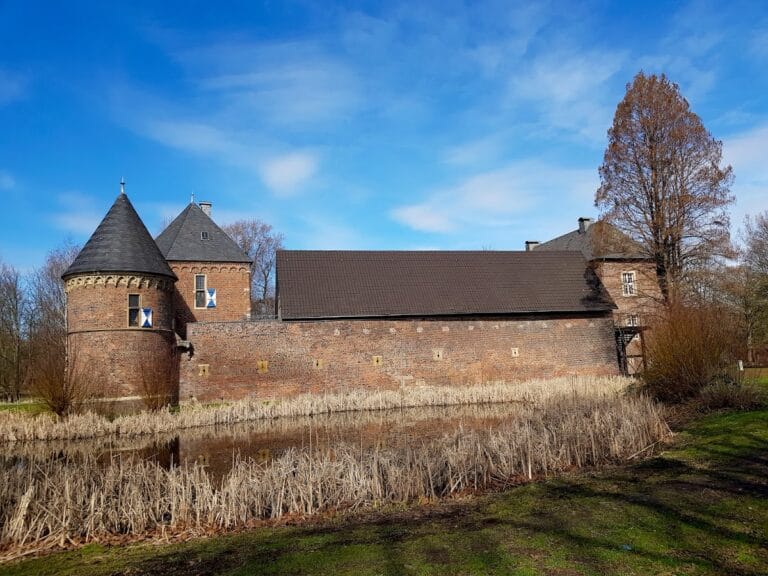
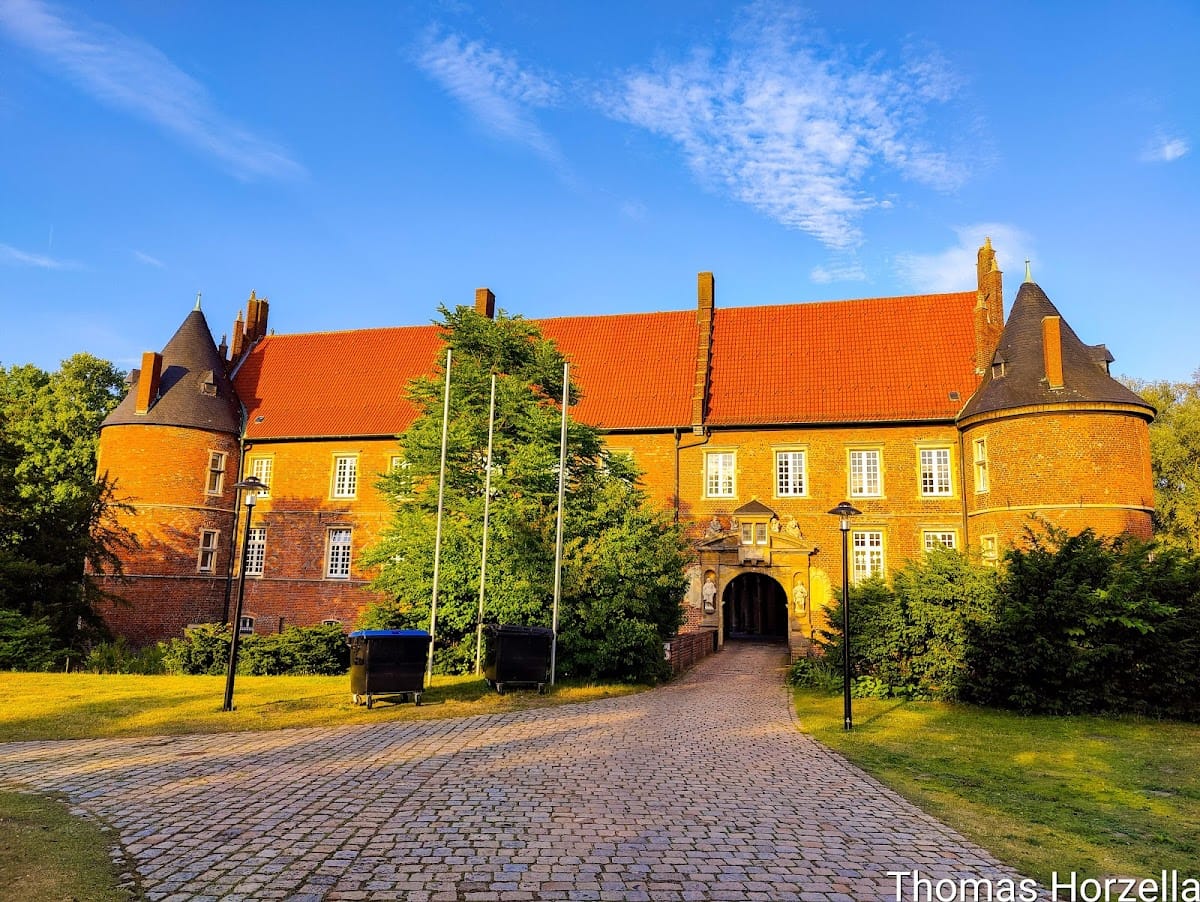
Herten Castle is a brick-built moated complex consisting of a main castle (Hauptburg) and an outer bailey (Vorburg), each situated on separate islands surrounded by water. A third island to the south once served as a garden. The Hauptburg forms an irregular quadrangle with four wings enclosing a courtyard. Most wings rise two stories, except the south wing, which is single-story. The brick walls are horizontally divided by stone water tables, a feature that helps protect the masonry from moisture.
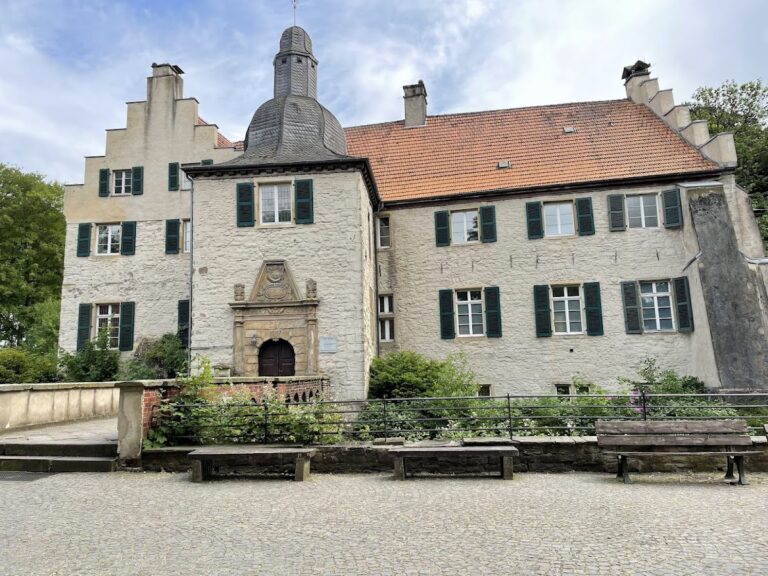
Three corners of the Hauptburg are marked by round, two-story towers topped with conical roofs. The east and west wings display stepped gables adorned with pinnacles. The main entrance, located on the southern part of the west wing, dates from the early 18th century and features an elaborate stone portal framed by a small projecting oriel window and topped with a segmental gable. Stone cartouches on the portal commemorate the resident families, a destructive fire, and the castle’s reconstruction. Above the gate, a Latin motto reads “QUAERATUR VIRTUS – INVENIETUR HONOS,” meaning “Virtue is sought – Honor will be found.”
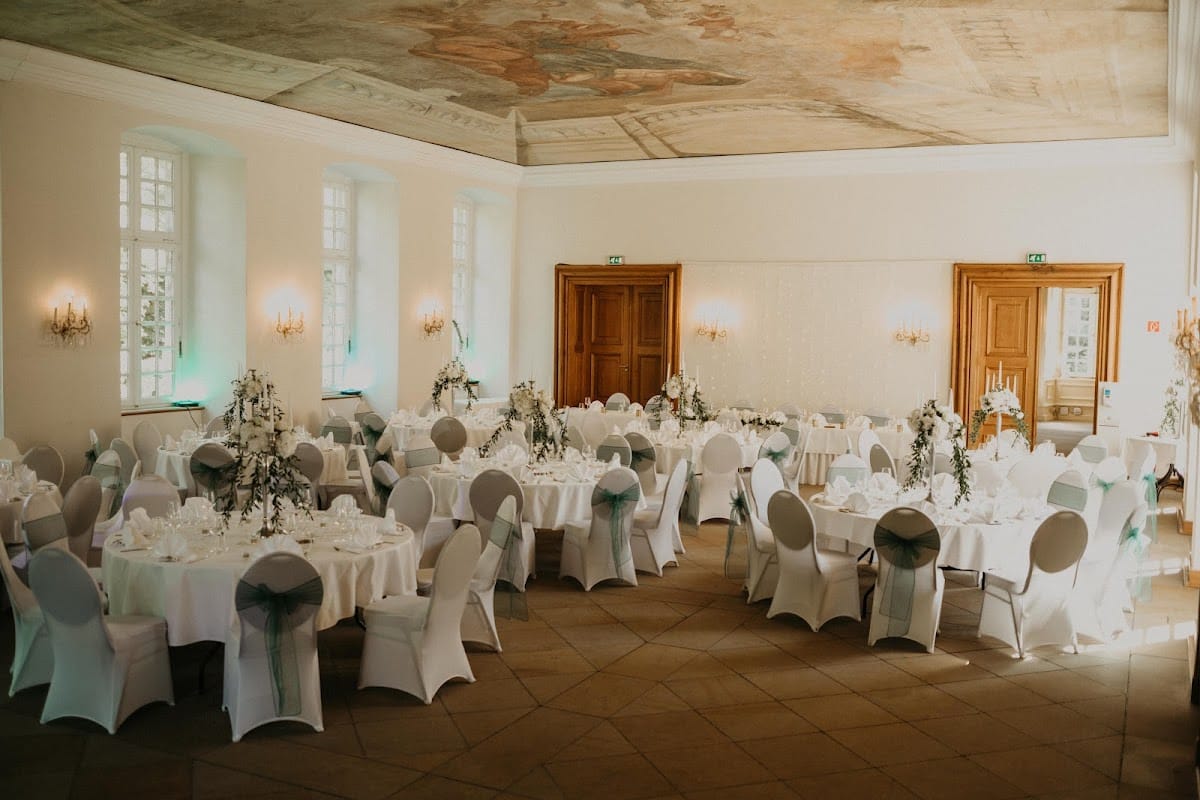
Inside, the north wing’s courtyard facade includes a simple round-arched portal flanked by two stair towers. The south wing features a late Gothic gallery with distinctive twisted fluted columns. The interior was largely remodeled during the 1980s restoration, but the east wing retains original Baroque decoration, including a stucco ceiling from around 1700 and a partially preserved ceiling painting from the mid-17th century in the great hall.
The vaulted cellar of the north wing contains remnants of the original medieval stone residential tower, including a vault with band ribs resting on older foundations uncovered during a 1974 emergency excavation. The castle’s expansion in the 16th century, designed by master builder Henric de Suer and his son Johann, created a fortified late Gothic four-wing complex with bastions. Remnants of these defensive walls survive near the eastern chestnut avenue.
The north wing was extended on pile foundations, with a two-story gallery added later. Its facade is the oldest surviving show facade in Westphalia, completed before the mid-16th century. The east wing housed large representative halls on the ground floor, while the west wing incorporated an earlier house with a preserved gable visible in the attic. Additional towers were added to the northwest and south of the west wing.
A two-story connecting wing with a late Gothic columned gallery was built obliquely between the east and west wings on the south side. The second story of this wing was likely demolished between 1850 and 1870. An octagonal stair tower, one of the earliest of its kind, stands in the southeast corner of the inner courtyard, built during the construction of the south wing.
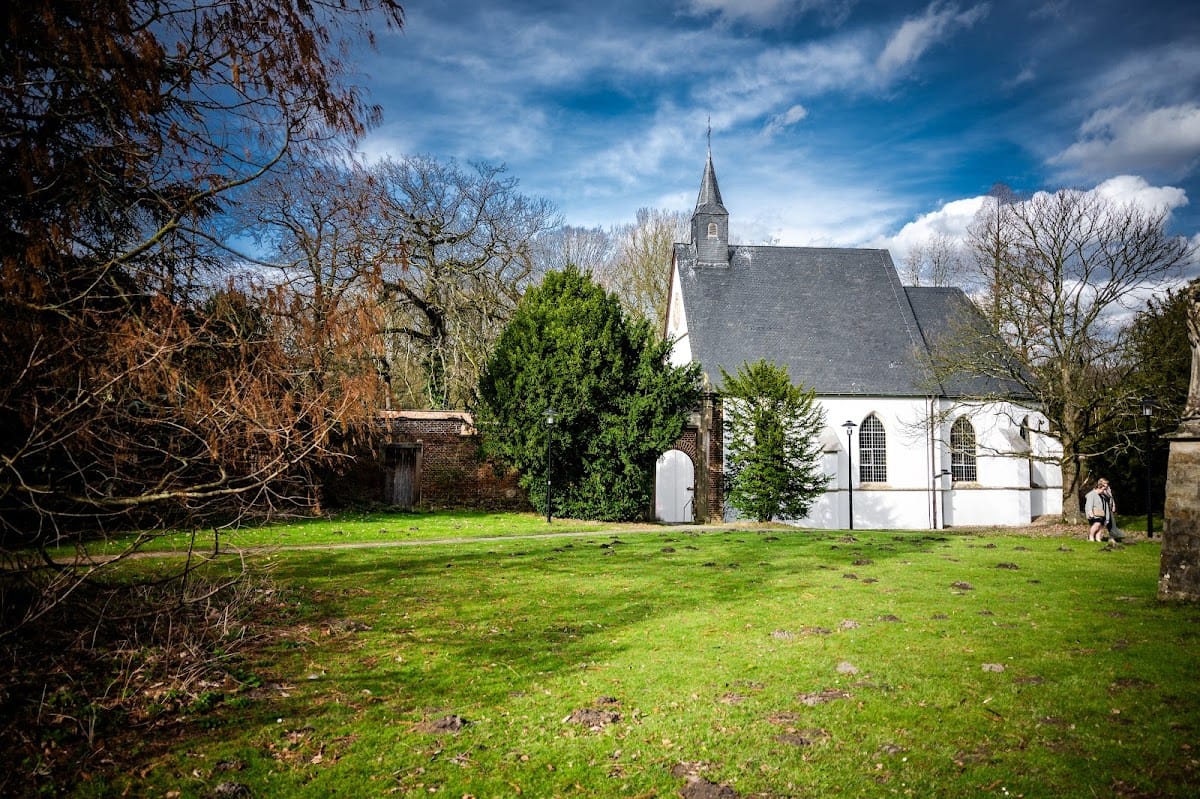
North of the main castle, the Vorburg island contains a brick building believed to be the western wing of a 16th-century carriage house, featuring a high gabled roof and stepped gables. Ruins of another wing lie at its northern end. The castle chapel, relocated in 1908 from Schloss Grimberg, stands on the Vorburg grounds. Originally a 14th-century Gothic three-aisled hall church, it features rib vaults supported by columns and wall consoles. Its Baroque interior dates to the early 18th century, partly designed by Johann Conrad Schlaun, with choir stalls and altar by master carpenter Schild and an altarpiece by Johann Anton Kappers. The chapel’s portal and a freestanding portal on its access path, both designed by Schlaun in the 18th century, were added later and are not original.
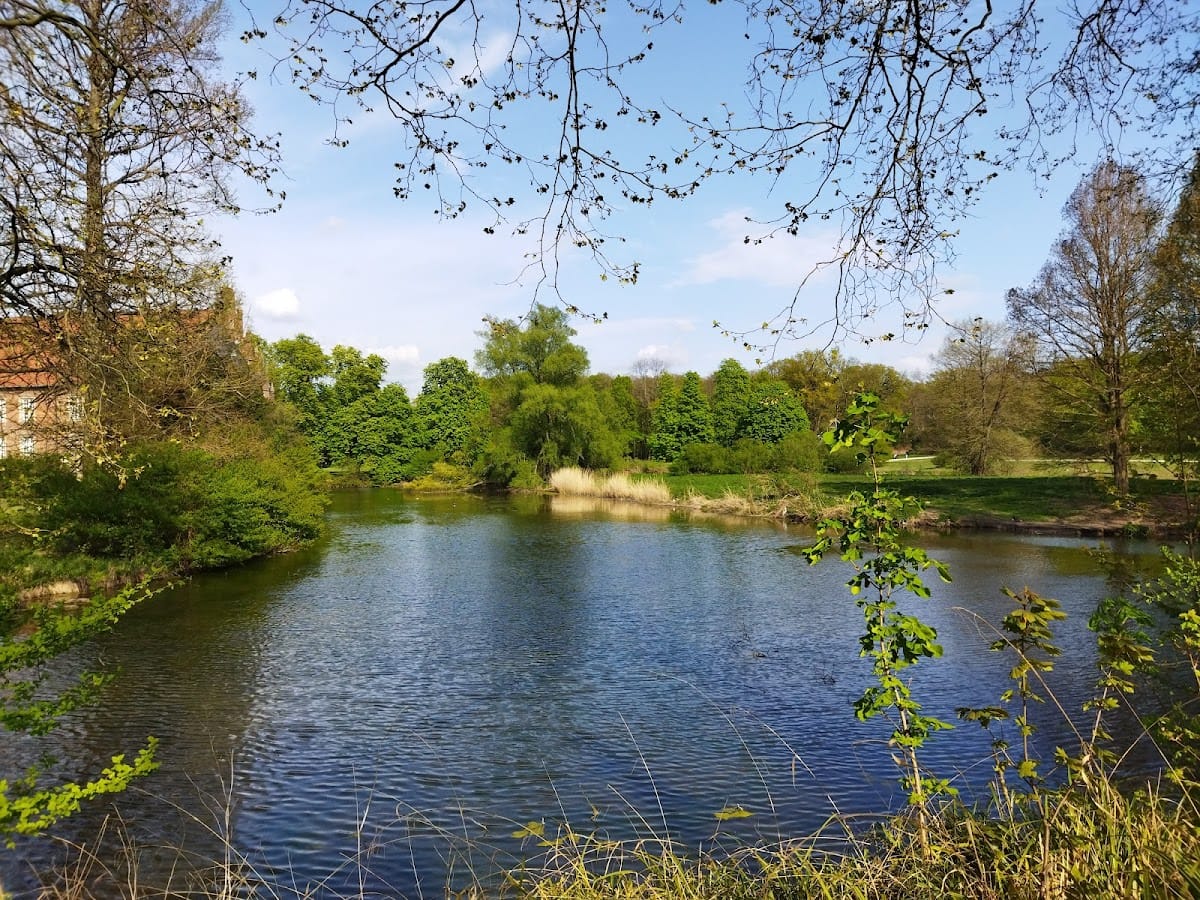
The castle park covers about 30 hectares and was transformed from a French formal garden into an English landscape garden between 1814 and 1817 by court gardener Maximilian Friedrich Weyhe. Some Baroque elements remain, including alleys and the orangery building. The park contains over 200 tree species, including rare specimens such as a 125-year-old Chinese handkerchief tree and a large-leaf magnolia. Two fish ponds and a mixed forest of roughly 200 hectares, established in the mid-19th century, are part of the grounds. Two mid-19th-century cavalier houses stand at the northern entrance. A small square garden pavilion with a mansard roof, known as the Tabakhaus, commemorates two French Counts Riaucourt who used it for tobacco smoking before the French Revolution.
The castle’s foundations were threatened by mining-induced ground subsidence, which dried up the moat and damaged wooden pile foundations. Starting in 1967, these were replaced with reinforced concrete supports. During restoration, the building was divided into six sections with movement joints to accommodate ground shifts. Most original oak roof trusses were replaced by modern softwood constructions, except for a small part of the west wing.
About 200 meters northeast of the castle stands a single-story Neo-Renaissance orangery built by 1725. It measures 35 meters long, 10.5 meters wide, and 8.5 meters high, with a ten-axis window facade topped by a balustrade featuring twelve life-size sandstone sculptures of Greek mythological figures. The orangery served as a winter shelter for sensitive plants, a garden casino, and dining hall, and housed a renowned camellia collection. It fell into ruin after 1921 but was partially stabilized in 2010, with restoration efforts ongoing since 2017.
Nearby sites