Heilig Kreuz (Polling): A Holy Cross Pilgrimage and Parish Church in Germany


Site at a Glance
- Rating
- 4.8
- Popularity
- Very Low
- Country
- Germany
- Primary era
- Early Modern
- External website
- Open
- Eras represented
- Medieval, Early Modern, Modern
- Civilizations
- Duchy of Bavaria, Electorate of Bavaria, German, Holy Roman Empire
- Site type
- Religious
- Remains
- Church
On this page10 sections
History
Heilig Kreuz is a Roman Catholic parish church in Polling, Germany, and a former church of the Augustinian canons’ foundation. It also bears the title Sankt Salvator, a Christian designation for Jesus Christ meaning “Savior of the World,” and remains associated with the veneration of the Holy Cross.
Early monastery and collegiate foundation
An eleventh-century account places the foundation of a Benedictine monastery at Polling around 750 by members of the Huosi noble family. A later tradition attributed its origin to Tassilo III, the eighth-century duke of Bavaria, who was said to have found a cross scratched from the ground by a hind while hunting. The first monastery was destroyed during the tenth-century Hungarian invasions, raids by Magyar forces that damaged many settlements and religious foundations across central and western Europe.
In 1010, Duke Heinrich IV of Bavaria established a collegiate foundation on the site. He was crowned Emperor Heinrich II in 1014, and the church’s later artistic program continued to remember him and his wife, Kunigunde. After 1100, the foundation became a monastery of Augustinian canons, clergy who followed the Rule of Saint Augustine while serving a collegiate and pastoral community.
Medieval churches and the Holy Cross pilgrimage
A new church for the foundation was consecrated in 1160 by Hartmann, Bishop of Brixen. Its surviving crypt lies beneath the Gottesackerkapelle on the opposite side of the Tiefenbach. During the thirteenth century, pilgrimage to the Holy Cross became an important religious focus at Polling. A church at the present location was consecrated in 1298, but it was destroyed in 1414. A Gothic replacement was then built between 1416 and 1420.
The church’s former Cross Altar was produced around 1420 by the artist now known as the Master of the Polling Panels. Its wings show the legendary discovery of the cross by Tassilo III and the Exaltation of the Cross. The altar is now preserved in the Alte Pinakothek in Munich. Another central object of devotion, the Pollinger Cross, also called the Tassilo Cross, originally stood on a side altar and was transferred to the high altar in 1628.
Seventeenth-century enlargement
Construction of a Renaissance tower began in 1605 according to plans by Hans Krumpper, but the project stopped because funds ran short. Between 1621 and 1628, Provost Kilian Westenrieder expanded the Gothic hall church. The choir was extended eastward by three bays and received a new vault. A sacristy was built on the north side and the Reliquary, or Achberg, Chapel on the south, with an oratory above each. Chapels were added along the long sides, and galleries were installed around the church. Heinrich V von Knöringen, Bishop of Augsburg, consecrated the enlarged building in 1628.
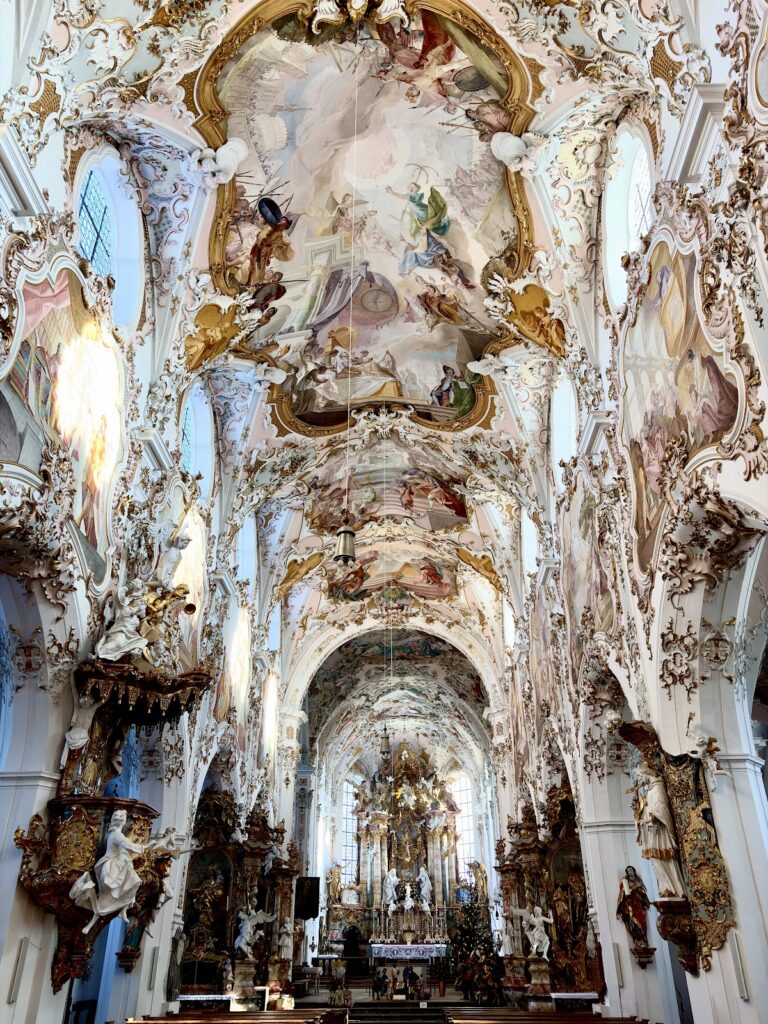
The church was among the earliest buildings decorated with Wessobrunn stucco, a South German tradition of elaborate architectural stucco work. Georg Schmuzer executed the decoration in 1625. Geometric forms, framed panels, rosettes, and garlands expressed the transition from the late Renaissance to the early Baroque. This transformation connected the medieval building with the new devotional and ceremonial requirements of the Augustinian foundation.
Baroque and Rococo renewal
A vestibule was added to the west in 1733. Its inscription, Liberalitas Bavarica, means “Bavarian Generosity.” Under Provost Franz Töpsl, the church and its furnishings were extensively remodeled between 1761 and 1765 in the late Rococo style. This period gave the interior much of its present character and also preserved memories of the foundation’s legendary beginnings. Two vestibule paintings from around 1735 depict Tassilo III founding the monastery in the eighth century and Heinrich II and Kunigunde restoring it in the eleventh century.
The church is protected as a listed architectural monument in Bavaria. Its gravestones and epitaphs include memorials to Eusebius Amort, Gerhoh Steigenberger, and Franz Töpsl, all identified with the Catholic Enlightenment in Bavaria. This eighteenth-century movement sought to combine Catholic religious life with learning, reform, and selected aspects of Enlightenment thought. Heilig Kreuz therefore continues to unite parish use with its older identity as a pilgrimage church dedicated to the Holy Cross.
Organ history
By 1628, the organ builder Simon Hayl had supplied four instruments for the rebuilt church: a large main organ, two smaller choir organs, and a fourth small instrument. During renovations that began in 1763, Johann Georg Hörterich built a new main organ and choir organ, while Franz Xaver Schmädl made the case. The main instrument survived secularization largely intact and was repaired by Max Maerz of Munich in 1881 and 1899.
In 1915, during the First World War, the Hörterich organ was replaced by a substantially reduced two-manual instrument made by the Rhine-based firm Koulen. Its Rückpositiv, a secondary organ division traditionally placed behind the organist in its own gallery-rail case, was deactivated, although the case remained. Max Offner of Augsburg built another organ in 1964, intended to restore the earlier Hörterich instrument, including that division. The materials soon proved insufficiently durable, and a new instrument was decided upon in 1996.
In 2004, Johann Pirchner of Steinach am Brenner installed the present organ in the historic case. It has 42 stops on three manuals and pedal, mechanical key and stop action, slider chests, and unequal temperament according to Vallotti. Its couplers are II/I, III/I, III/II, I/P, II/P, and III/P. Archabbot Jeremias Schröder consecrated the instrument on 5 December 2004. Its disposition, prepared by the collegiate church organist Stefan Niebler, follows South German Baroque sound models.
Remains
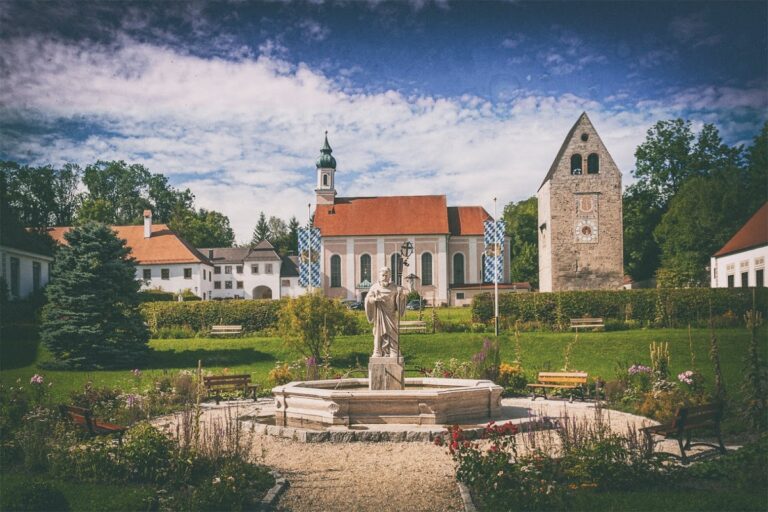
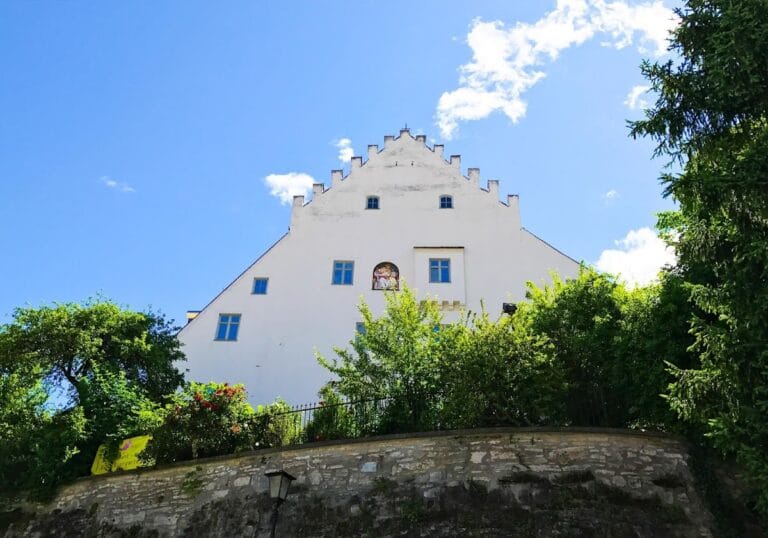
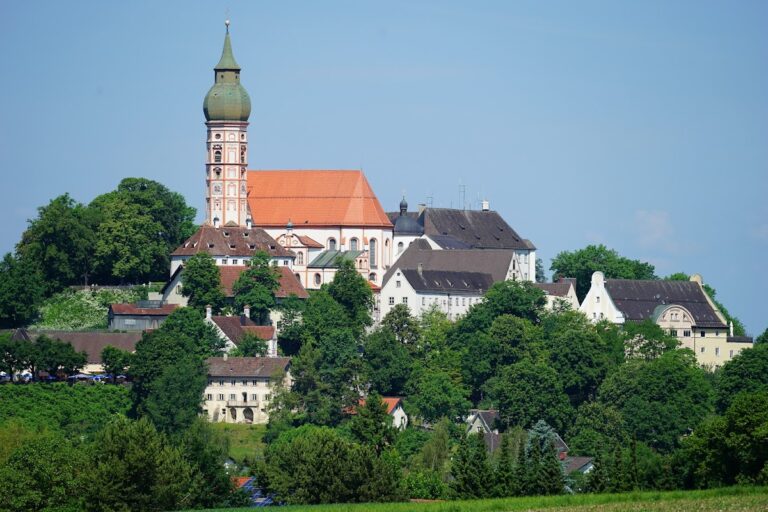
Heilig Kreuz is built from Polling limestone tuff and has a three-aisled hall plan with five bays. Surviving Gothic pointed arcades rest on tall octagonal piers covered with Baroque stucco. The three-bay choir is as wide as the nave and ends in a five-eighths termination, a polygonal chancel end formed from five sides of an eight-sided figure. The unfinished tower stands on the south side of the western facade. Its octagonal upper stage and pointed helmet were added in 1822, bringing it to approximately 57 meters in height.
Chapels, stucco, and painted decoration
The seventeenth-century expansion added the northern sacristy and the southern Reliquary, or Achberg, Chapel. The chapel has four cross-vaults supported by a central pier. Johann Baptist Baader painted its ceiling cycle, which follows episodes from the childhood of Jesus. The scenes include the Annunciation, Visitation, Adoration of the Shepherds, and Flight into Egypt. Each of the four colored principal scenes is accompanied by two monochrome emblems in Rocaille cartouches referring to its subject.
Georg Schmuzer’s 1625 stucco includes geometric designs, fields bordered by egg-and-dart bands, rosettes, and garlands. The slender piers have acanthus-decorated capitals, while winged angel heads frame the windows. The ceiling above the organ gallery carries a 1766 fresco by Johann Baptist Baader showing King David playing the harp. Related decorative and inscriptional themes include Noah’s Ark, the rainbow, and a dove beneath the words Nuntia Pacis, “Message of Peace,” along with scenes and phrases concerning the Adoration of the Shepherds, the Resurrection, the Flight of the Holy Family, and protection.
Altars, pulpit, and furnishings
The high altar was made by Bartholomäus Steinle between 1623 and 1628 to 1629 and remodeled by Johann Baptist Straub between 1763 and 1765 as a theatrical Rococo altar. Surviving parts of the earlier work include some putti and figures of Saint Ulrich and Saint Augustine. Three female sculptures around the tabernacle represent Faith with a chalice, Charity with a heart, and Hope with an anchor. Figures of Emperor Heinrich II and Empress Kunigunde, made around 1774, are attributed to Straub or his workshop.
In 1763, the Holy Cross was placed at the center of the altarpiece beneath a Rococo baldachin and within a halo of gilded copper rays. The Marian Altar and Augustine Altar were made by Steinle in 1625 and remodeled by Straub in 1762 to 1763. Eight new stucco-marble altars were installed in the side chapels in 1763. The Augustine Altar’s altarpiece is among the final works of the painter Balthasar Augustin Albrecht.
The richly gilded pulpit dates from 1705. Oil paintings on its basket represent Faith, Hope, and Charity, while a dove beneath the sounding board represents the Holy Spirit. Putti heads on the lower part of the basket express attentive listening and reinforce the pulpit’s role in preaching. The pews, carved shortly after 1760, have Rococo cheek pieces. Screens beneath the organ gallery and painted sheet-iron screens with carved cresting on the choir and nave galleries also belong to the remodeling of the 1760s.
Cross and commemorative sculpture
The Pollinger Cross was made from spruce boards cut from a tree felled between 884 and 1018. As the wood became brittle, metal clamps were added to hold it together. Around 1180, the cross was covered with horsehide to conceal the clamps, and around 1230 to 1240 it received a life-size painted image of the Crucified Christ. Its later placement on the high altar established it as the principal focus of the church’s Holy Cross devotion.
Opposite the pulpit, at the triumphal arch, stands a Madonna and Child seated on a throne. Dated to 1526, it is regarded as a major work by Hans Leinberger, a sculptor based in Landshut. The church also contains the monumental cathedral peal in the octagonal tower stage. Cast by the Bochum Association in 1947, its notes follow the sequence A-flat 0, B-flat 0, C 1, E-flat 1, and F 1.