Rottenbuch Abbey: A Former Augustinian Canonry in Germany


Site at a Glance
- Rating
- 4.8
- Popularity
- Low
- Country
- Germany
- Primary era
- Medieval
- External website
- Open
- Eras represented
- Medieval, Early Modern
- Civilizations
- Duchy of Bavaria, Electorate of Bavaria, Holy Roman Empire
- Site type
- Religious
- Remains
- Monastery
On this page8 sections
History
Rottenbuch Abbey is a former house of the Canons Regular of Saint Augustine in Rottenbuch, Germany, founded in 1073 by Duke Welf I of Bavaria and his wife, Judith of Flanders. The Augustinian canons were priests who followed the Rule of Saint Augustine while undertaking religious and pastoral work. Dedicated to Saints Peter and Paul and the Nativity of Mary, the abbey became a major center of ecclesiastical reform in Old Bavaria.
Origins and foundation
Hermits probably lived in the area from about 950, forming a loose religious community before the canonry was established. Another tradition places the beginnings of the monastic cell around the turn of the ninth and tenth centuries, so the earliest phase remains approximate. The foundation of the canonry took place in 1073 at the initiative of Welf I and Judith, at the request or with the advice of Altmann, the reform-minded bishop of Passau. Altmann introduced the Augustinian Rule, and the first canons arrived from St. Nikola in Passau.
During the Investiture Controversy, the medieval conflict between the papacy and secular rulers over the appointment of bishops and other church officials, Rottenbuch offered refuge to supporters of the papal reform movement. Bishop Altmann stayed there, as did the theologian Manegold of Lautenbach, who served as the community’s dean. Papal privileges issued in 1090 and 1092 confirmed the abbey’s direct subordination to Rome.
A center of Augustinian reform
During the eleventh and twelfth centuries, Rottenbuch became a leading center for the reform of the Augustinian canons in Old Bavaria. Under Provost Ulrich I, the community’s observance was transmitted to Berchtesgaden, Baumburg, Dietramszell, Beuerberg, Bernried, Diessen, and Schlehdorf. A Rottenbuch canon named Eberwin later became the first provost of both Berchtesgaden and Baumburg, linking those two institutions directly to Rottenbuch as their mother monastery.
A community of canonesses was established at Rottenbuch around 1120. The women’s foundation continued until 1272, when the canonesses moved to St. Laurentius in Benediktbeuern and adopted the Benedictine Rule. Rottenbuch’s wider sphere of activity also included the pilgrimage church of the Assumption of Mary on Hohen Peissenberg.
Rottenbuch was the seat of an archdeaconry, an ecclesiastical district overseen by an official responsible for clergy and church affairs. Its provost served as archdeacon for the Ammergau and Werdenfels, and the institution retained a predominant position in the Diocese of Freising until its dissolution. In the fourteenth century, under the patronage of Emperor Louis the Bavarian, Louis IV of the Holy Roman Empire, and with the advantage of its position on the pilgrimage route to Italy, Rottenbuch became one of the most influential houses of the Canons Regular in Germany. Together with Polling, it was also a major center of regional spiritual life.
Rebuilding and secularization
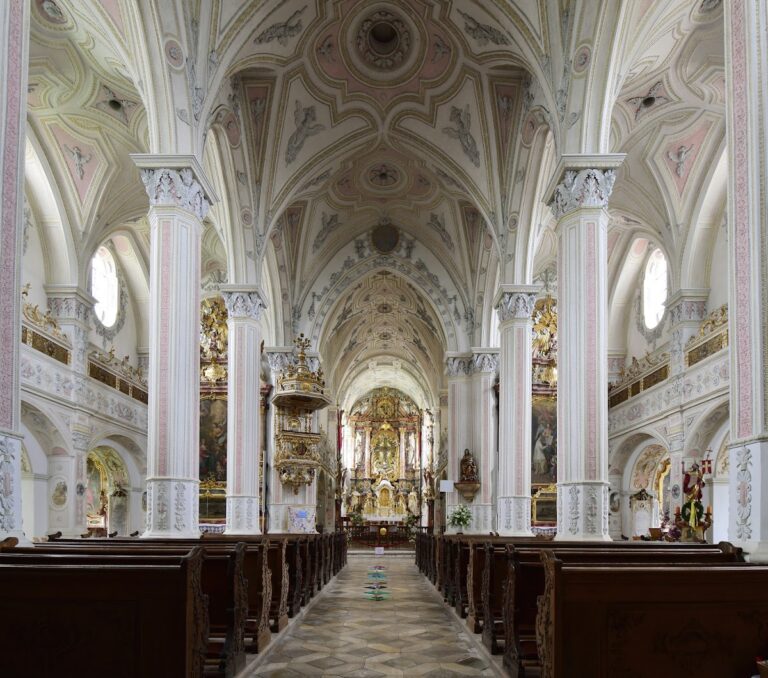
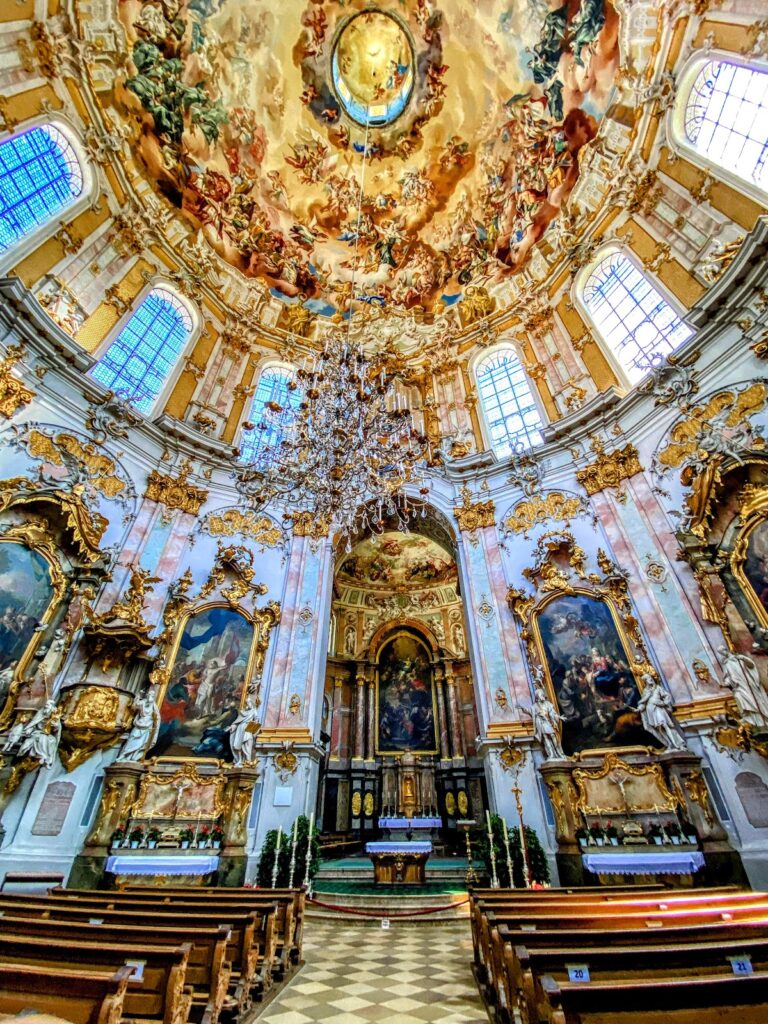
The monastic complex was rebuilt between 1750 and 1770. During the same broad period, the medieval interior of the church was redecorated in the ornate High Baroque and Rococo styles. These changes gave the surviving church much of its later artistic character while preserving its older structural fabric.
Bavarian secularization brought the abbey to an end on 21 March 1803, when the monastery was suppressed and the complex was sold. Most of the monastic buildings were subsequently demolished, although responsibility for the demolition remains disputed. The church and part of the complex survived. The monastery library was largely transferred to the Munich Residence and later sold; much of it ultimately reached a paper mill.
From 1804 to 1813, the former monastic estate belonged to the Swiss silk-ribbon manufacturer Johann Rudolf Meyer of Aarau and then to his son, who sold it to the Kingdom of Bavaria in 1816. Since secularization, the former collegiate church has served as Rottenbuch’s parish church.
Modern institutional uses
Between 1960 and 1963, the Don Bosco Sisters took over the surviving buildings and adapted them for the Maria Auxilium home. The project initially operated as a holiday camp, then expanded to include apartments for people with disabilities in 1969, a special educational center for intellectual development in 1973–1975, a special educational day facility, and a boarding school for intellectually disabled children and young people.
On 1 September 2010, the Regens-Wagner Foundation of Dillingen acquired the Maria Auxilium home and has operated the facilities since then. The Don Bosco Sisters moved to the neighboring renovated building known as the Schloss. The surviving former monastic buildings now serve several civic and residential purposes, including dwellings, Rottenbuch Town Hall, a primary school, and a village museum.
On the night of 19 September 2018, fire severely damaged the roof structure of the former monastic brewery. The public prosecutor’s office suspected negligent arson, but discontinued the investigation because no suspect could be identified.
Remains
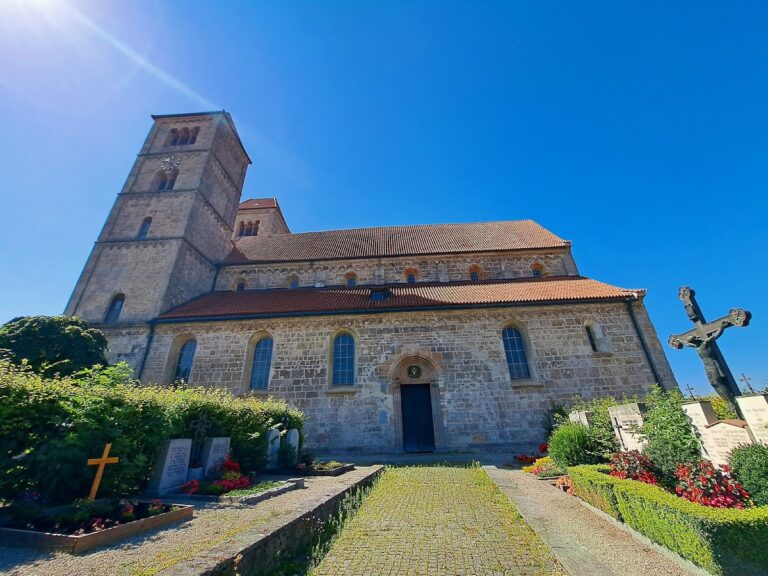
Rottenbuch Abbey stands above the Ammer Valley in Upper Bavaria, approximately twelve kilometers northeast of the Wies pilgrimage church. The surviving complex is centered on the former collegiate church, whose medieval Romanesque structure was later enlarged in the Gothic style and whose interior received eighteenth-century Baroque and Rococo decoration. Parts of the former monastic buildings remain around it and have been adapted for residential, educational, municipal, and care-related uses.
Former collegiate church
Construction of the former collegiate church began in 1085, and the building was erected in the Romanesque style between 1085 and 1125. Romanesque architecture is characterized by massive masonry, rounded arches, and heavy forms. The church was later enlarged in the Gothic style, a medieval architecture associated with pointed arches, greater verticality, and larger openings. It remains the principal surviving ecclesiastical structure of the former complex.
The church has a crossing transept, the crossarm that intersects a church’s main axis, and a free-standing tower detached from the main body of the building. This arrangement is unusual for a Bavarian church. The interior was redecorated in the mid-eighteenth century in an ornate High Baroque or Rococo style. Josef Schmuzer, a Wessobrunn stuccoist known for molded plaster decoration, created the stucco work, and the painter Matthäus Günther contributed the paintings. The choir is specifically associated with Schmuzer’s Rococo design. A gallery organ and a pulpit also remain within the former church.
Surviving monastic buildings
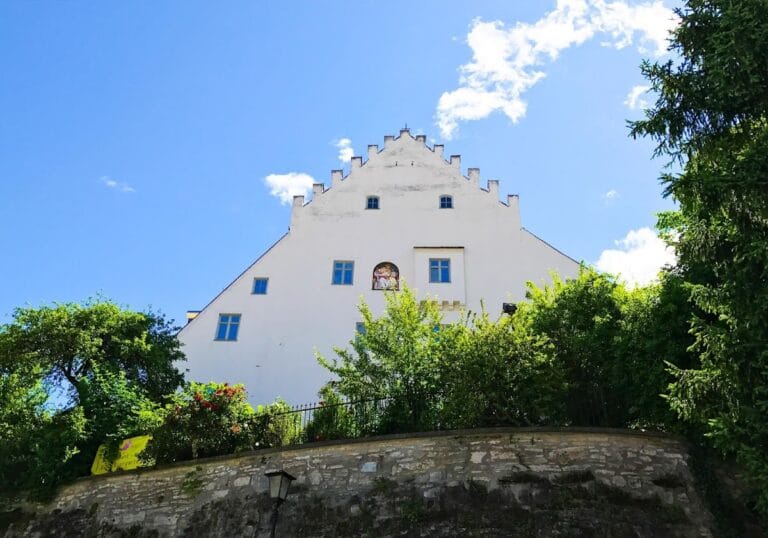
Only part of the former monastic complex survived the nineteenth-century demolition. The remaining buildings preserve the institutional footprint of the abbey while accommodating later functions. Some are dwellings, one houses Rottenbuch Town Hall, and another contains the primary school and village museum. Other surviving spaces were adapted for educational and care-related institutions established after the Don Bosco Sisters took over the complex.
The former monastic brewery is another surviving component. Its roof structure was severely damaged in the 2018 fire, which altered the condition of this part of the historic complex.