Augustinian Canons’ Monastery at Bernried: A Monastic and Educational Complex
Site at a Glance
- Rating
- 4.5
- Popularity
- Low
- Country
- Germany
- Primary era
- Early Modern
- External website
- Open
- Eras represented
- Medieval, Early Modern, Modern
- Civilizations
- Duchy of Bavaria, Electorate of Bavaria, German, Holy Roman Empire, Kingdom of Bavaria
- Site type
- Religious
- Remains
- Monastery
On this page14 sections
History
The Augustinian Canons’ Monastery at Bernried is a former monastery in Germany, located at Bernried am Starnberger See and founded in 1121 as a community of Augustinian canons dedicated to Saint Martin. Its founders were Count Otto I of Dachau-Valley and his wife, Adelheid of Weilheim. The foundation belonged to the Diocese of Augsburg and became an important centre of the church reform movement in southern Germany.
Foundation and church reform
The first canons probably came from Dießen. Sigeboto, a member of the secular clergy from the Lech region, became the community’s first head. He belonged to a reform-minded clerical circle associated with the hermit Gerluka, whose members sought a more disciplined clergy and opposed the sale of monastic offices and priestly rank.
Gerluka fled to Bernried in 1121, where she met the priest Paul and his pupil Gebhard of Regensburg. Paul later became known as Paul of Bernried and emerged as an important reform advocate and biographer. He travelled to Rome to gather material for a biography of Pope Gregory VII. In 1122, he secured papal protection for Bernried, placing the monastery directly under the papacy rather than under the Bishop of Augsburg.
By 1202, the community consisted of six canons, two deacons, a subdeacon, and three monks. The monastery’s medieval history is only partly known because several fires destroyed its archives. Its possessions nevertheless extended beyond inner Bavaria into the Alpine region during the late Middle Ages, including vineyards in the Gries-Quirein area near Bolzano. Bernried Park also belonged to the canons from the twelfth century until the secularization of 1803.
Medieval parish foundations
In 1382, under Provost Ulrich Saller, a separate church dedicated to the Assumption of the Virgin Mary was built for the inhabitants of Bernried village. This created a distinct parish foundation alongside the monastery’s collegiate church of Saint Martin.
Rebuilding after the Thirty Years’ War
The Thirty Years’ War, a major European conflict from 1618 to 1648, brought extensive damage to the surrounding area and saw Spanish soldiers billeted in the monastery. With financial assistance from Elector Ferdinand Maria and other nobles, Provost Johann Riedl rebuilt the monastery and church during his tenure from 1638 to 1675. His work led to his later reputation as the monastery’s second founder.
Under Provost Mansuet Resch, who led the community from 1723 to 1741, the collegiate buildings were restored. The monastery then entered a renewed period of prosperity, with Resch encouraging scholarship, art, and culture.
Secularization and conversion into a castle
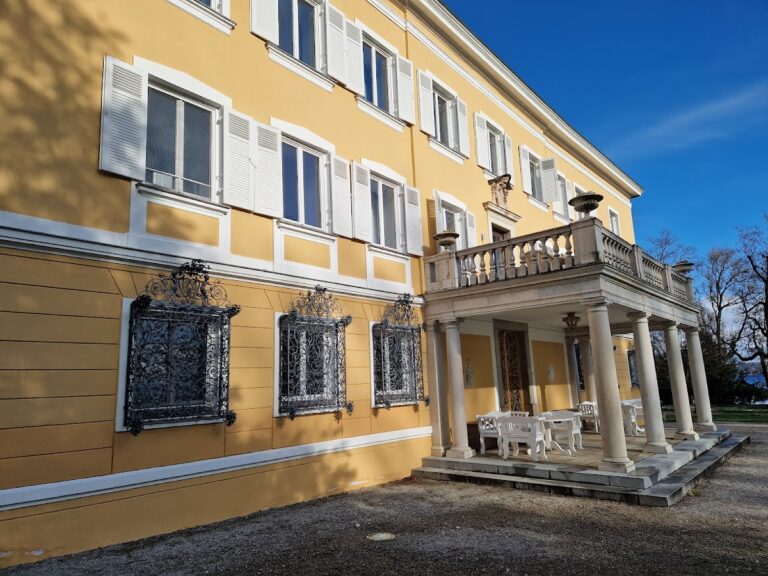
The Augustinian monastery was dissolved in 1803 during the secularization of Bavaria, a process that abolished many ecclesiastical institutions and transferred their property to secular owners. Ignaz Count Arco acquired the former monastic estate in 1810. August Freiherr von Wendland purchased the buildings and land in 1852, demolished the eastern and western wings, and converted the southern wing into a Neorenaissance castle, a nineteenth-century revival of Renaissance architectural forms.
The Reich Ministry of the Interior acquired the castle and its adjoining park in 1941. From 1942 to 1948, wartime conditions led to the relocation of the Orthopaedic Clinic from Munich to Bernried.
Religious and educational uses after 1949
In 1949, the former monastery again became a religious community when the Missionary Benedictine Sisters from nearby Tutzing acquired the complex. The sisters established a boarding school, later developing it into a preparatory institution for women entering social professions and a centre for women’s education. Their novitiate, the period and institution in which candidates receive formation before taking religious vows, operated at Bernried from 1953 to 1995 before moving to Tutzing.
The school closed in 1972, and the former monastery buildings were converted into an educational centre for church-based adult education. Bildungshaus St. Martin now provides adult education, seminars, and conferences, while part of the complex continues to serve as a monastery for the Missionary Benedictine community. The complex is protected as a historic monument, and its medieval and early-modern archaeological remains are also registered as an archaeological monument.
Remains
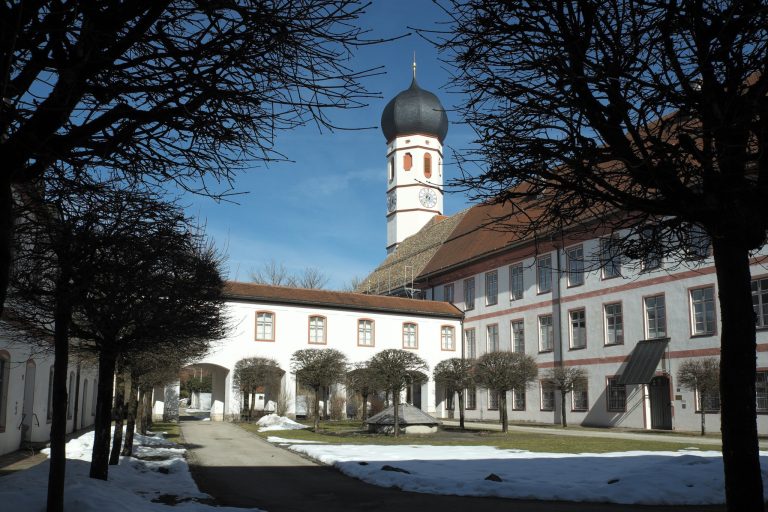
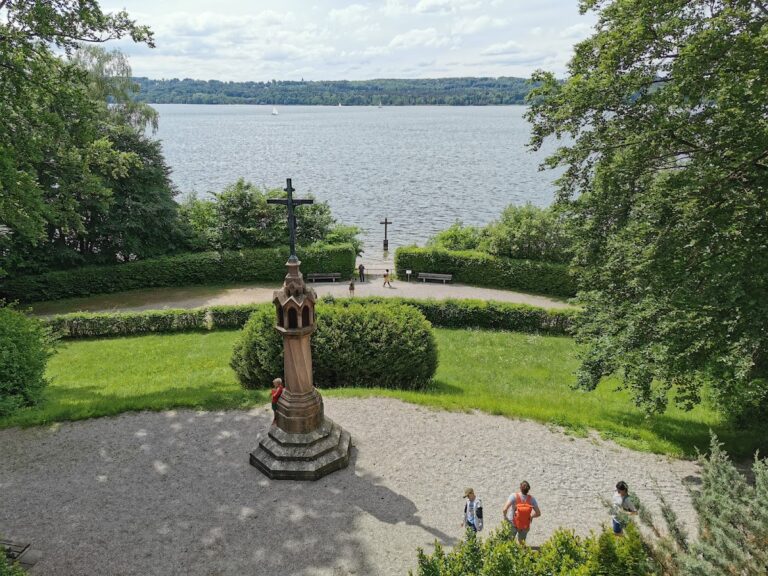
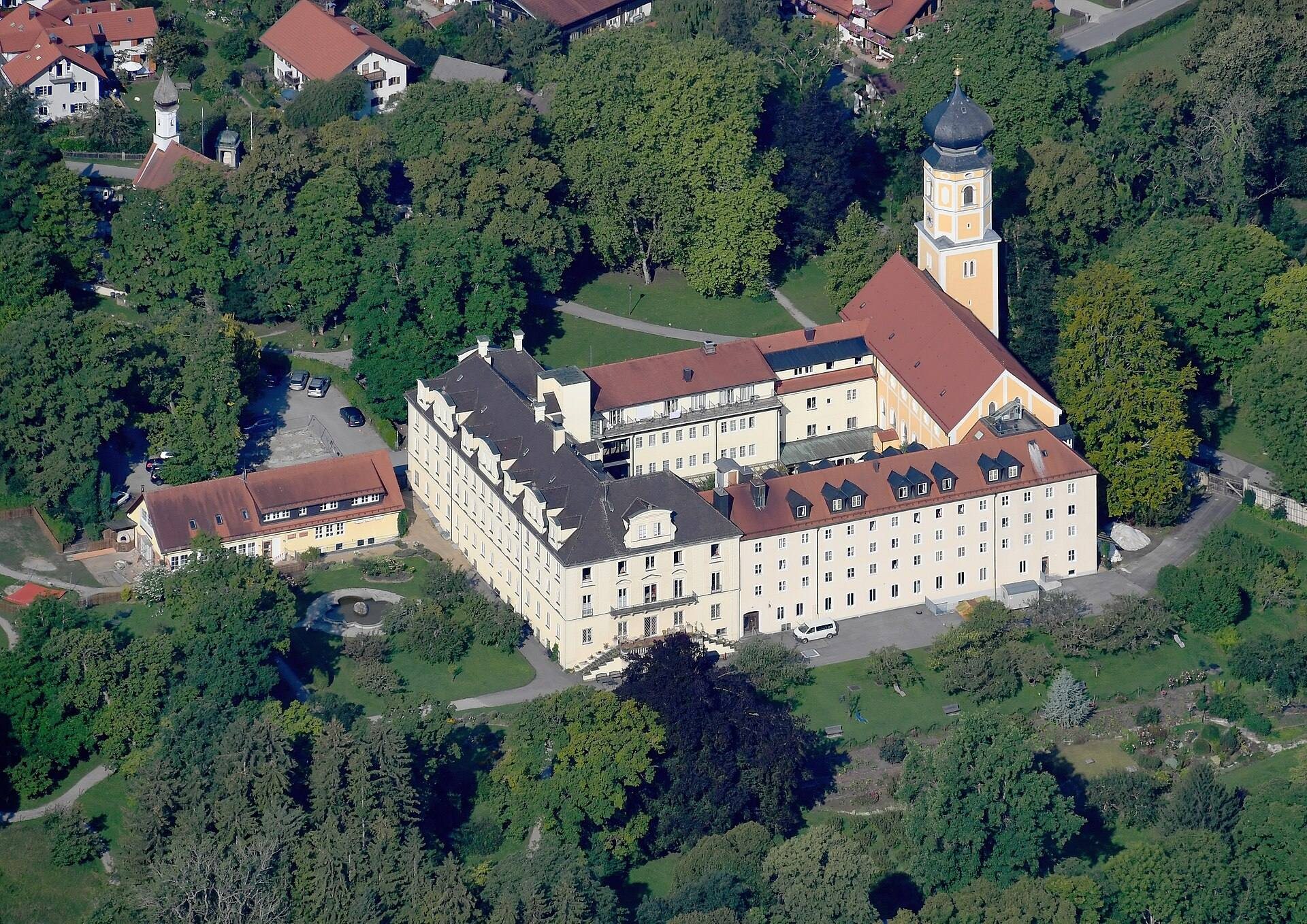
The complex lies within Bernrieder Park beside the lake. Its surviving fabric combines former monastic buildings, the parish church of Saint Martin, the former village church of the Assumption, and the nineteenth-century castle conversion. The arrangement also includes a monastery courtyard, a Baroque hall, and an adjoining park shaped by later landscape design.
Churches
Saint Martin’s Church
The Catholic parish church of Saint Martin served as the collegiate church of the Augustinian canons from 1122 until 1803, when it became the parish church. Damage sustained during the Thirty Years’ War led to a Baroque redesign between 1659 and 1663. Baroque architecture is characterized by dynamic forms, rich ornament, and theatrical spatial effects. Lightning destroyed the tower in 1734, and it was rebuilt in 1873.
Church of the Assumption
The separate former Hofmark church of the Assumption of the Virgin Mary was built in 1382 for the inhabitants of Bernried village. A Hofmark was a Bavarian territorial lordship whose holder exercised specified local judicial and administrative rights. Medieval and early-modern remains connected with this church and the former monastery survive below ground within the archaeological monument area.
Monastery and castle complex
Castle and courtyard
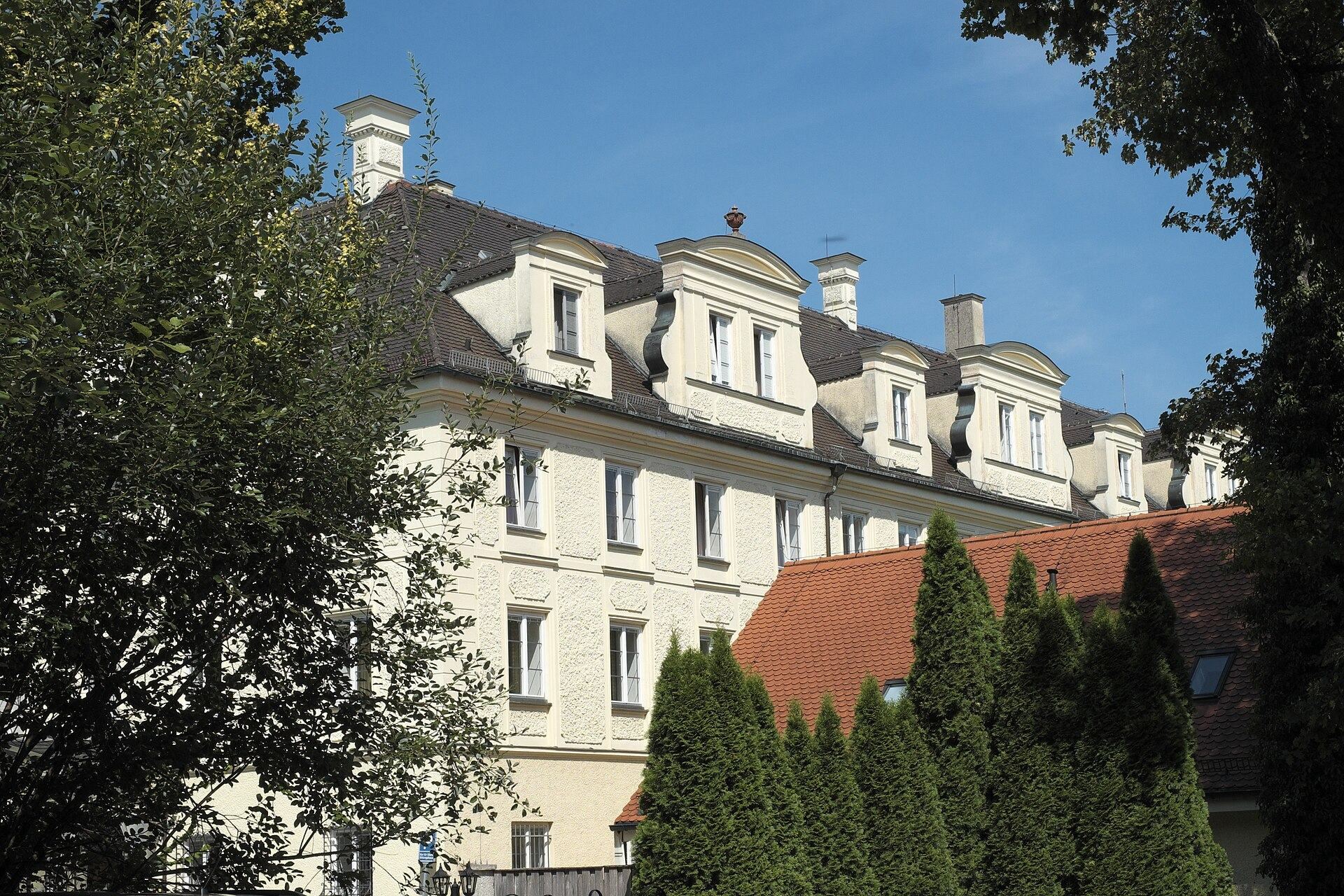
The nineteenth-century conversion altered the former monastery’s appearance. The eastern and western wings were demolished, while the southern wing was remodelled as a Neorenaissance castle. The complex still includes a monastery courtyard and a Baroque hall. Around 1860, August Freiherr von Wendland created a circular castle garden arrangement in the courtyard and planted plane trees that were regarded at the time as exotic.
Gate building and service buildings
The arched gate building originally accommodated the gatekeeper. Between 1806 and 1825, it served as a schoolhouse. The opposite side of the gateway contained the stables and carriage shed, preserving evidence of the complex’s practical functions after its monastic use had ended.
Bernrieder Park
The adjoining Bernrieder Park contains meadows, shrubs, and solitary trees. Its northern section was landscaped in the English-park style during the mid-nineteenth century by the royal court gardeners Carl and Carl Joseph von Effner. The park formed part of the former monastic estate and remained associated with the complex through its later transformation into a castle and educational centre.