Teppōzu Inari Shrine: A Tutelary Shinto Shrine in Tokyo


Site at a Glance
- Rating
- 4.2
- Popularity
- Low
- Country
- Japan
- Primary era
- Modern
- External website
- Open
- Eras represented
- Modern
- Civilizations
- Japanese
- Site type
- Religious
- Remains
- Sanctuary
On this page7 sections
History
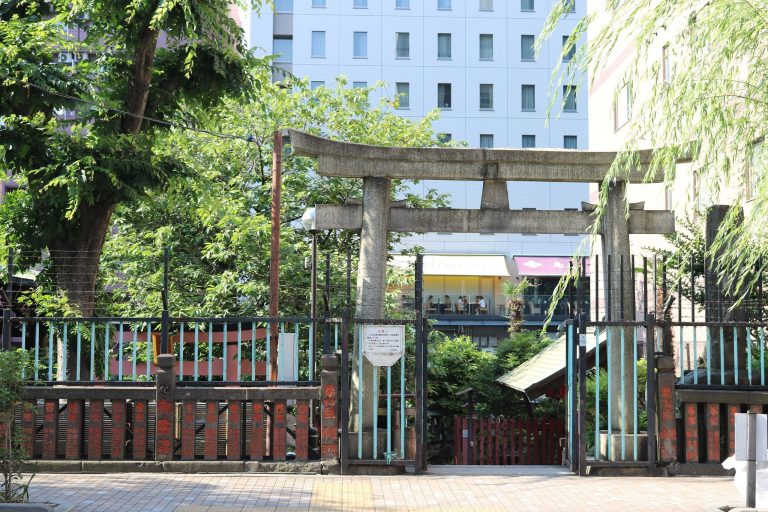
Teppōzu Inari Shrine is an Inari shrine in Japan’s Chūō City, Tokyo, and serves as the tutelary deity, or local guardian deity, of the Kyōbashi area. Tradition places its foundation on 9 May 841 in the Julian calendar, when residents of Sakurada village in Ebara District, facing a poor harvest, enshrined Inari Ōkami for their community. Its principal deities are Wakanmusubi-no-kami, Toyouke-hime-no-Ōkami, and Ukanomitama-no-Ōkami. The shrine formerly held the rank of a village shrine, a category in Japan’s prewar system for classifying Shinto shrines.
Early relocations
As the surrounding inlet was reclaimed, the shrine was moved to Kyōbashi. During the Daiei era of the late Muromachi period, it was transferred again to the area later called Shin-Kyōbashi, near present-day Ginza 1-chōme. There it was known as Hatchōbori Inari Shrine. In 1624, the shrine moved to the southeastern end of Inari Bridge, close to the point where the Sakuragawa River joined the Kamejima River, approximately around present-day Minato 1-8. The former Hachiman Shrine at that location was incorporated as a subsidiary shrine.
The eighteenth-century work Jiseki Kōkō states that the shrine had previously stood on the south bank of Hatchōbori 1-chōme before being moved to Hatchōbori 8-chōme, where the surrounding houses had become too densely packed. Its position at the entrance to Edo’s waterways brought worshippers from among sailors travelling from across Japan. In the late Edo period, the Yoshida house gave the shrine the name Minato Shrine, and it also became known as “Wave-Repelling Inari.”
The Fuji mound and the present site
A Fuji mound, a miniature sacred mountain built for worship of Mount Fuji, was constructed in 1790 and became popular. Land requisition in 1868 required another relocation, and the shrine was moved about 120 metres south to its present site. The mound was transferred there in 1870, rebuilt in 1874, and later moved within the precincts in 1885, 1928, and 1936.
Earthquake, reconstruction, and later community life
The Great Kantō Earthquake of 1923 caused substantial damage. From 1935 onward, the main sanctuary and kagura hall, a building used for ritual music and dance offered to the deities, were reconstructed. The shrine escaped damage during the 1945 Tokyo air raid, preserving early Shōwa-period features in the form of the present complex.
Adjoining land became the site of a children’s park in 1962, the first municipal children’s park in Chūō Ward. The shrine’s parish organization consists of 17 neighborhood associations, including communities in the Kyōbashi Fifth and Fourth Divisions and part of the Echiichi association in Shinkawa 2-chōme. These divisions preserve the former Large and Small Ward System established in the early Meiji period and continue to operate as neighborhood-association units. Minato 1-chōme and 2-chōme form a joint parish association during festivals.
The Fourth Division chiefly corresponds to the former Ginza East and prewar Kobikichō areas, and its parish includes the Kabuki-za and Shinbashi Enbujō theaters. Part of Shinkawa 2-chōme, across the river in Reiganjima, belongs to the shrine’s parish even though most of that district belongs to Tomioka Hachimangū. The parish organizations include a worshippers’ association, a women’s devotional association, and the Yayoi Association, founded in 1998 to revive postwar mikoshi processions.
The major annual festival takes place from 2 to 5 May. A cold-season water-bathing event is held on the second Sunday of January, while access to the Fuji mound for ascent is permitted only on 1 July, in connection with the opening of Mount Fuji’s climbing season. In 2018, the shrine refused a monetary offering from an organized crime group during its annual festival. After people connected with the group were arrested for threatening shrine personnel, the shrine renewed its declaration against organized crime in 2019.
Remains
The present precinct in Minato, Chūō, contains a sanctuary complex shaped by reconstruction after the 1923 earthquake and a sacred Fuji mound built from Mount Fuji lava. Together, these features preserve the shrine’s early Shōwa-period architectural form and its continuing association with Mount Fuji worship.
Sanctuary complex
The main sanctuary and kagura hall were reconstructed from 1935 onward. Their survival through the 1945 Tokyo air raid left early Shōwa-period architectural features represented in the present shrine complex. An image from the Ansei era by Utagawa Hiroshige, a major nineteenth-century ukiyo-e landscape artist known for views of Edo, depicts the shrine as “Teppōzu Inari Bridge and Minato Shrine.” The image shows vermilion-painted walls and shrine buildings.
Teppōzu Fuji
Teppōzu Fuji is the only Fuji mound in Chūō Ward. It rises 5.4 metres and is made from lava brought from Mount Fuji. The mound is topped by Teppōzu Fuji Asama Shrine, a subsidiary shrine associated with Mount Fuji worship and related mountain deities. Its successive transfers and rebuilding shaped its present position within the precincts.
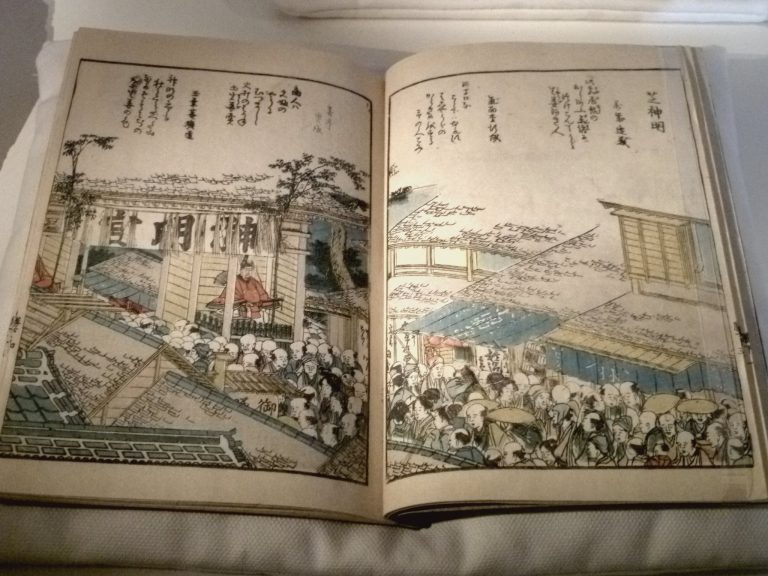
The mound appeared in the Edo-period Illustrated Guide to Famous Places in Edo and in Utagawa Hiroshige’s Picture Album of Edo Souvenirs. In these representations, it appears larger than the main sanctuary, conveying its imposing appearance at that time.