Hagigadar Monastery: An Armenian Apostolic Pilgrimage Site in Romania
Site at a Glance
- Rating
- 4.8
- Popularity
- Low
- Country
- Romania
- Primary era
- Early Modern
- Eras represented
- Early Modern, Modern
- Civilizations
- Armenian, Austrian Empire, Habsburg, Ottoman, Principality of Moldavia
- Site type
- Religious
- Remains
- Monastery
On this page12 sections
History
Hagigadar monastery is a former Armenian Apostolic women’s monastery in Romania, near Suceava, founded by the Armenian community during the reign of Bogdan III of Moldavia. Construction began in 1512–1513 in the Moldavian architectural tradition, and the monastery was first mentioned in 1513. Dedicated to the Dormition of the Mother of God, it became a centre of Armenian religious life and is regarded as the only Armenian pilgrimage site in Romania.
The Armenian community of Suceava
Armenians had established a community in Suceava by the beginning of the fourteenth century. Merchants and craftsmen built churches and monasteries in the city and in other Moldavian towns. An act of 1388 placed these communities under the Armenian episcopal see of Lviv. In 1401, Alexandru cel Bun, the Moldavian ruler from 1400 to 1432, established an Armenian bishopric in Moldavia with its seat at Suceava and appointed the bishop Hovhannes. This brought the Armenian churches of Moldavia under their own episcopal authority.
During the sixteenth century, Suceava’s Armenian colony numbered about 3,000 people and possessed four Armenian churches. Hagigadar formed part of this wider religious network. Its name means “fulfilment of wishes,” and the monastery became associated with prayers before an icon of the Mother of God believed to be miraculous. It is also known as the Monastery of Wishes.
Foundation and early development
An inscription on the jamb of the entrance door names Dragan Donavac, also called Donavachian, as the founder. He was an Armenian cattle merchant. Another tradition gives the founder’s name as Asduadzadur, or Bogdan Donavachian, identified as Donavac’s son, although his young age has been used to question whether he could have founded the church.
Foundation traditions connect the church with a journey by cattle traders toward Budapest or Vienna. According to the story, Dragan Donavac, or Donavac and his brother, stopped on Bulai Hill after dreaming of angels and the Mother of God. They vowed to build a church there if their trading venture succeeded. One version adds that a small abandoned wooden chapel already stood on the hill. The church itself was built in 1512, initially as a simple structure consisting of a nave and altar.
The monastery was already known beyond the local community by the early modern period. In 1608, the Armenian traveller Simeon Lehați described Hagigadar as one of two beautiful stone monasteries near Suceava. A Latin description from 1693 referred to a nuns’ monastery south of the city whose revenues supported about 40 unmarried women and widows living there without formal vows.
Alterations, damage, and religious use
Hagigadar developed through three principal building phases. The original church was erected in 1512. During the second half of the seventeenth century, the present entrance antechamber and an octagonal tower were added, while the enclosure wall was built around the complex. During the second half of the nineteenth century, the church was substantially altered, including the removal of the partition between the antechamber and the nave.
Repeated enemy invasions had damaged the church by the beginning of the eighteenth century. Dominic Bogdanovici, a wealthy Armenian merchant from Lviv and a great-grandson of Dragan Donavac, left 300 Polish florins for repairs in his will of 10 March 1707. During the Austrian administration of Bukovina, from 1774 to 1918, Hagigadar was generally treated as a women’s dependency. Its residents were described as secluded women rather than nuns in the strict sense, and the monastery also served as a residence for Armenian bishops.
The nineteenth-century works were formally received on 4 August 1863 during celebrations of the institution’s 350th anniversary. Further restoration was carried out in 1896 by an Italian craftsman. These works followed the major nineteenth-century changes to the church and contributed to the form in which the building survives.
Pilgrimage and twentieth-century history
Armenians began making pilgrimages to Hagigadar twice a year from 1848, fulfilling a vow for protection from Asiatic cholera. The observances took place on the Sunday near the Dormition of the Mother of God, celebrated on 15 August, and on the feast of Saint James on 29 December. Liturgies are associated with the Dormition, the Transfiguration, and Saints Joachim and Anne. The principal celebration is held on the Sunday before 15 August and draws Armenian and Romanian pilgrims.
Pilgrimage traditions include silent prayer, kneeling, touching the forehead to the ground, and ascending the roughly 100-metre approach to the hill on one’s knees. Pilgrims may also enter the church in this manner and circle it three times, praying at its four corners. These actions are traditionally connected with the fulfilment of wishes.
In the late nineteenth century, Armenians in Suceava collected money twice a year to buy cattle. The animals were slaughtered and distributed as food to poor people at Hagigadar in a practice called Madach, understood as a Christianized continuation of an older Armenian sacrificial custom. The patronal celebrations continue to include Armenian liturgy and a communal meal called h urban. Traditionally, one or two cattle are fed consecrated salt, slaughtered, and cooked in large copper cauldrons before the meal is distributed to pilgrims regardless of religion.
By 1929, the Armenian population of Suceava and the former Austrian province of Bukovina had declined sharply. The community’s spiritual leader was the Armenian priest Knel Mandalian. In 1943, Vasken Balgian, who later became Catholicos of All Armenians, received canonical training at Hagigadar under the priest Mampré Biberian.
A lightning-caused fire damaged the monastery in 1993. Between 2004 and 2007, repairs and restoration affected the access road, paths around the church, entrance gate, courtyard fountain, refectory, and parts of the tower. Archaeological research directed by Florin Hău and Ștefan Dejan of the Bucovina Museum in Suceava took place inside and outside the church in 2010. The exterior investigations were inconclusive, while the interior work confirmed three construction phases and revealed an intact medieval grave beneath the nineteenth-century brick pavement.
Hagigadar was included in Suceava County’s 2004 register of historical monuments as a protected religious and architectural complex comprising the church and enclosure wall. Its foundation was commemorated in 2013 by a joint Armenian and Romanian postage stamp marking the five-hundredth anniversary.
Remains
Hilltop complex and church
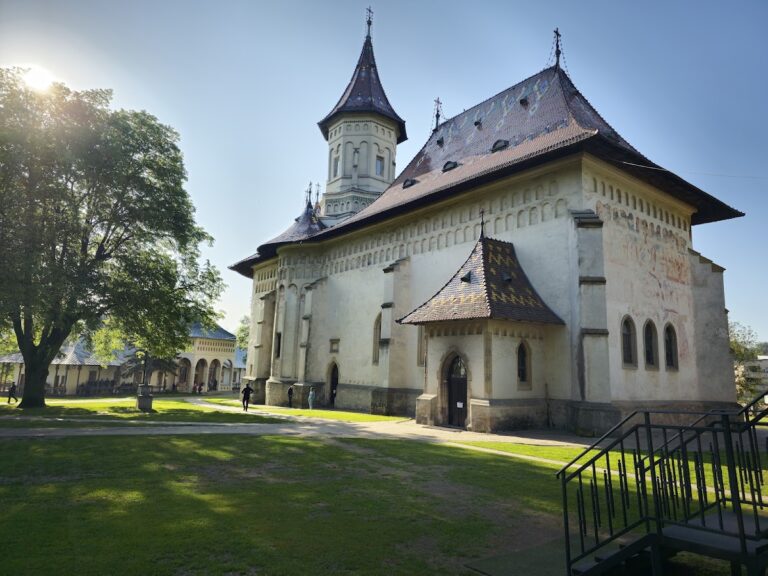
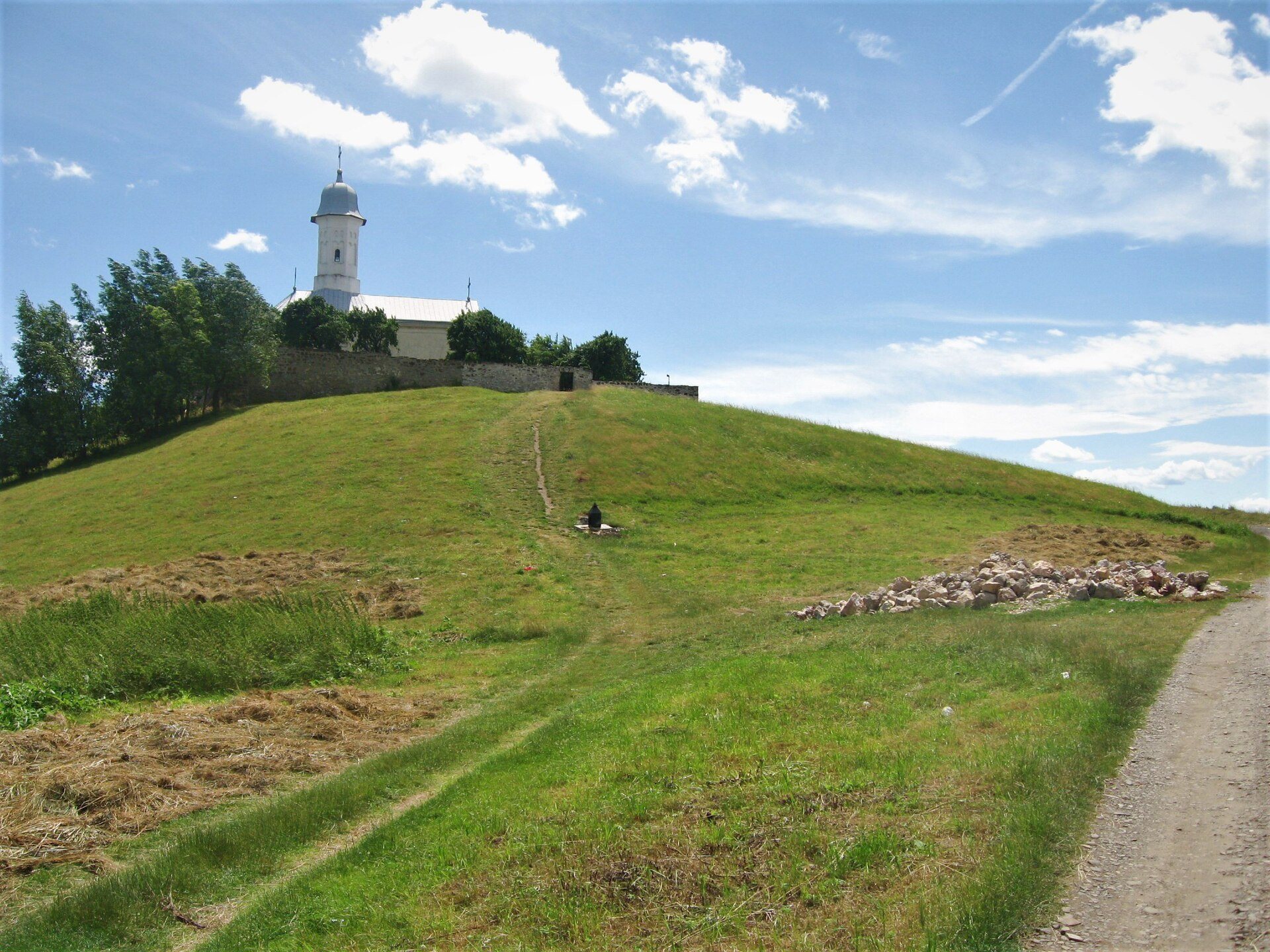
Hagigadar stands on Bulai Hill, a rounded green elevation in the middle of a valley near the E85 road, about 3 kilometres from Suceava. A pond lies below the monastery on the Moara side. The complex is centred on the Church of the Dormition of the Mother of God and an enclosing wall, both dated to 1512 in the heritage register.
Church of the Dormition of the Mother of God
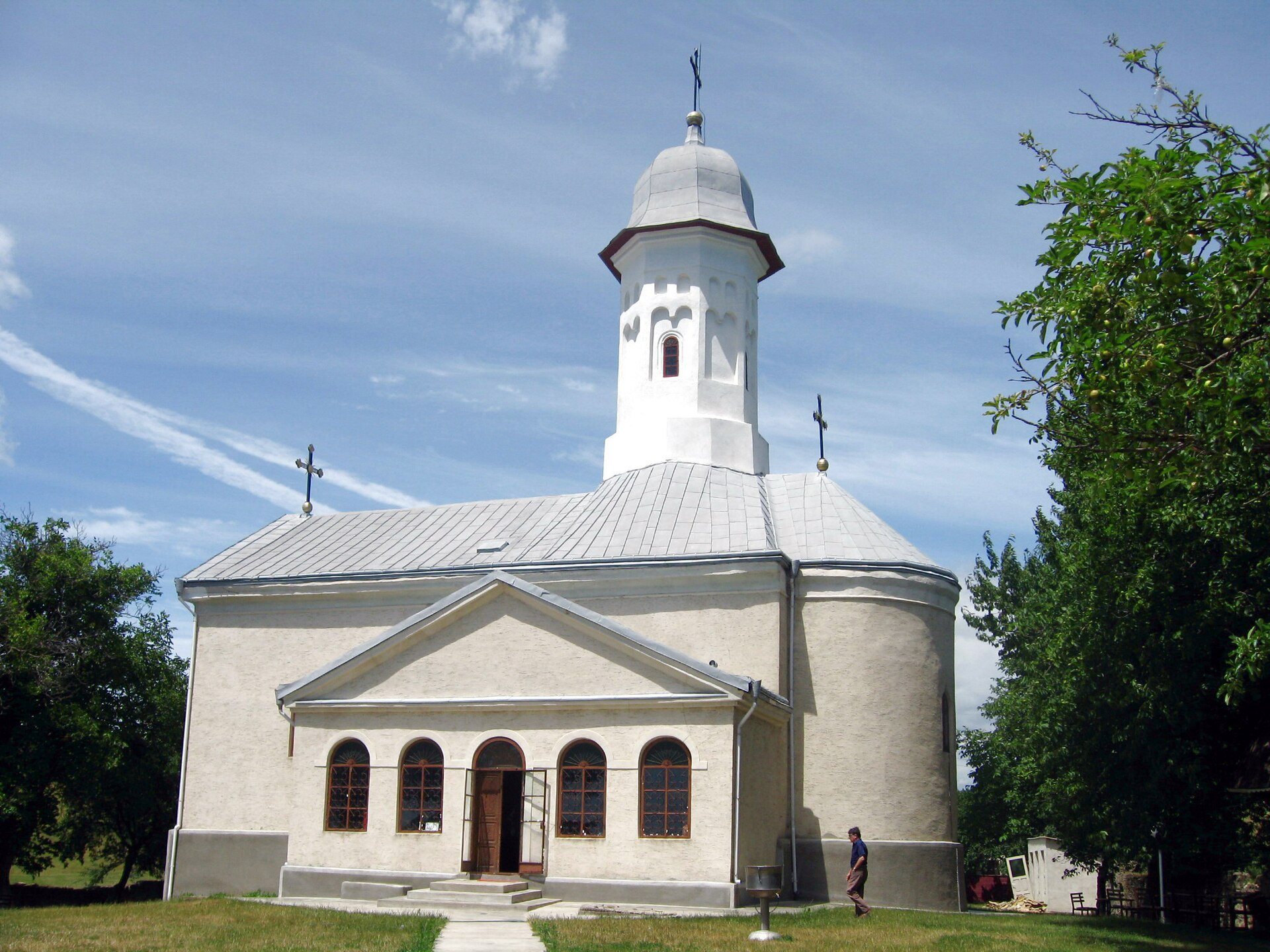
The church follows Moldavian architectural forms and has a rectangular plan. Its altar apse, the eastern terminal space containing the altar, faces east in accordance with Armenian church practice. The nave was widened to accommodate the three altars required for Armenian worship. The first building had only a nave and altar and was covered by a hemispherical vault, a dome-like vault shaped as part of a sphere. Its foundations are particularly solid.
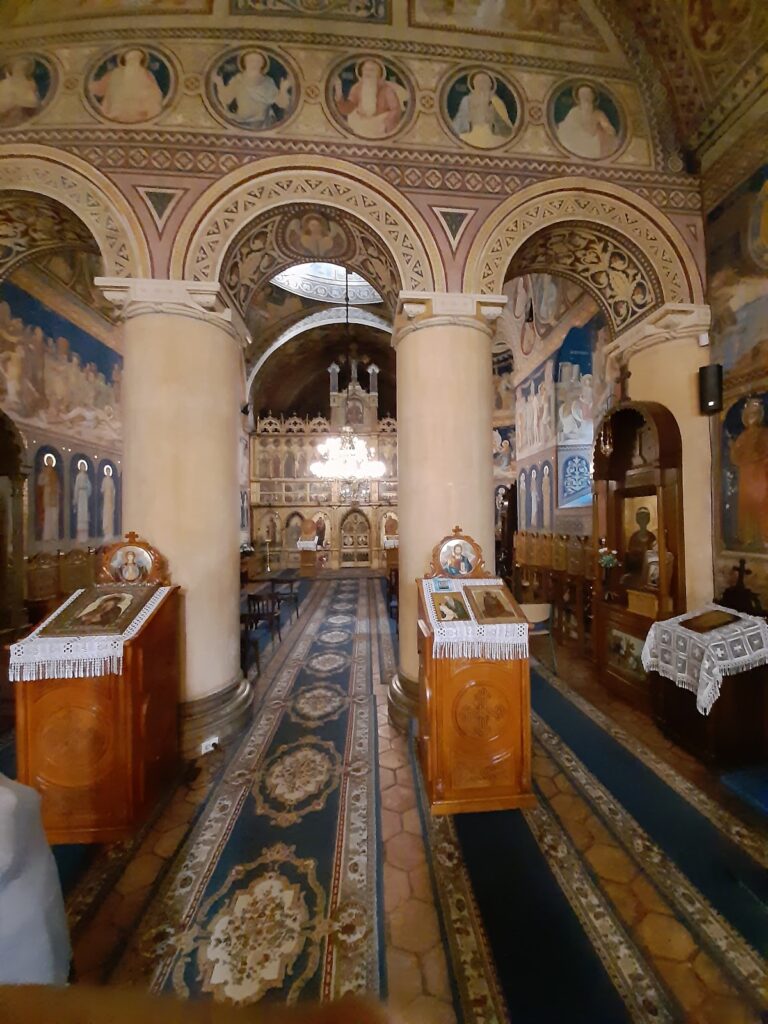
The present pronaos, or entrance antechamber, was added during the second half of the seventeenth century and is entered through a northern portal. An octagonal, slender tower was constructed during the same phase. In the second half of the nineteenth century, the wall between the pronaos and nave was demolished, creating the church’s present internal volume. Two enclosed porches were also added, although only the southern porch survives.
The tower has four narrow windows directed toward the cardinal points. The surviving porch has a triangular cornice and two windows on each side of its entrance. Moldavian-style vaults cover the pronaos and nave. Between them is a narrow space with a semicylindrical vault, shaped like half a cylinder, and transverse arches. This space resembles a gropnita, a burial chamber incorporated into some Moldavian churches.
Enclosure and subsidiary buildings
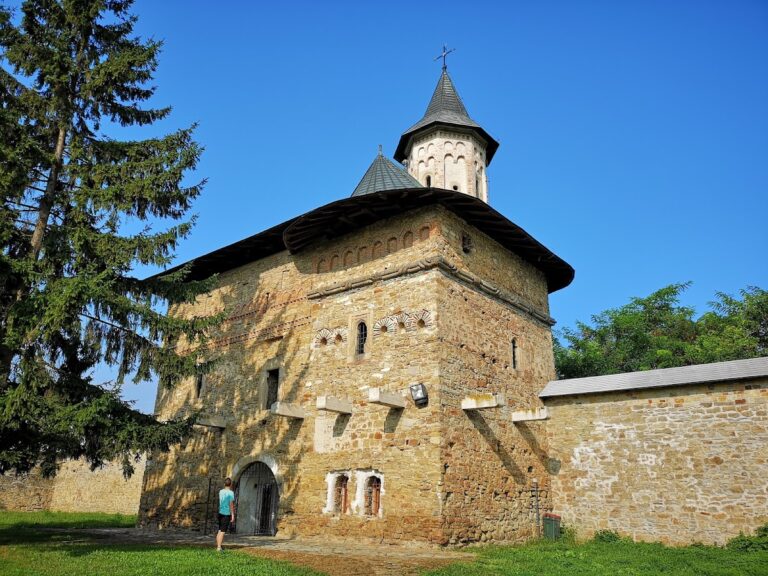
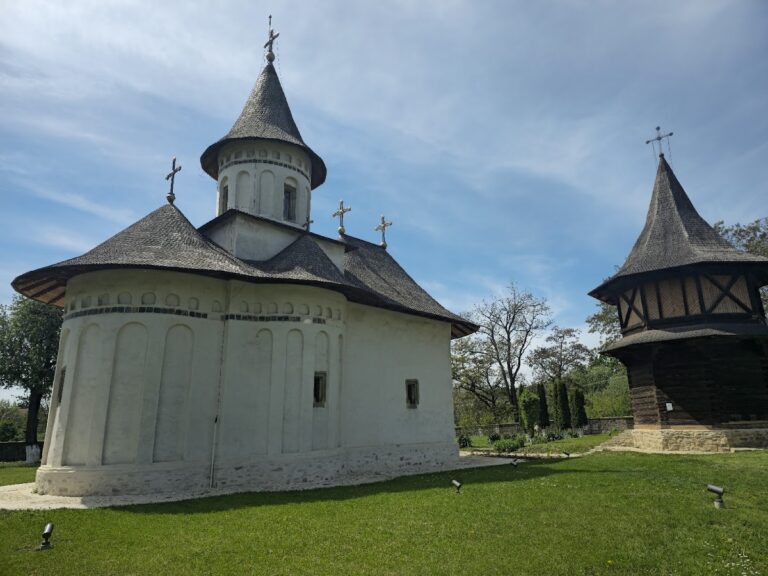
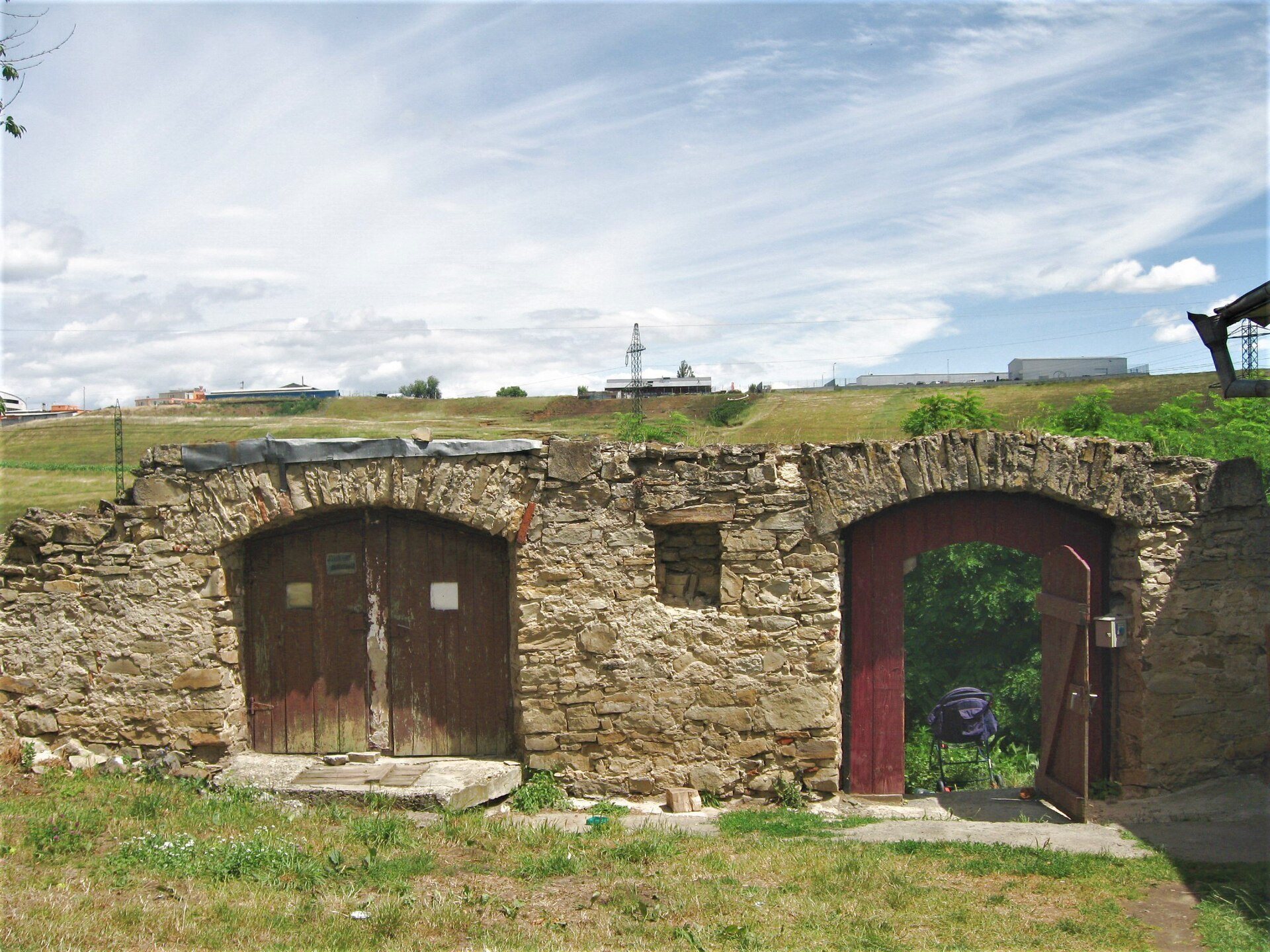
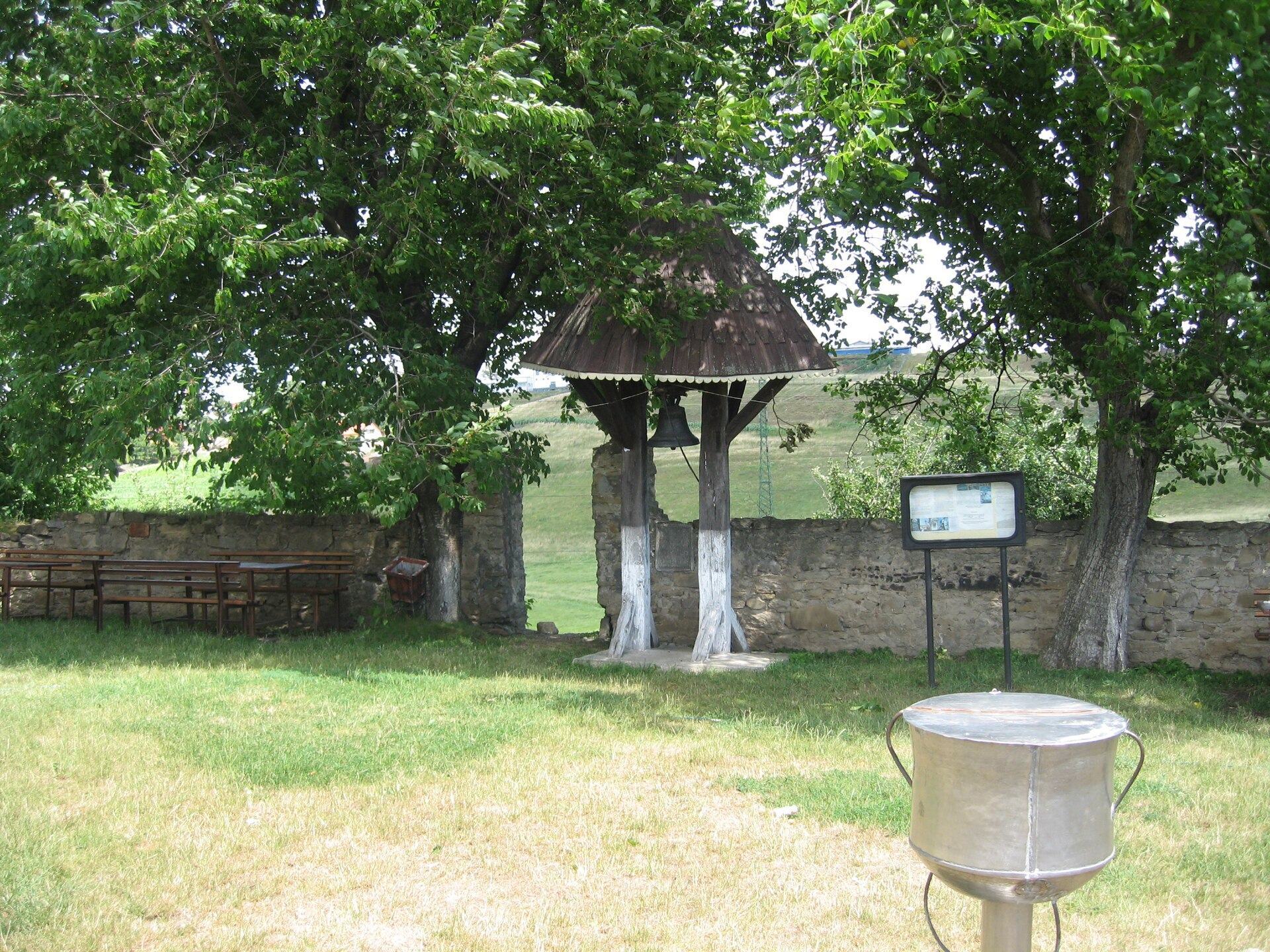
The monastery is surrounded by relatively low walls with at least six openings for exit. The principal entrance is on the northern side. Within the enclosure are a refectory, or communal dining hall, a well with a covered wheel, a wayside cross, and a bell tower positioned between two tree trunks.
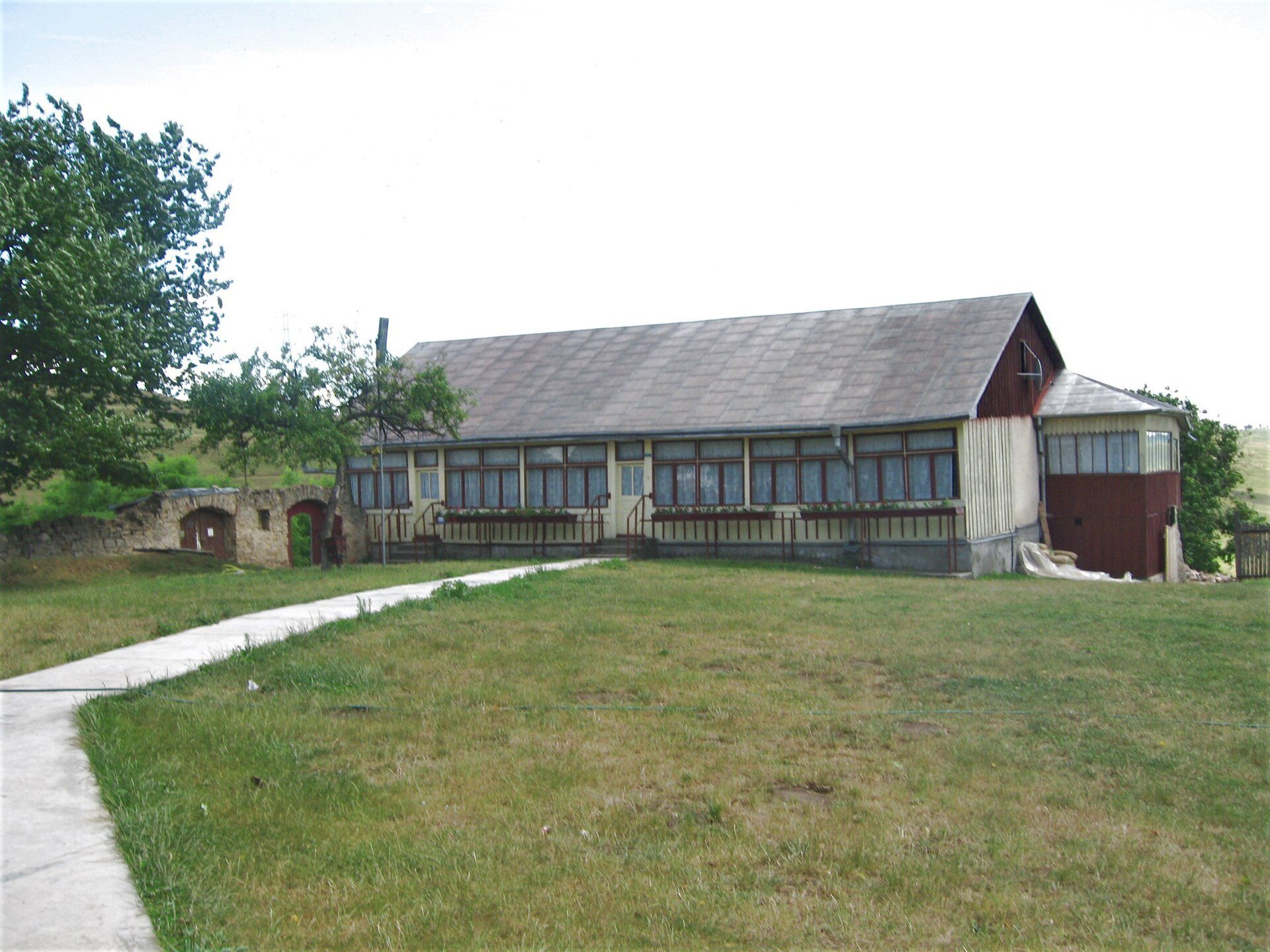
An annex in the northeastern corner, probably the residence of an abbess, has disappeared. A southeastern annex survives and functions as a guesthouse. The courtyard fountain, refectory, entrance gate, paths, and parts of the tower were among the features repaired or restored between 2004 and 2007.
Graves, icons, and other objects
Armenian graves
Two Armenian graves lie within the monastery grounds. In front of the northern church door is the grave of Bishop Grigor Zaharian, marked by a white-marble tombstone bearing an Armenian inscription. Pilgrims traditionally place coins on the stone while praying for the fulfilment of wishes. Near the western wall is the grave of the protoiereus Knel Mandalian and his wife, the presbytera Araxi Mandalian.
Church furnishings and archaeological finds
The altar contains an old icon of the Mother of God regarded as miraculous. It was said to carry numerous gold and silver votive representations of eyes, teeth, ears, feet, and hands offered by suffering worshippers. The church also contains an icon of the Apostles Bartholomew and James with a Slavonic inscription, icons of the four Evangelists on the iconostasis, and icons of Saint Archdeacon Stephen and Saint Deacon Lawrence on the altar doors, bearing Romanian inscriptions.
Seven well-preserved silver coins were found at the base of a scaffolding support. Dating from the reign of Bogdan III, each coin measures 18 millimetres and bears the Moldavian aurochs-head emblem on one side and a shield with the voivode’s heraldic insignia on the other. Archaeological work inside the church also exposed an intact medieval grave near the longitudinal axis, beneath the nineteenth-century brick floor. It had no covering slab.
A bell known at the end of the nineteenth century had been found while a grave was being dug in the cemetery of the Church of Saint Simeon. Its Armenian inscription commemorated Ghetrats Arakeli of the monastery of Saint Tatev and dated the bell to 1244. Dimitrie Dan interpreted the inscription as evidence that it had been brought from Armenia, while some writers further associated it with the former Armenian capital of Ani. A Gospel manuscript copied at Hagigadar in 1649 is displayed at the Museum of the Armenian Diocese in Bucharest.