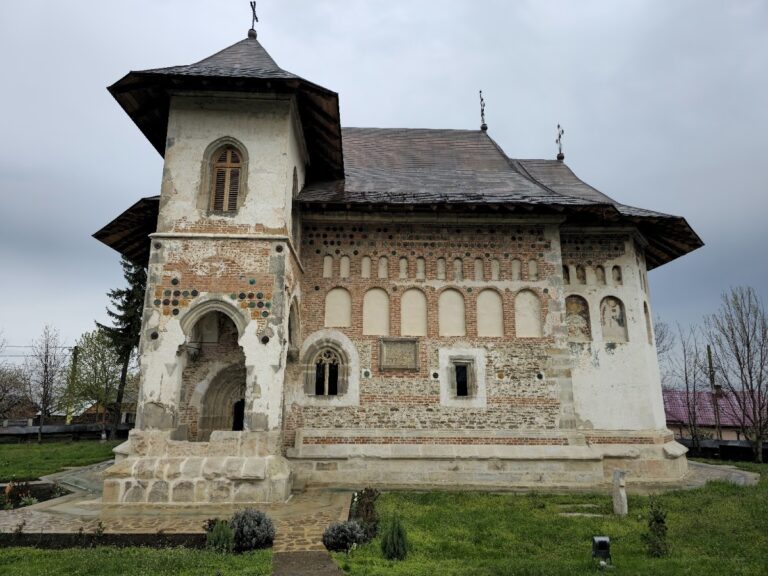
Mirăuți Church of Saint George in Suceava: The Old Metropolitan Church of Moldavia


Site at a Glance
- Rating
- 4.8
- Popularity
- Low
- Country
- Romania
- Primary era
- Early Modern
- Eras represented
- Medieval, Early Modern, Modern
- Civilizations
- Habsburg, Principality of Moldavia
- Site type
- Religious
- Remains
- Cathedral
On this page15 sections
History
Mirăuți Church of Saint George is an Orthodox church in Suceava, Romania, traditionally associated with the medieval Moldavian principality and probably first built in the late fourteenth century under Petru I Mușat in a Middle Romanesque manner. It is regarded as the oldest church in the city and stands near the former princely court. Dedicated to Saint George, whose feast is celebrated on 23 April, the church became the principal ecclesiastical center of Moldavia and later served as the state’s metropolitan cathedral.
Origins and the medieval metropolitan church
The foundation of Mirăuți is not securely dated by a surviving written document. Tradition attributes the church to Dragoș Vodă, while other interpretations connect its foundation with a local political leader who controlled the area before the main princely residence was transferred to Suceava. Nicolae Iorga proposed that the name came from a landowner called Mirăuță, giving the sense of “the church of Mirăuță.” Other explanations associate Mirăuți with the anointing of Moldavian rulers before enthronement or with a boyar family named Mirea or Mereuță.
An oral tradition recorded by Simeon Florea Marian tells of an earlier settlement that grew around a hermit’s dwelling in a dense alder forest. In the story, a wooden church was built beside the tree in which the hermit had lived. An invasion by one-eyed monsters and Tatars supposedly burned the church and destroyed a nearby stone fortress. The tradition assigns the later stone-and-brick church to Iuga, ruler of Moldavia from 1399 to 1400, and links its name to the hermit’s anointing of shepherds.
Architectural comparisons provide a different reconstruction of the church’s beginnings. The masonry resembles that of the Suceava Seat Fortress, while glazed bricks from the interior pavement and the oldest interior tombs point to an early masonry building. These details have led to the conclusion that the first stone church was erected during the reign of Petru I Mușat, probably toward the end of the fourteenth century.
In 1388 Petru I Mușat transferred Moldavia’s capital from Siret to Suceava for diplomatic, political, and religious reasons. The princely court, administration, and government moved with the capital, partly reducing direct Catholic and Hungarian influence in Siret. Churches were established near the new princely center and the Seat Fortress, placing Mirăuți within the religious landscape of the new capital.
From 1402 until the completion of the new Saint George Cathedral at the Monastery of Saint John the New in 1522, Mirăuți served as the metropolitan cathedral of Moldavia. The metropolitan cathedral was the principal episcopal church of the Metropolitanate of Moldavia, the highest-ranking Orthodox ecclesiastical institution in the medieval principality, and Mirăuți was consequently known as the Old Metropolitan Church.
The church was also connected with the establishment of the Moldavian metropolitan hierarchy. At Petru I Mușat’s initiative, Antonie, Metropolitan of Halicz, ordained Iosif Mușat, abbot of Neamț Monastery and a relative of the ruler, as bishop of Cetatea Albă. Iosif was later elected metropolitan of Moldavia, although the Ecumenical Patriarchate did not recognize him until 26 July 1401. On that occasion, Alexandru cel Bun secured his recognition at Suceava. The delegation sent there was led by Grigore Țamblac, who later became metropolitan of Kyiv.
In 1402 Alexandru cel Bun brought the relics of Saint John the New from Cetatea Albă and placed them in Mirăuți in a silver-bound reliquary. They remained associated with the church until 1589, when Petru Șchiopul transferred them to the new cathedral. Mirăuți also received villages, estates, and other income from Moldavian rulers, including mills, fishponds, vineyards, apiaries, pastures, hayfields, livestock, dependent peasants, fishermen, and craft workers. Ștefan cel Mare added further princely donations and renovated the church. The ruler’s first wife, Evdochia of Kyiv, was buried there after her death on 25 November 1467.
Damage, rebuilding, and abandonment
Around 1513 Mirăuți suffered serious damage. The devastation is commonly associated with the Polish expedition that followed Bogdan III’s invasion of Poland in 1509. The Polish army entered Suceava, looted the metropolitan cathedral, and took back a large bell that Bogdan III had carried away from Rohatin. The church was damaged but not completely destroyed.
The cathedral’s condition and Suceava’s growing population encouraged Bogdan III to begin a new metropolitan cathedral in 1514. His successor, Ștefăniță Vodă, completed it in 1522 at the Monastery of Saint John the New, where the dedication to Saint George was also adopted. Mirăuți was probably repaired or rebuilt after the sixteenth-century devastation rather than immediately abandoned. Architectural evidence suggests that one rebuilding began from the foundations and retained the earlier plan while adding a bell tower. The older building later fell into disrepair and was abandoned around the end of the sixteenth or the beginning of the seventeenth century.
During the first half of the seventeenth century, the church was repaired and reconstructed on its earlier site. Coins found within the tower masonry, including a Swedish coin bearing the monogram of Gustavus Adolphus and a Polish coin from the reign of Sigismund III Vasa, support this dating. The appearance of the earlier church remains uncertain, although the present building, apart from its bell tower, may follow the older plan. A gravestone for Mihail Fira, dated October 1699, shows that burials continued beside the church until at least that year. Its final abandonment and ruin probably took place after 1700.
Decline and nineteenth-century rescue
After the Habsburg occupation of Bukovina in 1775, the authorities showed little interest in preserving Mirăuți. In 1792 Dr. Gutter W. received permission to demolish the church for building stone. Suceava residents protested on 25 January 1792, petitioning that the Old Metropolitan Church be spared.
The building survived when the retired arnăut major Iane, also called Ioan, Florea bought the church and its site at auction for 220 florins. On 28 November 1799 he donated them to the Romanian Orthodox community, requiring that the church be restored when circumstances allowed. The townspeople sought help from Metropolitan Iacob Stamati in 1801, but the Orthodox community could not pay for the necessary work. The church was consequently leased as a storehouse for hay and straw.
Later uses further altered the condition of the abandoned building. A military unit stored grain there in 1825, and during the Crimean War the church was leased for five years as a military storehouse. After that lease ended in July 1859, Jewish merchants rented it for agricultural produce and animal hides. Parts of the adjoining cemetery became public grazing land, while the enclosed porch was used as a cattle stall. Neglected maintenance and unpaid rents contributed to continued deterioration.
An inspection in 1815 described Mirăuți as a total ruin. Doors, windows, roof timber, and other repairable elements had been removed; the tower supporting the vaults and much of the wall structure had collapsed; damp had badly cracked the vaults and the arches of the windows and entrance hall; and rain had washed away the foundations. Officials judged repairs impracticable and recommended demolition, but the church continued to survive.
Restoration and archaeological reassessment
In 1880 Eudoxiu Hurmuzachi, prefect of Suceava, requested that the authorities in Vienna restore the church. Emperor Franz Joseph I approved the restoration report in 1886, and the execution project received approval in 1893 after further technical investigation. The plan aimed to return Mirăuți to worship and make it available to Orthodox students from Suceava’s schools.
From 1898 to 1901, Karl A. Romstorfer, the Austrian architect and conservator responsible for historical and artistic monuments in Bukovina, directed a major restoration financed by the Greek-Orthodox Religious Fund of Bukovina. The work gave the church much of its present appearance, although later critics including Nicolae Iorga and Orest Tafrali argued that the reconstruction differed substantially from the earlier building and preserved mainly its plan and walls. The question of historical accuracy remains central to the interpretation of the monument.
From 1898 to 1903 Karl Jobst decorated the interior with tempera paintings in a Westernizing Art Nouveau manner rather than the Byzantine style associated with medieval Moldavian churches. This decoration replaced earlier painting that was not preserved through the later restoration history. Vladimir de Repta, Archbishop of Chernivtsi and Metropolitan of Bukovina and Dalmatia, reconsecrated the church on 2/15 November 1903. A marble inscription beside the entrance commemorates the restoration, the church’s association with Alexandru cel Bun, and imperial approval. The first liturgy after reconsecration was celebrated at Easter 1904.
Mirăuți remained closed until early 1919, when it temporarily became a filial church of the Saint Demetrius parish while that parish church was being repaired. It was removed from that parish in 1926. A stone cross was installed in the churchyard in 1923 and consecrated by Metropolitan Nectarie Cotlarciuc. In 1957 Mirăuți became a parish church under the decision of Metropolitan Iustin Moisescu, with an adjoining district and the Church of Saint John the Baptist-Coconi as a filial church.
Archaeological research outside the building in 1976, directed by Lia and Adrian Bătrîna, uncovered the foundations of a large late-fourteenth-century structure without lateral apses or buttresses. Stratigraphic observations and nearby burials led the archaeologists to identify it as the first metropolitan church and associate it with Petru I Mușat. Extensive restoration and conservation followed from 1992 to 2001 under the architect Virgil Polizu, while investigations led by Mircea D. Matei uncovered 32 graves and expanded knowledge of the church’s earlier phases.
During the 1996–1997 restoration, an almost intact brick crypt was found. One coffin was identified as that of Evdochia of Kyiv, overturning Nicolae Iorga’s earlier proposal that she had been buried at Probota Monastery. Her gravestone, found at Mirăuți in 1996, is now held by the History Museum in Suceava. Another brick burial chamber discovered in the nave in autumn 1997 contained an oak coffin, human remains, and valuable textiles. The burial was first attributed to Petru Mușat, but later research dated it to the sixteenth or seventeenth century. The recovered costume was conserved at the Restoration and Conservation Laboratory of the Bucovina Museum in Suceava and is kept in controlled storage.
Mirăuți was entered on the 2015 list of historic monuments of Suceava County under classification code SV-II-m-A-05475.
Remains
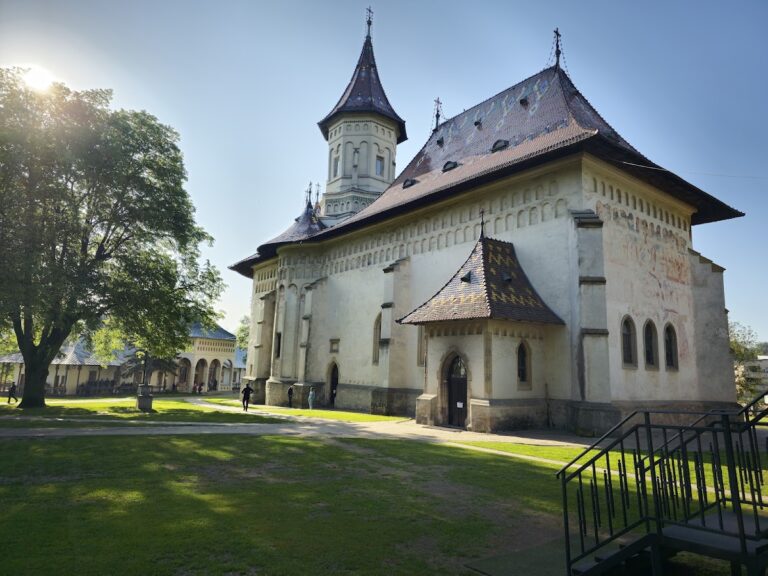
The surviving church combines a triconch plan, a compact arrangement with three apsidal projections, with a pronaos, or entrance area, and a nave, the principal congregational space. Two piers linked by arches divide the pronaos from the nave rather than a solid wall. A single bell tower is attached to the southern side of the pronaos. Its lower level forms an open porch and entrance, while the tower rises above it. The churchyard includes a parish house, the 1923 stone cross, and the adjoining cemetery.
Early church and archaeological remains
First masonry building
The first masonry church measured approximately 19 by 12.5 metres and stood within a cemetery. Built from stone and brick, it had massive walls, no lateral apses or buttresses, and a presumed complex Greek-cross plan. Its floor area may have been about half that of the present church. Foundations of a large late-fourteenth-century building found outside the present structure have been associated with this first metropolitan church.
Burials and recovered evidence
The oldest interior tombs are associated with glazed paving bricks. A child’s grave was found in the northern part of the nave, while the later investigations uncovered 32 graves across the site. The brick crypt associated with Evdochia of Kyiv contained her coffin, and the gravestone recovered in 1996 is preserved at the History Museum in Suceava. The later brick burial chamber in the nave contained an oak coffin, human remains, silk and gold-painted linen shrouds, a face covering, a long silk garment with velvet sleeves and gilded silver buttons, a shirt decorated with metallic thread, a hair cap, a silk hat, and an eye band. The costume is kept in controlled microclimate storage at the Bucovina Museum in Suceava.
Seventeenth-century reconstruction
Interior arrangement
The seventeenth-century reconstruction enlarged the interior and exterior dimensions and introduced a raised tower over the central nave. Superimposed circular arches support the tower, while columns and ornamented arcades replaced dividing walls. The church also has late Gothic capitals and pointed-arch windows. It lacks a separate burial chamber.
Exterior decoration
The exterior includes a belt course framed by two rows of saw-tooth brickwork. Ogee-shaped window arches and engaged semicircular colonnettes joined by arches decorate the tower. The building also retains an entrance portal, an altar door, an open porch, and visible traces of painting on an exterior wall.
Restored interior and later additions
Restoration changes
Romstorfer’s restoration cut the corners of the square tower base, added rich cornice mouldings, and created an exterior entrance to the vestry. Square openings were inserted high in the walls of the two lateral apses, with corresponding openings toward the nave, to provide additional ventilation. A marble inscription from the 1903 reconsecration is set to the left of the entrance.
Paintings and acoustic features
Karl Jobst’s replacement interior decoration consists of tempera paintings in a Westernizing Art Nouveau style. Biblical scenes fill the pronaos, while painted surfaces continue across the nave and the arcade separating the principal spaces. During the 1897–1898 restoration, earthenware pots were found embedded in the demolished vaults. Their arrangement was intended to produce resonance and contributes to the church’s notable acoustics.
Nearby sites