Gryt Church: A Medieval Church in Södermanland, Sweden
Site at a Glance
- Popularity
- Very Low
- Country
- Sweden
- Primary era
- Medieval
- Eras represented
- Medieval, Early Modern, Modern
- Civilizations
- Swedish
- Site type
- Religious
- Remains
- Church
On this page18 sections
History
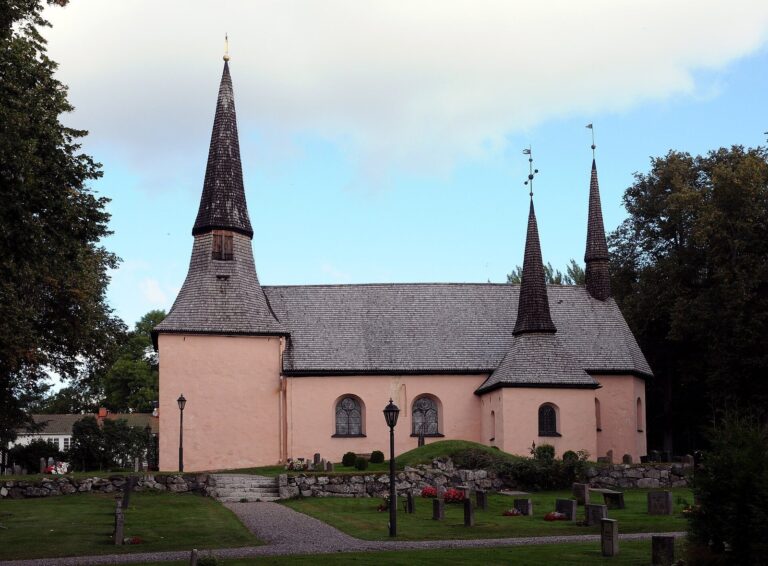
Gryt Church is a medieval church in Stjärnhov, Sweden, consecrated in the 12th century and affiliated with the Church of Sweden, a Lutheran Christian church. It belongs to Daga Parish in Strängnäs Diocese, a church administrative district, and to the diocese’s cathedral deanery, a subdivision within it.
Worship and church collections
A break-in on 22 August 1818 resulted in the theft of the church’s silver, including a gilded chalice and paten, two boxes for communion wafers, and two wine jugs. One of the jugs had been made in 1729. In 1821, Stockholm maker Gustaf Folcker the Elder produced a new chalice and paten, along with an oval communion-wafer box.
An old bridal canopy was dyed in Mariefred in 1773 and converted into an altar cloth. Several medieval sculptures that remained in the church into the early 20th century are now held in a museum. They included two damaged wooden figures, probably once part of an altarpiece, dating to about 1500, and two images of the Virgin Mary, one from the second half of the 13th century and one from around 1500. A blue silk-damask priest’s vestment from the early 18th century is also now at the Swedish History Museum.
Restoration and research
Interior restoration took place in the 1890s, in 1937–1938, and between 1957 and 1970. Erik Josephson prepared plans for the 1890s work, while architect Martin Westerberg led the 1937–1938 restoration. During the later renovation, the lower organ gallery was taken down, changing the openness of the interior. Music researcher Ingrid Rydefalk discovered medieval musical notation beneath the gallery stairs in the church’s southern extension.
Remains
The church brings together a medieval core, a large southern extension, and later interior furnishings. Its surviving features include medieval vaults and paintings, a runestone, historic church fittings, and a churchyard enclosed by a stone wall.
Church fabric and layout
Medieval church and southern extension
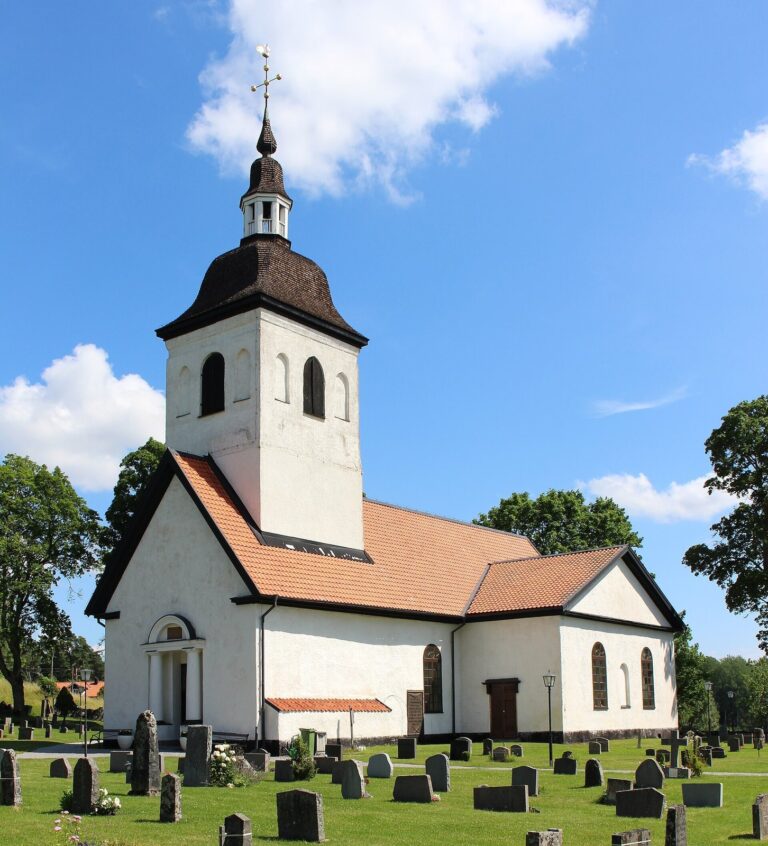
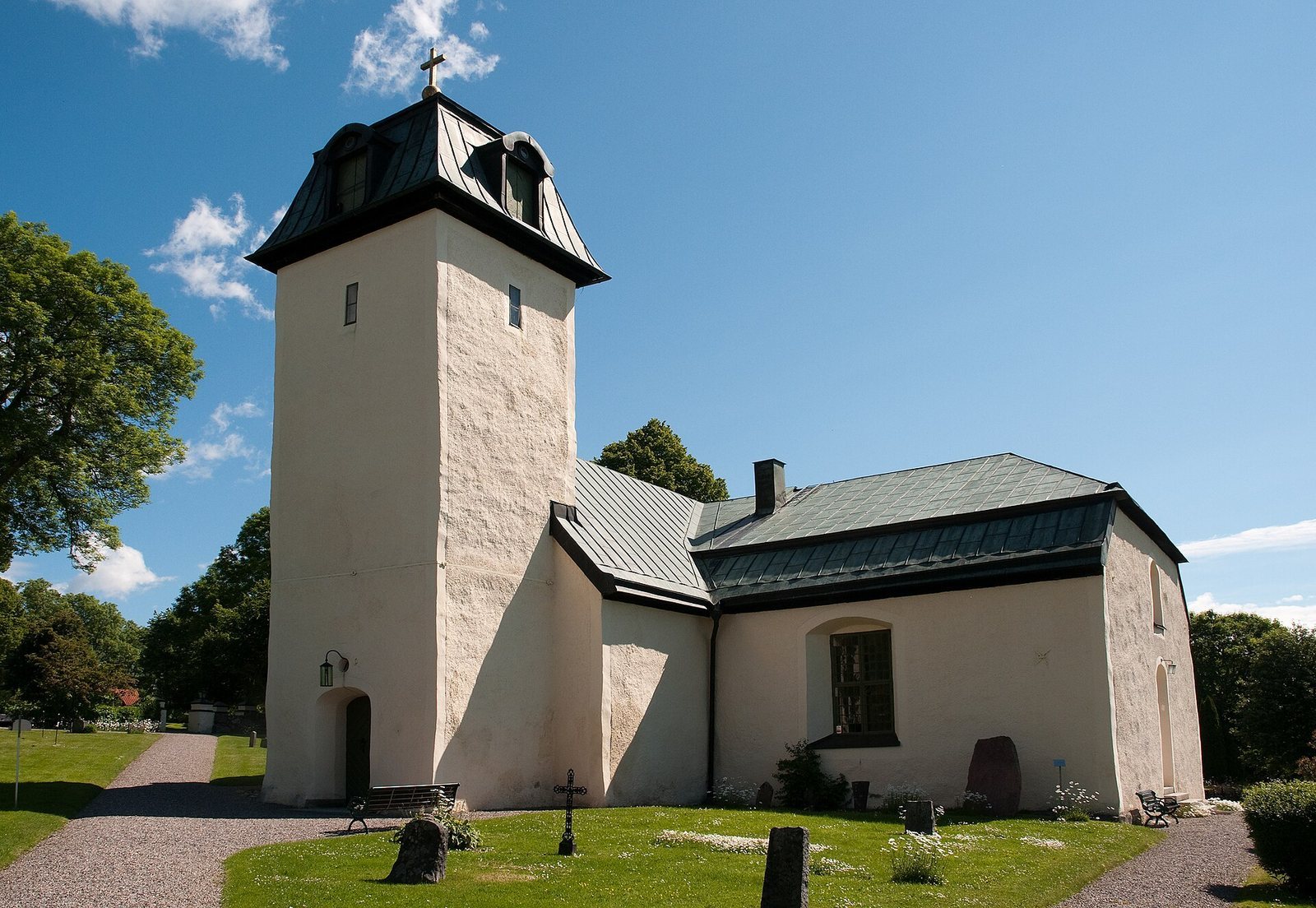
The oldest parts of the building date from the 12th century. Around 1300, the nave was lengthened and a sacristy was added. The vaults date to the 15th century and are Romanesque, belonging to a medieval European architectural style. A substantial addition to the south, known as the “new church,” gave the building its present exterior form in 1778. The 15th-century porch was demolished during this work.
Tower and galleries
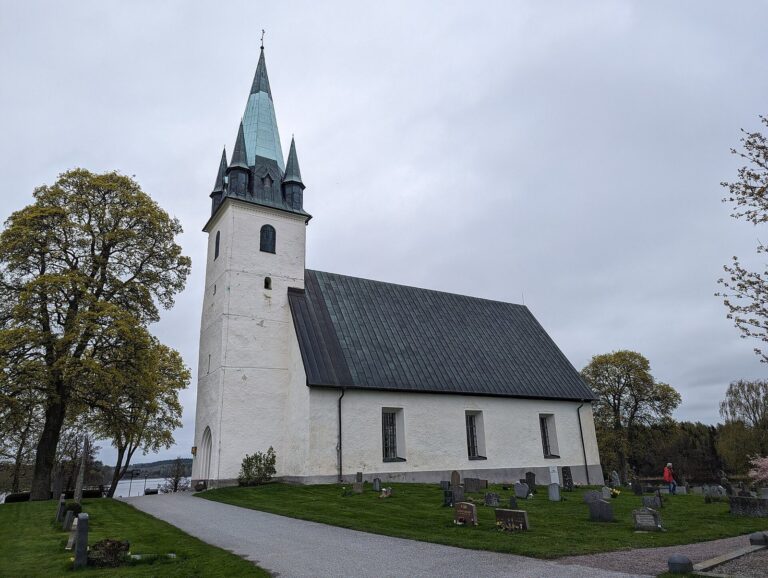
The present tower hood was built in 1769. A gallery was added in the southern transept in 1779. At the west end of the nave, a gallery built in 1806 replaced an earlier one that had stood there since at least the late 17th century. The lower organ gallery was removed during the 1957–1970 renovation.
Runestone
Runestone Sö 11 stands beside the west wall of the southern extension. It was first placed at the entrance to the old porch and later served as the threshold of the south portal. Its inscription says that Fröbjörn and Gudrun raised it in memory of their brave son Rodmund, Rodger’s brother, and asks God to help his spirit. The inscription also names Öpir as the rune carver.
Interior and furnishings
Painted surfaces and altar
Paintings on the choir vaults, dating from the second half of the 16th century, were uncovered in 1938 after being concealed by whitewash. The church also has a painted-glass window behind the altar. It depicts a yellow ring cross amid vines, with cornflowers below, and bears the words “God is love.” The Neumann & Vogel glass studio in Stockholm made the window. Beneath it stands a gilded wooden cross on a marbled base, given by C. Sternfeldt and his wife, Hedvig Kurck, of Nässelsta.
Enclosed pews were replaced by open benches with curved ends in the 1890s. The altar table, altar rail, and open pews date from the 1937–1938 restoration.
Pulpit and baptismal furnishings
Woodcarver Gabriel Bentin made the pulpit in 1733–1734. Its construction reused parts of an older pulpit, but the carved decoration was newly made. The pulpit’s hourglass may be the one acquired by the church in 1704. A pewter baptismal bowl made in Nyköping in 1828 was once set on a simple wooden table during baptisms. The table, from the 18th century, is now in the parish museum. A wooden baptismal font was acquired in 1939.
Paintings
A portrait of Gustav II Adolf, king of Sweden from 1611 to 1632, bears the inscription “PINXIT IN GRYT – ÖCKNA – 1635 GKB.” It identifies Colonel Georg Krail von Bennenberg as the painter. The portrait follows a lost original painted in 1628 or 1629 by Jakob von Doort.
Another painting shows Tomyris, a queen of ancient tradition, dipping the severed head of Cyrus, an ancient Persian king, in blood. It reproduces a work by Flemish Baroque painter Peter Paul Rubens through an engraving of his painting. A simply executed 17th-century canvas depicts King David and singers performing one of his psalms with harp accompaniment. An 18th-century painting of the Last Supper probably served as an altar decoration before the present cross was donated in 1800.
Communion vessels, lighting, and processional objects
A brass box for communion wafers, dating to around 1700 and decorated with pressed plant ornament, probably remained after the 1818 theft. Four long wooden processional staffs from the pre-Reformation Catholic era hang in the lower part of the church. Small angel figures were originally fixed to their tops.
Six chandeliers hang in the church. A six-armed example in the choir was given in 1776 by Provost P. Hedberg, a senior cleric, and his wife. A 16-armed chandelier in the second vault from the east was donated in 1912. Another, in the third position from the east, was given in 1777 by Governor Sven Liljencrantz and his wife, Agnes Maria Transchöld. In the southern extension, a chandelier from the mid-17th century has 14 arms, a sphere below, and a double-headed eagle above. Two smaller 18th-century chandeliers hang in relation to that extension’s gallery. Other lighting includes 18th-century pressed-brass candle plates, a pair of pewter candlesticks in the Empire style, a neoclassical design popular in early 19th-century Europe, and nickel-silver candlesticks given in 1840.
Vestments and collection items
The church has a plain black-velvet priest’s vestment from the 19th century, decorated with silver braid, and a collection bag made from the same material. A 17th-century black-velvet collection bag is embroidered with silver-thread leaves, while another, from the 18th century, is made of green patterned silk with gold lace. A silver bell that once belonged to a collection bag bears the inscription “ANDREAS : ROTKIRCH : ANNO : 1665.” Andreas Rotkirch was a major and owner of Nässelsta. Four carved wooden poles decorated with hearts, which once supported the bridal canopy, are also preserved.
Music, memorials, and churchyard
Bells and organ
The great bell has no inscription, but its maker’s mark matches one on the great bell at Aspö Church, suggesting that the same founder cast both. It probably dates from the late 15th century. The smaller bell was given to the church by Jäderlund Manor in 1728 and recast in 1775.
Major Gustaf Miles Fleetwood donated an organ in 1767. It had four stops and was repaired and installed by Georg Rudolph Londicer of Strängnäs. E. A. Setterquist & Son of Örebro built a seven-stop organ in 1878, and Åkerman & Lund of Stockholm enlarged it to 15 stops in 1938. Magnus Fries of Sparreholm built the present mechanical organ in 1970.
Burial memorials
Several grave slabs are set into the church floor. South of the altar rail is an iron slab marked “KPS MHD / 1664.” North of the rail, another iron slab names Peter Flor and Bieta Stniea, includes a biblical passage, and gives the year 1710. West of the rail, a limestone slab commemorates Colonel Georg Günter Krail von Benenberg of Öckna and Mora, who died in 1641, and his wife Christina von Masenbach, who died in 1657.
A large iron slab in the central aisle covers the burial of three children of Herman tor Smede: his daughter Gertrud, who died in 1646, and his sons Thomas and Petrus, who died in 1648. The church also contains a heraldic funeral banner, a family-emblem banner used at a funeral, associated with the Bagghufvud family, owners of Pungsund. Parts of a banner probably connected with the Stiernfelt family are held in the parish’s local-history museum in the parsonage.
Churchyard
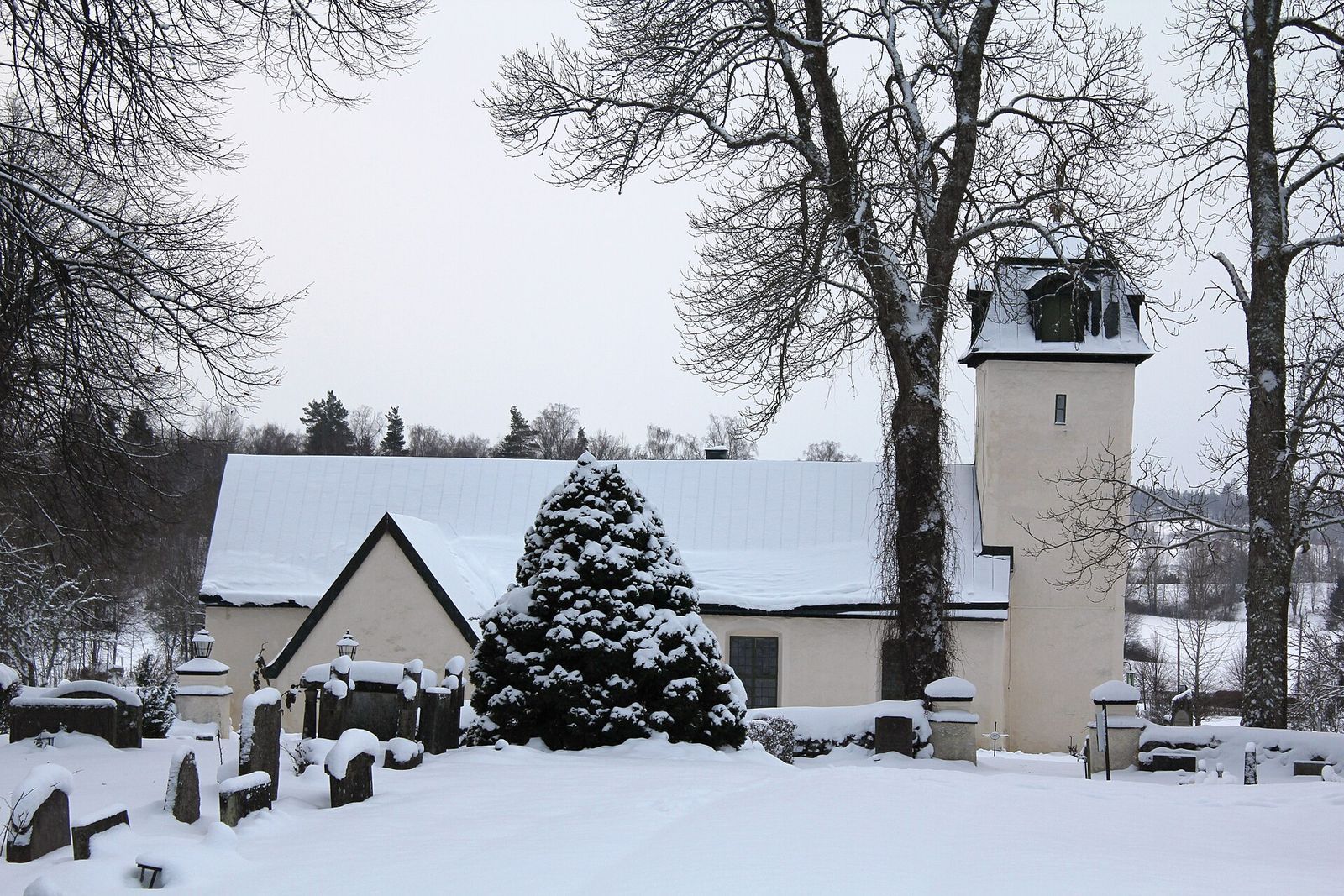
The churchyard was extended northward in 1848. Another area to the north was laid out in 1920 to plans by architect Knut Nordenskjöld. A burial chapel built there in 1934 followed designs by architect Bengt Liljeblad. The churchyard wall is made of gray stone, and its entrances are flanked by whitewashed masonry gate piers with unusual shapes. A shed in the northeastern corner, now used for materials, formerly served as a mortuary.