Church of the Nativity in Izmaylovo: A Russian Orthodox Church in Moscow
Site at a Glance
- Popularity
- Medium
- Country
- Russia
- Primary era
- Early Modern
- Eras represented
- Early Modern, Modern
- Civilizations
- Russian
- Site type
- Religious
- Remains
- Church
On this page13 sections
History
Settlement and Construction
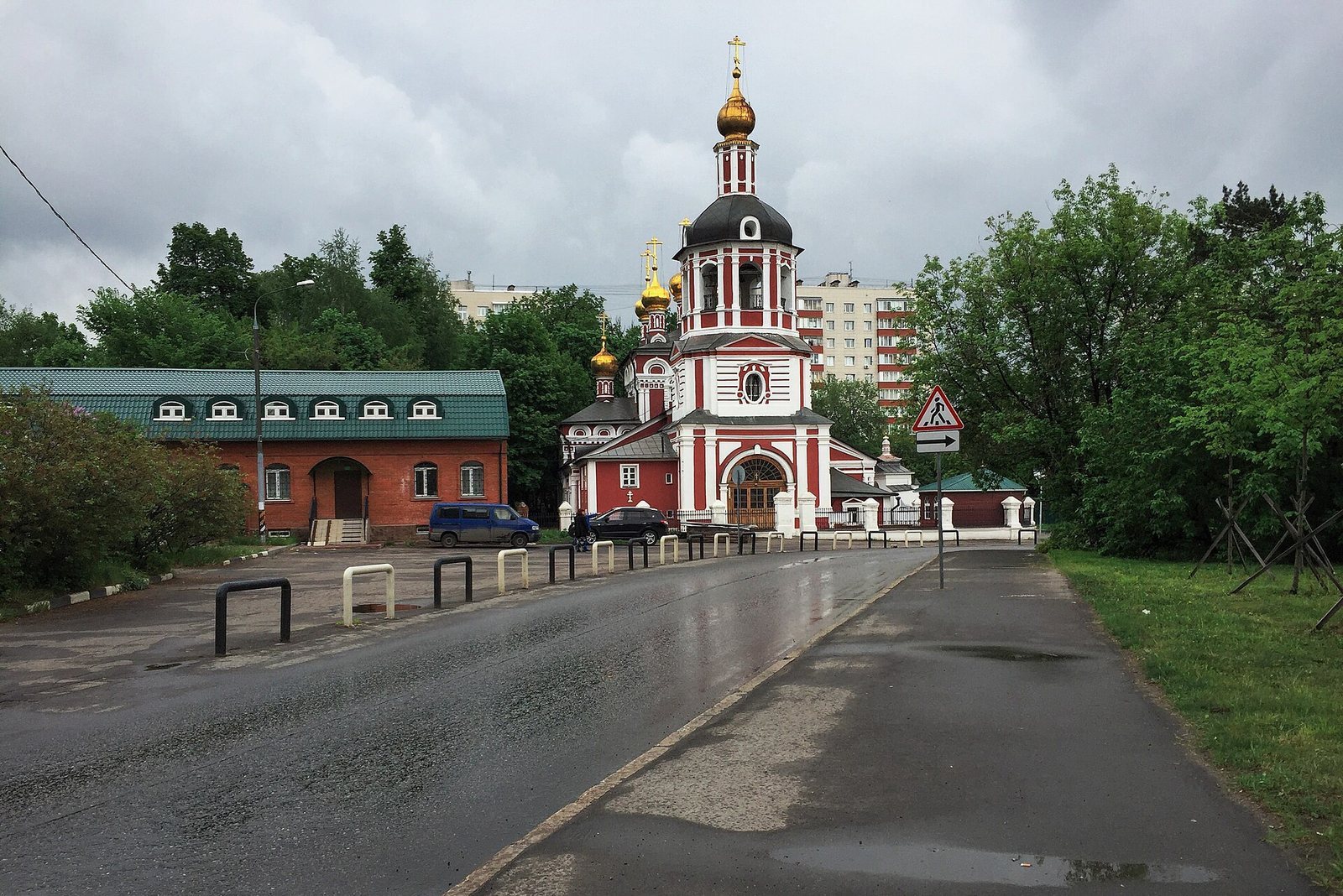
The Church of the Nativity in Izmaylovo is a Russian Orthodox church in Moscow, Russia, whose brick building was completed in 1676. Its history is tied to the New Settlement of Izmaylovo, established for peasants brought from Kostroma, Valdai, Pereyaslav, Alatyr, and other districts to build and serve the tsar’s residence. In the summer of 1664, soldiers from a Streltsy regiment, Russian state troops commonly armed with firearms, built a wooden church on the site. Kostroma builders later erected the masonry church, financed by Tsars Alexei Mikhailovich and Fyodor III. Alexei Mikhailovich is also identified as its founder. Patriarch Joachim, a senior bishop and church leader in Eastern Orthodoxy, consecrated the completed church in 1676.
The church served the Izmaylovo royal residence and was one of its three churches, alongside the Church of the Intercession and a church dedicated to the royal prince Joasaph. The latter was demolished under Soviet authorities.
Veneration and Damage
The Jerusalem Icon of the Mother of God, an Orthodox image of Mary, was venerated as miraculous from 1771, during Moscow’s plague epidemic and the Plague Riot, an uprising amid the outbreak. The copy was brought to the church in 1804, moved to another church in Izmaylovo in 1854, and returned around 1927–28. A summer feast recalls the events of 1771. On the icon’s feast day, October 25, services were held at the church in different years by Patriarchs Alexy I, Pimen, and Alexy II.
French troops stationed in Izmaylovo looted church property in 1812. The property was looted again after the Russian Revolution, the upheavals of 1917 that ended tsarist rule.
Soviet Period and the Church Today
Two rectors were shot during the Soviet period. Alexei Smirnov, rector in 1934, was killed in 1938; Pavel Ansimov, who served from 1935 to 1937, was killed in 1937. Both were canonized in 2005 as hieromartyrs, clergy recognized as martyrs for the Christian faith. Ioann Krestiankin served at the church in the 1940s and was ordained there in October 1945. Arrested in 1950 for his preaching, he later sent icons to the church in memory of his early priestly ministry.
The church remained open throughout the Soviet period and is still active. It belongs to the Moscow Diocese, a regional church jurisdiction, and the Nativity Deanery, a grouping of local parishes. It is designated a federal-level cultural heritage monument of the peoples of Russia.
Remains
Main Church and Chapels
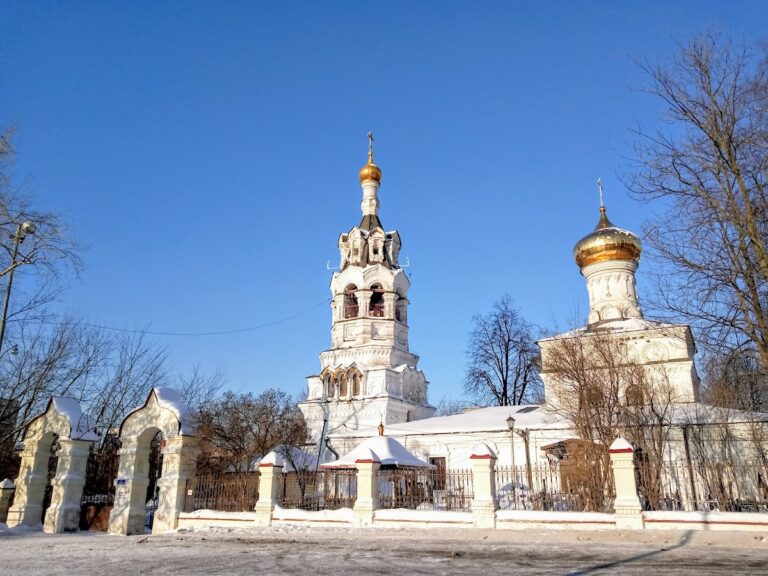
The symmetrical brick church centers on a pillarless, four-sided main block with windows arranged in two tiers. Five domes rise above it, along with three levels of ornamental arched gables, decorative roof-end forms. A single-domed, cube-shaped chapel projects from each side: the southern chapel is dedicated to the Kazan Icon of the Mother of God, and the northern one to St Nicholas. Together, the main church and its two chapels have seven domes. Broad arches spanning the full width of the side walls connect the interiors, and the church has three altars.
Its exterior ornament includes a complex projecting molding beneath the roof, paired columns at the corners, and elaborate window frames topped with pointed decorations. Recessed entrances are embellished with melon-shaped forms.
Later Additions
Communal Hall
A two-pillar communal hall, used for worship and gatherings, was added around 1690.
Entrance and Bell Tower
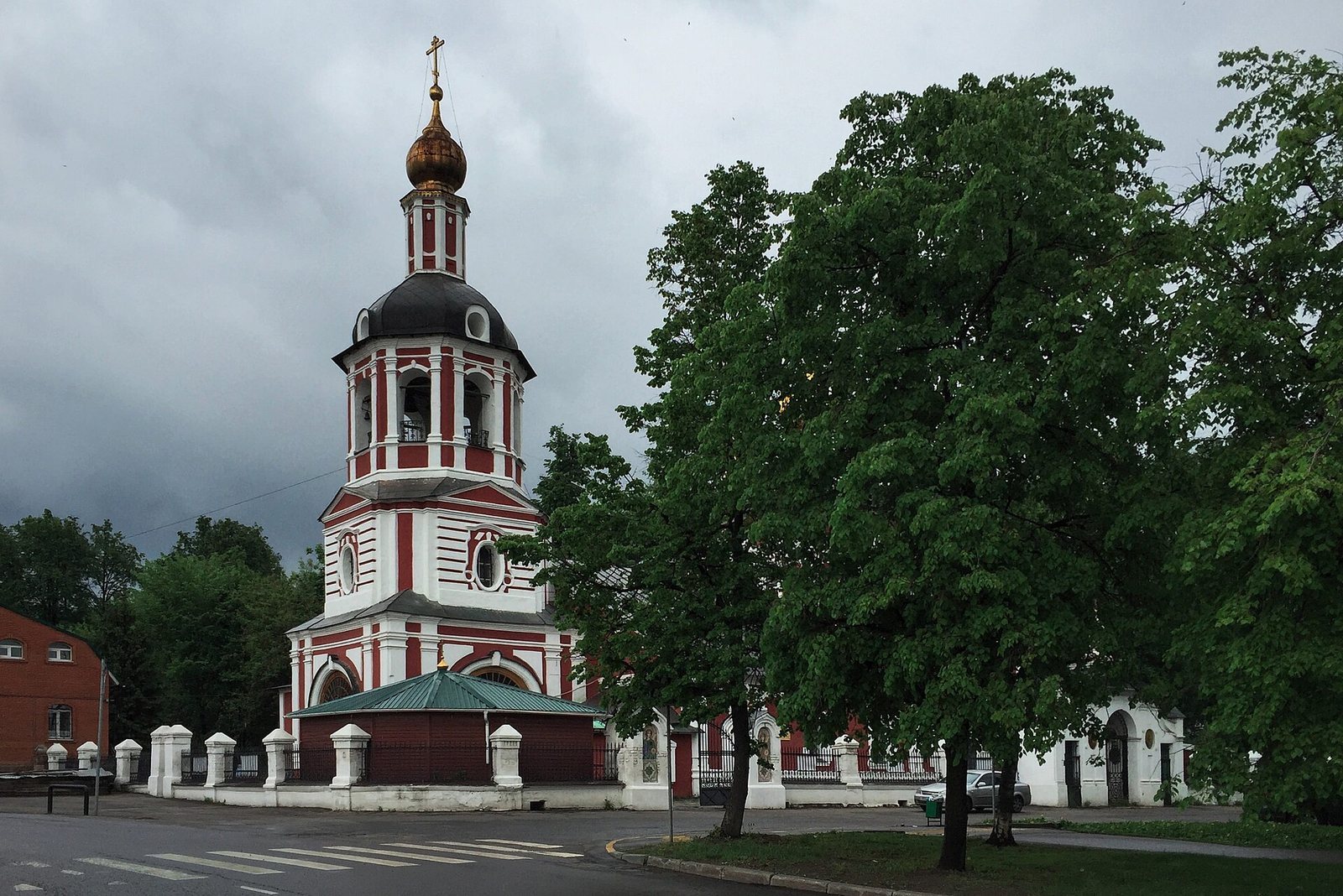
After the church’s initial consecration, a spacious entrance hall was added on the west. A porch and a bell tower in the Baroque style followed in the early 18th century; the tower dates to around 1710. Its features include walls with emphasized joints, windows set into the roof, oval windows, and spiral-scroll ornaments around the openings.
Interior Furnishings and Sacred Images
Icon Screens
Three icon screens, which separate the sanctuary from the main body of the church, were made in 1678 by the Kostroma master Sergei Rozhkov. Their icons were renewed in 1735 by guild painter F. Piskulin on the order of Empress Anna Ioannovna. Carved decoration was added to the screens and their icon cases in the mid-19th century.
Venerated Icons
The southern chapel houses the Jerusalem Icon of the Mother of God, a copy whose place and date of production are uncertain. Other venerated images include a Vladimir icon containing a relic fragment of the Apostle Thomas; icons known as “Gracious Heaven,” “Savior Not Made by Hands,” and the Smolensk Savior; an icon of the Great Martyr Panteleimon painted at Athos; and icons of St Joasaph of Belgorod and the Martyr Tryphon that contain relic fragments.
Izmaylovo Cemetery
Izmaylovo Cemetery lies beside the church. Many priests who served there are buried in the cemetery, where new burials are no longer conducted.