Gråsten Palace: A Baroque Royal Summer Residence in Denmark


Site at a Glance
- Rating
- 4.5
- Popularity
- Medium
- Country
- Denmark
- Primary era
- Early Modern
- External website
- Open
- Eras represented
- Early Modern
- Civilizations
- Danish
- Site type
- Domestic
- Remains
- Palace
On this page7 sections
History
Gråsten Palace is a Baroque palace in Denmark and the summer residence of the Danish royal family. Its present form was built between 1700 and 1708, after two earlier buildings had occupied the estate. The palace was originally known as Grauenstein, a name translated into Danish as Gråsten.
Earlier buildings and the Baroque palace
The first known predecessor was a hunting lodge constructed in the mid-sixteenth century. It was destroyed by fire in 1603. A second manor house was built in 1616, probably on the site now occupied by the palace’s south wing. After this building fell into disrepair, Carl von Ahlefeldt, governor of the royal territories in Schleswig and Holstein and owner of the Seegaard estate, commissioned the present palace. Its Baroque design was carried out between 1700 and 1708. Baroque was an ornate European architectural style known for dramatic decoration, monumental interiors, and strong visual effects.
Christian August I, Duke of Schleswig-Holstein-Sonderburg-Augustenburg, acquired Gråsten in 1725. Much of the complex was destroyed by fire in 1757. Reconstruction began the following year in a simpler and considerably smaller form, with Johann Gottfried Rosenberg commissioned to create the Rococo rebuilding. Rococo was a later eighteenth-century style characterized by lighter ornament and more delicate, asymmetrical decoration.
Changing ownership and the Schleswig conflicts
Gråsten remained associated with the Augustenburg family until Christian August II, Duke of Augustenburg, transferred his possessions, including the palace, to the Danish state in 1852. He had been exiled because of his pro-German position during the First Schleswig War. In 1863, his eldest son Friedrich proclaimed himself Duke of Schleswig-Holstein. After Schleswig-Holstein became a Prussian province in 1867, Friedrich regained Gråsten.
The palace also figured in the political tensions surrounding the Second Schleswig War of 1864, a conflict over the duchies of Schleswig and Holstein. After the war, Otto von Bismarck prevented Christian, the younger son of Christian August II, from spending his honeymoon at Gråsten with his English wife, Helena of Great Britain and Ireland.
The ownership sequence reflects these political changes. Gregers von Ahlefeldt held the estate until 1559, followed by Hans von Ahlefeldt from 1559 to 1580 and Gregers von Ahlefeldt again from 1580 to 1620. Hans von Ahlefeldt held it from 1620 to 1648, followed by Duke Philipp of Schleswig-Holstein-Sonderburg-Glücksburg from 1648 to 1662. Friedrich von Ahlefeldt the Elder owned it from 1662 to 1686, Friedrich von Ahlefeldt the Younger from 1686 to 1708, and Carl von Ahlefeldt from 1708 to 1725. Christian August I held it from 1725 to 1754, Frederik Christian I from 1754 to 1794, Frederik Christian II from 1794 to 1814, and Christian August II from 1814 to 1852. The Danish state held it from 1852 to 1862, followed by Count Adam Gottlob Moltke-Huitfeldt from 1862 to 1864, Prince Christian of Augustenburg from 1864 to 1865, Prince Friedrich VIII of Schleswig-Holstein from 1865 to 1880, and Duke Ernst Günther from 1880 to 1921.
Return to Denmark and royal use
After Northern Schleswig was ceded to Denmark in 1920, Gråsten returned to Danish state ownership. In 1935, following their marriage, the state granted Crown Prince Frederik and Crown Princess Ingrid the right to use the palace as a summer residence. Frederik later became King Frederik IX, who reigned from 1947 to 1972, while Ingrid became queen. The Danish royal family has retained this use, and since 2000 Gråsten has been associated with Queen Margrethe II. The royal family traditionally spends part of the summer at the estate, with the royal yacht Dannebrog arriving in the area and guard parades and changes of guard taking place during royal stays.
The palace is also linked with Hans Christian Andersen, the Danish author known for literary fairy tales such as The Little Match Girl. He visited Christian August II at Gråsten in November 1845. A later tradition connected the palace with the writing of The Little Match Girl, although the tale was written at Augustenborg Palace instead.
Remains
Palace and grounds
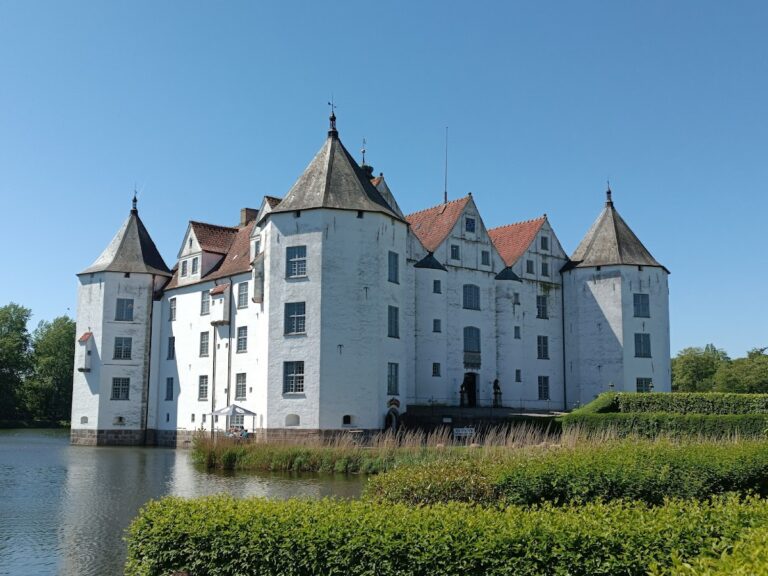
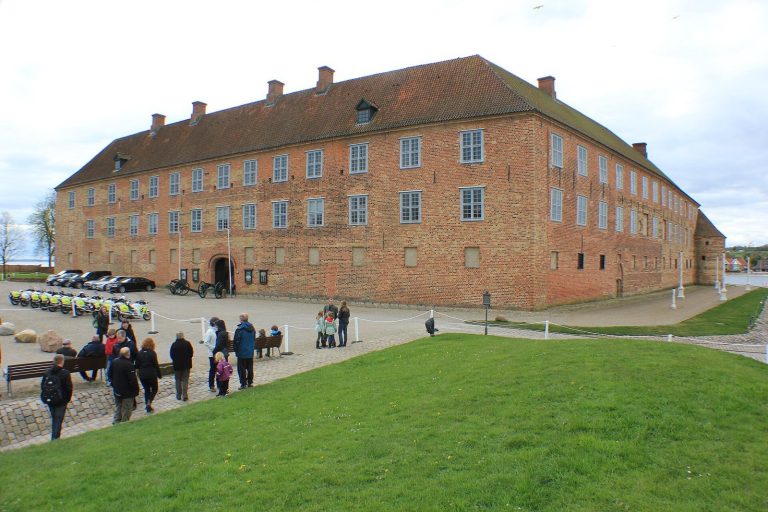
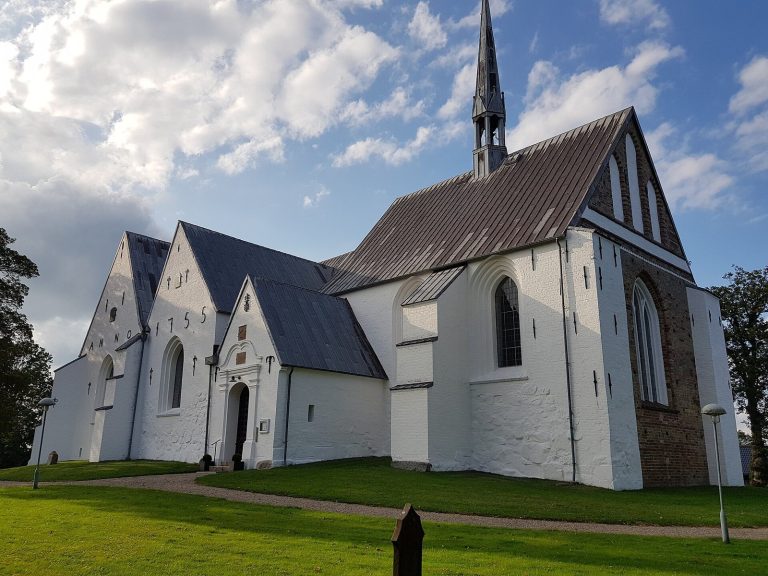
The main palace is a whitewashed, three-winged building arranged around an honor court, a formal courtyard enclosed or partly enclosed by palace wings. Its facade is entirely white, with Venetian doors opening toward lawns and gravel walks. A large stable court forms part of the complex. The estate covers approximately 6.6 square kilometres and lies on a lake, with manicured lawns, gravel walkways, and landscaped grounds extending around the palace.
The palace park was laid out in 1700 and is now arranged in the style of an English garden. Queen Ingrid’s interest in flowers and gardening strongly shaped its present appearance. The grounds include a swimming pool and a tennis court, while a kitchen garden was added as a gift to Queen Margrethe II for her eightieth birthday.
Gråsten Slotskirke
Gråsten Slotskirke, the palace chapel, is embedded in the north wing and cannot be seen externally as a separate building. It developed through the eighteenth-century alterations to the earlier palace and is one of the surviving elements associated with the palace before the 1757 fire. Two pavilions from that earlier complex also survive. Since 1851, the chapel has served as a parish church for both Danish- and German-speaking congregations, with services held in both languages.
The chapel’s large Baroque altarpiece covers the end wall from floor to ceiling. Sculptures and paintings stand between red-and-white marble columns, while the stucco ceiling shows angels and putti, small usually winged child figures used as decorative motifs, against a light-blue sky. The interior once contained 80 paintings, of which 75 are stated to have survived. The chapel was badly damaged during the Second Schleswig War. It is also described as a copy of the Jesuit church in Antwerp.