Franciscan Monastery in Żagań: A Medieval Religious House in Poland
Site at a Glance
- Popularity
- Very Low
- Country
- Poland
- Primary era
- Medieval
- Eras represented
- Medieval, Early Modern
- Civilizations
- Holy Roman Empire, Kingdom of Bohemia
- Site type
- Religious
- Remains
- Monastery
On this page15 sections
History
The Franciscan monastery in Żagań, Poland, was established shortly before or around 1284 by Franciscan friars, members of the Catholic Order of Friars Minor, although its founder is disputed. Its surviving church is Gothic, and the monastery became a focus of recurring disputes over parish jurisdiction, religious reform, and ecclesiastical authority.
Foundation and Franciscan jurisdiction
One interpretation credits Duke Konrad II with founding the house, while another attributes the initiative to townspeople. In a letter dated 21 August 1284, Bishop Thomas II of Breslau told Archbishop Jacobus of Gniezno that he had failed to prevent friars from the Saxon Franciscan Province from establishing a convent in Silesia, which the letter described as Polish territory. Thomas had warned the citizens against receiving friars from another province, and his account indicates that he had not authorized the foundation.
Żagań belonged to the Saxon Province from its beginning. It was probably attached soon afterward to the Goldberg custody, a group of convents overseen by a custodian; this connection is securely recorded by 1340. In 1285, the head of the Bohemian-Polish Province unsuccessfully demanded that the Saxon provincial surrender the convents at Żagań and Namslau. That year, the Breslau cathedral chapter also complained that friars from several houses, including Żagań, supported Duke Henry IV against Thomas II, who had placed the duke under interdict, a church penalty restricting religious services and sacraments. The chapter alleged that the convents had moved from the Bohemian-Polish Province to Saxonia, but Żagań had never belonged to the former province.
A necrology, a register commemorating the dead, preserves a tradition that in 1294 Duke Henry III of Głogów gave the Franciscans a building plot near his castle. In 1303, Hartung, a Franciscan who was bishop of Semigallia, consecrated an altar to the Holy Spirit and the Archangel Michael in the Holy Spirit Hospital outside town. Guardian Romscho, the convent’s superior, witnessed the record of the ceremony. The hospital chapel was under the care of the Augustinian canons associated with Żagań.
Parish disputes and civic relationships
The Franciscans repeatedly clashed with the Augustinian canons, religious clergy who followed the Rule of Saint Augustine and commonly served churches. The canons held the patronage of the town parish, and their abbot also served as parish priest. The disputes concerned authority over parishioners, income, and payments made by the faithful. One episode began when an Augustinian novice, Breczkow, joined the Franciscans, claiming that he sought a stricter religious life. His accusations led to Abbot Dietrich I, who held office from 1351 to 1365, being summoned before a diocesan official. Franciscan preachers praised Breczkow’s choice, but he left the order after a year and married.
In 1363, Albertus Baldramus, an official of the Naumburg diocese appointed by the Holy See, the papal authority governing the Catholic Church, mediated an agreement between Petrus of Dippoldiswalde, custodian of the Goldberg group, and Abbot Dietrich. The two orders were not to harm or disparage each other, particularly in sermons. Franciscans could hear confessions only with the bishop’s consent, while parishioners were to confess at least once a year to the town priest or his deputy and pay the usual fees. People could choose burial at the Franciscan house, but the Augustinians retained the customary church payments. An excommunication imposed by either community was to apply to the other as well. Franciscan funeral processions were restricted to Sundays after evening prayers and were to take place without ceremony, singing, or prayers.
Further disputes arose under Abbot Nicholas I, whose term ran from 1365 to 1376, with both communities accusing the other of violating rights and income. In 1372, the papal legate John of Alexandria initially decided in favor of the Franciscans; in 1376, Cardinal John, bishop of Sabina, ruled against them. Relations improved during the abbacy of Ludolf of Żagań, from 1394 to 1422. He sometimes preached in the Franciscan church and encouraged parishioners to give alms to the friars. In 1403, Henczel Greiffenberg left the convent money in return for an entry commemorating his parents in its necrology. Town negotiations over beer sales also took place at the monastery in 1415.
Interdicts and Franciscan reform
In 1426, Duke John I’s dispute with the Augustinian canons turned violent. The duke’s actions included imprisoning Abbot Heinrich Undirburg of Leslaw, prompting Bishop Konrad of Breslau to place him under interdict. The Franciscans initially observed the penalty, but in 1430 they held services in town despite it, perhaps from fear of or deference to the duke. They were then placed under interdict themselves. On 7 October 1431, the provost of Sprottau received authority to suspend the penalty for six weeks while the dispute was resolved. The friars were forbidden to hold services and risked expulsion and loss of their benefices, ecclesiastical offices or endowments carrying income, if they disobeyed. They were probably absolved soon afterward.
On 10 January 1453, the Franciscan preacher and reformer John of Capistrano visited Żagań and preached in support of the Observance movement, which promoted stricter adherence to Franciscan rules. The convent is said to have joined the movement, but its reform followed the milder Martinian Constitutions rather than the stricter Observance. Under those rules, convent property was formally assigned to the Holy See and managed by laypeople, while friars could draw on funds to maintain their buildings. That year the convent also lent 25 Hungarian gulden to Dukes Rudolf and Balthasar. The loan was secured against Żagań’s customs revenue, which provided annual interest to the monastery.
Rebuilding and changing provincial ties
In 1482, the town council appealed to Duke Albrecht of Saxony after the friars’ request to take timber freely from ducal forests for their own use was refused. A town fire in 1486 destroyed the monastery and its church. Guardian Simon Grissel was said to have lost his reason during the fire and died in Görlitz that June. The friars began rebuilding soon afterward, and the reconstructed church was completed in 1495. The convent also operated a house of studies, where novices received basic theological instruction; lectors, or teachers, Johannes Werneri in 1476 and Andreas Hoffmann in 1530 attest to its activity.
Arguments over the level of Franciscan discipline continued. In 1488, the council of Görlitz complained that the Goldberg custodian had encouraged friars there to leave the Observance and move to Żagań for a less austere life. After a reform effort in 1498, the convent resisted the custodian’s attempt to appoint a reformed guardian, with the town council supporting the friars. In 1501, Guardian Franziskus Goltmann of Crossen defended the established mendicant way of life at several convents, including Żagań. The Goldberg custodian reported declining Observance in 1505, and a reform may have been imposed at Żagań in the following years.
In 1515, Żagań hosted the one provincial chapter, or assembly of a religious province, held at the convent. The Augustinian abbot and his choir-clad brethren welcomed the arriving friars on foot, escorted them to the parish church, and then accompanied them to the Franciscan house after the abbot preached in Latin. The Franciscans admitted the Augustinians to their confraternity and shared prayers for one another; both communities also agreed not to attack each other in sermons or services. Their relationship had worsened again by 1519. The convent borrowed 40 marks from the town council to finance the meeting. The debt remained unpaid in 1520, and repayment was arranged in two installments for 1521.
In 1518, the Franciscan Province of Saxonia was divided according to the strictness of observance rather than geography. Żagań was assigned to the province of Saint John the Baptist, which followed the milder Martinian rules. The Goldberg custody was dissolved in 1523. The convent appears to have had little landed property and to have relied substantially on alms, while also receiving rents, gifts, and legacies and making loans. Between 1510 and 1516, Duke Georg of Saxony gave it 20 marks and permission to collect two loads of wine annually in Dresden around the feast of Saint Bartholomew on 24 August. In 1517, townsman Jorge Ehrlich left 40 marks from his wife’s inheritance to two sons who had entered the convent.
Reformation and dissolution
In 1519, the Holy See’s general auditor, Joannes Hieronymus de Chinutiis, was to admonish the guardian and friars. They were instructed to celebrate Mass before the parish church’s main service and not to administer sacraments without the Augustinian abbot’s permission. In 1522, the new Augustinian abbot, Paul Lemberg, introduced Luther’s teaching in Żagań. The Franciscans opposed the Reformation, while the Catholic Duke and Elector Georg of Saxony supported them, and the new teaching did not yet take hold across the duchy.
Georg died in 1539 and was succeeded by his evangelical-minded brother Heinrich. When Heinrich came to Żagań in 1540, the Reformation became established there almost completely. The convent may already have been vacant around 1539, but it was formally dissolved and its friars expelled in 1540. The church was then handed to Protestants, who used it until 1628. Its images and altars were destroyed, and its liturgical vestments, vessels, and other church equipment were sold.
Jesuit possession
In 1549, Elector Moritz of Saxony ceded the duchy of Żagań to King Ferdinand I of Bohemia. The change brought the duchy into the direct possession of the Bohemian Crown and created conditions for its return to Catholicism. In 1628, during the Thirty Years’ War, Emperor Ferdinand II granted the duchy as a fief to his commander Wallenstein. Wallenstein invited the Jesuits, members of the Catholic Society of Jesus, to Żagań and transferred the former Franciscan monastery to them. The 1629 Edict of Restitution, an imperial measure intended to restore Catholic ecclesiastical property in the Holy Roman Empire, furthered the emperor’s policy of Catholic restoration.
After the war, the Bohemian Franciscan Province tried to reclaim the monastery. The friars argued that Wallenstein could not transfer a fief without the consent of his feudal lord and that no imperial or royal approval had been granted. Their challenge did not alter the outcome: the church and monastery buildings remained in Jesuit possession.
Remains
Church and chapel
Gothic church
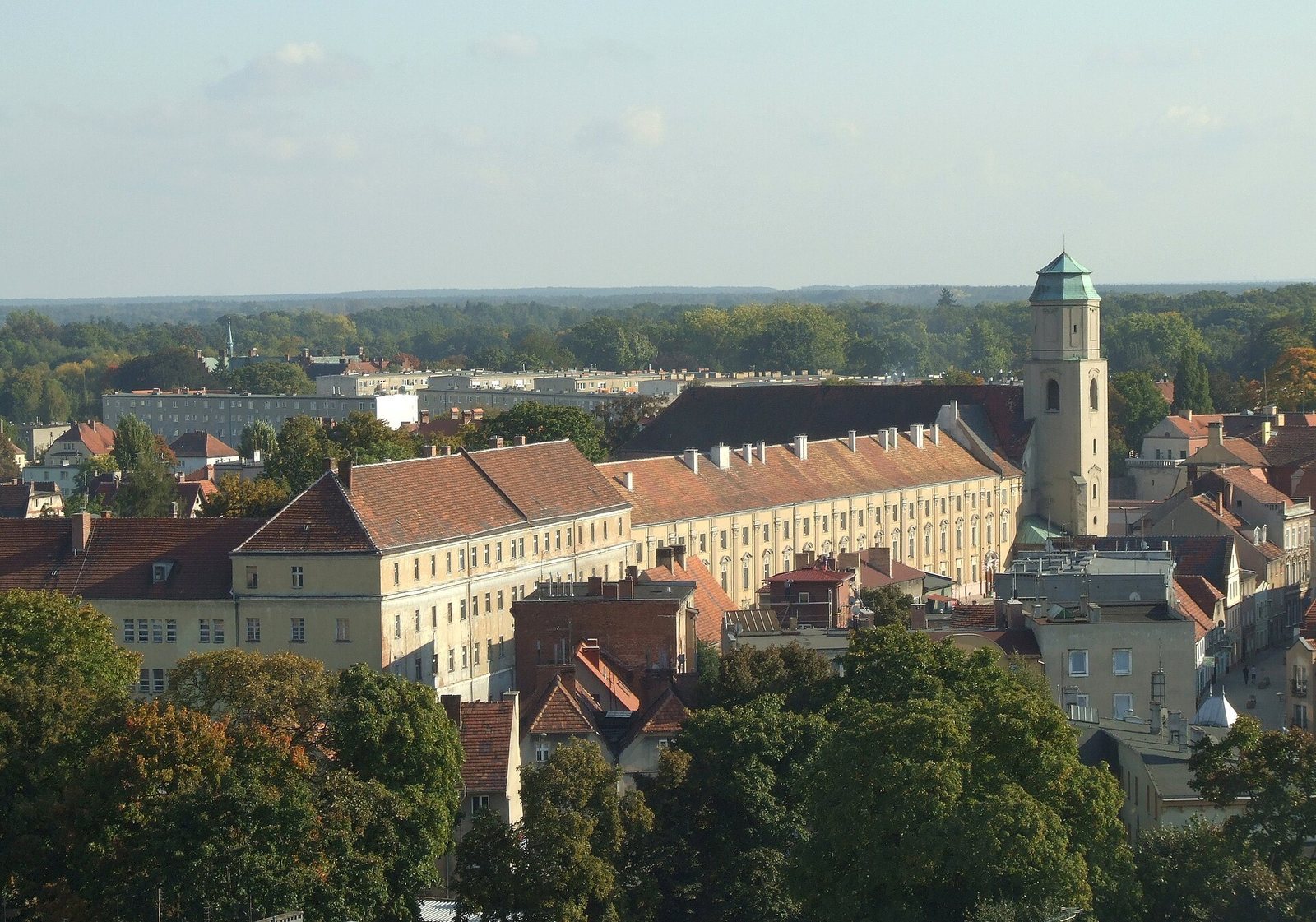
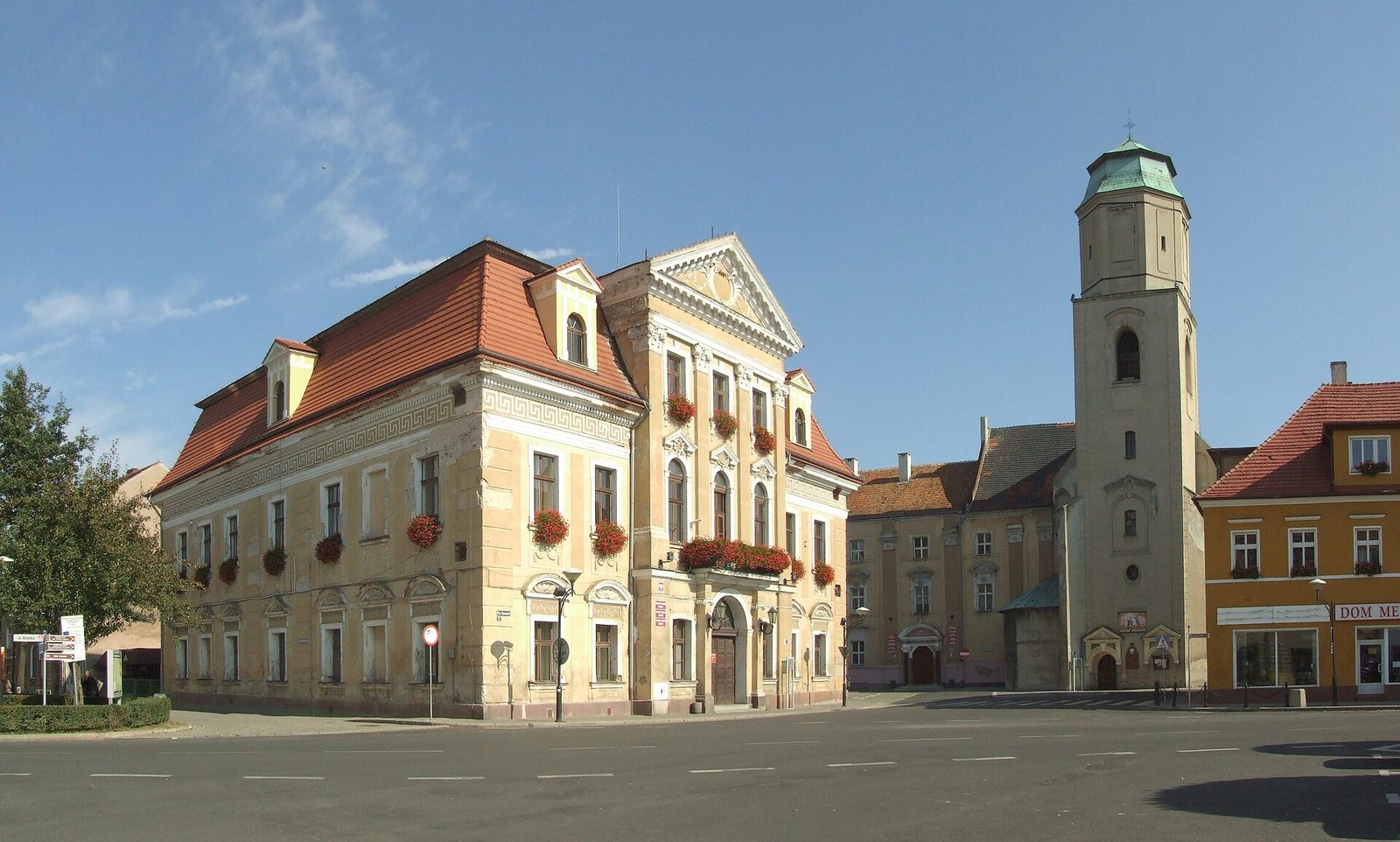
The former monastery stood at the eastern edge of town beside the later town wall. Its Gothic church survives in a substantially altered form and now serves as a Roman Catholic church dedicated to Saints Peter and Paul.
Chapel
In 1514, a chapel was added to the church by an administrator of the duchy from the von Schlieben family. Dedicated to the Sorrowful Compassion of the Virgin Mary, it contained an altar.
Monastic buildings and grounds
Refectory
The monastery included a refectory, or dining hall. Lightning struck it on the evening of 15 August 1537, causing no major damage.
Gardens
The friars owned a larger garden and may also have had a smaller one. In 1524, they sold a garden between Holy Cross and Mill Lane to Margarete Baierin, who paid the full price.
House
The convent also owned at least one house. In 1530, Guardian Johannes Wache and Lector Andreas Hoffmann, acting through the convent’s representative, confirmed that Merten Sommer had paid for a house the friars sold him on Lost Lane.