Epidaurus: An Ancient Greek City and Healing Sanctuary
Site at a Glance
- Popularity
- Very High
- Country
- Greece
- Primary era
- Classical
- Eras represented
- Iron Age, Classical
- Civilizations
- Ancient Greek, Roman
- Site type
- Religious
- Remains
- Sanctuary
On this page20 sections
History
Early traditions and the Greek city
Epidaurus was an ancient Greek city and healing sanctuary at present-day Archaia Epidauros, Greece. People lived in the area from the third millennium BC. The coastal city became an independent Greek city-state, with its surrounding territory known as Epidauria, and was later incorporated into Argolis under Roman rule. The sanctuary’s cult history began with worship of Apollo Maleatas in the seventh century BC; worship of Asclepius took hold there by the sixth century BC.
Greek traditions linked the city’s name to the hero Epidauros and identified Epidaurus as the birthplace of Asclepius, the god of healing. One account named Apollo and Coronis as his parents, while a local version named Apollo and Arsinoe, daughter of a king of Messenia. Epidaurus promoted its claim to be the god’s birthplace, although other Greek communities, including Trikka in Thessaly, made similar claims. The local tradition helped draw wider attention to its sanctuary.
Stories about the city’s earliest peoples described Carians, an ancient people of southwestern Anatolia, as its first inhabitants, followed by Ionians during the Mycenaean period of the Late Bronze Age. In a later tale about the Dorian arrival, the Ionian king Pityreus led some residents to Attica; others stayed or departed for Asia Minor. Epidaurus took part in the Persian Wars between Greek states and the Persian Empire. In the Peloponnesian War, the long conflict between Athens and Sparta and their allies, it supported Sparta. It also fought the Argives, who were allied with Athens, in the Epidaurian War.
The healing sanctuary and its festivals
As worship of Asclepius grew, the older hilltop sanctuary of Apollo Maleatas could no longer accommodate the cult’s needs, and a larger center developed at Epidaurus. Apollo continued to have a sanctuary of his own, while the two deities also shared a broader cult. Asclepius was first revered there as a hero rather than a god, and his worship retained heroic elements, including an association with a sacred serpent, before his status developed into that of a god.
From the fifth century BC, people travelled from across Greece and the Mediterranean to seek healing. A practice involved spending the night in the sanctuary in the hope that Asclepius would reveal a remedy in a dream. Patients then discussed treatment with priests. A proposed sequence also involved ritual cleansing and a sacrifice to Apollo. Treatments may have included bathing, rest, medicines or surgery, used separately or together; hypnosis may have been employed in later periods. The sanctuary’s growth may have been encouraged by the plague at Athens and the establishment of an Asclepius sanctuary there.
From the fifth century BC, games honoring Asclepius, called the Asklepieia, were held every four years, nine days after the Isthmian games. They began with athletic contests and later added cultural events. The sanctuary’s fame brought prosperity, particularly in the fourth and third centuries BC, and led to daughter sanctuaries elsewhere, including Athens, Pergamon and Rome. Its influence continued through the Hellenistic period, which followed Alexander the Great’s conquests, and into Roman times. Epidaurus joined the Lamian War in 323/322 BC, a revolt by Greek states against Macedonian rule after Alexander’s death, and became a member of the Achaean League, a federation of Greek city-states, in 243 BC.
Roman rule and late antiquity
Pirates repeatedly attacked Epidaurus during the first century BC. Around 85–87 BC, during the First Mithridatic War, Rome’s first war against Mithridates VI of Pontus, the Roman general Sulla plundered the sanctuary. He distributed votive offerings and cult objects to his soldiers as payment. The sanctuary was later rebuilt. Construction renewed in the second century AD, and its prosperity revived after Emperor Hadrian visited in AD 124.
In AD 395, Goths led by Alaric I raided and badly damaged the sanctuary; some areas were rebuilt afterward. As Christianity spread, the ancient cults declined, and the sanctuary was officially closed in AD 426. It nevertheless remained known as a Christian healing center into the middle of the fifth century. The eventual end of the ancient city is uncertain. Proposed explanations include illness associated with nearby marshes, or an eruption of the Methana volcano followed by a tsunami. The latter event may also have joined the peninsula of Nisi to the mainland.
Modern settlement and archaeological work
From 1821, the coastal settlement again functioned as a village under the name Palaia Epidaurus. It grew into an important port for eastern Argolis, exporting local produce and maintaining regular sea links with Piraeus, Aegina, Poros and Syros.
Excavation and conservation at the sanctuary began in the late nineteenth century. Panagiotis Kavvadias directed work from 1879 to 1928, with the most intensive campaign in 1881–1889. Ioannis Papadimitriou focused chiefly on the older Apollo Maleatas sanctuary in 1948–1951, and excavation there continued in 1974. Excavation and conservation at different sanctuary buildings have proceeded, with interruptions, since the 1980s. The coastal city’s theater was discovered by Evangelia Deilaki in 1971, excavated in 1972 and investigated again from 1990, followed by renovation.
The sanctuary and theater were added to the UNESCO World Heritage List in 1988. The sanctuary theater also continues to host dramatic performances and has been used by the Athens and Epidaurus Festival, founded in 1952.
Remains
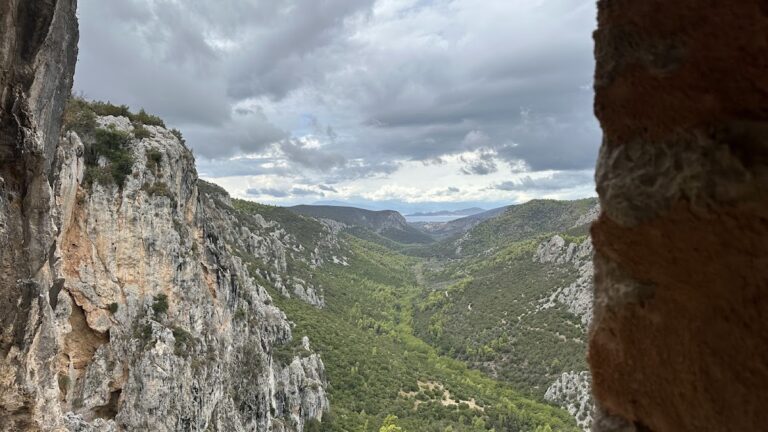
The inland sanctuary lies about 8 km from the coastal town, in the foothills of Mounts Arachnaion, Koryphaion and Tithion. The older sanctuary of Apollo Maleatas occupies Mount Kynortion, roughly 2 km from the main cult area. A route used by pilgrims has been excavated. Within the larger complex, religious buildings stood alongside facilities for patients and athletes and spaces for cultural activities. Greek temples and columned halls formed part of this varied layout. Springs and mineral springs occur in the surrounding area, although their use in healing remains uncertain.
The sanctuary’s entrance and cult buildings
The Propylon
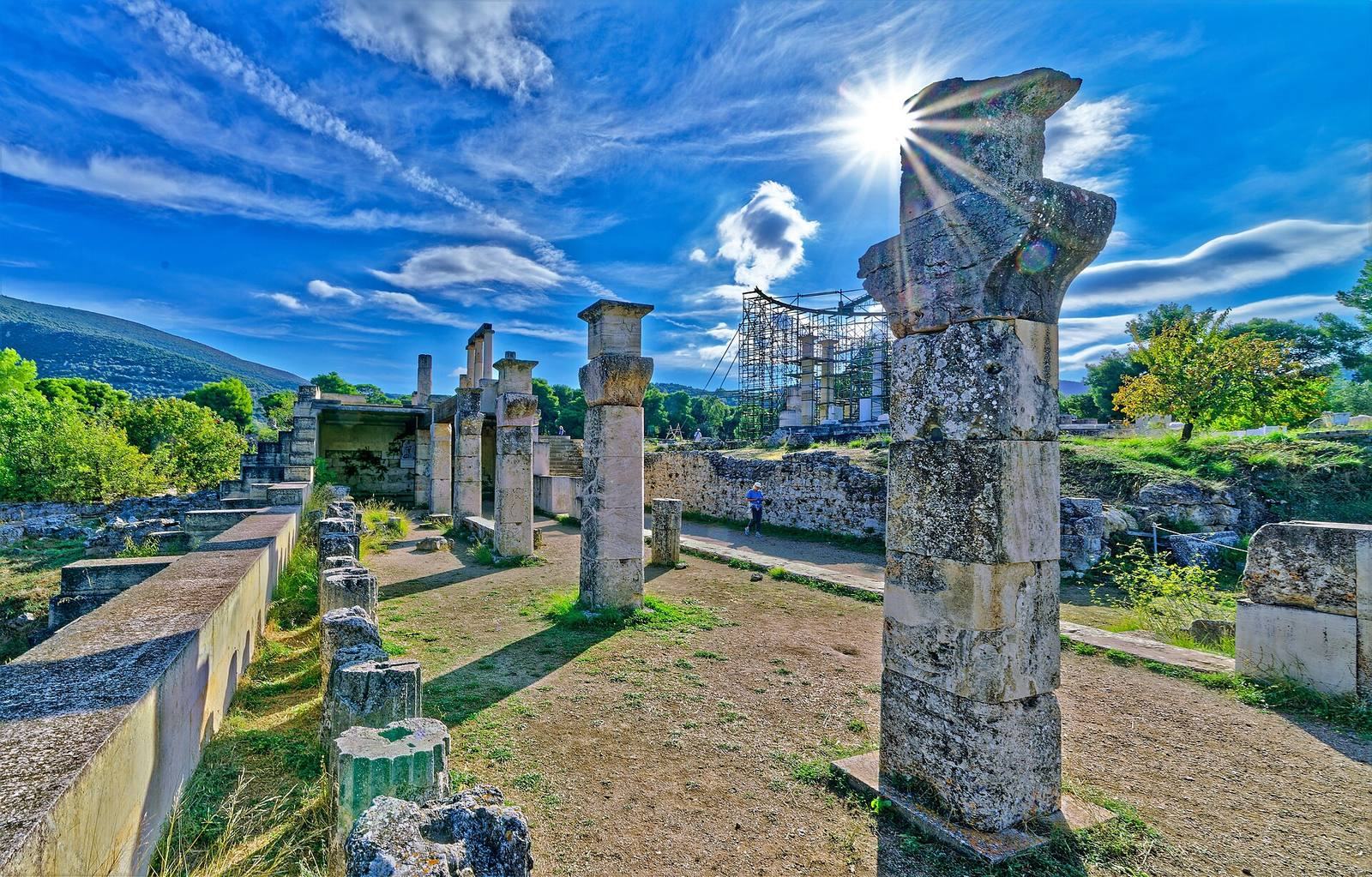
The sanctuary entrance, probably built between 340 and 320 BC, was a monumental structure formed by two columned halls. Each hall had six columns: one used the Ionic style and the other the Corinthian, two types of Greek column design. The halls opened onto the sacred road leading into the sanctuary.
Temple of Asclepius
Built around 400–390 BC, the Temple of Asclepius was a small rectangular building in the Doric style, a Greek architectural style, measuring about 23 by 11 m. Its construction took five years. Around 350 BC, the sculptor Thrasymedes of Paros made an ivory-and-gold statue of Asclepius for the temple. The statue was reportedly modelled on Phidias’s statue of Zeus at Olympia.
Tholos
Behind the temple stood the circular building known as the Tholos, also called the Thymele in local inscriptions. Built around 365–335 BC and attributed to the architect Polykleites, it had an outer ring of 26 Doric columns and an inner circle of 14 marble columns in the Corinthian style. Only the foundations survive. Its purpose is uncertain; it may have represented a symbolic tomb for Asclepius in his aspect as a hero. A labyrinth-like space beneath the ancient floor may have represented the god’s underworld, though whether people could enter it is also unclear. An effort to restore and partly rebuild the Tholos and a nearby fountain house began in the early twenty-first century.
Abaton and guesthouse
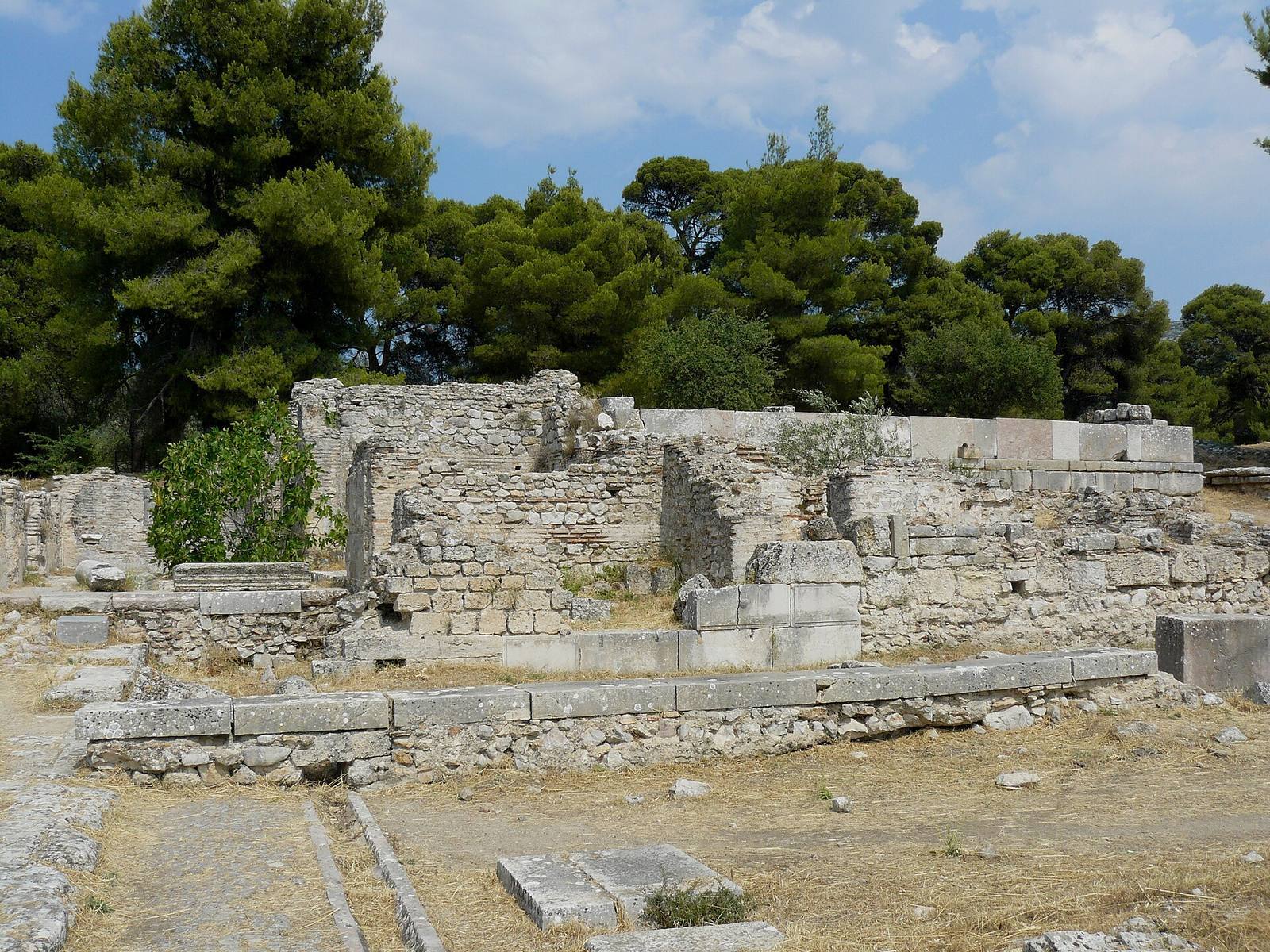
The Abaton, a sacred sleeping hall, is the oldest building in the sanctuary. Originating in the sixth century BC, it measures about 21 by 24 m and probably housed patients waiting for Asclepius to visit them in dreams. The guesthouse, built in the fourth century BC, was a large, two-storey structure with about 160 rooms. Its foundations are now visible.
Other sanctuary buildings
Other identified structures include sanctuaries of Artemis and Apollo, a priests’ residence, a gymnasium, a stadium, an athletic training ground, baths and a ceremonial dining hall. A library is also associated with the complex. At the older sanctuary on Mount Kynortion, remains include an ash altar, a small temple and a later roofed colonnade. Roman-period additions there included a cistern, a well and a courtyard building.
Performance and athletic buildings
Sanctuary theater
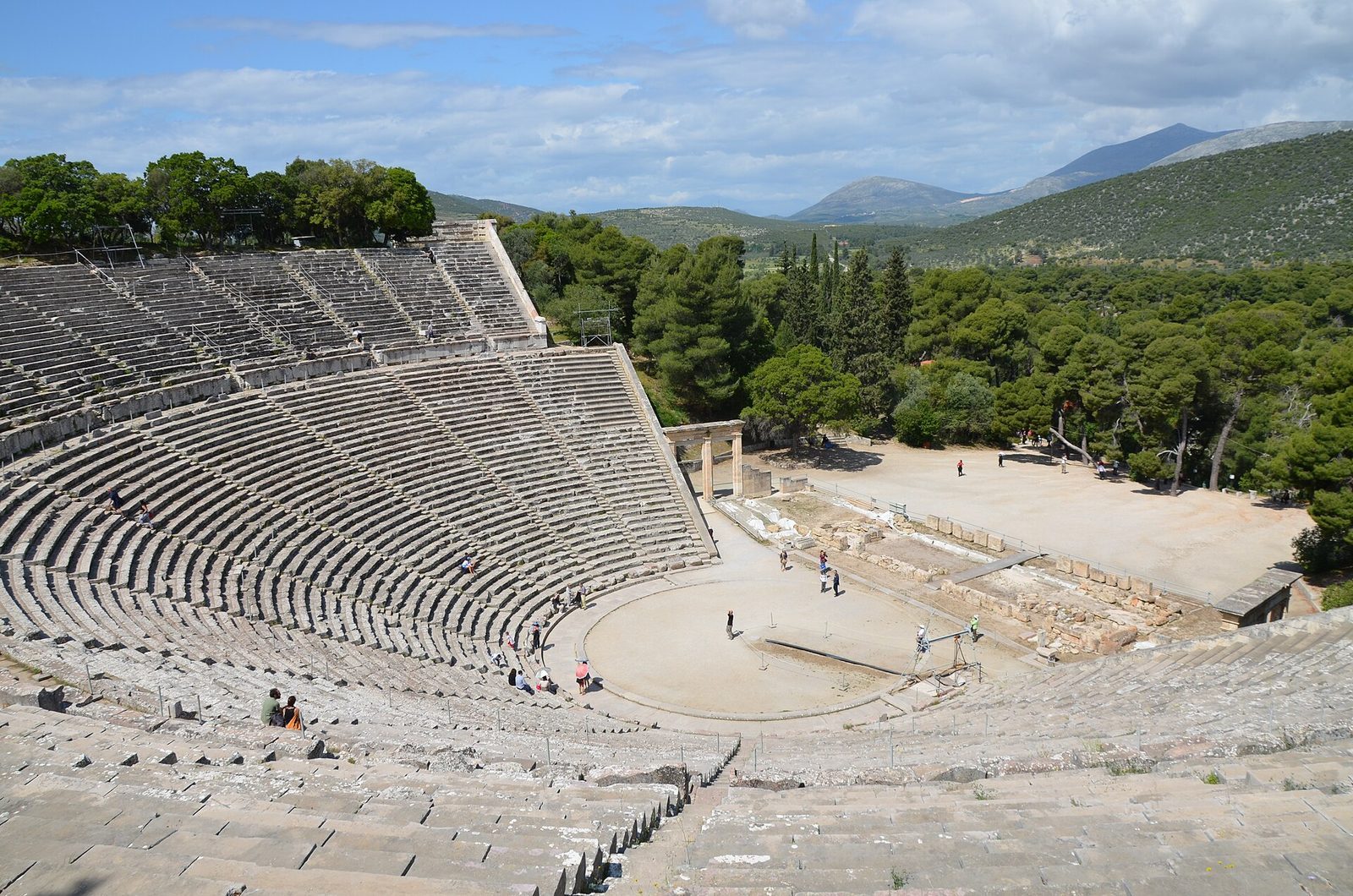
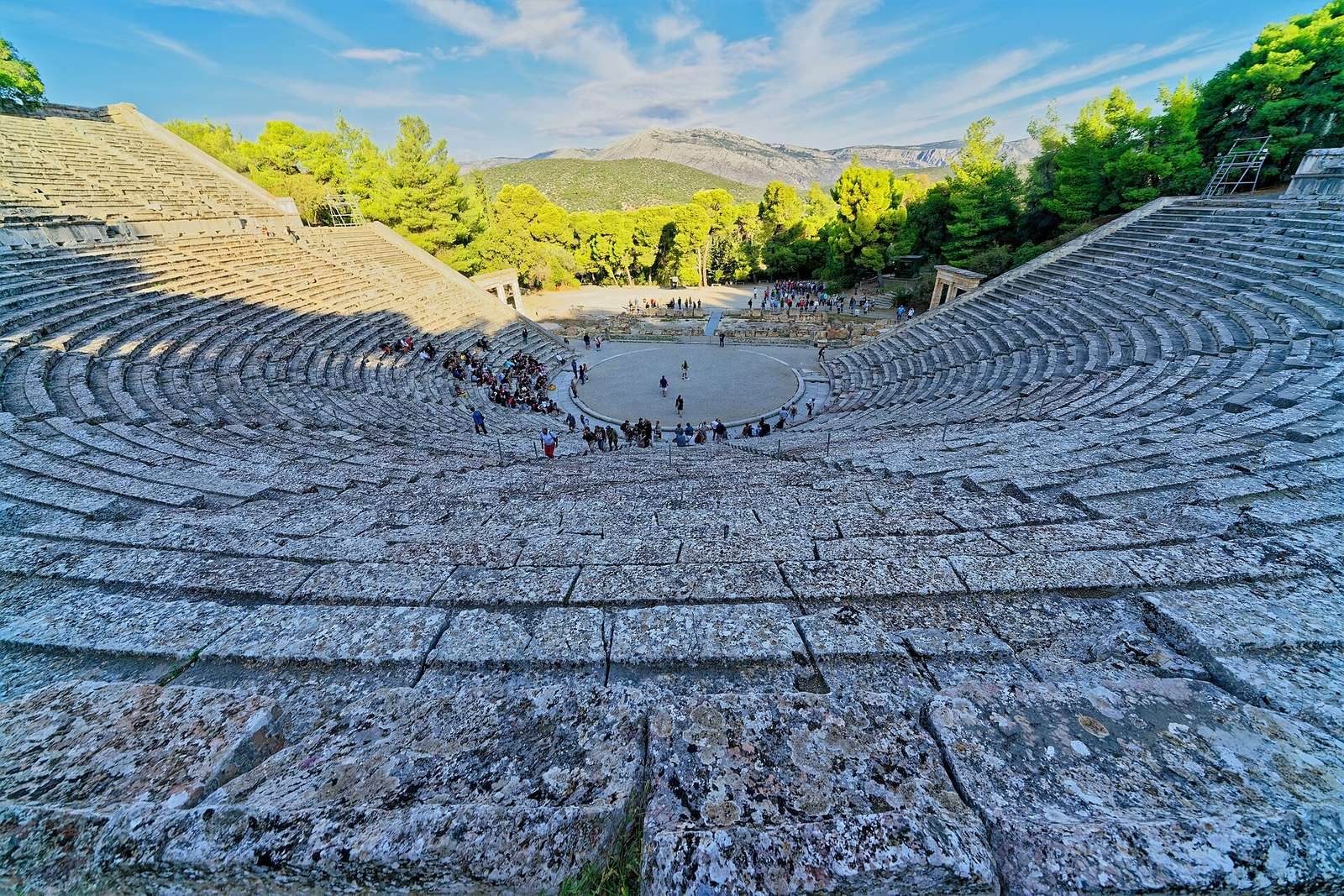
Built around 330 BC into a hillside and attributed to Polykleitos the Younger, the sanctuary theater had a semicircular seating area for about 14,000 spectators. Its original 34 rows were enlarged by 21 rows in Roman times. The circular orchestra was the central performance space for the chorus. A stage building once stood behind it, but only its foundations remain. The surrounding mountain landscape forms part of the theater’s setting.
The theater is known for its acoustics, though speech is not equally clear from every seat. Its limestone seating filters lower-frequency sounds and amplifies higher-frequency sounds coming from the stage.
Stadium, gymnasium and odeon
The stadium occupies a natural hollow. Its running track is 181.3 m long and 21.5 m wide. Parts of the starting installation and seating survive. Some seats were cut into bedrock, while others were built from masonry. Seats reserved for people of honor, including seats with backs, stood along the southern side. An underground passage linked the stadium with the athletic training ground and gymnasium.
The foundations of the gymnasium and a later Roman musical performance hall, or odeon, remain identifiable. Work to rebuild the gymnasium’s entrance gate began in 2007.
Coastal city and later remains
City layout and tombs
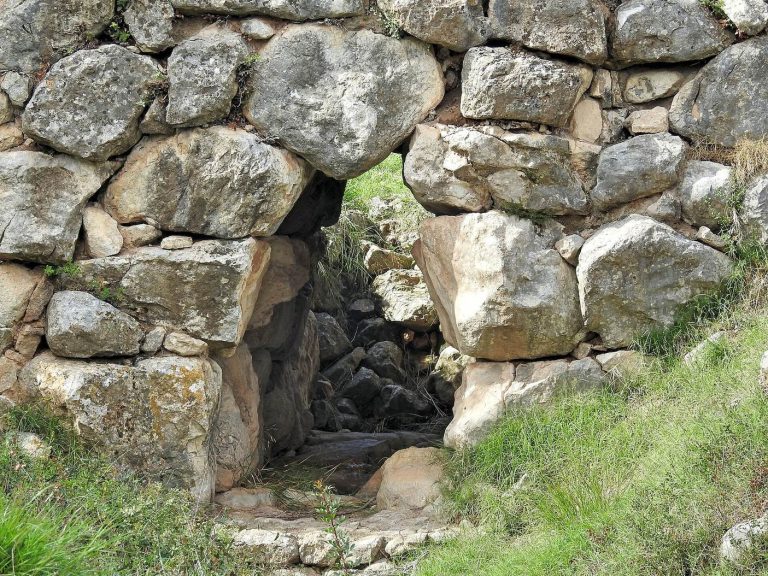
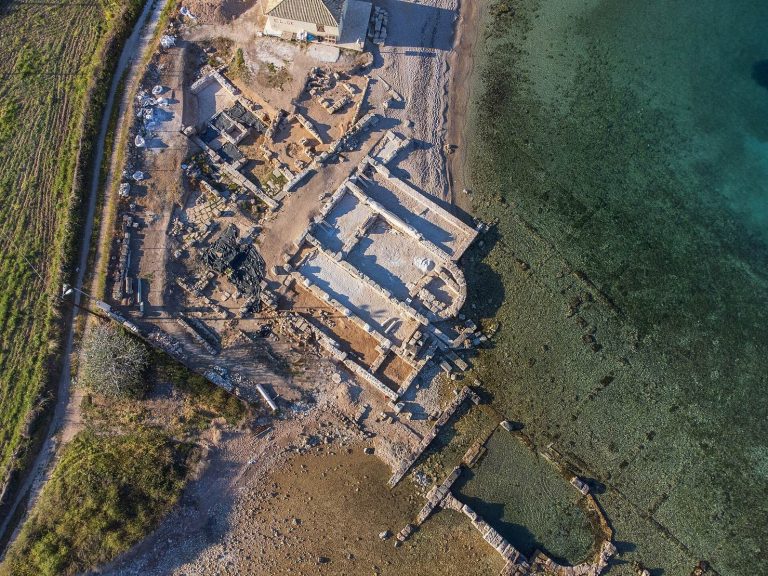
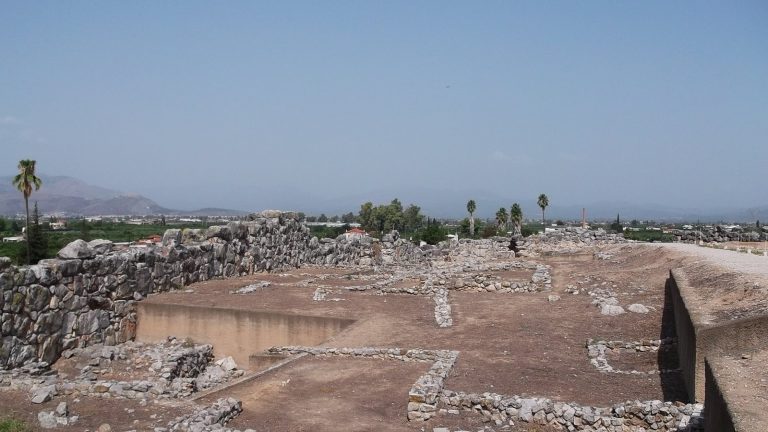
The ancient coastal city’s remains lie chiefly on and around the peninsula of Nisi, where its high central area and harbor were situated. Polygonal fortification walls survive along the elevated ridge. Inscriptions place the city’s public gathering and marketplace area at the peninsula’s neck, while Roman-period houses show that settlement extended northwest. Archaeological remains also lie in the sea around Nisi and to its south. Seven Mycenaean chamber tombs in the heights provide evidence of activity during the Late Bronze Age.
City theater
Separate from the sanctuary theater, the coastal city’s theater stands on the ridge of Nisi. Dating to the fourth century BC, it held about 2,000 people and is well preserved. Inscriptions on its seats record gifts made to Dionysus, the god associated with theater and religious festivals, by city officials. The inscriptions date to the fourth or third century BC.
Sanctuaries and churches
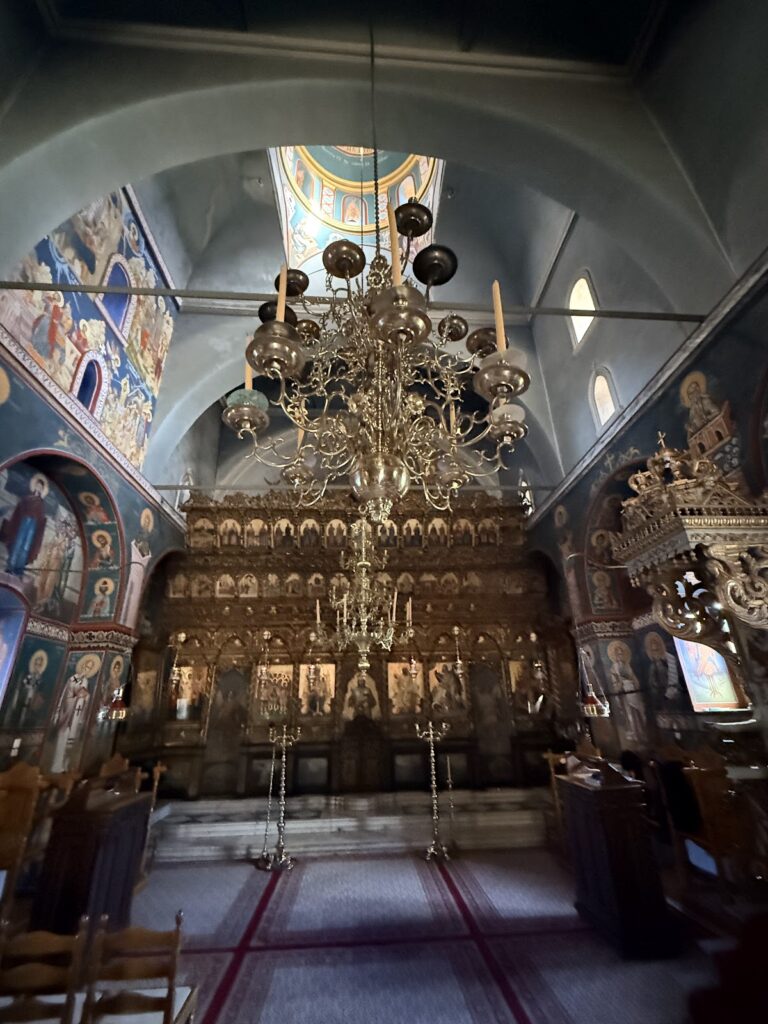
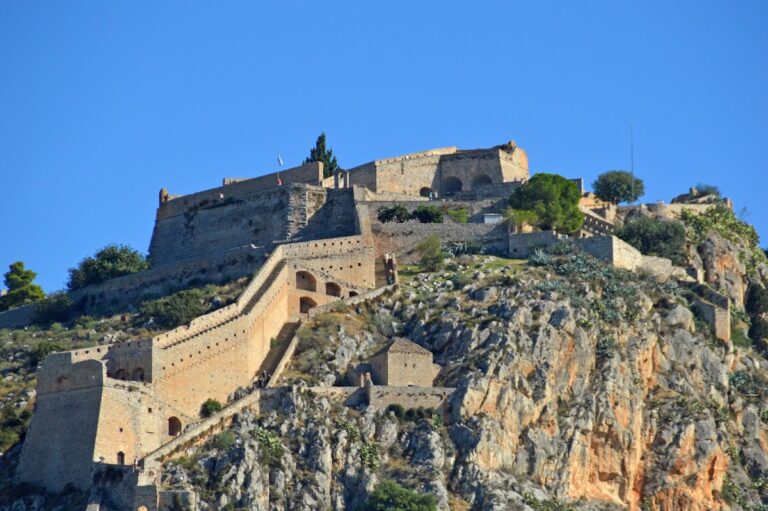
A sanctuary of Artemis lies on heights west of the harbor. The location of the village church of Agios Nikolaos may have been occupied by a sanctuary of Hera, although that identification is uncertain. On Nisi are the remains of a small early Christian church dedicated to the Virgin Mary. It had a single aisle and a semicircular sanctuary end, and dates no later than the end of the sixth century. It may have served as a church within a castle. A large fifth-century church with five aisles stood northeast of the main sanctuary.
Museum
A small museum was established within the sanctuary in 1905–1907. Its displays include excavated statuettes, small clay and marble figures used in worship, statues of the gods worshipped at the site and a model of the Tholos.