Fragrant Hills: Beijing’s Former Imperial Garden and Mountain Park
Site at a Glance
- Rating
- 4.8
- Popularity
- Very Low
- Country
- China
- Primary era
- Early Modern
- Eras represented
- Medieval, Early Modern
- Civilizations
- Jurchen Jin, Liao, Ming, Qing
- Site type
- Domestic
- Remains
- Park
On this page21 sections
History
Fragrant Hills is a former imperial garden and mountain park at the eastern foot of the Western Hills in Beijing, China. The present park covers about 188 hectares and incorporates the surrounding mountain landscape. Its historical development reaches from the Tang period through the Jin, Yuan, Ming, and Qing dynasties, before the site became a public park and a place associated with modern Chinese political history.
Early temples and imperial residences
The history of Yong’an Temple, now commonly called Fragrant Temple, is traced to the Tang period. Religious and imperial activity continued through the Liao and Jin periods. In 1186, Jin emperor Shizong rebuilt the temple, renamed it Great Yong’an Temple, and ordered a temporary imperial residence beside it. During the reign of Jin emperor Zhangzong, the area was counted among the Western Hills’ eight water estates, a group of imperial scenic properties associated with water and cultivated landscapes. The temple underwent further repairs in later periods.
During the Yuan and Ming dynasties, emperors built residences at Fragrant Hills. They used the cooler mountain environment for summer stays and hunted there in autumn. These successive buildings and activities established the site as an imperial retreat before its transformation into a large, formally planned Qing garden.
The Qing imperial garden
Construction of the Fragrant Hills Palace began near the temple in 1677, during the reign of the Kangxi Emperor. The palace was enlarged in 1735 under the Yongzheng Emperor. In 1745, the Qianlong Emperor ordered a major imperial garden at Fragrant Hills and defined its twenty-eight scenic views. In 1747, he renamed the palace and garden Jingyi Garden.
Jingyi Garden formed one mountain and one garden within the Qing imperial complex known as the Three Mountains and Five Gardens. The complex was organized around three mountain areas and five major gardens west of Beijing. Fragrant Hills was also associated with Clear Snow on the Western Hills, one of the Eight Views of Beijing. The Qianlong Emperor’s inscriptions and poems gave the garden a literary as well as physical structure.
Destruction and new uses
British and French forces looted and burned Jingyi Garden in 1860 during the Second Opium War, a conflict in which Britain and France used military pressure against Qing China to expand their access and privileges. The Eight-Nation Alliance looted and damaged the site again in 1900 during the Boxer Rebellion, an anti-foreign and anti-Christian uprising followed by an international military intervention.
New educational and charitable uses emerged in the early twentieth century. In autumn 1913, Ying Lianzhi established the Furen Society at Jingyi Garden to educate Catholic young people. The society later became a predecessor of Fu Jen Catholic University. After a flood in Zhili Province in 1917, the statesman and philanthropist Xiong Xiling established the Fragrant Hills Charity Children’s Home there.
During the Republic of China period, prominent figures occupied much of the former garden outside the charity home and built numerous private villas. Hongguang Temple, which had been destroyed in 1860, became the private villa of Tian Zhongyu during this period. These later uses altered parts of the former imperial landscape and contributed to the varied historical character of the present park.
Revolutionary history and public park
On 25 March 1949, the Central Committee of the Chinese Communist Party established its headquarters at Fragrant Hills. The headquarters moved into Beijing later that year. Shuangqing Villa and Laiqing Studio are among the places associated with this period and were later incorporated into the Fragrant Hills Revolutionary Memorial Site.
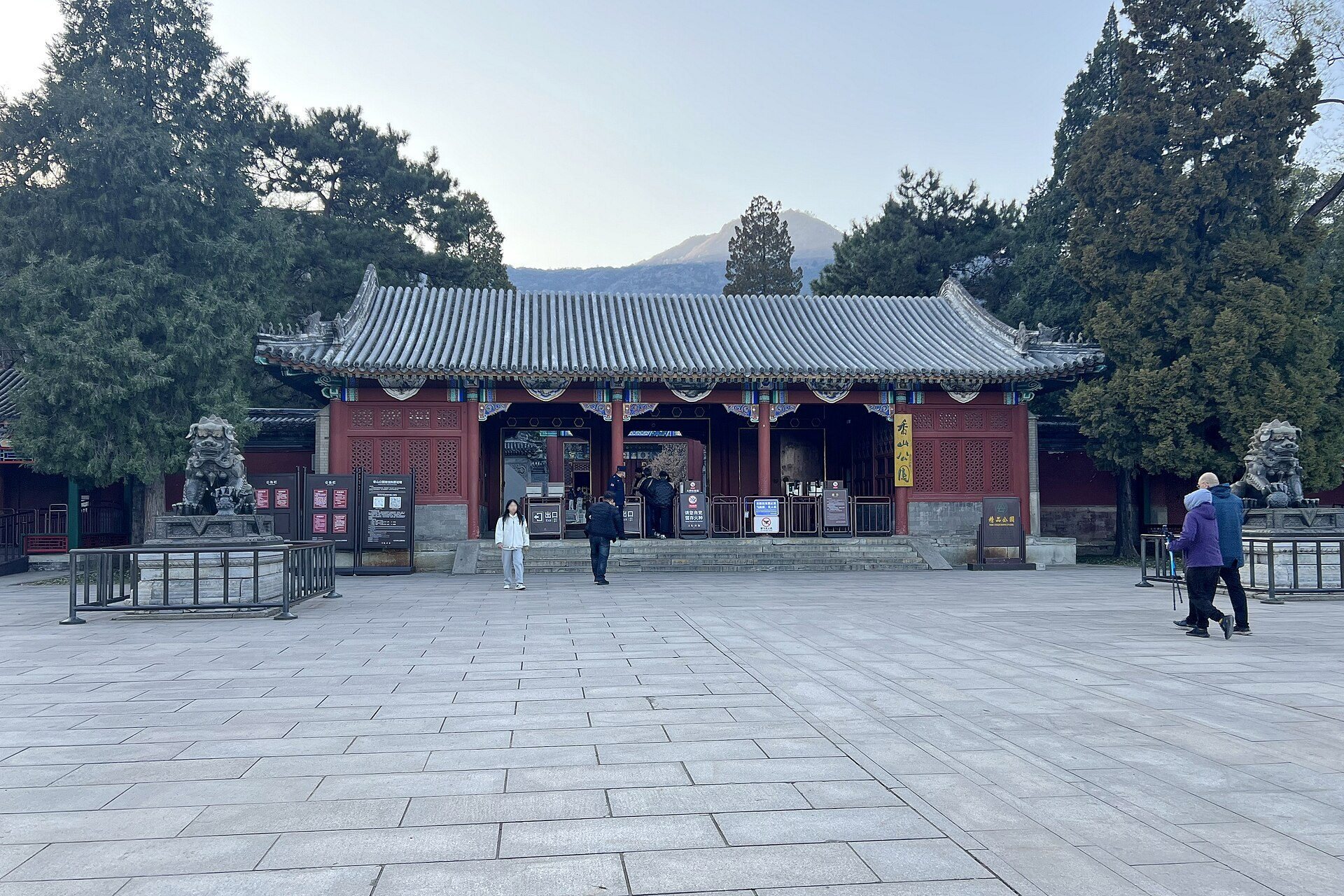
Jingyi Garden opened to the public as Fragrant Hills Park in 1956. Biyun Temple was rebuilt in 1979 and opened as part of the park. Fragrant Hills Park became a Beijing municipal cultural relic protection site in 1984, and its red autumn foliage was included among the Sixteen Views of New Beijing in 1986.
Between 1984 and 2012, six of Jingyi Garden’s twenty-eight scenic views were reconstructed. Reconstruction of Fragrant Temple, the largest of these projects, began in 2012. Other views have remained connected to later buildings or to uncertain original forms, shaping the modern balance between preserved remains, reconstructed features, and later structures.
The Fragrant Hills Revolutionary Memorial Site opened to the public on 13 September 2019. It comprises a memorial hall and revolutionary historic sites, including Shuangqing Villa and Laiqing Studio. Together with the surviving temple complexes, reconstructed garden features, and mountain landscape, these places preserve several distinct periods in the history of Fragrant Hills.
Remains
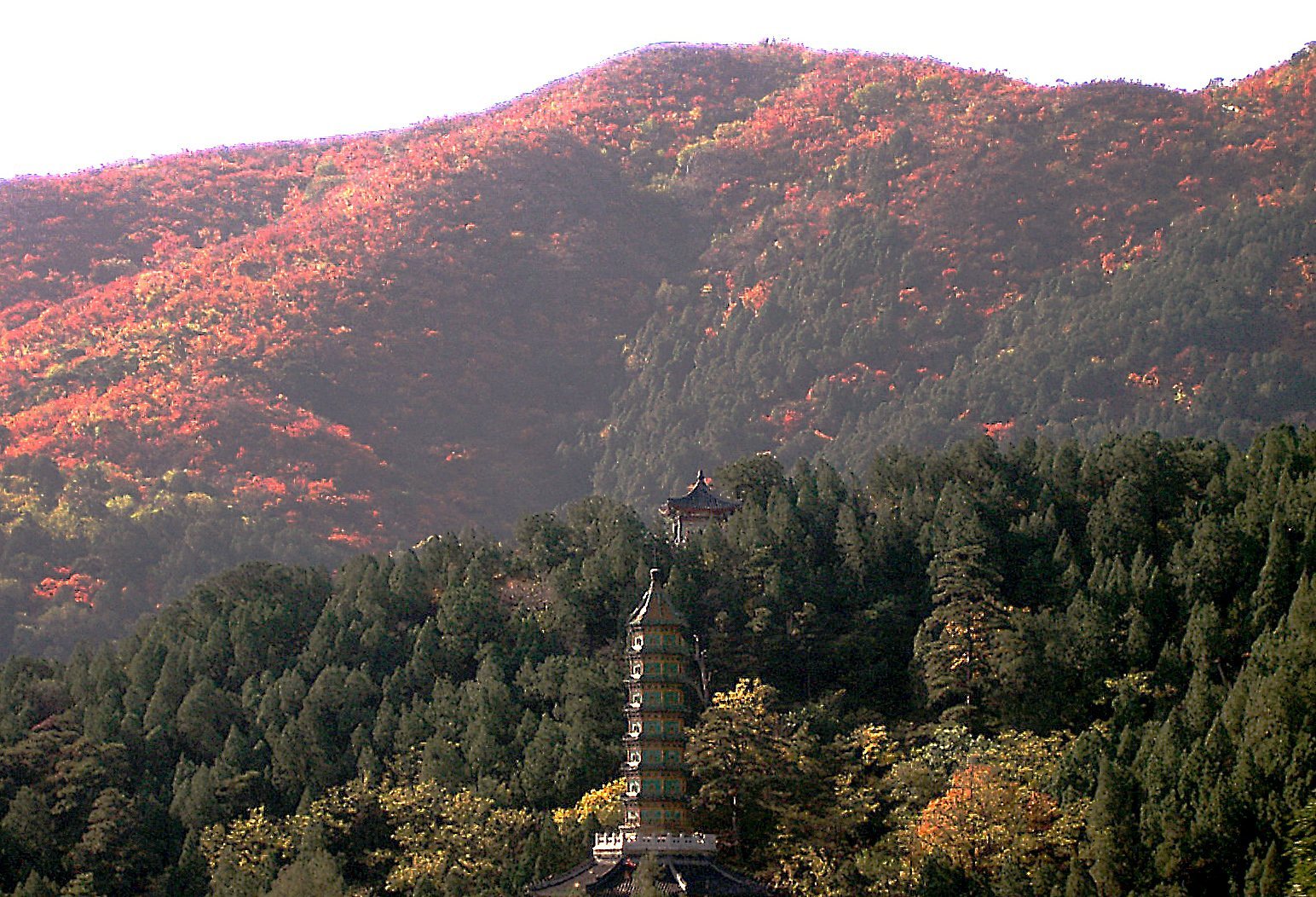
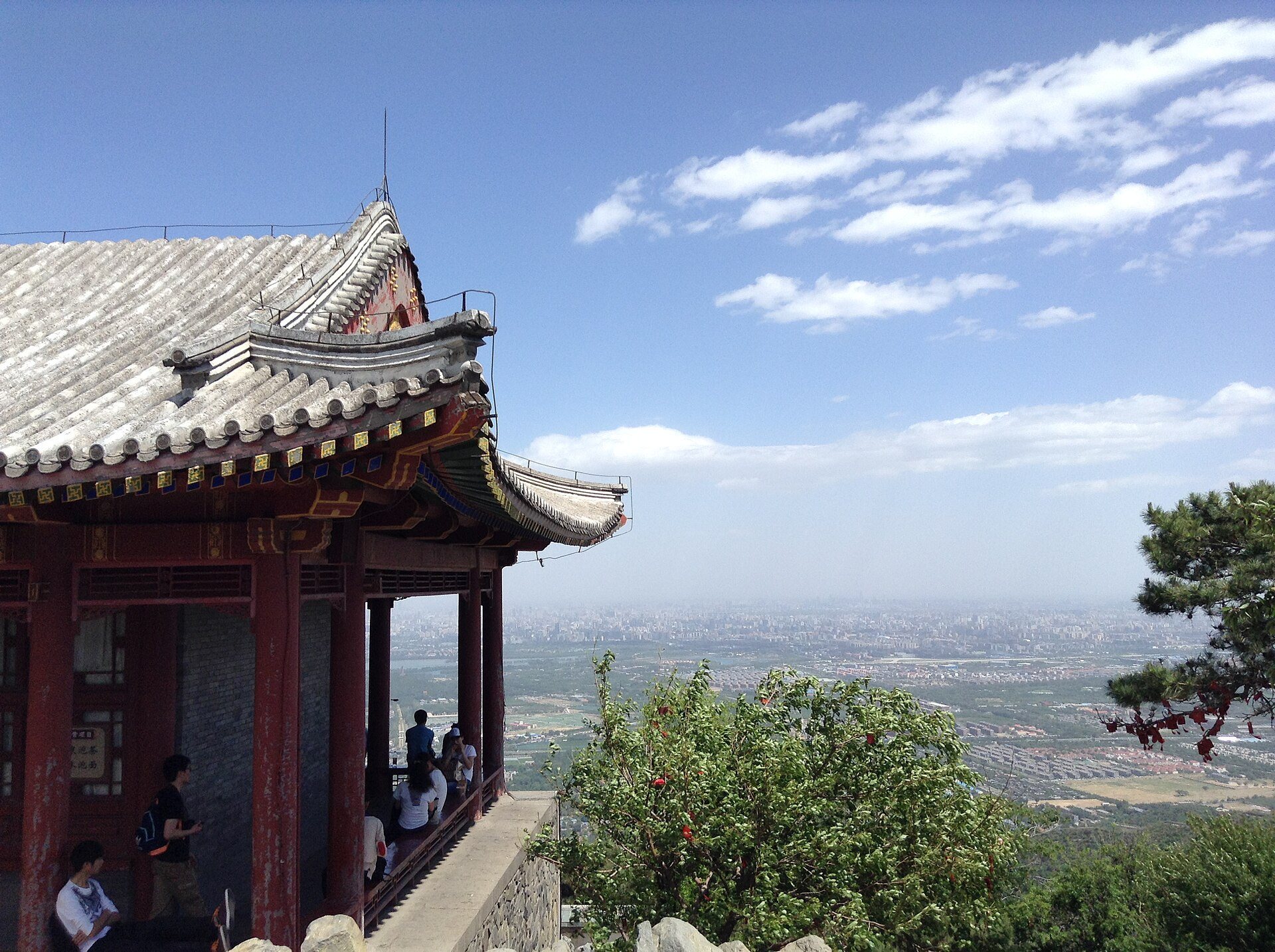
Fragrant Hills occupies a mountainous setting at the foot of the Western Hills. Forest covers about 96 percent of the park. The highest summit, Incense Burner Peak, also called Ghost Sees Sorrow, is generally given as about 575 metres above sea level. Two large stones resembling incense burners are associated with its name. More than 5,800 ancient trees grow across the park, while its autumn foliage includes about 140,000 trees from eight families and fourteen species on roughly 1,400 mu of planted land. Smoke trees form the dominant group, with more than 100,000 trees covering about 1,200 mu.
Jingyi Garden landscape
Garden enclosures and scenic views
Jingyi Garden was arranged in an inner enclosure, an outer enclosure, and a separate enclosure. It contained more than eighty scenic sites and over fifty architectural groups. Twenty-eight views bore inscriptions or poems by the Qianlong Emperor and became known as the Twenty-Eight Views of Jingyi Garden. The separate enclosure contained two additional views, creating a landscape in which buildings, rock formations, water features, and mountain routes were linked by named scenes.
Diligent Governance Hall
Diligent Governance Hall stands in the southeastern part of the former garden. Begun in 1745, it served as the emperor’s audience and government hall. Its complex included a main hall, northern and southern side halls, audience rooms, artificial hills, a moon-shaped watercourse, and a ceremonial archway. The hall was reconstructed in 2002.
Green Cloud Boat and Jewel-Garland Rock
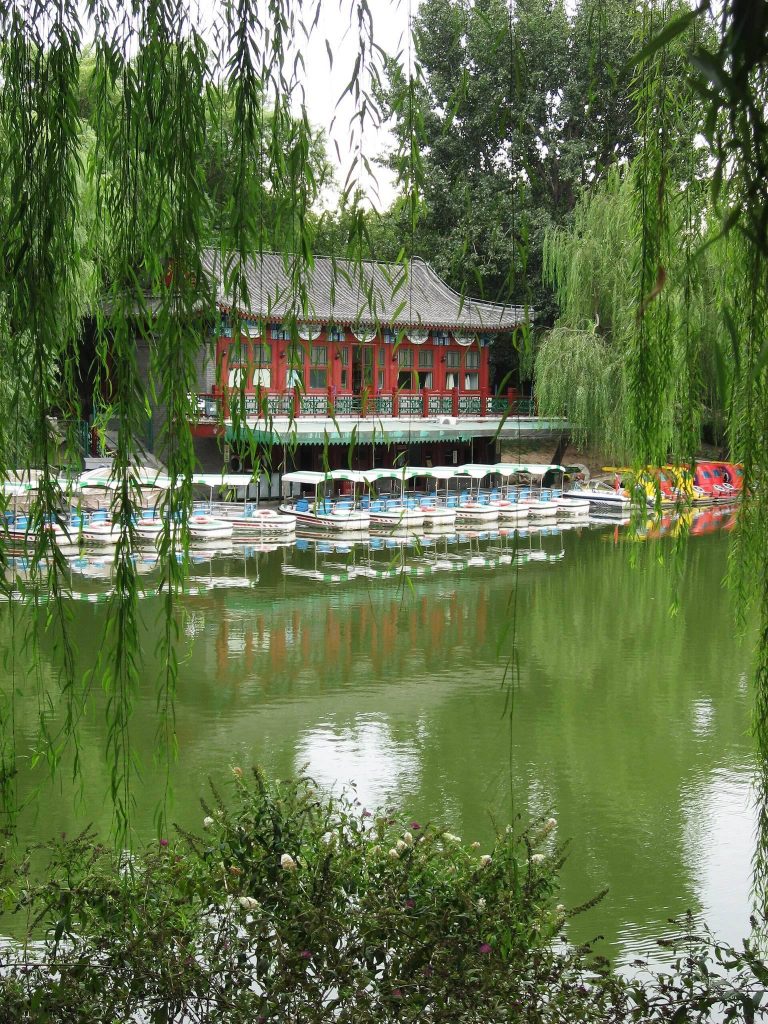
Green Cloud Boat was built in 1745 in imitation of Cloud Sail and Moon Boat at the Mountain Resort of Chengde. British and French forces destroyed it in 1860. Nearby Jewel-Garland Rock is an artificial rockery north of Green-Mist Pavilion, with a pavilion in front of it. The rockery was restored in 1984.
Green-Mist Pavilion and the western scenic views
Green-Mist Pavilion stood southwest of Tranquility Green Lake. It was destroyed in 1860 and converted into a silkworm-breeding room by the Fragrant Hills Charity Children’s Home in 1920. The pavilion was rebuilt in 1991. Green Without End takes its name from a line in a poem by Du Fu, a major poet of the Tang dynasty, while Deer-Taming Slope formed another named scenic view.
Toad Peak, also called Milk Peak Stone, consists of two natural rock pinnacles outside the western wall of the Garden of Joy. Their form was said to resemble a toad. Cloud-Dwelling Tower stood within Shuangqing Villa, while the Knowing Joy Moat lay outside the gate of Fragrant Temple. The moat’s name comes from the dialogue on fish in the Autumn Floods chapter of the Zhuangzi, a foundational text of philosophical Daoism.
Rain-Fragrance Hall and Sunward Alcove
Rain-Fragrance Hall comprised a palace gate, Green-Mist Mountain House, Orchid-Sprinkling Study, Forest-and-Heaven Stone Sea, and Pavilion for Gathering Fine Views. It also contained the Qianlong Emperor’s inscription meaning “Cut Jade.” Sunward Alcove stood northwest of Forest-Jade Tablet and included the Guanyin Pavilion, Moon-Extending Pavilion, and Sunward Cave. Sunward Cave is a natural rock cavity with a Qianlong inscription above its entrance, while eight of his poems were carved on the adjacent cliff.
Forest-Jade Tablet and Cloud-Separating Bell
Forest-Jade Tablet lies southeast of Clear Snow on the Western Hills. It is a smooth rock wall about 15 metres high, named for its resemblance to the tablet carried by an official at court. The Qianlong Emperor’s inscription of the name is carved on the rock. The associated buildings included Transcendent Hall, Broad-View Terrace, Jade-Peak Hall, and Victory Pavilion.
Cloud-Separating Bell was a pavilion on the northeastern peak of Forest-Jade Tablet. It was rebuilt in August 1994 at a high elevation from which bells at Sleeping Buddha Temple, Baosheng Temple, Fahai Temple, and Dajue Temple could be heard. The reconstruction formed one of the six restored views of Jingyi Garden by 2012.
Mountain pavilions and caves
Lotus Terrace consists of three pavilions on the mountainside southwest of the Bright Temple. Fragrant-Mist Grotto, also called the Quiet Room, stood halfway up the mountain within walls and a gatehouse. Its interior included covered walkways, halls, and pavilions. Moon-Resting Rock took its name from a passage in the Commentary on the Water Classic and originally consisted of a three-bay hall. Layered Green Ridge and Autumn-Bright Forest were additional named views.
Jade Flower Cave, south of Hibiscus Hall, included Jade Flower Temple, Jade Flower Cave, the Studio of Gaotu, Moon-Inviting Waterside Pavilion, Ornate-View Pavilion, and Fragrant Overflow Studio. Jade Flower Temple was built in 1444, while the other buildings were added beside it in 1745. Jade Flower Cave was one of the six views reconstructed by 2012.
Temple complexes
Fragrant Temple
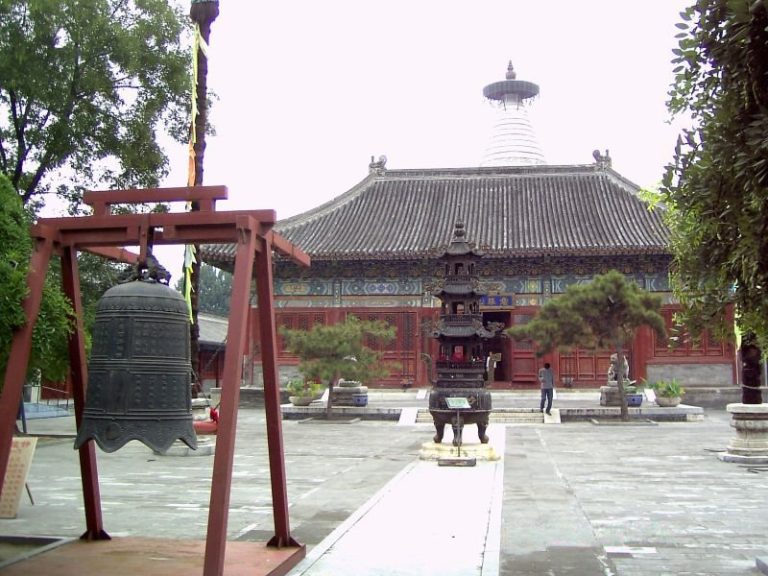
Fragrant Temple is the present Yong’an Temple complex. Listening-to-the-Dharma Pines consists of two white-barked pine trees outside the temple’s western Buddhist hall. Laiqing Studio forms part of the temple’s eastern route. First built during the Ming period, it bears a title written by the Wanli Emperor.
The Knowing Joy Moat lies outside the temple gate, and the six-sided pavilion known as Lishuanggao stood northwest of the complex. Fragrant Stone Chamber was located in Hongguang Temple west of the temple. Zheng Tong, a eunuch originally from Korea, built Hongguang Temple in 1468, and its layout imitated the Thousand Buddhas Around Vairocana arrangement associated with Mount Geumgang in Korea. The temple was destroyed in 1860.
Bright Temple
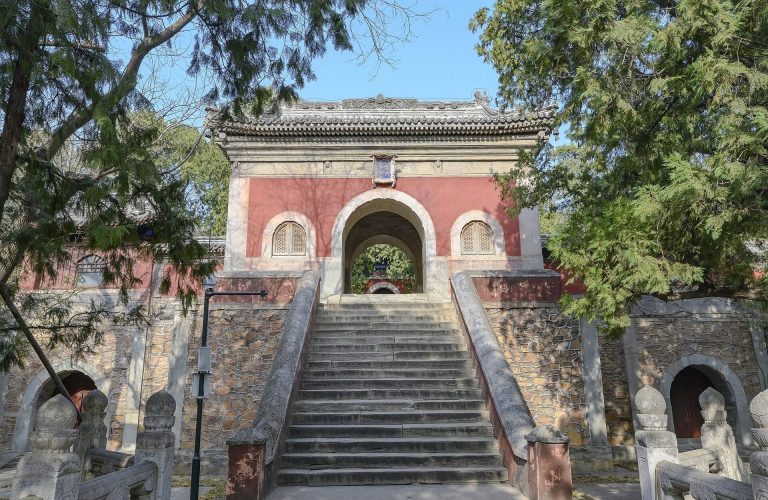
Bright Temple, also called Zhaomiao, is a large Tibetan-style monastic complex in the northern part of the park. It was built in 1780 as a residence for the Sixth Panchen Lama during visits to the Qianlong Emperor. The Panchen Lama is one of the highest-ranking leaders in Tibetan Buddhism. Surviving features include a glazed-tile archway, a terrace, and a glazed-tile pagoda with bells hanging from its eaves.
Biyun Temple
Biyun Temple lies near the northern side of the park, outside the north gate. Its buildings include a Diamond-Throne Pagoda, a stupa form based on a central tower surrounded by smaller towers or shrines. The pagoda serves as Sun Yat-sen’s cenotaph, a commemorative monument for a person whose remains are not necessarily interred there. The complex also includes a Sun Yat-sen Memorial Hall.
Revolutionary and archaeological remains
Shuangqing Villa and Laiqing Studio
Shuangqing Villa was an early headquarters site of the Central Committee of the Chinese Communist Party and was associated with Mao Zedong’s residence. Mao Zedong was a Chinese Communist leader and the founding chairman of the People’s Republic of China. Shuangqing Villa is now part of the Fragrant Hills Revolutionary Memorial Site. Laiqing Studio, with its Ming-period origins and Wanli inscription, forms another preserved part of the eastern route associated with Fragrant Temple.
Yong’an Mausoleum
The park also contains the ruins of the Yong’an Mausoleum, which dates from the Liao period. Its remains add an earlier imperial layer to a landscape later shaped by Jin, Ming, Qing, republican, and twentieth-century political uses.