Temple of Azure Clouds: A Buddhist Temple Complex in Beijing
Site at a Glance
- Rating
- 4.7
- Popularity
- Very Low
- Country
- China
- Primary era
- Early Modern
- Eras represented
- Medieval, Early Modern
- Civilizations
- Unclassified
- Site type
- Religious
- Remains
- Monastery
On this page26 sections
History
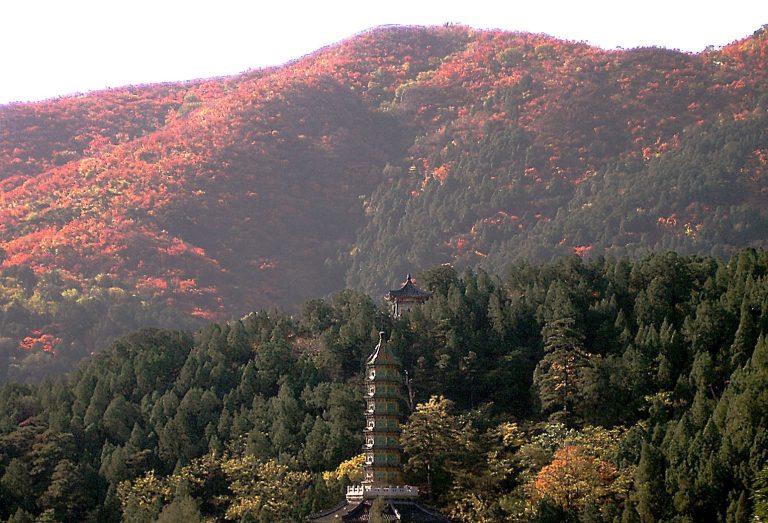
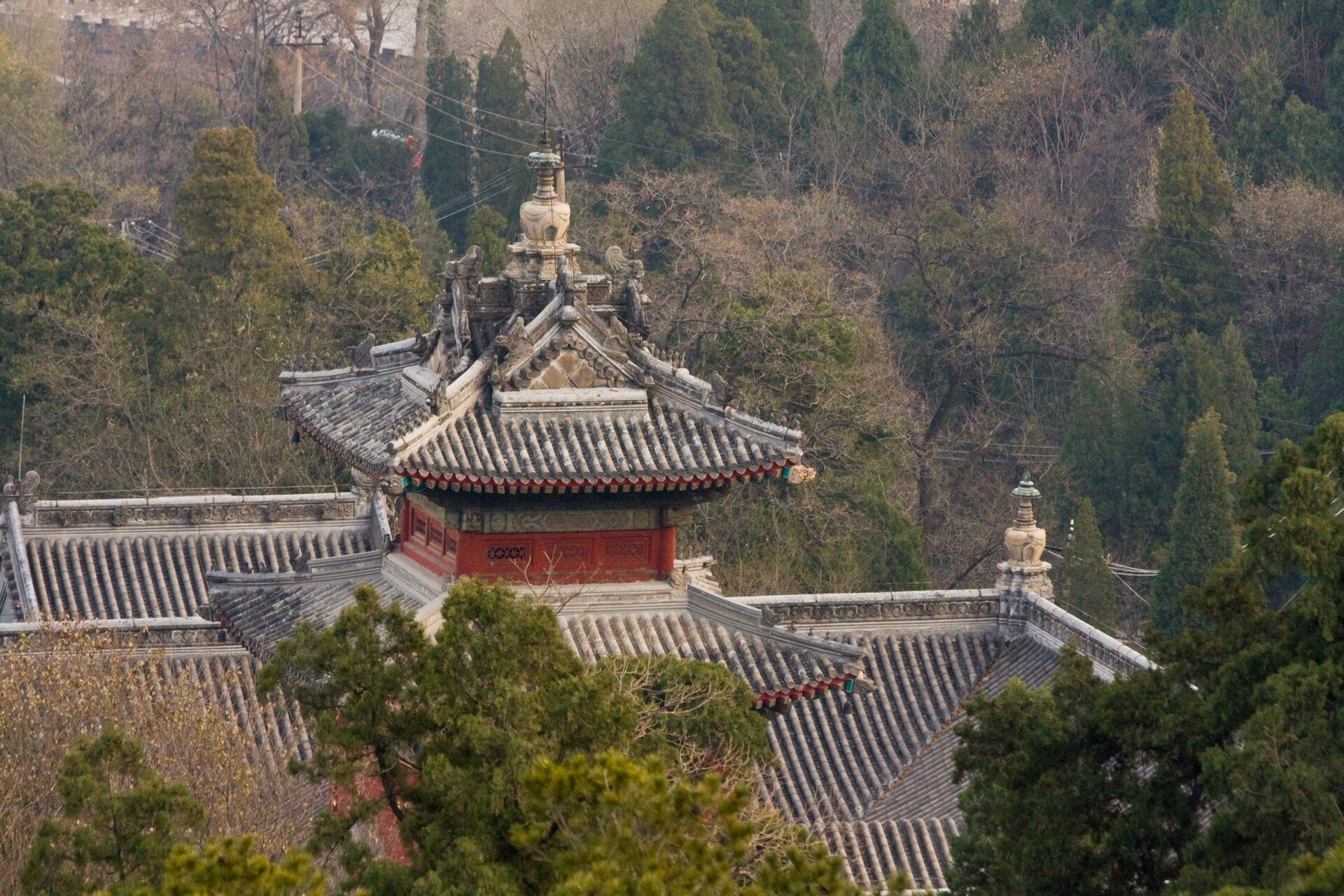
Temple of Azure Clouds, also called Blue Cloud Temple or Biyun Temple, is a Chinese Buddhist temple in Haidian District, Beijing, in the People’s Republic of China. Built in 1331 during the Yuan dynasty, it occupies the eastern foothills of the Western Hills in the northern part of Fragrant Hills Park. Tradition holds that a descendant of the statesman Yelü Chucai donated his residence for conversion into a monastery, then known as Blue Cloud Hermitage.
Yuan and Ming foundations
The temple was enlarged in 1514 when Yu Jing, a Ming eunuch, financed an expansion after judging the location auspicious according to fengshui, the traditional Chinese system for interpreting relationships between buildings, landscape, and directional forces. He also began excavating a burial site in the rear hills. Early in the Jiajing reign, however, Yu Jing was imprisoned for corruption and died there before the burial project could be completed or used.
In 1623, the powerful eunuch Wei Zhongxian financed another expansion and enlarged Yu Jing’s unfinished burial chamber. Wei was disgraced and committed suicide early in the Chongzhen reign. He was later posthumously mutilated. In 1644, his associate Ge Jiusi entered Beijing with Qing forces and buried Wei’s clothing and headgear in the chamber, creating a symbolic tomb.
Qing reconstruction
In 1704, the Qing censor Zhang Yuan initially mistook the burial site for a former imperial tomb. After learning that it was Wei Zhongxian’s symbolic tomb, he submitted a memorial, and the Qing court ordered the tomb demolished that same year.
In 1748, the Qianlong Emperor ordered extensive renovation and expansion on the Ming-period foundations. The Vajrasana Pagoda, Water-Spring Courtyard, Arhats Hall, and other buildings were added during this work, giving the complex much of its present scale. The following year, the Qianlong Imperial Stele Pavilion for the Reconstruction of the Temple was built to commemorate the rebuilding.
Sun Yat-sen and twentieth-century history
After the revolutionary leader Sun Yat-sen died in Beijing in March 1925, his coffin lay at the temple while Buddhist rites were performed. His body was moved to Nanjing in 1929 after the completion of the Sun Yat-sen Mausoleum. His clothing and headgear were then interred beneath the Vajrasana Pagoda as a symbolic tomb. A public memorial ceremony took place in the former Universal Illumination and Wondrous Awakening Hall from 23 to 25 May 1929.
In November 1925, more than ten Kuomintang members opposed to alliance with the Soviet Union and cooperation with the Chinese Communist Party held the Xishan Conference at the temple. The meeting took place in the Contentment with Greenery Studio.
During the 1950s, the temple served as a convalescent facility for the China Federation of Literary and Art Circles. Writers and scholars including Feng Zhi, Zhu Guangqian, Chang Renxia, and Zhong Jingwen took part in a study tour of northwest China in 1956. Zhong Jingwen later stayed at the temple and wrote essays partly based on that experience, including Autumn Colors at the Temple of Azure Clouds.
Protection, damage, and continued use
Temple of Azure Clouds became a Beijing municipal cultural-protection site in 1957. It suffered extensive damage during the Cultural Revolution and closed in 1971. After reopening in 1979, it was repaired to restore its earlier appearance. The temple became a nationally protected major historical and cultural site in 2001.
Repairs near the Vajrasana Pagoda in September 2005 revealed two stone human figures and a pair of tomb guardians. They were identified as remains of Wei Zhongxian’s burial complex. In early 2013, the tomb guardians were stolen after the rear gate had been forced open, while the two human figures remained in place. The temple continues to function as an active Buddhist institution and contains a memorial complex devoted to Sun Yat-sen.
Remains
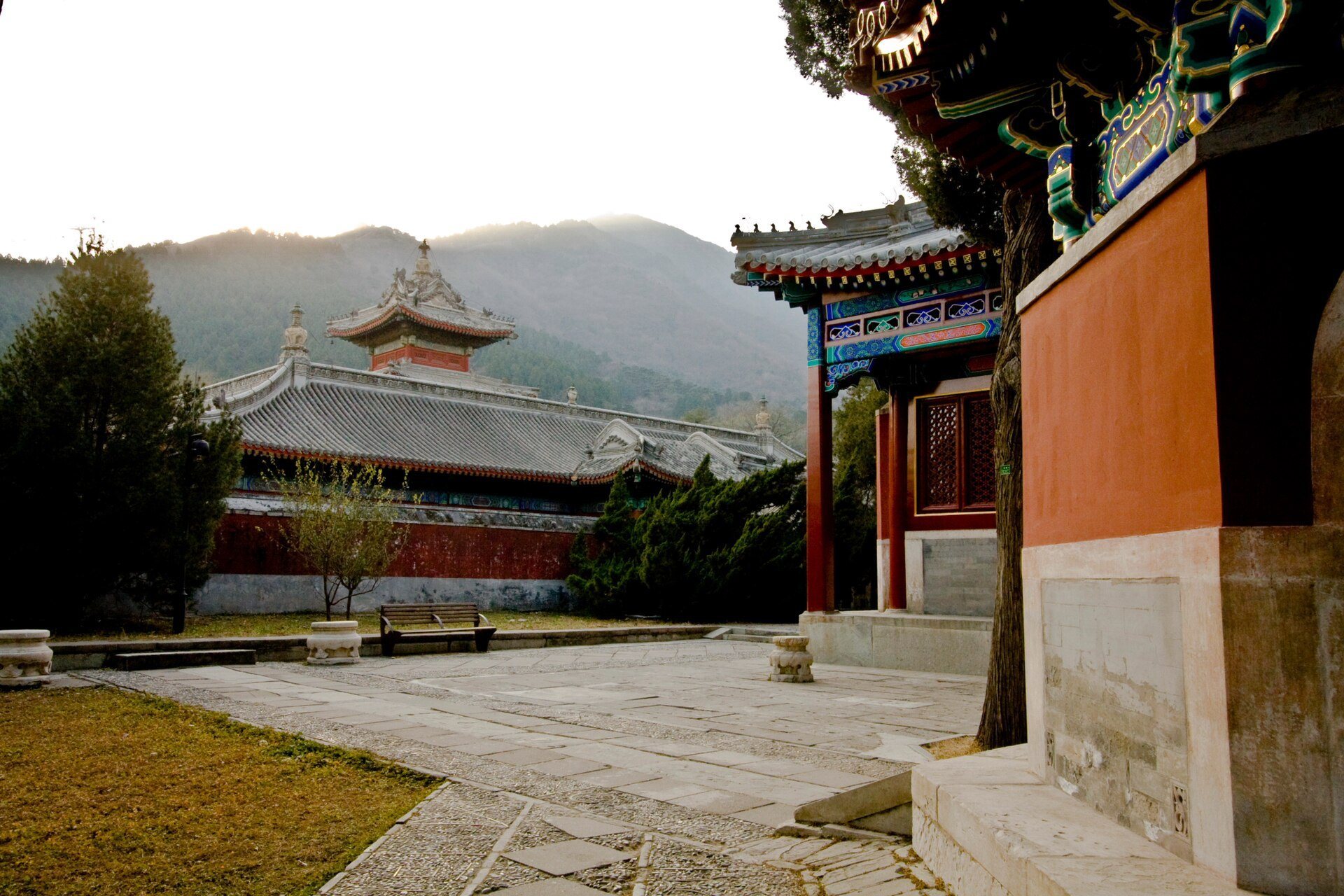
The temple occupies more than 40,000 square meters on a rising slope. Its principal axis runs from southeast to northwest, and the complex faces east. Six successive courtyards are arranged on ascending terraces, with subsidiary courtyard groups to the north and south. The entrance is in the northern part of Fragrant Hills Park, just inside the northern gate. A surrounding wall contains the south-facing entrance, while a watercourse and stone bridge lie below the outer gate.
Gates and principal halls
Outer and Inner Mountain Gates
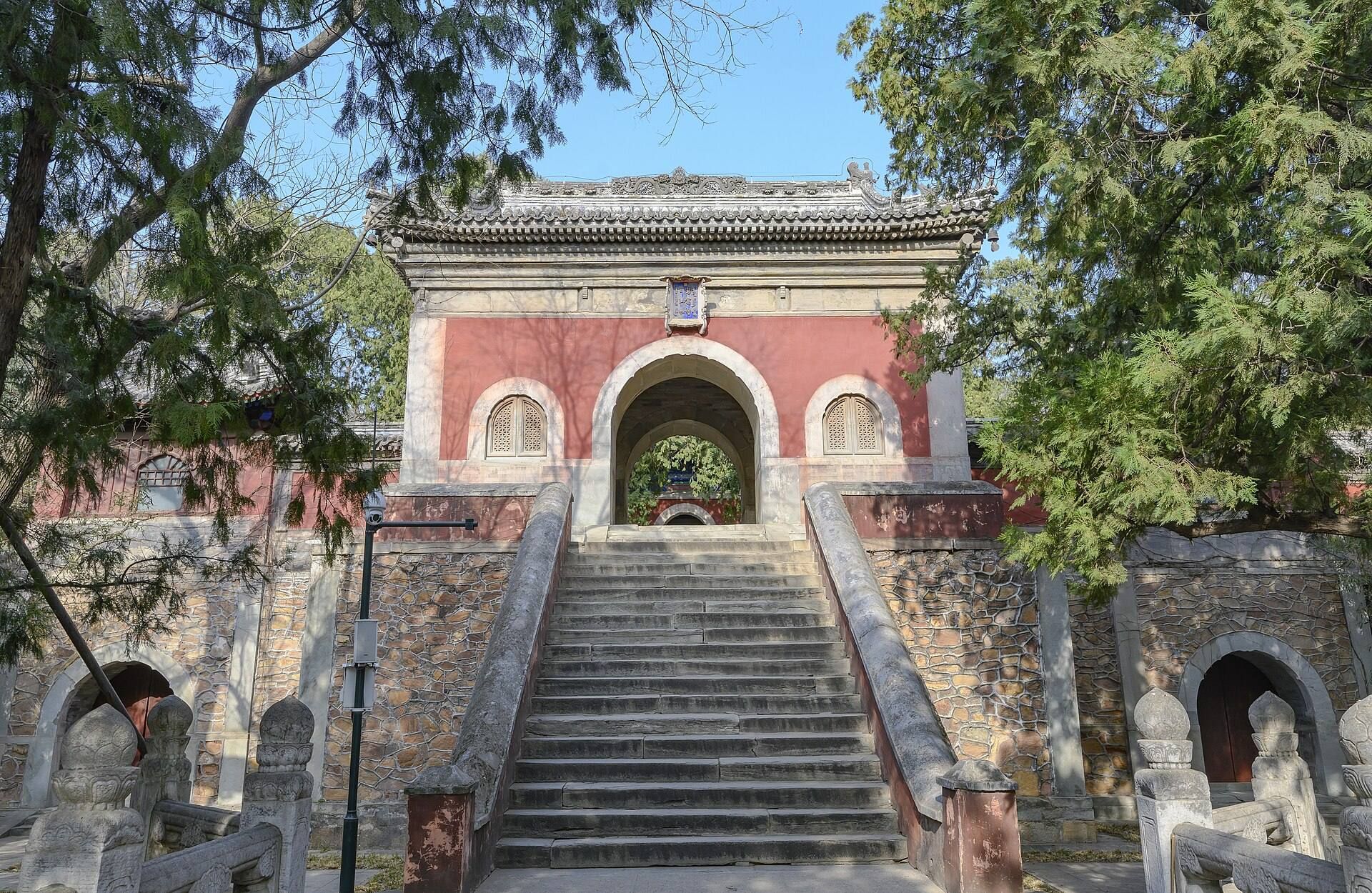
Two finely carved stone lions, reportedly dating from the Ming period, stand before the bridge. The Outer Mountain Gate is three bays wide, with an arched entrance in the central bay and arched side windows filled with three-interlaced, six-bowled diamond lattice. Above it, a blue-and-gold signboard gives the temple name in Manchu, Chinese, Tibetan, and Mongolian. Two two-storey buildings flank the gate, each with arched openings on its southern side.
The Inner Mountain Gate Hall is a Ming-period, three-bay building with a single-eaved hip-and-gable roof covered in gray tiles. Its painted decoration includes whorl-pattern polychrome work, and curling-cloud motifs frame the arched openings. Two clay guardian warriors inside were destroyed during the Cultural Revolution and remade in 1992. Each is 4.8 meters high and carries a vajra, a diamond or thunderbolt-shaped Buddhist ritual object. One represents the closed-mouthed Heng guardian and the other the open-mouthed Ha guardian. Small single-eaved side gates flank the hall.
Maitreya Hall
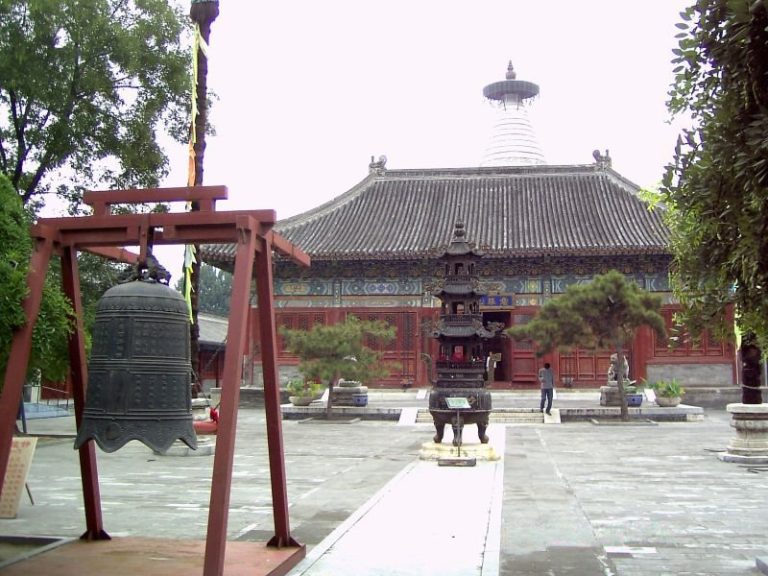
The Maitreya Hall, also called the Hall of the Heavenly Kings, is a Ming-period, three-bay building with a single-eaved hip-and-gable roof and exposed columns. Its central image is a 2.5-meter-high bronze Maitreya in the form of the cloth-bag monk. Maitreya is the future Buddha, and this image type is associated with the Five Dynasties period, although the sculpture here was made during the Ming period. The former images of the Four Heavenly Kings, Buddhist guardians of the four directions, were destroyed during the Beiyang government period. A two-storey Bell Tower and Drum Tower stand on opposite sides of the hall’s forecourt.
Great Hero Hall
The Great Hero Hall, also called the Hall of Benevolent Still Illumination, is a Ming-period, three-bay structure with lattice doors and windows. Its interior arrangement was restored in 1995. A preaching image of Shakyamuni Buddha stands at the center, with Ananda and Kasyapa beside him, while Manjushri and Samantabhadra face inward. Eighteen Arhat images, representing Buddhist saints who have achieved spiritual liberation, and mountain-and-cloud scenes occupy the sides. The scenes include figures from Journey to the West. A sculpture of Guanyin on an island is attached to the rear of the central Buddha image and faces north, with Sudhana and the Dragon Girl beside it.
Two six-sided sutra pillars stand before the hall. Between the Maitreya Hall and the Great Hero Hall lies a liberation pond crossed by a balustraded stone bridge.
Qianlong Imperial Stele Pavilion
The Qianlong Imperial Stele Pavilion for the Reconstruction of the Temple was built in 1749. It has an octagonal, double-eaved pyramidal roof with yellow glazed tiles, bracket sets beneath the eaves, and red walls and columns. Its painted decoration includes a double dragon and pearl design. The stele rests on a tortoise pedestal and records the temple’s history and scale in Manchu and Chinese. Intertwined-lotus carvings decorate its sides. A ceremonial stone on the approach bears phoenix, crane, and bat designs.
Bodhisattva Hall
The Bodhisattva Hall, also called the Hall of Quietly Expounding the Three Vehicles, is a Ming-period, five-bay building. Its central three bays have lattice doors, while the outer bays contain lattice windows with three-interlaced, six-bowled diamond patterns. Red-painted surfaces carry happily meeting whorl decoration, curling-vine brackets, and a covered gallery supported by square columns.
The five present bodhisattva images were remade in 1995. From left to right, they represent Mahasthamaprapta riding a qilin, Manjushri riding a blue lion, Guanyin riding a chaotianhou guardian beast, Samantabhadra riding a white elephant, and Ksitigarbha riding the divine beast Diting. Images of the Twenty-Four Devas, protective deities associated with Buddhist temple decoration, stand with figures from Buddhist narratives at the sides.
Memorial and meditation courtyards
Sun Yat-sen Memorial Hall
The Sun Yat-sen Memorial Hall occupies the former Universal Illumination and Wondrous Awakening Hall at the center of the complex. The building underwent major repairs in 1954 and was then renamed. Song Qingling, Sun Yat-sen’s wife and a major twentieth-century political figure, wrote the name on its red-and-gold signboard.
A bust of Sun Yat-sen stands in the main hall, with white-marble panels reproducing his testament to the Soviet Union. On the right is a glass-covered steel coffin sent by the Soviet government on 30 March 1925. It was never used because Sun had already been placed in a coffin. His writings and calligraphy are displayed on the left.
Gallery rooms and side buildings connected to the hall contain the exhibition Sun Yat-sen and the Temple of Azure Clouds. Its six sections cover Sun’s education, revolutionary activity, overthrow of the monarchy, establishment of the republic, opposition to Yuan Shikai and defense of constitutional government, and later political turning point. A former mourning-rest room used by Song Qingling occupies the northern side building.
Meditation Hall Courtyard
The Meditation Hall Courtyard lies south of the Great Hero Hall’s forecourt. Its square entrance opens through the courtyard wall, and the complex contains a main building and side rooms. During the Ming and Qing periods, monks used the courtyard for seated meditation and lessons. It reopened in 2006 for a historical exhibition on the Western Hills.
Arhats Hall
The Arhats Hall was built in 1748 in imitation of Jingci Temple in Hangzhou. It lies in the southern cross-courtyard of the Sun Yat-sen Memorial Hall and follows a plan resembling the Chinese character for a field, with nine rooms on each side and four small courtyards at the center.
The hall contains 500 wooden, gilt Arhat statues, each about 1.5 meters high, with varied poses and expressions. A central group represents the Three Buddhas of the Three Worlds, while figures stand at the four entrances. A statue of the eccentric monk Jigong crouches on a roof beam. Tradition identifies the 295th and 360th Arhats with the Kangxi and Qianlong emperors. A projecting front structure contains the Four Heavenly Kings.
Contentment with Greenery Studio
The Contentment with Greenery Studio, originally called the Studio of Containing Greenery, was built in 1748 north of the Great Hero Hall. It served as a resting place for emperors and ministers and formed the second group of imperial retreat buildings. Its two courtyards contain a three-bay front hall, a five-bay rear hall, rockwork, and a pond known for its refined landscape.
Water-Spring Courtyard
Courtyard landscape
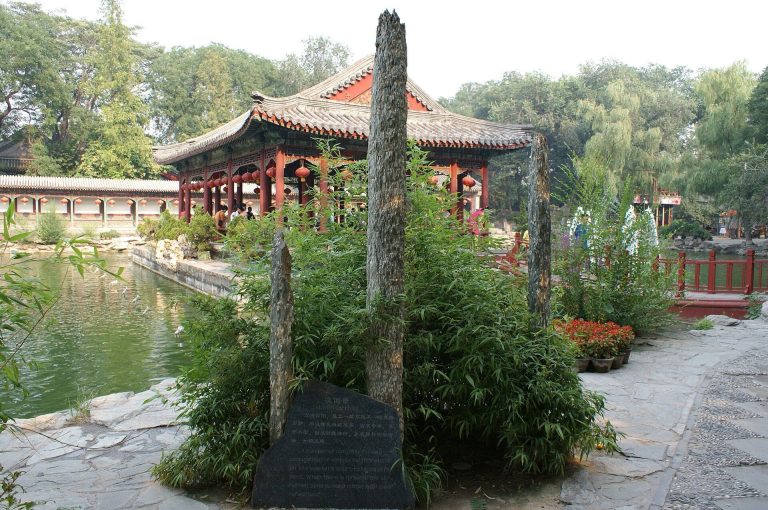
The Water-Spring Courtyard lies below the stone steps north of the Sun Yat-sen Memorial Hall. Dense pine and cypress grow among a stone bridge, raised stone platform, ponds, rockeries, pavilions, caves, and surviving foundations. A third-generation gingko growing from the center of two dead earlier cypresses is known as the Three Generations Tree. The Cleansing-Heart Pavilion, rebuilt in the 1980s, stands on a rockery south of the bridge.
Three Immortals Cave and surrounding remains
The Three Immortals Cave lies west of the Cleansing-Heart Pavilion below a cliff beside a pond. One cave contains two subsidiary caves and images of three immortals. An outer gallery pavilion bears a sign meaning “Pure Heart.” The Hall Surrounded by Water, once the principal building west of the bridge, survives as a foundation. An unnamed building in front of the pond below the small temple likewise survives as a foundation.
Water-Listening Spring
The Water-Listening Spring, also called the Zhuoxi Spring, emerges audibly through a fissure in the southern rock wall. It was formerly an imperial place for appreciating water and was already famous in Beijing during the Ming period. A small temple stands on the westernmost rockery above a pond.
Vajrasana Pagoda and tower courtyard
Approach to the pagoda
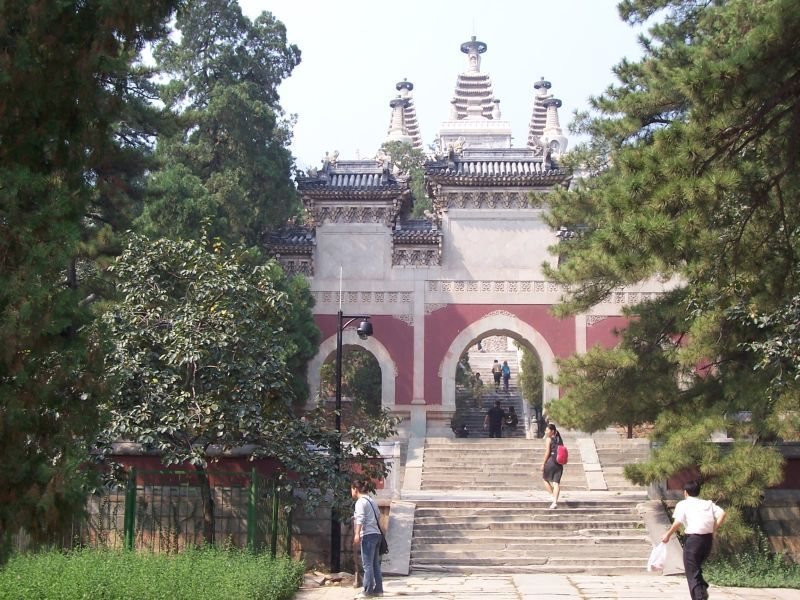
The Tower Courtyard occupies the westernmost and highest part of the central axis. West of the Sun Yat-sen Memorial Hall, a single-bay wooden gateway has golden dragon imperial painted decoration, drum-shaped foundation stones, and two brick screen walls. Behind it stands a white-marble gateway with four pillars and three bays. Its simulated wooden hip-and-gable roof carries flying-crane and coiling-dragon carvings, while an inscription identifies the site as the Pure Land of the West and the sanctuary of Amitabha Buddha.
Four stone screen walls beside the gateway carry lions, qilins, the Eight Immortals, and reliefs of eight historical figures associated with loyalty, filial piety, integrity, and moral principle. A stone bridge crosses the watercourse behind the marble gateway. Beyond it are two octagonal, double-eaved imperial stele pavilions built in 1748. Their domed ceilings have dragon-head caissons, or decorated recessed ceilings. The inscriptions explain the origin of the Vajrasana Pagoda, with Manchu and Mongolian texts in the left pavilion and Chinese and Tibetan texts in the right.
A three-bay, seven-roof brick gateway stands behind the stele pavilions. It has three arched openings, plain arch faces and beams, and a pair of stone lions before it.
Vajrasana Pagoda
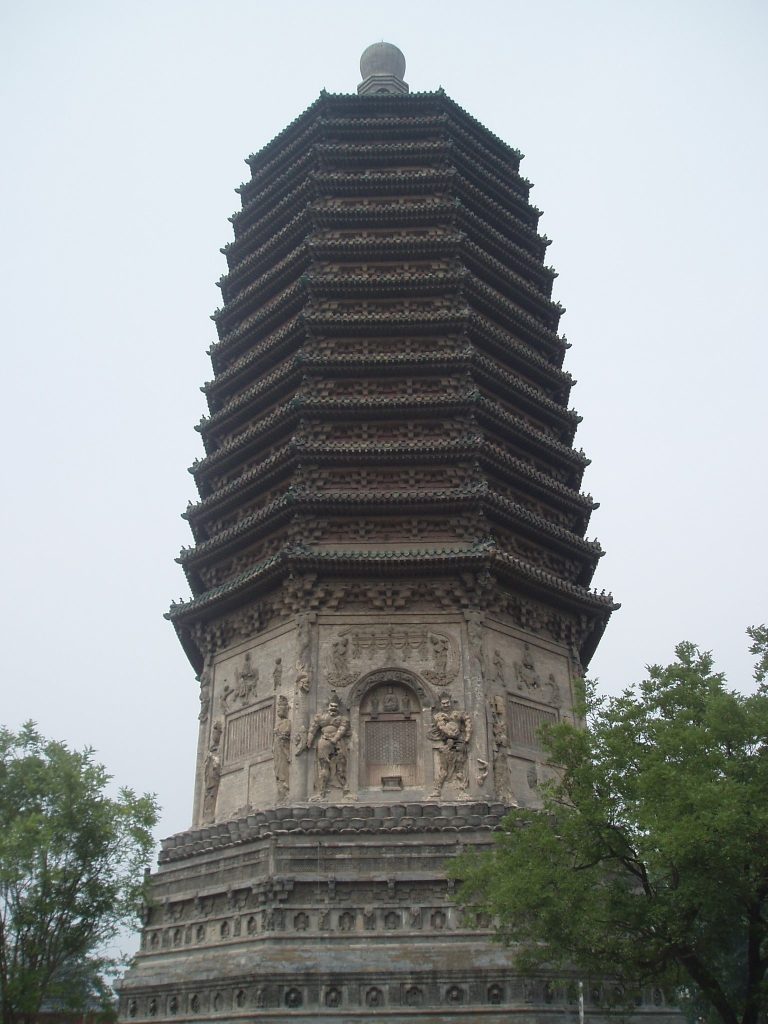
The Vajrasana Pagoda rises 34.7 meters and is described as the tallest and largest surviving pagoda of its type in China. A Vajrasana Pagoda is a Buddhist tower based on the diamond throne traditionally associated with the Buddha’s enlightenment. The structure resembles the Vajrasana Pagoda of the Temple of True Awakening but is larger.
Its five-tiered base is decorated with Maitreya and heavenly kings, dragons, phoenixes, clouds, lions, and elephants. The eastern arched entrance bears the Qianlong inscription “The Lamp Is in Bodhi.” Beneath a stone niche in the entrance passage is the symbolic tomb of Sun Yat-sen, whose clothing and headgear were sealed in a nanmu coffin. Recessed sections on the southern and northern sides of the base contain images of the Medicine Buddha, who is associated with healing.
Stairways beside the entrance lead to the upper platform and a square white-marble canopy pavilion. Its eastern arched opening contains a stone offering table and bears the inscription “Manifest Relic Light.” High-relief western-region intertwined flowers decorate the doorway. A stupa-shaped tower rises at the center of the pavilion roof, while four white-marble bell-shaped stupas stand at the corners, forming a miniature vajrasana composition described as unique in China.
Upper towers and ancient trees
Behind the canopy pavilion stand five square, thirteen-storey, dense-eaved towers. The central tower is the largest. Each face contains three tiers of Buddha niches with high-relief images of Buddhas, bodhisattvas, and Arhats. Their roofs imitate timber construction and formerly carried bronze bells, while lions and qilins decorate the corners. Two additional bell-shaped stupas stand on the eastern sides of the pavilion. Their faces bear seated Buddhas, and their finials have openwork Daoist trigrams.
A cypress rooted on the tower platform divides into nine branches behind the central tower and is known as the Nine-Dragon Cypress. It was designated a first-grade ancient tree in 1988. A memorial stele with a portrait of Sun Yat-sen was moved to the open ground before the pagoda in 1983. A Chinese white pine was planted there in 2006 during a visit commemorating Sun Yat-sen’s symbolic tomb.
Wei Zhongxian’s burial remains
Above the cliff south of the Water-Spring Courtyard and not far north of the Vajrasana Pagoda are two life-sized white-marble human figures, each about 3 meters high including its base. One represents a civil official and the other a military official. They were excavated with two tomb guardians during repairs in 2005 and formed part of the burial complex associated with Wei Zhongxian. The tomb guardians were later stolen.