Zhenjue Temple: A Buddhist Temple and Five-Pagoda Monument in Beijing
Site at a Glance
- Rating
- 4.8
- Popularity
- Low
- Country
- China
- Primary era
- Medieval
- Eras represented
- Medieval
- Civilizations
- Ming
- Site type
- Religious
- Remains
- Pagoda
On this page8 sections
History
Zhenjue Temple, also known as the Five Pagoda Temple and formally named the Temple of the Great Righteous Awakening, is a Buddhist temple in Beijing, China. It is associated with Chan Buddhism, a Chinese school of Buddhism that emphasizes meditation, and was built in 1473 during the Ming dynasty.
Tradition and construction
A tradition links the Diamond Throne Tower’s design to the Indian monk Sariputra. He is said to have presented the design at the court of the Yongle Emperor in the early fifteenth century and brought five golden Buddha statues for the temple. A legend places one statue beneath each pagoda. How the design reached China remains uncertain.
Construction was postponed until the reign of the Chenghua Emperor, another Ming ruler. Similar forms appear in a mural at Dunhuang dating to the Northern Dynasties, successive regimes that ruled northern China before the Sui dynasty, about a millennium earlier.
Ming and Qing periods
During the Ming dynasty, the temple grounds included six wooden halls as well as the stone pagoda structure. In 1761, under the Qing dynasty, which followed the Ming, the halls were renovated and covered with yellow tiles.
Fires and later use
Fire damaged the temple in 1860 during the Second Opium War, a conflict between China and foreign powers. In 1900, another fire occurred as the Eight-Nation Alliance intervened to suppress the Boxer Rebellion, an anti-foreign and anti-Christian uprising in China. The wooden halls burned down, while the stone five-pagoda structure survived.
Recognized as a national monument since 1961, Zhenjue Temple remains an active Buddhist temple and houses the Beijing Art Museum of Stone Carvings.
Remains
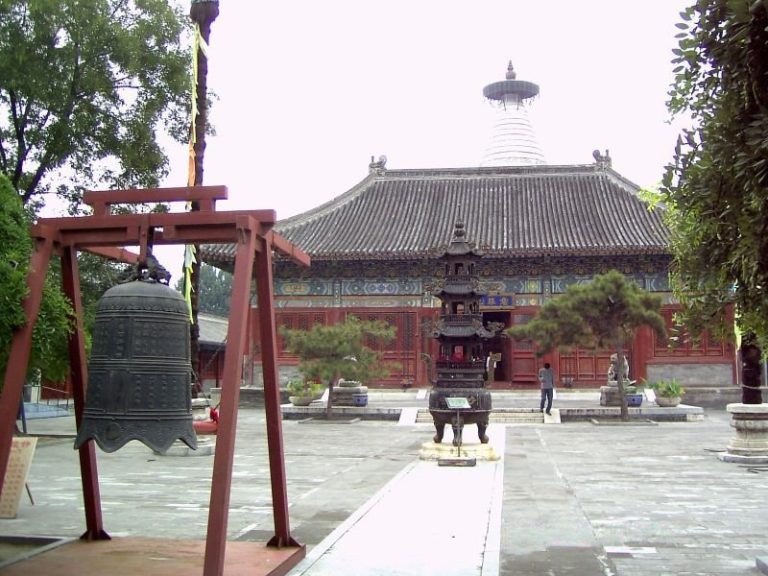
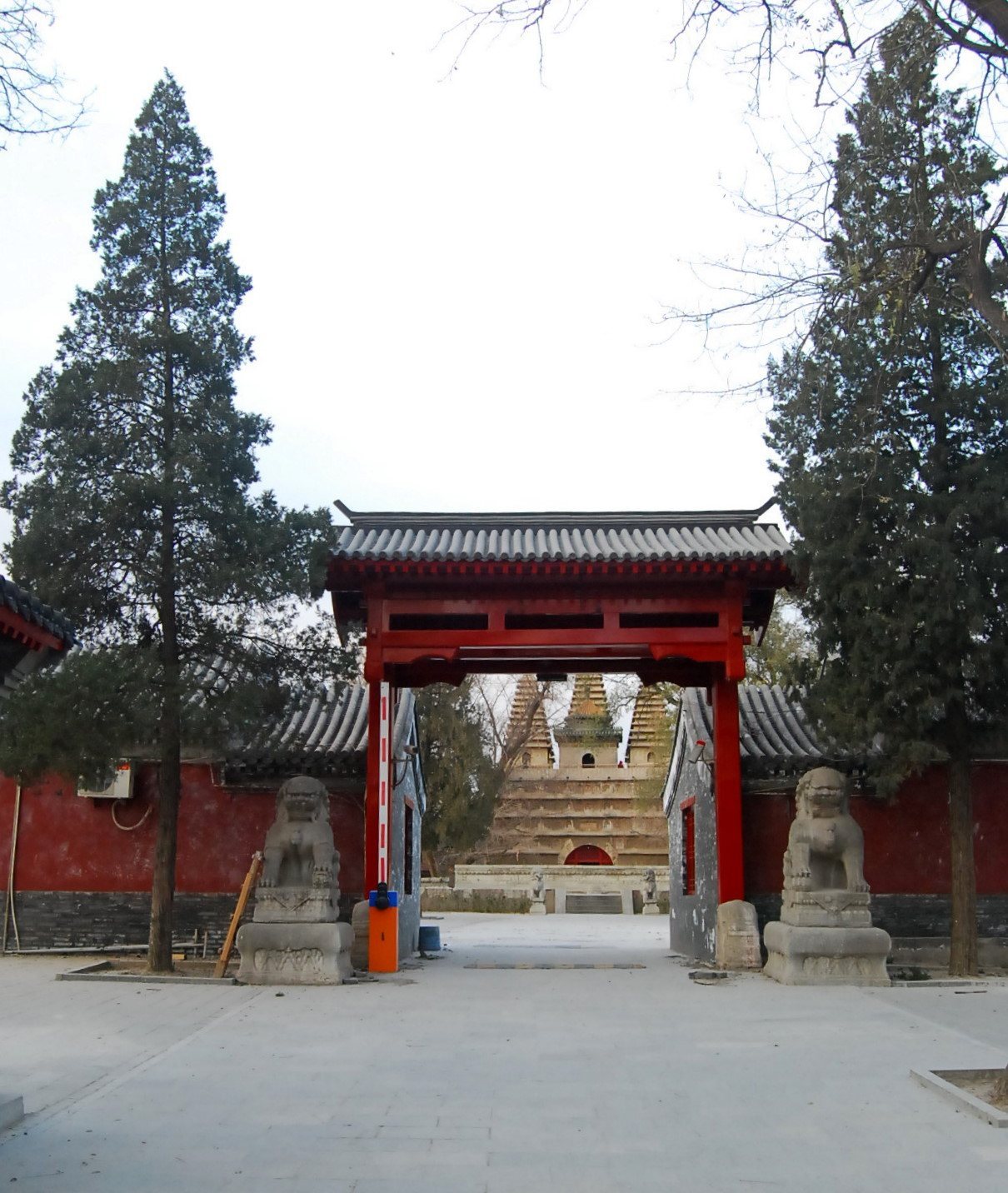
The surviving layout includes the main temple gate and the brick-and-white-marble Diamond Throne Tower behind it. The site is on the bank of the Changhe in Beijing’s Haidian District, northwest of the Beijing Zoo. A pedestal that once supported the Big Treasure Hall also remains.
Diamond Throne Tower
Platform and pagodas
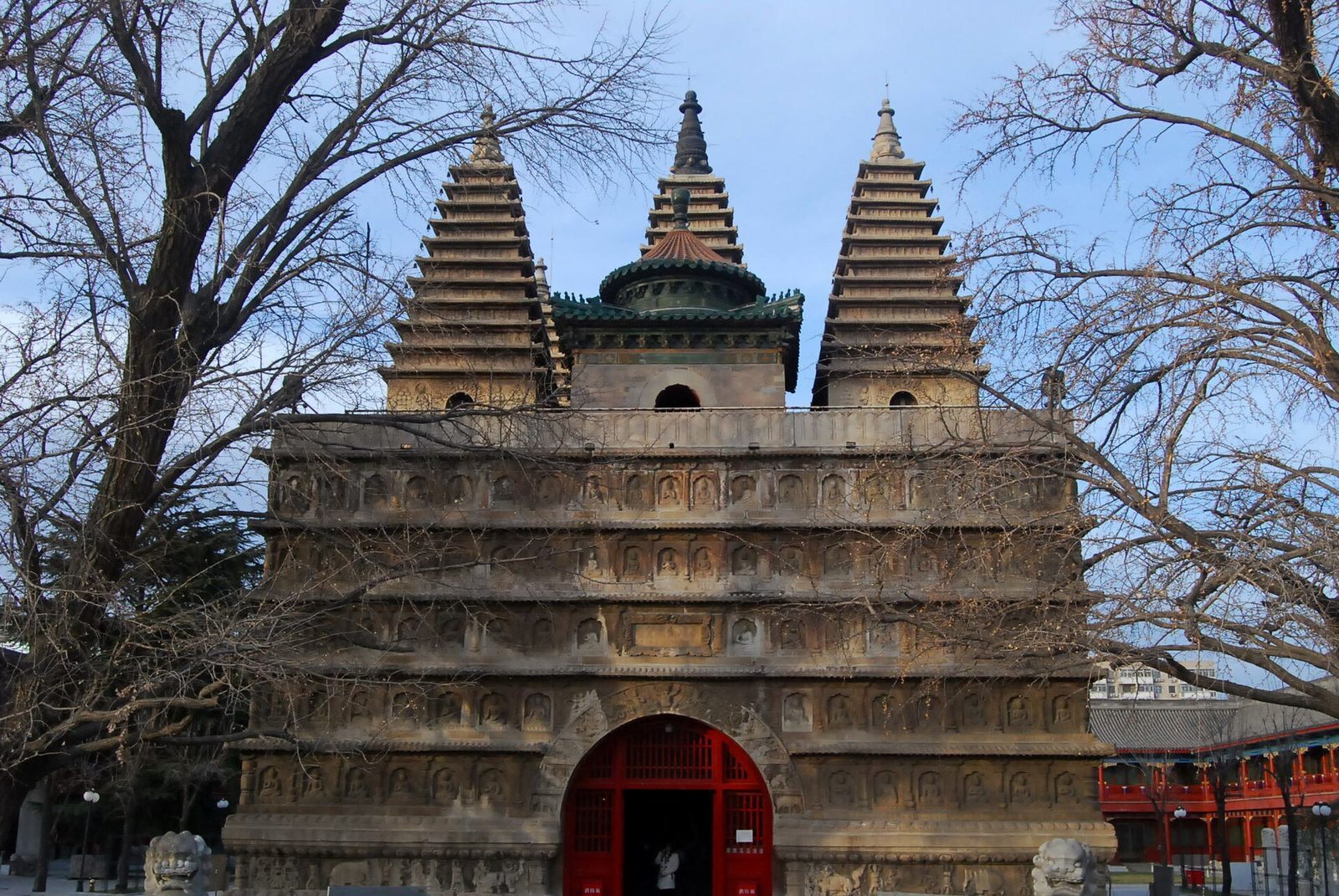
The tower stands on a square base 7.7 metres high, reached by a spiral staircase. A glazed pavilion and five pagodas occupy the platform. Each pagoda has a rectangular plan, with one at each corner and one in the center. The corner pagodas have 11 tiers of eaves; the central one has 13 and rises slightly higher. From the base to the central pagoda’s tip, the structure measures 17 metres. The five pagodas are associated with the Five Dhyani Buddhas, a group of five Buddhas in Buddhist cosmology.
Carved base
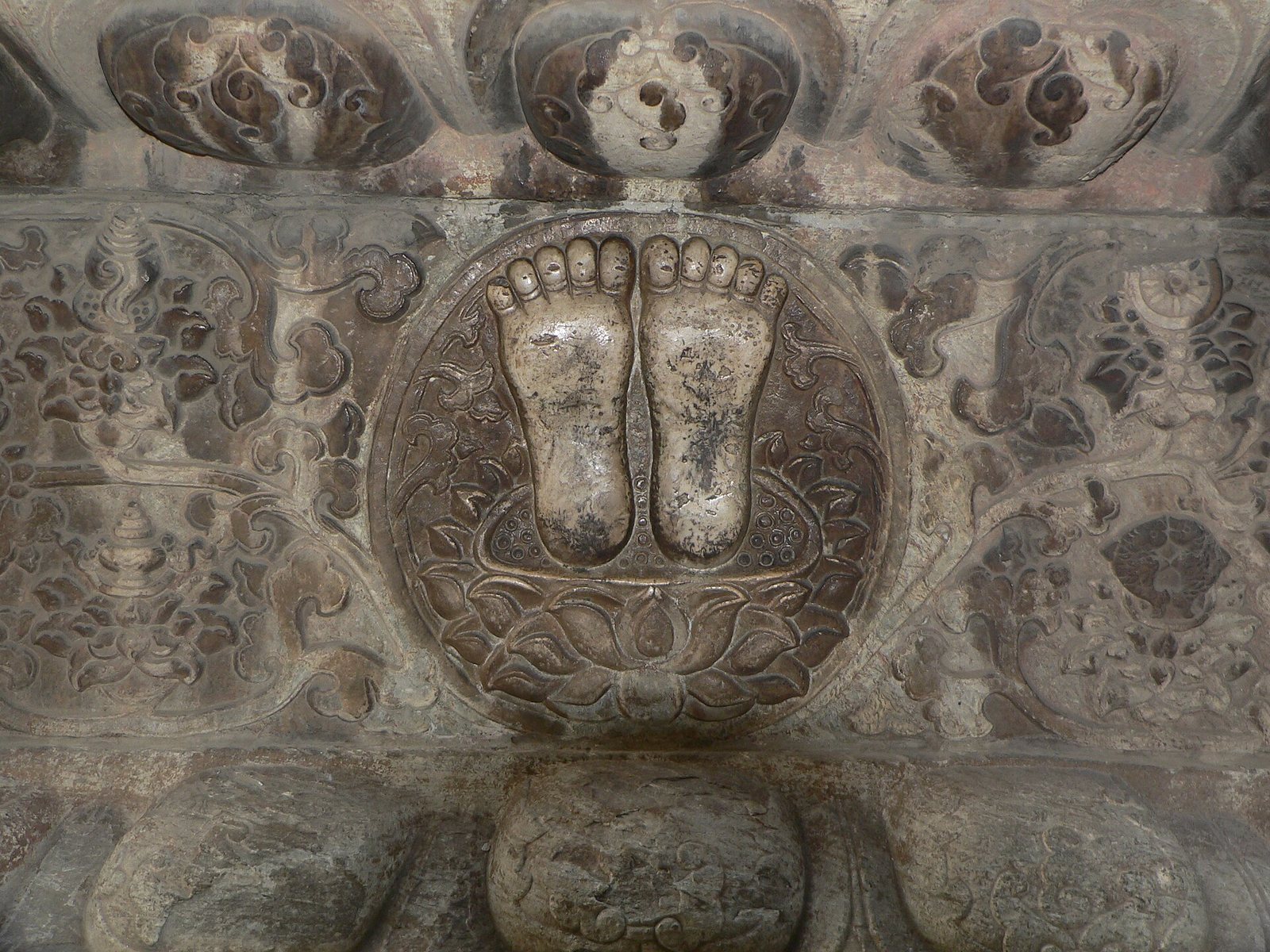
Carvings cover all four sides of the base. They include rows of 1,000 Buddhas, Buddhist teaching wheels, elephants, peacocks, bodhi trees and sutra texts. A pair of carved footprints represents the spread of Buddhism around the world, and traces of red pigment remain from an earlier painted surface. Iron traces in the stone have oxidized, giving it a rusty color.
The tower’s design draws on the Mahabodhi Temple at Bodh Gaya, India, associated with the place where Gautama Buddha attained enlightenment. Zhenjue’s base is proportionally taller, and its central pagoda stands only slightly above the four corner towers. Its decoration follows Chinese forms.