Fort Tron: A Nineteenth-Century Fortress and Italian Army Barracks


Site at a Glance
- Rating
- 3.4
- Popularity
- Very Low
- Country
- Italy
- Primary era
- Modern
- Eras represented
- Modern
- Civilizations
- Italian
- Site type
- Military
- Remains
- Fort
On this page5 sections
History
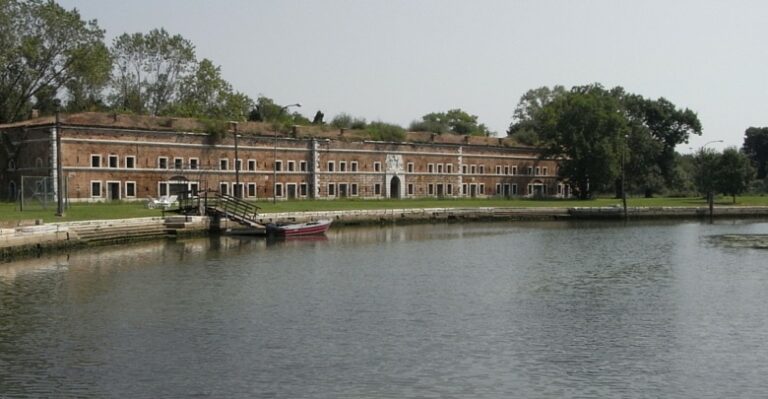
Fort Tron is a nineteenth-century fortress and former Italian Army barracks in Italy, on the mainland near Ca’ Sabbioni in the Marghera municipality of Venice. Built by the Kingdom of Italy between 1887 and 1890, it formed part of the Mestre entrenched camp, a coordinated group of forts and defensive works arranged around a city or strategic installation. The fort also belonged to the wider defensive system of the Venetian Lagoon, helping protect Venice, its port, and its arsenal from attacks advancing from the mainland.
Planning the Mestre defenses
Fort Tron, Fort Carpenedo, and Fort Gazzera formed the original nucleus of the Mestre entrenched camp. Their positions were arranged radially around Fort Marghera, while the distances between them reflected the effective range of contemporary artillery. This arrangement connected the individual forts into a broader defensive system rather than treating them as isolated strongholds. Fort Tron stood west of Fort Marghera.
The project was submitted in Rome in 1883 and approved on June 13 of that year. Construction was then suspended for approximately three years while the plan and its costs were revised and minor improvements were incorporated. The contract was definitively awarded on August 21, 1886.
Construction and later military use
Work began in 1887 on a marshy site measuring 18.55 hectares. Ground subsidence and water infiltration considerably slowed construction and required changes to the original design. The fort was completed in 1890 and was restored in 1910.
Fort Tron had been designed to resist impact shells, which damaged targets through the force of the projectile striking them. The later development of explosive shells, combined with rifled barrels whose spiral grooves improved artillery range and accuracy, soon made this defensive concept obsolete. The fort was subsequently used for several purposes, including a farm, a powder magazine, and a depot. The military definitively abandoned it during the first half of the 1980s, ending its military use.
Remains
Fort plan and armament
Fort Tron has a polygonal plan, meaning that its fortification is organized around angled faces and projecting sections rather than a simple rectangular enclosure. Its design follows the Prussian style, a nineteenth-century system of military engineering associated with Prussian defensive principles and linked here to the designs of the Austrian architect and engineer Andreas Tunkler (1820–1873).
The fort is oriented toward the west, along the route of the access road leading from Padua toward the Venetian mainland. Its armament comprised six principal guns mounted on central pivots, four secondary guns, and six machine guns. The marshy ground beneath the 18.55-hectare site affected the physical construction through subsidence and water infiltration, prompting revisions to the planned form as the work progressed.
Nearby sites