Sant’Andrea della Zirada: A Former Augustinian Monastery Church in Venice
Site at a Glance
- Rating
- 4.5
- Popularity
- Very Low
- Country
- Italy
- Primary era
- Medieval
- External website
- Open
- Eras represented
- Medieval, Early Modern
- Civilizations
- Venetian
- Site type
- Religious
- Remains
- Church
On this page14 sections
History
Foundation as a Hospice and Oratory
Sant’Andrea della Zirada is a Roman Catholic church in Venice, Italy, in the Santa Croce district, dedicated to the apostle Saint Andrew. Its origins lie in a foundation for poor women established by four Venetian noblewomen, Francesca Corraro, Elisabetta Gradenigo, Elisabetta Soranzo, and Maddalena Malipiero. In 1329, they received permission to build an oratory and hospice at a place known as the cao de zirada.
The project faced opposition from the Franciscan nuns of the nearby convent of Santa Chiara. With support from the Bonzio family, however, the foundation was completed in 1331. The name “della Zirada” refers to a Venetian word for a curve or turning point, probably recalling the bend of the Canale di Santa Chiara beside the church. The term was also associated with the turning point used in Venice’s historic regattas.
The Augustinian Community
Around 1346 or 1347, the surviving founders, Elisabetta Soranzo and Maddalena Malipiero, joined seven other noblewomen in adopting the Rule of Saint Augustine. This medieval rule emphasized communal religious life, prayer, discipline, and service. The women placed their community under the patronage of the doge, the elected head of the Venetian Republic, creating a formal relationship with Venice’s ruling institution.
They then began constructing an Augustinian monastery beside the original foundation, together with a new church to replace the oratory. The community continued its work assisting poor women for centuries. In 1684, the hospice was suppressed and incorporated into the monastery. The foundation nevertheless retained free admission for three lay sisters at a time.
Rebuilding and Later Changes
The church was substantially rebuilt from 1475 into the period around 1505. Its late Gothic façade belongs to the principal surviving elements of this earlier building. The church was consecrated in 1502 by Giulio Brocchetta, Archbishop of Corinth, and underwent further restoration during the seventeenth century.
The Augustinian community was suppressed by decree on 25 April 1810, and the monastery was demolished. The church reopened on 25 October of the same year as a dependency of San Nicolò da Tolentino. After major restoration, it was reconsecrated in 1957. It closed again in 1960 and was deconsecrated, meaning that it was removed from religious use.
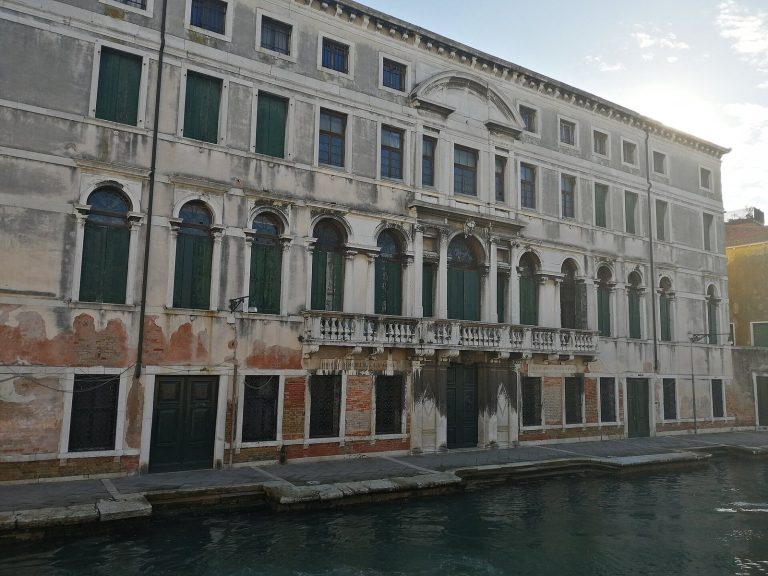
The former church subsequently served for twelve years as the studio of the artist Gianni Aricò before remaining unused. Later, the roof and interior were carefully restored by the relevant heritage authority, and the building went on to host cultural events. The church and monastery had originally stood beyond Venice’s built-up area among gardens. The site is now incorporated into the urban fabric, with the elevated People Mover route beside it.
Remains
Façade and Bell Tower
Late Gothic Façade
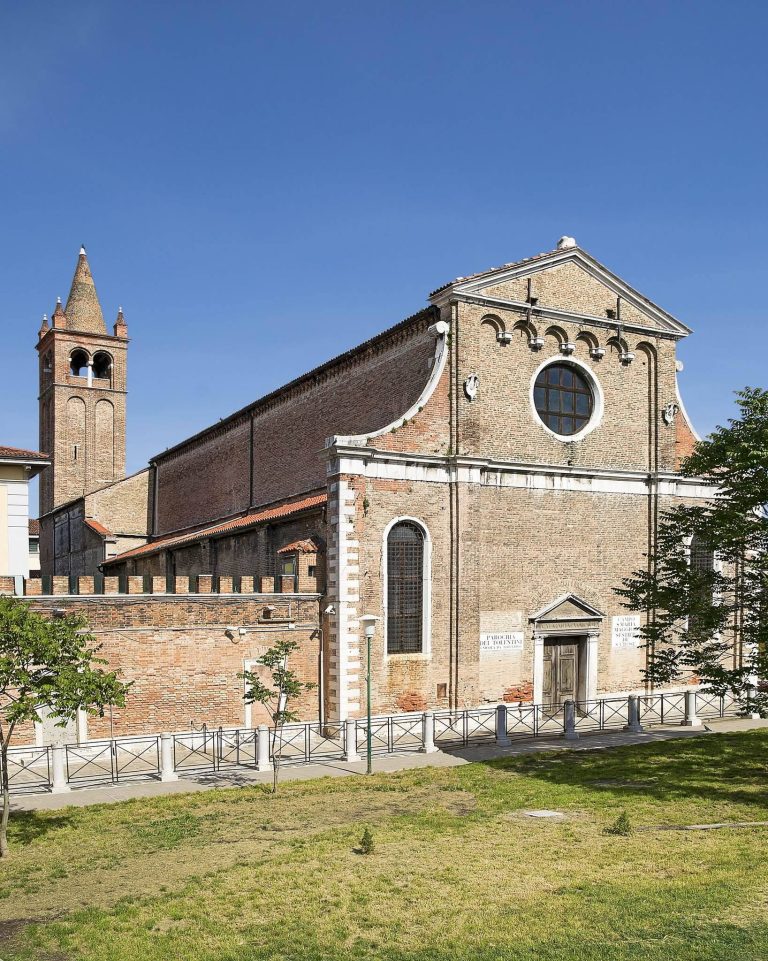
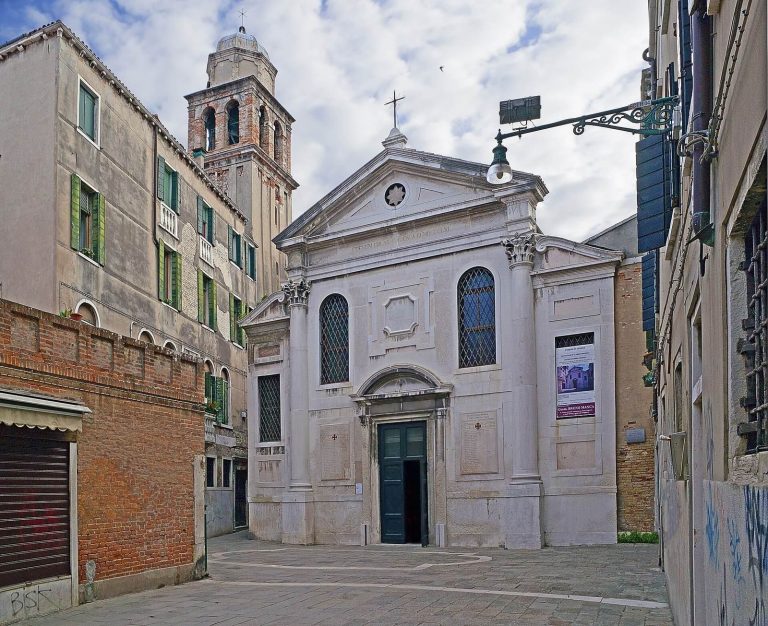
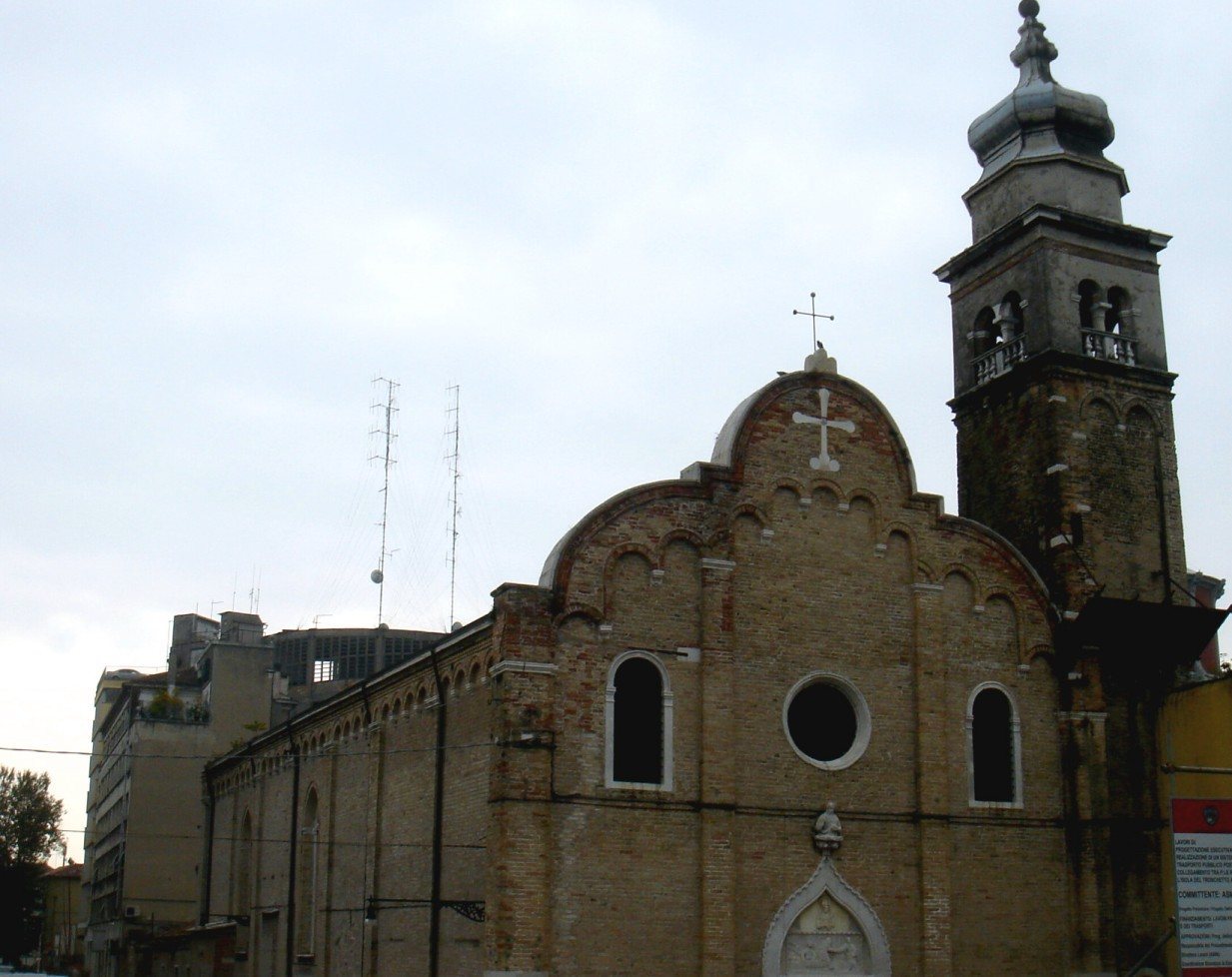
The church’s northwest-facing façade stands on Campo Sant’Andrea beside the Canale di Santa Chiara. Its late Gothic design is divided by pilasters into three sections joined by blind arches, creating a restrained composition comparable to the façades of Sant’Aponal and San Giovanni in Bragora. The principal entrance is formed from pale Istrian stone, a limestone widely used in Venetian façades, portals, and carved details.
Two fourteenth-century reliefs occupy the portal’s tympanum. One represents Christ as the Man of Sorrows, while the other shows the calling of the apostles Peter and Andrew from their fishing boat. Above the entrance is a monochrome rose window flanked by two mullioned windows. The exterior’s austerity contrasts with the elaborate Baroque decoration inside the church.
Bell Tower
A bell tower approximately 43 metres high was erected around 1475 with support attributed to the Boncia or Bonzio family. Its main form is stylistically compatible with the body of the church, while its upper stage is Baroque and crowned by a dome.
Interior and Nuns’ Choir
Single Nave and Gothic Choir
The interior has a single nave with a flat ceiling. At one end is a Gothic choir enriched with seventeenth-century stucco decoration. The combination preserves elements from the church’s medieval architectural phase alongside later ornamental work.
Barco, or Nuns’ Choir
On the counter-façade is a barco, an elevated choir or gallery used by nuns who took part in services while remaining separated from the main congregation. It retains its original paired Gothic wooden columns and wooden supports. Its front is richly ornamented with stucco floral festoons surrounding two large openings fitted with wrought-iron grilles, behind which the nuns could attend religious services.
Altars, Sculpture, and Paintings
Main Altar and Transfiguration
The main altar and retable were made in polychrome marble by the Flemish sculptor Josse de Corte, also known as Josse le Court, and completed in 1669. Their subject is the Transfiguration, the Gospel episode in which Christ appears in divine glory on a mountain before Peter, James, and John, with Moses and Elijah traditionally present. The mountain is identified with Mount Tabor, the traditional location of the event.
The composition includes a representation of Mount Tabor several metres high, built in coloured marble. Beneath the altar, a white-marble statue shows the dead Christ facing the worshippers. Five expressive groups of white-marble figures are arranged around and above the mountain. The mountain rests on an elaborate pedestal of coloured stone approached by red-marble steps, while a gilded carved wooden canopy hangs above it from the ceiling.
Other Furnishings and Paintings
Additional furnishings include marble statues of Saint Nicholas, Saint Mary of Clopas, and Saint Andrew the Apostle, each placed in niches lined with multicoloured marble. The church also contains an eighteenth-century crucifix made from polychrome marble.
Paintings associated with the church include The Dead Christ between Saint Charles Borromeo and Angels by Domenico Tintoretto and Saint Augustine with Two Angels by Paris Bordon. Paolo Veronese’s Saint Jerome, painted around 1580, once adorned the church and is now preserved in the Gallerie dell’Accademia in Venice.