Chiesa di San Girolamo: Mestre’s Medieval Roman Catholic Church
Site at a Glance
- Rating
- 4.7
- Popularity
- Very Low
- Country
- Italy
- Primary era
- Medieval
- Eras represented
- Medieval, Early Modern
- Civilizations
- Venetian
- Site type
- Religious
- Remains
- Church
On this page8 sections
History
Chiesa di San Girolamo is a Roman Catholic church in Mestre, Italy, within the municipality of Venice, traditionally regarded as Mestre’s oldest place of worship and the only surviving medieval church on the Venetian mainland. Tradition dates its foundation to 1261, on the site of an earlier hermit’s cell, and its original Romanesque-Gothic character has endured through repeated alterations.
Medieval foundation and Servite association
The church may have been consecrated on 12 February 1349. It was served by the Servites, or Order of the Servants of Mary, a medieval Italian Catholic order especially associated with devotion to the Virgin Mary. One of the earliest possible images of San Girolamo appears in a sixteenth-century miniature in the confraternity book of the School of San Marco. Saint Jerome is shown holding a three-naved temple, an emblem of the universal Church. Saint Jerome was a Christian scholar and translator of the Bible into Latin, and remains the church’s titular saint.
Destruction and reconsecration
Spanish and German forces associated with the League of Cambrai destroyed the church in 1513. The League was an early sixteenth-century alliance formed against the Republic of Venice, and its military operations affected Venetian territories. San Girolamo was reconsecrated in 1520, and the bell tower was probably built during this period. One of its bells also bears the date 1520, linking the surviving belfry equipment with the church’s renewed use.
Confraternities and later administration
After the Servite convent was suppressed in 1658, the apostolic nuncio Carlo Carafa entrusted the church to four confraternities. They were the School of San Marco, the School of the Rosary, the School of San Nicholas, associated with shoemakers and leather sellers, and the School of San Blaise, associated with boatmen. The confraternities administered San Girolamo through a chaplain whom they elected.
The Napoleonic edicts of 1807 suppressed the confraternities and made the church a subsidiary of the Duomo. A major restoration in the mid-eighteenth century rebuilt the facade, while later interventions altered and repaired the building. Work in the first half of the twentieth century partially restored its medieval appearance. In 1992, two ancient Gothic windows in the right wall were restored. On 11 January 2016, bad weather caused part of the facade’s upper horizontal stonework to collapse, and fundraising allowed the facade to be restored later that year. San Girolamo is now a rectory, a church administered by a rector rather than functioning as an independent parish, dependent on the parish of the Duomo and administered by the Daughters of the Church.
Remains
Facade and medieval structure
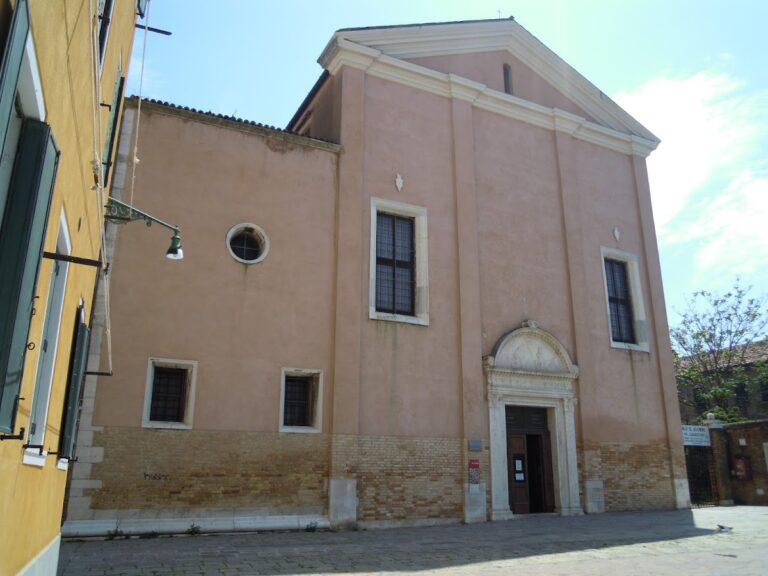
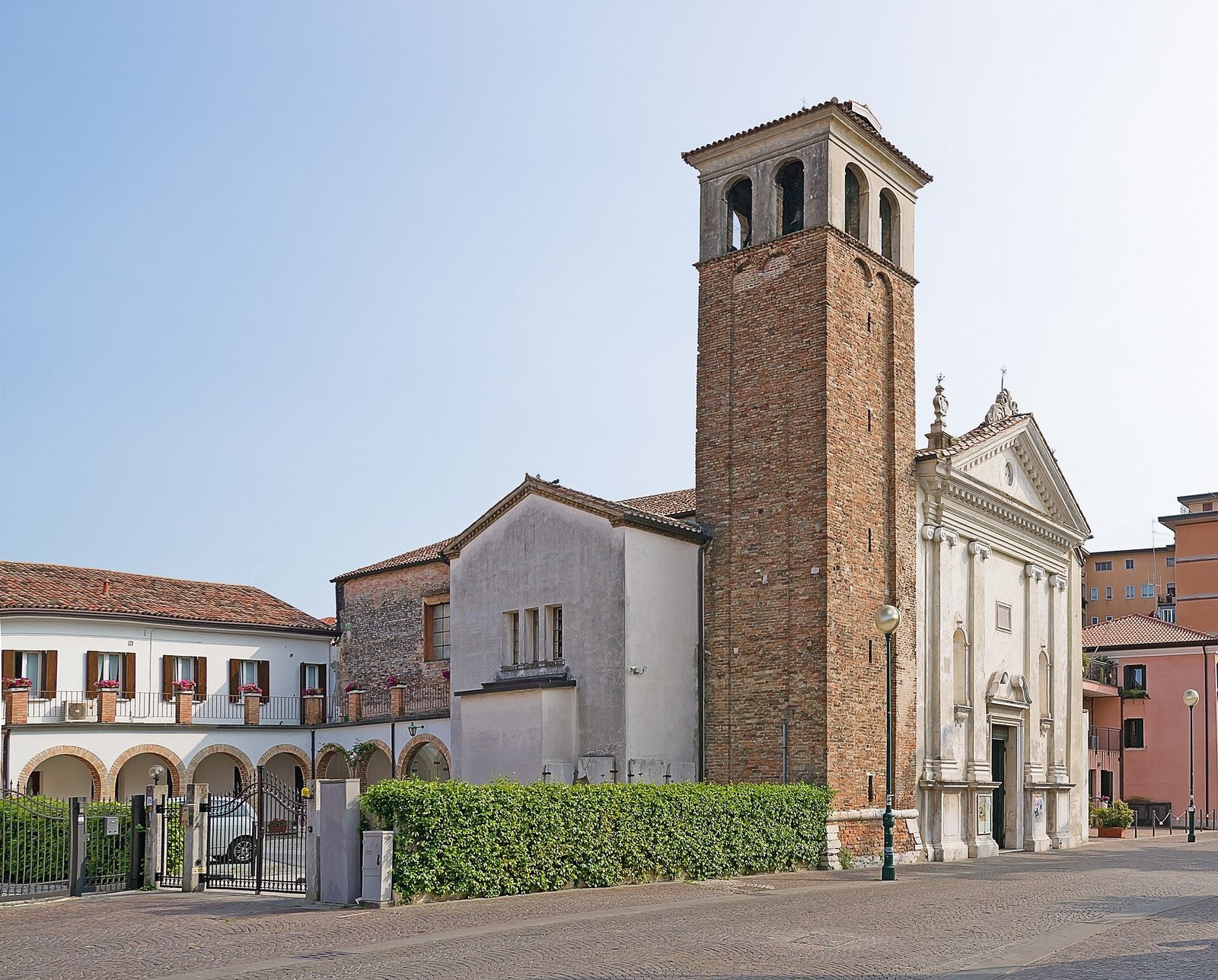
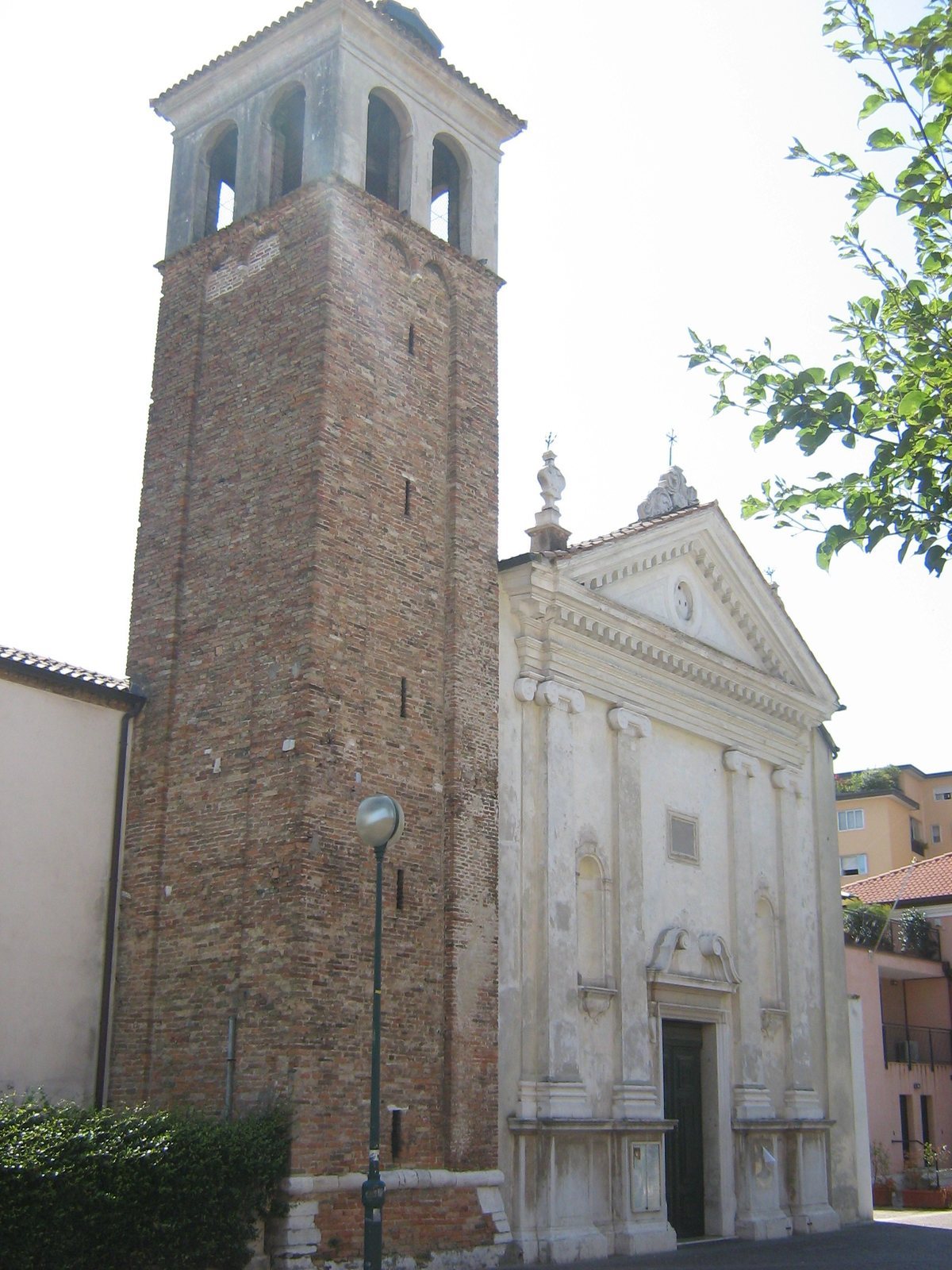
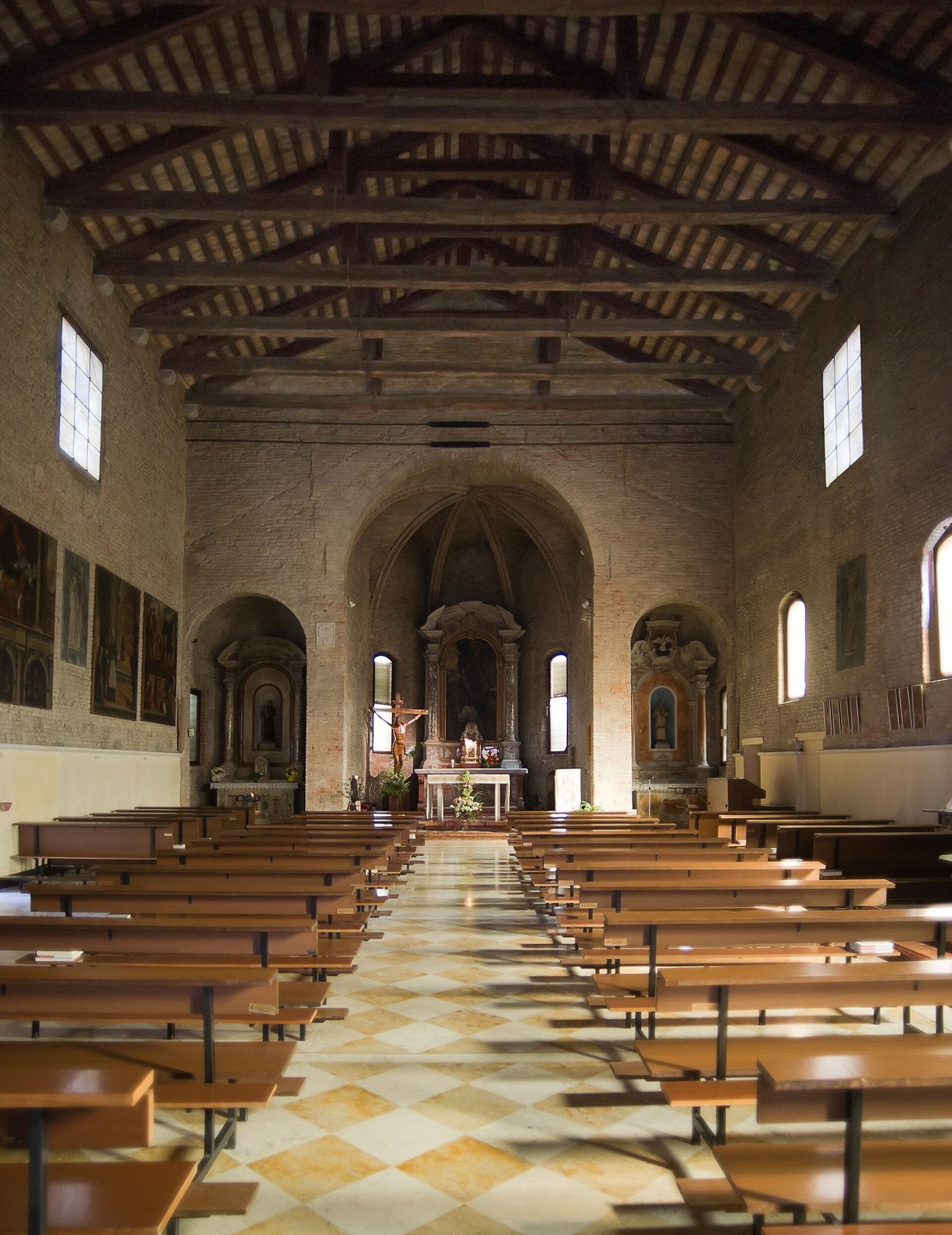
The eighteenth-century facade is coated in white plaster and arranged in three sections by four Ionic pilasters rising from tall stone bases. Above them, a pediment is finished with ornamental vase- and scroll-shaped elements at its corners and apex. The entrance portal has two volutes forming a pediment-like composition, while the corbels beneath the two empty side niches retain delicate stucco decoration recovered during the latest restoration. The building’s earlier Romanesque-Gothic character is also expressed in its medieval proportions and surviving details. Inside, the ancient wooden roof trusses were exposed again in 1949, and the presbytery, the area around the main altar reserved for clergy, has a Gothic ribbed vault supported by intersecting masonry ribs.
Paintings and devotional furnishings
Four paintings dated 1607 occupy the left side of the church. They are the only works certainly attributed to Annibale Mancini, a painter of the Venetian school. The cycle presents the election of Saint Nicholas of Myra as bishop and three miracles: his stopping the execution of three young men, his rescue of a ship carrying pilgrims from a wreck, and his appearance before the emperor to obtain the release of three unjustly accused prisoners. The scenes use a popularizing style and include written captions.
The presbytery contains a fifteenth-century crucifix carved from cedar wood. Tradition holds that boatmen transporting it were compelled to bring it to San Girolamo, where it remains an especially venerated object. The seventeenth-century high altar carries an altarpiece from the circle of Palma the Younger showing the Madonna and Child with Saints. Its figures include the child Saint John the Baptist, Saint Jerome beating his chest, and Saint Philip Benizi kneeling on the right. Philip Benizi was the prior general of the Servites, and tradition says that he refused election as pope.
Courtyard tombs and bell tower
The adjoining courtyard preserves two tomb slabs dated 1382 and 1483. Each shows the recumbent figure of a Servite religious who was formerly buried inside the church. The bell tower retains three electrically operated bells arranged in the Trevigiana ringing system. One sounds B3 and two sound D4, giving the smaller bells nearly the same note. The bells are used for the full ringing of the largest bell, the complete peal, and, very rarely, the full ringing of the third bell. One bell bears the date 1520, the year of the church’s reconsecration.