Fort of São João do Arade: A Coastal Defense of the Arade River


Site at a Glance
- Rating
- 4.3
- Popularity
- Low
- Country
- Portugal
- Primary era
- Early Modern
- Eras represented
- Medieval, Early Modern, Modern
- Civilizations
- Habsburg, Portuguese
- Site type
- Military
- Remains
- Fort
On this page8 sections
History
The Fort of São João do Arade is a Portuguese coastal fortification at Ferragudo, Portugal, whose origins reach back to the late fifteenth-century reign of King John II. Built and developed to watch and defend the mouth of the Arade River, it later controlled a strategic point facing the margins of Portimão.
From watchtower to enclosed settlement
The first defense on the site was a watchtower erected during the reign of King John II, who ruled from 1481 to 1495. After Ferragudo was settled around 1520, the site is believed to have been enclosed by a defensive wall built over rudimentary earlier walls. This development gave the fortification its original designation, the Castle of Arade.
Habsburg rule and the seventeenth-century fort
The fort’s later development began during the Philippine Dynasty, the period from 1580 to 1640 when Portugal was governed by the Habsburgs. Coastal defenses were strengthened during this era because of attacks by pirates and privateers serving hostile northern European powers. In the early seventeenth century, construction was delayed by disagreement over the best position. Engineer Alexandre Massai favored the right bank at Vila Nova de Portimão, while the municipality of Silves supported the left-bank site at Ferragudo.
In a report concerning the site, Massai stated that the battlements already existed in 1621 and described Ferragudo as an enclosed settlement. During the Portuguese Restoration War, the conflict that ended Habsburg rule and restored an independent Portuguese monarchy, King John IV ordered a new fortification in 1640 to replace the ineffective Castle of Ferragudo. The replacement bulwark was built downstream on a rocky platform. Erosion and Atlantic storms, especially a severe storm in 1669, seriously damaged the original structure.
Francisco da Costa Barros became the fort’s first captain on 2 May 1644. From its foundation, its position at the mouth of the Arade gave it a role beyond local defense. It controlled a strategic river entrance and could direct fire toward the margins of Portimão. An inspection by D. Rodrigo António de Noronha e Meneses, Governor of the Kingdom of the Algarve, found the fortification in perfect condition. At that time, the lower battery, a fortified artillery position, held three artillery pieces, while the upper battery held four.
Military decline and private adaptation
The fort survived the Lisbon earthquake of 1755 without damage, unlike many structures on the southern coast. Its construction on soft rock was identified as one reason for its survival. It remained active in 1821, when two heavily armed batteries occupied its upper level.
The site also served as a transit point for boats entering and leaving the Arade River, including river traffic connected with Silves. This role ended after the Convention of Evoramonte in 1834, the settlement that concluded the Portuguese Liberal Wars. The fort then fell into disuse and was decommissioned in 1896. It deteriorated gradually, was abandoned, and was sold at public auction that year for 600,000 reis, the Portuguese currency used before the escudo.
After the sale, the poet Joaquim José Coelho de Carvalho adapted the fort as a summer residence and carried out extensive renovations shaped by his personal taste. The complex remained privately owned when it was classified as a historic building in 1975 by the Instituto Português do Património Arquitectónico, Portugal’s former architectural-heritage authority. In 1976, the Junta de Freguesia de Ferragudo sought government permission to occupy the fort, while the local authority proposed converting it into a cultural center. The site was described as practically abandoned, although its structures remained largely untouched during the twentieth century while detailed studies and archaeological investigation were awaited.
Remains
Setting and plan
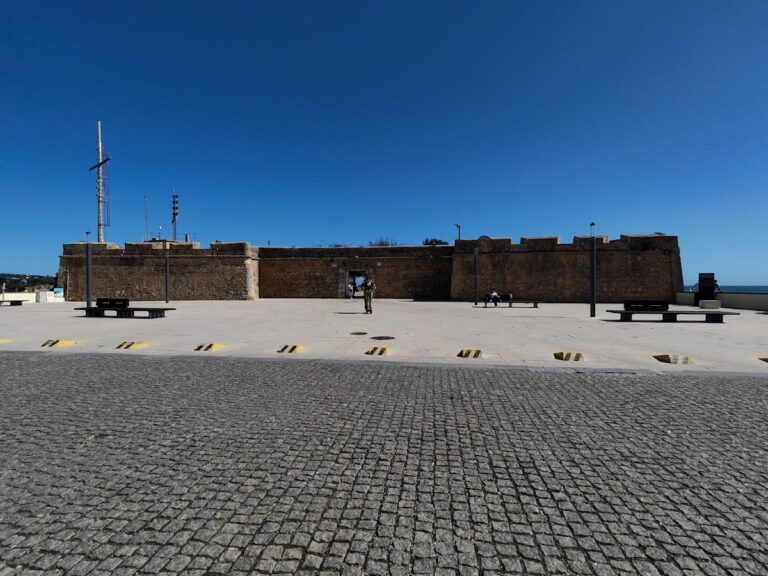
The fort is a rural coastal defense set on a hillock above the left bank of the Portimão estuary, at the mouth of the Arade River. It occupies an isolated, extensive wooded property in a dominant position between Praia da Angrinha and Praia Grande. Together with the Fort of Santa Catarina on the Portimão waterfront, it guards the estuary and the river mouth. Its irregular trapezoidal plan is arranged on elevated ground and includes a keep and several spaces oriented toward the sea.
Defensive construction
Stone and masonry form the fort’s main construction. Its vertical facades contain windows and barbicans, projecting defensive structures associated with the protection of an entrance or wall. The battlements served as artillery positions. Their elevated arrangement provided visibility toward the sea and over the surrounding area, while the height of the fort supported observation across its setting.
Garden and residence
The complex includes a large walled garden extending from Praia da Angrinha to Praia Grande. It also contains the large residence created when Joaquim José Coelho de Carvalho adapted the military complex for summer use. These later residential works form part of the surviving physical character of the fort alongside its defensive structures.
Nearby sites