Fort of Our Lady of the Incarnation: A Coastal Defence Monument in Portugal


Site at a Glance
- Rating
- 4.5
- Popularity
- Low
- Country
- Portugal
- Primary era
- Early Modern
- Eras represented
- Early Modern, Modern
- Civilizations
- Portuguese
- Site type
- Military
- Remains
- Fort
On this page9 sections
History
The Fort of Our Lady of the Incarnation is a military monument beside Carvoeiro in Portugal, built as a seventeenth-century coastal defence work. Construction began in 1670 on the orders of Nuno de Mendonça, captain-general of the Kingdom of the Algarve, a senior military and administrative commander. The fort probably occupied the site of an earlier watchtower, while the chapel dedicated to Our Lady of the Incarnation probably predated the military structure.
Construction and coastal defence
The works were completed in 1675 during the tenure of Nuno da Cunha de Ataíde. The fort protected the coast near Carvoeiro and neighbouring settlements, together with tuna and sardine fishing installations. Its purpose was to guard these places and activities against pirates and hostile nations, including France and England.
Earthquake damage and rebuilding
The earthquake of 1755 caused extensive damage, especially to the chapel, although its image of Our Lady of the Incarnation survived. In April 1758, the priest Ignácio de Sousa Oliveira described the chapel as very old. He also noted that its dome carried a tall octagonal stone-and-masonry obelisk, which served as a navigation landmark.
The fort was rebuilt in 1796 on the orders of António Silvestre C. Tavares Júdice, its commander. The entrance plaque was installed during this rebuilding, and the chapel was modified at the same time. In 1821, Gregório António of the Royal Corps of Engineers, the military body responsible for engineering and fortification works, found the fort seriously damaged. Only one dismounted 18-calibre cannon and a small platform remained in serviceable form.
Decline and changing use
Repairs to the fort and chapel took place in 1825, and an 18-calibre cannon was still present in 1832. By 1840 the cannon had been removed, and both the fort and chapel were in ruins. Further work that year altered the chapel’s design. The fort had closed by 1861 and was converted into a Fiscal Guard post in 1871. The Fiscal Guard was a Portuguese state service concerned chiefly with customs and tax enforcement, including control of coastal activity. Parts of the former fortifications and garrison buildings were subsequently used by the service.
Restoration and continuing religious use
Part of the old wall was demolished in 1937 during construction of the road to Algar Seco. The chapel was restored in 1942 through financing by Captain Josino da Costa and repaired again in 1965, when António Martins de Oliveira was parish priest. A wooden walkway connecting the fort with Algar Seco opened in 2014. Requalification of the surrounding area began in 2016, creating an outdoor amphitheatre and leisure area while recovering remnants of the fort wall and improving the former entrance portal.
The chapel continues to serve religious and cultural purposes. Eucharistic celebrations for the Feast in Honour of Our Lady of the Incarnation are held there, and the feast is regarded as the principal religious event in the village. The title Our Lady of the Incarnation refers to the Christian doctrine of the Incarnation, the belief that God became human in Jesus Christ.
Remains
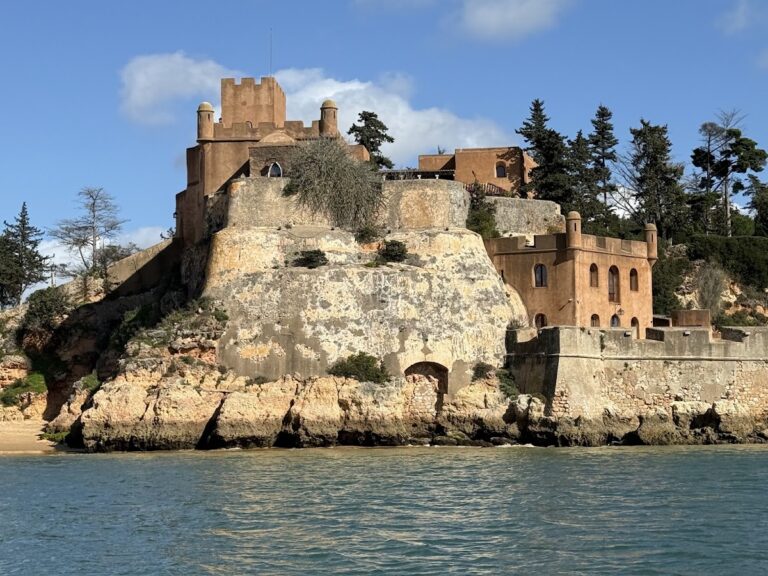
The surviving complex stands on a sea cliff beside Carvoeiro. The original fort had an irregular polygonal plan, with gun positions facing the ocean, and contained a chapel, a powder magazine for storing gunpowder, a cistern for collecting or holding water, and accommodation and service buildings for the garrison. The present remains consist of the eastern-facing wall with its entrance, the chapel, and several former Fiscal Guard buildings.
Fortifications and entrance
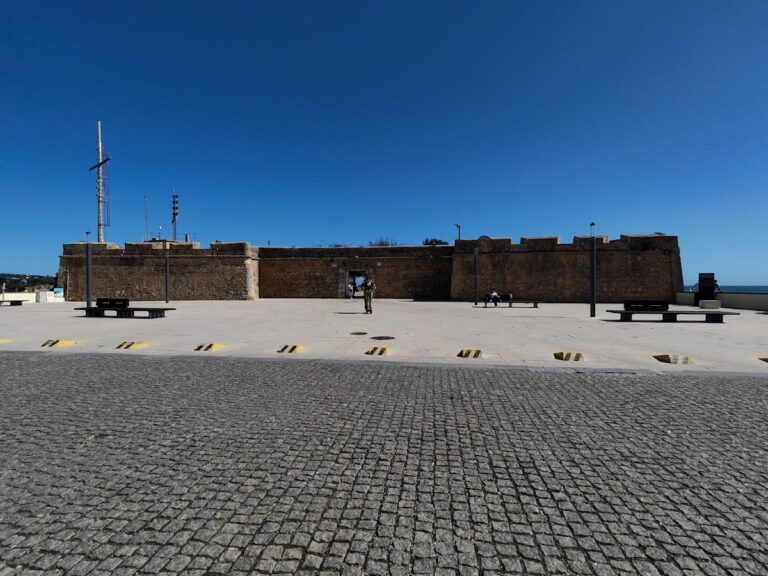
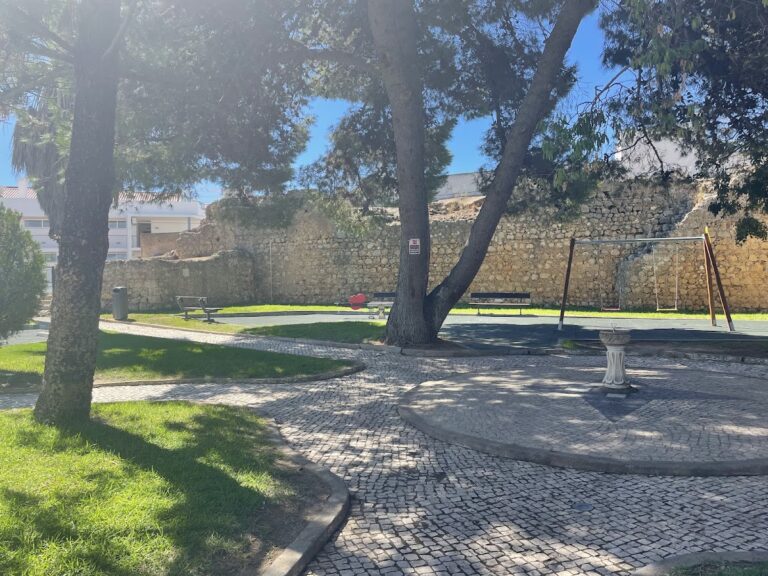
The surviving eastern wall preserves the principal entrance to the former fort. A stone plaque above the entrance gives 1670 as the beginning of construction. The fort’s ocean-facing batteries, fortified gun positions, originally carried two or three guns. During the 2016 requalification works, recovered portions of the former wall and entrance portal were incorporated into the outdoor amphitheatre, allowing these fragments to remain part of the present site.
Chapel of Our Lady of the Incarnation
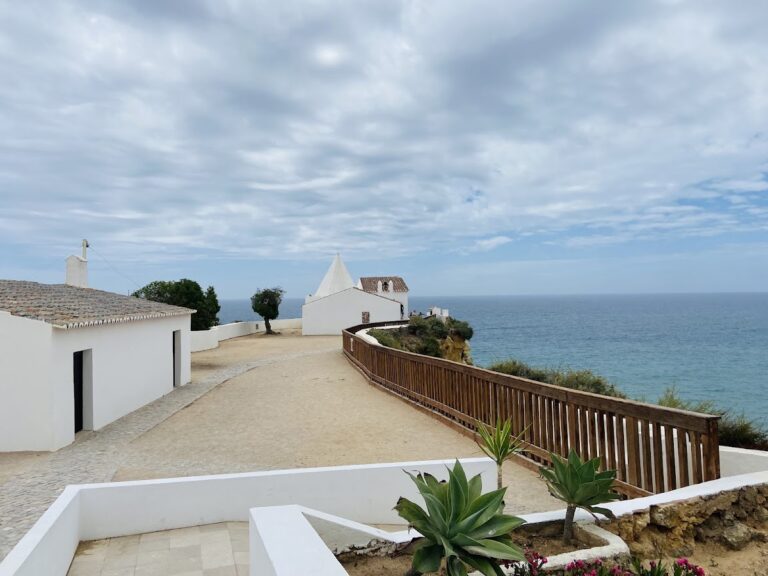
The chapel is the principal surviving religious building. It originally had a domed roof topped by a tall octagonal obelisk made from stone and masonry. The obelisk served as a navigational reference point for vessels along the coast. Repairs in 1965 enlarged the nave, replaced the lean-to roof over the principal facade, and inserted a compartment running across the nave for religious functions. The belfry was moved to the main facade, while its bell was retained.
Two images remain in the chapel. One is a seventeenth-century image of its patron, Our Lady of the Incarnation. The other is an image of the Crucifixion attributed to the nineteenth century.
Former service buildings
Several buildings once used by the Fiscal Guard survive within the remains of the former fort. Together with the eastern wall and chapel, they represent the later adaptation of the defensive complex after its military closure.