Castle of Alvor: An Islamic Alcazaba and Portuguese Fortress



Site at a Glance
- Rating
- 3.9
- Popularity
- Medium
- Country
- Portugal
- Primary era
- Medieval
- Eras represented
- Iron Age, Classical, Medieval
- Civilizations
- Ancient Greek, Carthaginian, Phoenician, Portuguese, Roman, Umayyad
- Site type
- Military
- Remains
- Citadel
On this page12 sections
History
The Castle of Alvor is a historic fortress in Portugal, in the town of Alvor, whose surviving remains belong chiefly to an Islamic citadel built from about the ninth century onward. The site occupies an older fortified settlement that developed into an important commercial centre and later became part of the medieval defensive landscape of the Algarve.
Ancient settlement and Roman Alvor
The hill was first occupied by a Lusitanian castro, a fortified settlement associated with the pre-Roman peoples of western Iberia. By about the seventh century BC, the community had become an economic and commercial centre connected successively with Phoenician, Greek, and Carthaginian groups. During Roman rule it continued to be inhabited under the name Ipses.
A tradition associates the site with Hannibal, the leading Carthaginian commander of the western Mediterranean. He is said to have conquered the fortress and named it Portus Annibalis, although the settlement was later known again as Ipses. Excavations in Alvor’s historic centre between 1986 and 1988, coordinated by the archaeologist Maria Teresa Júdice Gamito, revealed walls and other structures linked to the ancient fortified settlement.
Islamic fortification
Muslim forces captured Alvor in 716. Under Islamic rule, the settlement remained a political and commercial centre. The castle was probably established from the ninth century onward, during the instability surrounding the transition from the Emirate of Córdoba to the Umayyad Caliphate. It may have begun as a small hisn, a fortified Islamic settlement or castle, or as an al-bury, a fortified tower.
The castle probably formed part of a coastal defensive network that included the fortifications of Estômbar, Portimão, and Albufeira. Secondary redoubts between the castle and the coast supplemented the main defensive position. Alvor’s location beside the lagoon and waterways allowed the settlement to control movement inland while also watching part of the coast at the eastern end of Lagos Bay.
Conquest and Portuguese reconstruction
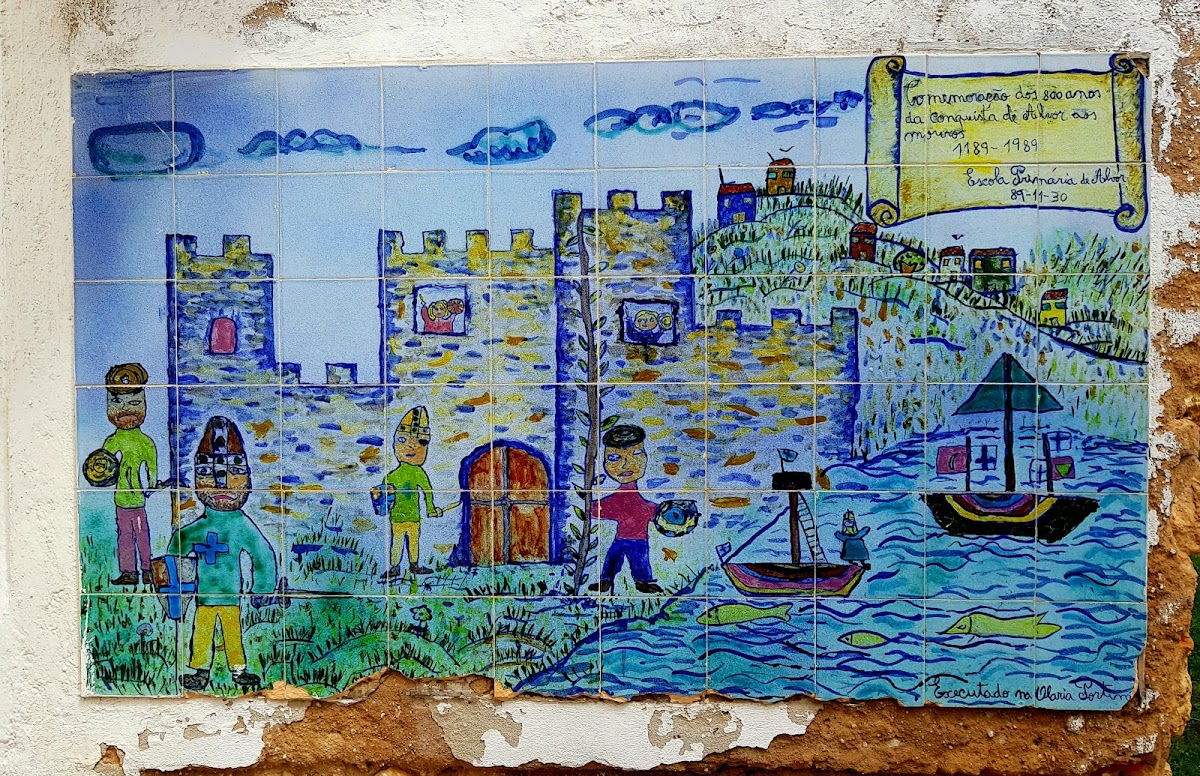
In 1189, during the campaign that preceded the conquest of Silves, Sancho I of Portugal and northern European crusaders captured Alvor. The assault destroyed the settlement and caused extensive loss of life, with the death toll possibly reaching several thousand. The Almohads, a North African Islamic dynasty that ruled much of southern Iberia during the twelfth and thirteenth centuries, recovered the region in 1191. Christian control was established definitively in the 1240s, during the reign of Afonso III.
King Denis ordered the castle to be rebuilt in 1300. Under Portuguese rule, Alvor became one of the principal settlements of the Algarve and remained administratively connected with Silves until separating from that municipality in 1498. John II raised Alvor to town status in 1495, and Manuel I granted a charter to the parish in 1505. John II died at Alvor. His body was first taken to Silves Cathedral and was later buried at the Monastery of Batalha.
Artillery, decline, and destruction
In 1573, King Sebastian ordered a circuit of walls around the settlement, but the work was probably never finished. By 1606, the castle was described as having heavy artillery. In 1621, the military engineer Alexandre Massai described it as a small square fort. Its limited usefulness in an age of artillery encouraged abandonment in favour of larger coastal fortifications, while the town gradually extended into the abandoned structure.
The earthquake of 1755 destroyed almost the entire castle. The surrounding town wall also disappeared, although parts of the former alcazaba, the fortified citadel or inner stronghold of an Islamic town, survived. On 25 April 1979, the area of the former alcazaba was converted into a children’s recreational space, commemorating the Christian conquest of Alvor while retaining a community function. The Castle of Alvor received the Portuguese protected-property designation Imóvel de Interesse Público by decree dated 25 June 1984.
Remains
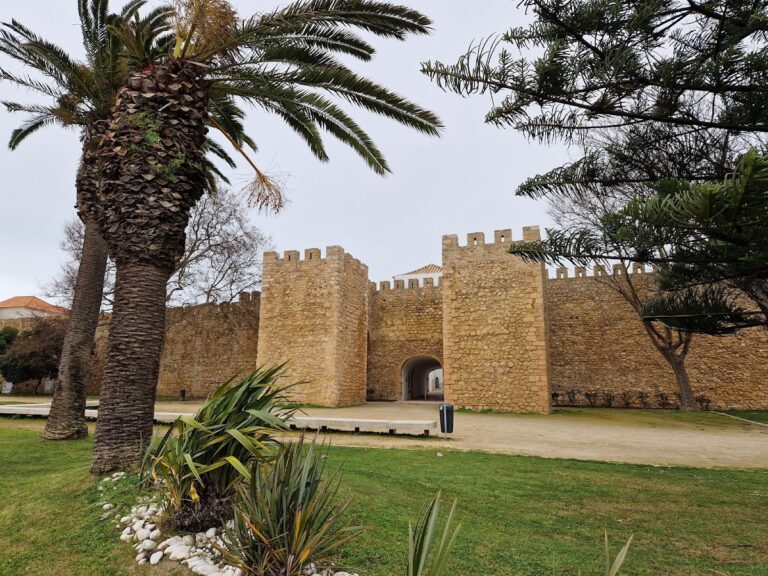
The surviving fortress represents the former Islamic alcazaba rather than the complete fortified settlement. It stood on a hill about five metres high beside an inlet of the Alvor lagoon, near the mouths of the Arão, Alvor, and Farelo waterways. The citadel originally covered approximately 960 square metres and had a sub-quadrangular or rectangular plan. The wider settlement was enclosed by its own wall circuit, while the surviving parts of the alcazaba are limited to sections incorporated into Alvor’s urban fabric.
Citadel walls and entrance
Stone walls
The walls were built from stone masonry, mainly limestone blocks, with some red sandstone known as Silves sandstone. Lime mortar, small stones, and ceramic fragments were incorporated into the construction. In the surviving sections, irregular stones are arranged in roughly horizontal courses.
The southwestern wall is about 1.70 metres thick at its highest point and reaches approximately six metres in height. Other surviving sections rise more than five metres. The remains do not establish the full original height or confirm whether the walls carried crenellations. A wall-walk, or adarve, ran along the tops of the walls. Its presence is indicated by a staircase attached to the southern corner or southern wall, measuring about 0.5 metres in width.
North gate
The principal entrance was on the north side. It used a bent, elbow-shaped passage approximately 2.50 metres wide, a design that made direct access more difficult. Surviving hinge sockets lie about 2.6 metres above the floor. The gate was probably connected with a projecting defensive tower, although its exact form is uncertain and may have involved an albarrana tower, a tower positioned to strengthen the outer defence of a wall or entrance.
Eastern defences and archaeological levels
Eastern tower and barbican
Foundations of a tower survive on the eastern side of the alcazaba. A nearby wall of exceptional thickness, constructed in the same masonry style as the fortress, may have formed part of a barbican, an additional defensive work protecting an entrance or wall. The eastern tower may have provided views over the lagoon inlet and the sea.
Earlier settlement remains
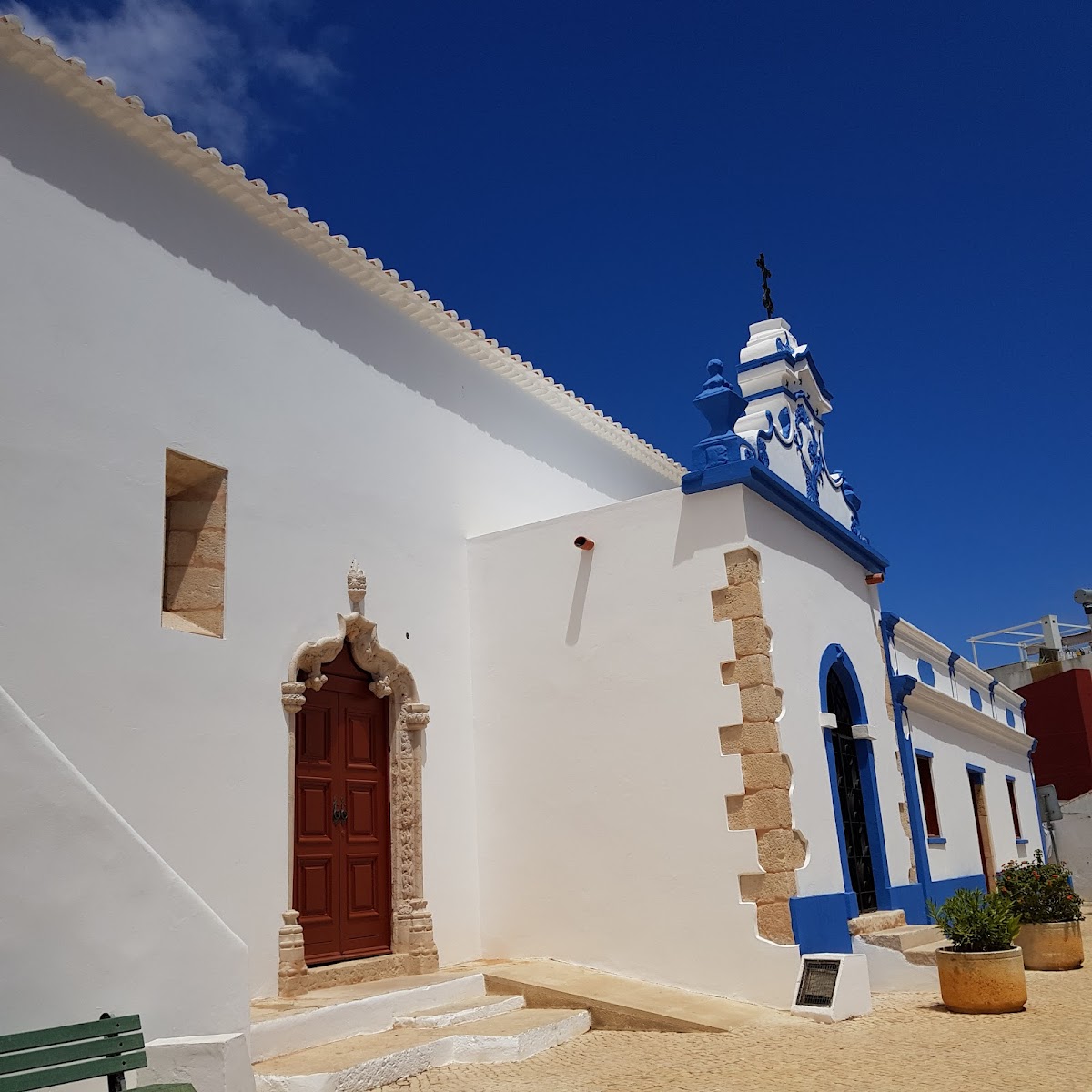
The former alcazaba lay beside Rua Poeta António Aleixo and Largo do Castelo, near the municipal market. Its interior now contains the children’s recreational area created in the late twentieth century. Archaeological investigation of the hill also exposed remains of the earlier fortified settlement of Ipses in front of the parish church, together with layers associated with Muslim occupation.