Festung Nauders: An Austrian Nineteenth-Century Fortification


Site at a Glance
- Rating
- 4.5
- Popularity
- Low
- Country
- Austria
- Primary era
- Modern
- External website
- Open
- Eras represented
- Modern
- Civilizations
- Austrian Empire, Habsburg
- Site type
- Military
- Remains
- Fort
On this page10 sections
History
Festung Nauders is a nineteenth-century Austrian fortification in Austria, about 2.5 kilometres northwest of Nauders in Tyrol. Built between 1834 and 1840 in a period of Habsburg military modernization, it controlled the Finstermünzpass, a strategic route near the Swiss border and the approaches to Italy. Its purpose was to prevent hostile forces from entering North Tyrol and to block the road from the Reschenpass toward Landeck, Vorarlberg, and Innsbruck.
From the Niclas-Mauer to the new fort
The fort replaced an older defensive work known as the Niclas-Mauer, whose construction began in 1513. Planning for the nineteenth-century structure was undertaken by Field Marshal Lieutenant Franz von Scholl, a military fortress designer who also worked on the fortresses of Verona and Franzensfeste. Major General Georg Eberle, a military engineer and former chief engineer during construction of the federal fortress at Rastatt, was responsible for the work on site.
Construction took place under Emperor Francis I and his successor Ferdinand I. Francis I was the first Emperor of Austria and had earlier ruled as Francis II, the last Holy Roman Emperor. A Latin inscription on the north gable refers to both rulers and to the years 1834 and 1840.
Military use and later history
During the First World War, Festung Nauders was the oldest manned fortified work on the Austrian side of the front. It was prepared for rifle and artillery fire but did not take part in combat or receive direct enemy fire. Its difficult position made direct bombardment impossible and helped preserve the fort. At the beginning of the war, eight 8-centimetre M. 94 guns were assigned to it, although two were later transferred to the Gomagoi barrier.
The planned garrison included detachments from the Trento and Innichen Landesschützen regiments, mountain infantry units of the Austro-Hungarian military. It also included a reserve company from Fortress Artillery Battalion No. 4 at Riva del Garda, a detachment from Fortress Artillery Battalion No. 7 at Malé in Val di Sole, and locally organized k.k. Standschützen from Landeck. The intended strength was about 40 men, although permanent occupation of the fort is considered unlikely.
Festung Nauders played no defensive role during the Second World War. It was regarded as obsolete, and the Finstermünzpass ceased to be a military objective after the Anschluss, Germany’s annexation of Austria in 1938. After the war, French occupation forces in Tyrol used the fort as a provisions depot.
The Austrian army definitively ended its military use of the property in 1970 and transferred it to local authorities. It was subsequently entrusted to a local preservation association. During Austria’s Cold War Raumverteidigung, or area-defence system of dispersed fortified positions and barriers, other regional installations remained in service, but Nauders was excluded because of its difficult accessibility.
At the beginning of the twenty-first century, an Interreg project supporting the cultural and historical improvement of important buildings in Terra Raetica contributed to the fort’s renovation, particularly its roofs. Earlier deterioration had caused leaks, falling material and paint, and increasing dampness inside the complex, threatening both the structure and its exhibitions. The Museumsverein Nauders now manages and conserves the fort, which houses the Festung Nauders military museum. The property is protected in Austria under registration number 39988 and object ID 39856.
Remains
Setting and defensive design
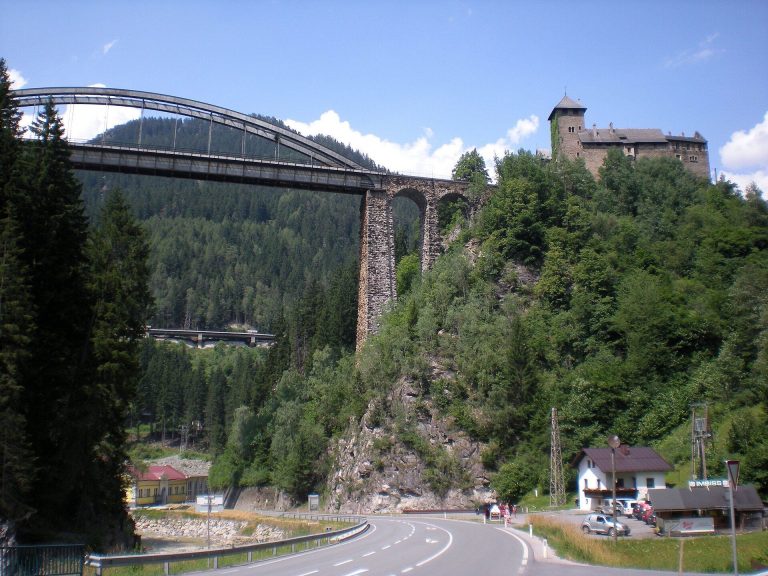
Festung Nauders stands at approximately 1,186 metres above sea level in a narrow gorge at the Finstermünzpass, on the route over the Reschenpass. The fort occupies the projecting section of a double bend in the road. Surrounding rock restricted the possibilities for a direct attack, while the fort’s defensive arrangements covered the road and both sides of the gorge, giving its guns a clear field of fire toward the north.
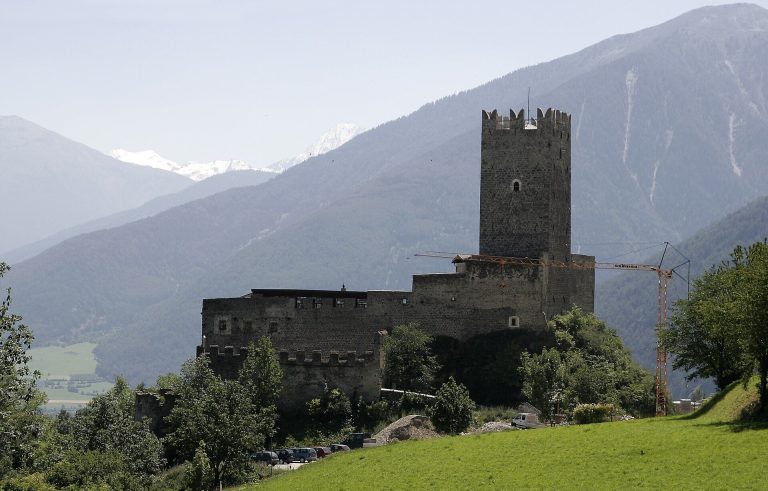
The masonry structure has a balanced architectural design and is partly embedded in the rock. Its exposed surfaces were intended to resist moderate explosions, while the sections cut into the rock were considered effectively bomb-proof. The exposed portions were judged only partially resistant to shellfire. A rear, or throat, ditch protected the landward side behind a drop bridge, a bridge designed to be lowered or released rapidly so defenders could enter the fort quickly.
Fort structures
Artillery casemates
The two-storey throat structure facing the road contains the artillery casemates, fortified chambers that shelter guns and crews while allowing fire through protected openings. The main two-storey section has four principal gun casemates, with two individual chambers on the lower floor and two double chambers above. Together they accommodated eight guns and covered the fort’s field of view.
Troop and supply rooms
The rear section rises to as many as four storeys in places and contains rifle loopholes. Inside, two-storey troop casemates and supply rooms supported the fort’s garrison. Fresh water was supplied by a stream flowing beneath the fortification. The complex remains substantially intact both internally and externally, and the roof rehabilitation helped protect its surviving masonry and interior displays.
Barracks building
A barracks building on the opposite side of the road was intended to accommodate about 40 men and their equipment. Some tanks and guns are displayed on the fort’s ramparts and in a garden across the road, linking the surviving fortification with its military museum.
Associated military collection
The Panzermuseum Festung Nauders lies approximately 180 metres south of the fort in a straight line, or about 280 metres by road. Its collection includes First World War armoured vehicles from both the Allied and Central Powers, displayed at locations where they were reportedly disabled by enemy fire.