San Peder: Medieval Church-and-Castle Complex in Switzerland
Site at a Glance
- Rating
- 4.3
- Popularity
- Very Low
- Country
- Switzerland
- Primary era
- Medieval
- External website
- Open
- Eras represented
- Medieval
- Civilizations
- Holy Roman Empire
- Site type
- Religious
- Remains
- Fortified Church
On this page8 sections
History
San Peder is a medieval church-and-castle complex at Sent in Switzerland. Its Romanesque Church of St. Peter was probably built in the twelfth century, with parts of its fabric possibly dating to around 1173. The complex later included a substantial defensive tower, and its remains preserve the changing religious and military functions of the hill.
Medieval origins
The early history of San Peder is uncertain. People named Chuno and Egino de Sancto Petro appear in records from 1139, while Conradus de Sancto Petro is mentioned in 1274, but these individuals may not have been associated with the complex at Sent. The church itself belongs to the Romanesque period, a medieval architectural tradition known for heavy masonry, rounded arches, and relatively small openings.
A larger defensive tower was probably built during the thirteenth century over the foundations of an earlier structure. The church, bell tower, and larger tower may have stood within a surrounding wall, forming a fortified church complex. The large tower was abandoned during the fourteenth century. By 1340, the Church of St. Peter had been reduced to the status of a chapel, indicating a decline in its institutional importance.
Religious transformation
The chapel’s interior was completely renovated and decorated with new murals during the fifteenth century. Its later religious history was shaped by the Protestant Reformation, the sixteenth-century movement that led parts of Europe to adopt Protestant worship and church organization. After Sent adopted the Reformation, San Peder ceased to function as a place of worship, and San Lurench became the preaching church of the Reformed village.
The surviving bell tower then served for centuries as a communal depot for gunpowder and ammunition. This reuse preserved a practical role for the tower after the church had lost its religious function, while also reflecting the continued communal value of the complex.
Preservation and archaeological work
The church hill was acquired in 1856 by Peider Lansel, a Romansh philologist, poet, and language politician. It is now owned by the Corradini family, his descendants, who have worked to preserve the ruins. Lansel restored the church ruins in 1901 and created a small poet’s room in the upper part of the tower.
The first archaeological investigations on the hill took place in 1937 under Lansel. A further repair and reinforcement project was completed in 1968–69. San Peder is designated a Class B Swiss cultural property of regional significance.
Remains
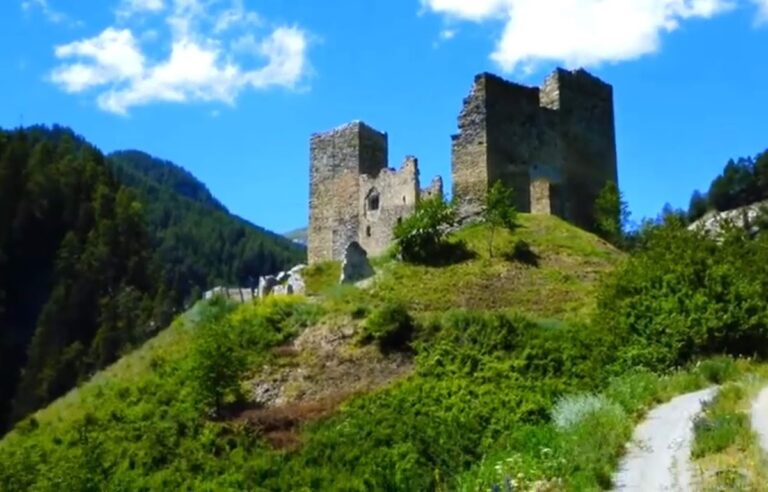
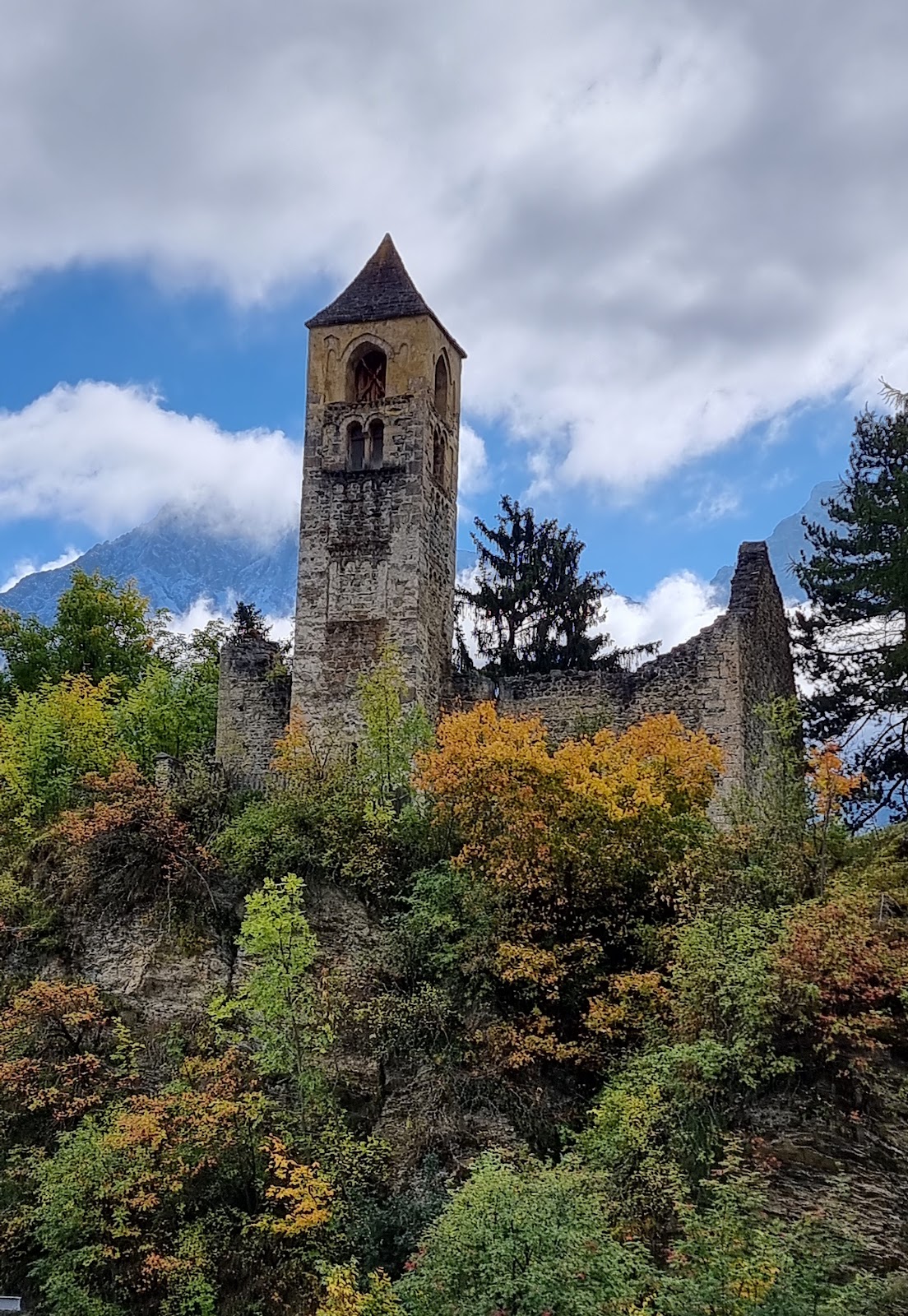
San Peder occupies a rocky hill at the western edge of Sent. The surviving complex consists of a ruined stone church, a medieval bell tower that is itself partly ruined, and the remains of a larger tower on a sloping terrace to the southeast. These structures may once have been joined within a surrounding wall.
Church and bell tower
The ruined Church of St. Peter is a Romanesque stone building associated with the dedication to Saint Peter. Traces of fifteenth-century mural decoration survive in the ruins, although their present condition is not specified. Beside it stands the five-storey bell tower, whose form resembles a medieval watchtower with bells added at the top. Its walls are about 2.2 metres thick at the base and taper to approximately 1 metre near the top. A high entrance on the north wall at the fifth storey appears to have been blocked with masonry. The elevated entrance is consistent with a defensive purpose, while the tower shows no indication of regular habitation. Lansel’s small poet’s room occupies its upper part.
Large defensive tower
Archaeological investigations revealed the remains of a larger tower southeast of the church, positioned on a sloping terrace. It measured approximately 12 by 13 metres, with walls reaching up to 2.3 metres in thickness. The structure was built over the foundations of an earlier building. Small finds now preserved in the Rhaetian Museum place its construction in the thirteenth century. The surviving remains, together with the church and bell tower, may have formed part of an enclosed fortified complex.
Church hill
The hill retains tall larch trees planted by the Corradini family. Together with the ruined masonry and the surviving upper section of the bell tower, they form part of the preserved physical setting of San Peder.