Yokoyama Fudōson: A Soto Zen Buddhist Temple in Miyagi


Site at a Glance
- Rating
- 4.4
- Popularity
- Low
- Country
- Japan
- Primary era
- Medieval
- External website
- Open
- Eras represented
- Medieval, Early Modern
- Civilizations
- Tokugawa
- Site type
- Religious
- Remains
- Temple
On this page12 sections
History
Yokoyama Fudōson is a Soto Zen Buddhist temple in Japan, located in Tome, Miyagi Prefecture. Formally named Daitokuji and known by the mountain name Shirauozan, the temple traditionally traces its foundation to 1156, when Tachibana Chizen is said to have sponsored a small hall for a Buddhist image that had drifted from Baekje. That hall, now called the Okunoin, is regarded as the beginning of the site.
Foundation and Religious Tradition
The temple’s principal deity is Fudō Myōō, a Buddhist figure associated with unwavering resolve and the removal of obstacles. A tradition attributes the small solid-gold image enshrined at Yokoyama Fudōson to Kūkai, the monk traditionally associated with the development of esoteric Buddhism in Japan. The image is approximately 5 centimetres high and is kept inside the larger wooden statue of Fudō Myōō.
The gold image is shown publicly once every twelve years, in the Year of the Rooster. The temple’s recurring religious calendar includes a spring festival on April 27 and 28 and an autumn festival on October 28.
Heian Image and Heritage Protection
The large seated wooden Fudō Myōō image was made during the Heian period, the era of Japan’s imperial court from 794 to 1185. Its form reflects the influence of the Ōshū Fujiwara clan, a powerful ruling family in northern Japan during the late Heian period. Worshipped throughout the region as “Yokoyama Fudō,” the statue was designated an Important Cultural Property of Japan on June 30, 1997.
The temple’s natural and built features have also received formal protection. The pond and its ugui habitat, together with the basins of the Kubo, Naka, and Tera rivers, became a national Natural Monument on August 27, 1935. The bronze five-story pagoda received designation as a Miyagi Prefectural Tangible Cultural Property on January 16, 1957. Ginkgo, cedar, and oak trees at the temple were designated natural monuments of the former Tsuyama Town on April 1, 1994.
Remains
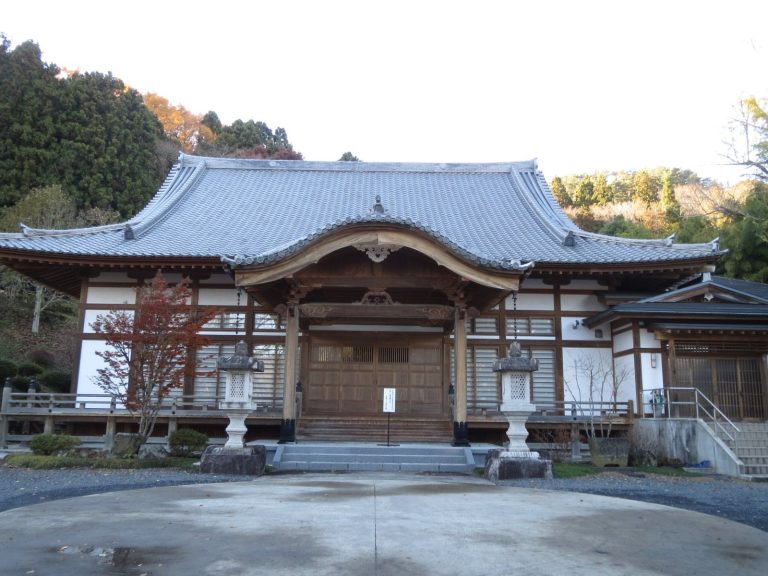
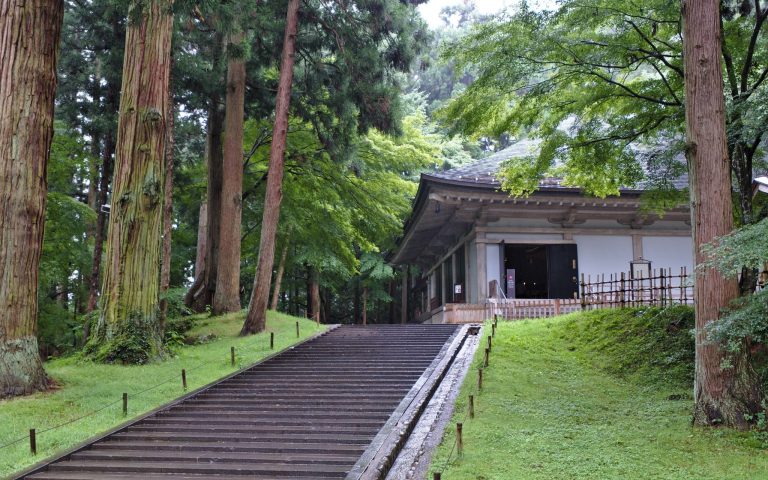
Yokoyama Fudōson stands at the foot of a densely wooded mountain planted with Tsuyama cedars. The complex includes the Fudō Hall, the main hall, and the Okunoin, the small hall associated with the temple’s foundation tradition. Its surviving features combine Buddhist buildings and images with a spring-fed pond, protected fish habitat, notable trees, and a substantial bronze pagoda.
Temple Buildings and Sculptures
Fudō Hall and Okunoin
The Fudō Hall is set against the wooded mountain slope and houses the temple’s principal devotional imagery. The Okunoin is the small hall identified with the site’s earliest foundation tradition. Within the Fudō Myōō image is the solid-gold figure, approximately 5 centimetres high, whose traditional attribution to Kūkai gives it a distinct place in the temple’s religious identity.
Niō Gate
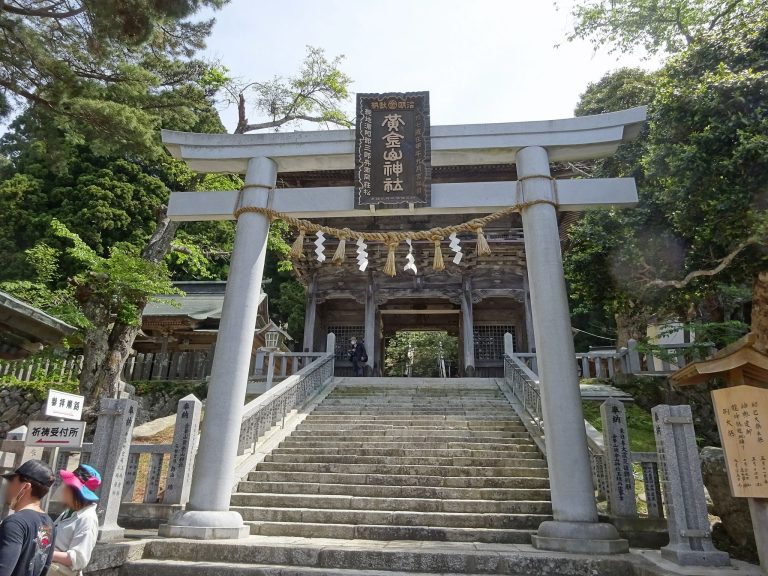
The Niō Gate contains the paired Kongō Rikishi guardian figures. Its upper floor enshrines sixteen Arhat statues, images of Buddhist saints who have attained spiritual liberation. A plaque bearing the name “Shirauozan” carries calligraphy by Yamaoka Tesshū, one of the figures known as the Bakumatsu Three Boats, a sobriquet for three prominent people active during the final years of the Edo period.
Fudō Myōō Statue
Wooden Seated Image
The wooden seated Fudō Myōō is 275 centimetres high and was carved from four katsura-wood members. The blocks are joined along the central vertical line and through the middle of the sides, using joined-block construction, in which a large wooden sculpture is assembled from separately carved timber sections. The statue has undergone little alteration. Almost all of its fingers retain their original form, and the sacred sword in its right hand is considered original.
Pond and Bronze Pagoda
Ugui Habitat
The temple pond was made approximately 400 years ago. Fed by springs, it is oval in plan, measuring about 30 metres from east to west and 15 metres from north to south, with a circumference of approximately 80 metres. Its depth is about 1 to 1.5 metres, and its bottom is sandy and muddy.
The pond supports many ugui, fish of the carp family regarded as messengers of Fudōson. Worshippers have traditionally protected and fed them. During the breeding season, males develop red bellies and are called “akahara.” The fish move into the Kubo, Naka, and Tera rivers to spawn, linking the pond habitat with the protected river basins.
Bronze Five-Story Pagoda
The bronze five-story pagoda is considered to date from 1765. Its stated base measurements are 166.7 and 354.5 centimetres, while its total height above ground is 536.4 centimetres and the tomb beneath it is 195.4 centimetres high. The roofs were cast separately and assembled, and the tower shaft is hollow. A flattened jewel crowns the pagoda, while a relief of Jizō appears on its front.
The pagoda was cast by Takada Teishirō Jien and Hayama Hachirō Tsugikazu of Sendai. Its unusually large size for a bronze five-story pagoda, separately cast roofs, hollow shaft, summit jewel, and Jizō relief distinguish it among the temple’s surviving built features.