Eifuku-ji Temple: A Head Temple and Mausoleum of Prince Shotoku in Japan


Site at a Glance
- Rating
- 4.3
- Popularity
- Low
- Country
- Japan
- Primary era
- Early Modern
- External website
- Open
- Eras represented
- Medieval, Early Modern, Modern
- Civilizations
- Japanese, Tokugawa, Toyotomi regime
- Site type
- Religious
- Remains
- Monastery
On this page23 sections
History
Eifuku-ji Temple is a Buddhist head temple in Japan, located in Taishi in Osaka, traditionally associated with the mausoleum of Prince Shotoku and with the long history of his religious veneration. The temple belongs to the Taishi school within the Shingon Buddhist tradition, an esoteric school associated with ritual practice and the teachings attributed to Kukai. Its mountain name is Shingasan, and its principal deity is Chintamanicakra, represented by a seated image of Nyoirin Kannon, a form of the bodhisattva of compassion associated with a wish-granting jewel and the wheel of Buddhist teaching.
The mausoleum tradition
Temple tradition places the beginnings of the mausoleum in the early seventh century. It states that Prince Shotoku selected the site for his tomb in 620, that his mother, Anahobe no Hashihito, was buried there in 621, and that Shotoku and his consort, Kashiwade no Hokikikimi no Iratsume, were buried there in 622. After Shotoku’s death, Empress Suiko, a ruler of Japan in the late sixth and early seventh centuries, is said to have donated a tract of land measuring six cho square and established a temple there. Temple guardians supposedly lived at the site and maintained offerings at the mausoleum.
Eifuku-ji is traditionally counted among the Three Temples Associated with Prince Shotoku. In this arrangement, Nakano-ji is known as the “Middle Prince” and Daishokugunji as the “Lower Prince,” while Eifuku-ji is called the “Upper Prince.” The temple’s association with Shotoku made it a major center of devotion alongside Horyu-ji and Shitenno-ji. Prince Shotoku was an imperial prince traditionally connected with the early promotion of Buddhism in Japan, and his posthumous religious importance shaped the temple’s identity and traditions.
Foundation traditions and changing names
Another tradition dates the establishment of the temple complex to 724, when Emperor Shomu sponsored two seven-hall monastic compounds. The Eastern Compound was called Tenporinji, while the Western Compound was called Eifuku-ji. Emperor Shomu ruled in the eighth century and was associated with major state-sponsored Buddhist foundations. The 724 account does not appear in the official historical records, and some interpretations place the temple’s actual foundation after the beginning of the Heian period.
The institution was associated at different times with the names Gombyo-ji, Taishi-ji, Seirei-in, Tenporinji, Shinaga-dera, and Ishikawa-dera. The name Eifuku-ji became established from the beginning of the fifteenth century. Taishi-ji, Kamitaishi-ji, and Fumon-ji were also used later. These names reflect the temple’s connections with the mausoleum, Prince Shotoku devotion, and the compounds that formed its religious complex.
Imperial and Buddhist patronage
Eifuku-ji remained an important place of pilgrimage and retreat. Emperors, including Emperor Saga, visited the temple during the Heian period. Between 1171 and 1175, Emperor Takakura ordered repairs to its halls and pagodas. Taira no Shigemori carried out the work on the orders of his father, Taira no Kiyomori.
Buddhist leaders from several traditions are associated with periods of retreat at the temple, including Kukai, Ryonin, Shinran, Eison, Shoku, Ippen, and Nichiren. Kukai, also known as Kobo Daishi, founded the Shingon tradition in Japan. Shinran founded the Jodo Shinshu tradition, while the other figures were major Buddhist leaders associated with different Japanese movements. Their connection with Eifuku-ji reflects the authority that the site derived from its association with Shotoku’s tomb.
War, destruction, and reconstruction
On January 12, 1348, warfare reached the temple and its buildings burned. During the Sengoku period, a time of prolonged military conflict among competing rulers, Eifuku-ji had more than twenty subtemples. Oda Nobunaga’s attack in 1574 caused extensive damage, and no ancient buildings survived. A tradition preserved at nearby Saiho-in instead attributes the burning to Akechi Mitsuhide.
Reconstruction followed under an imperial prayer order from Emperor Go-Yozei. Toyotomi Hideyori restored the monastic complex, and rebuilding continued during the Keicho era. The Jodo Hall was rebuilt in 1597 by Ito Hidemori, while the Seirei-den was rebuilt in 1603. The main hall first took the form of a temporary building in 1715, followed by construction of a permanent main hall in 1732.
In the Edo period, increasing devotion to Prince Shotoku led to Eifuku-ji being praised as “the most sacred site in the three countries.” The temple’s later history also includes the theft of thirty-two Buddhist paintings in 1998, among them a Goryeo painting of the Willow-Branch Avalokitesvara. A Korean theft group was arrested in Seoul in October 2004 and received prison sentences in January 2005. The painting was reportedly taken to Korea and remains missing.
The mausoleum’s status and commemoration
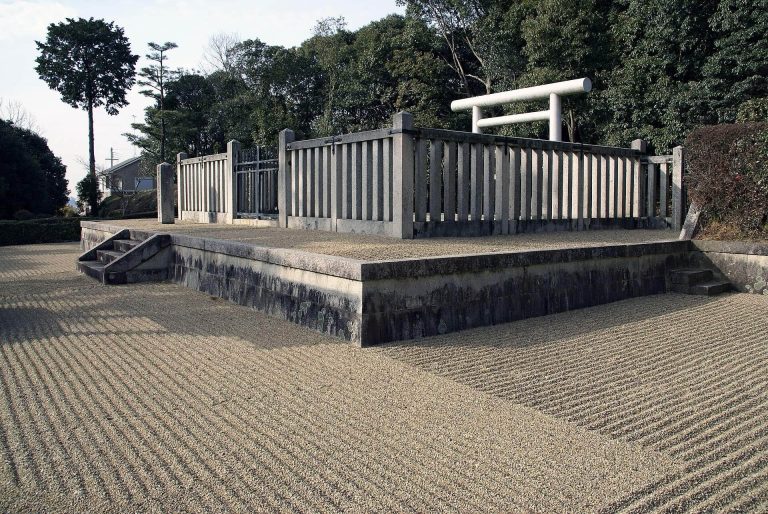
Eifuku-ji’s mausoleum is identified with the tomb of Prince Shotoku, although the identification of the burial mound with Shotoku is disputed and has also been interpreted as a later attribution. The mound is officially designated by the Imperial Household Agency as the imperial tomb called Shinaga no Haka. It was investigated in 1889, and conservation work with limited excavation took place in 2002 to protect its boundary stones.
The temple precinct is a prefectural historic site. The Seirei-den and Tahoto are Important Cultural Properties of Japan. The Kondo, bell tower, stone five-ring pagoda, and stone seated image of Amitabha are tangible cultural properties designated by Osaka Prefecture. A memorial Buddhist observance marking 1,400 years since Prince Shotoku’s death included performances of gagaku, Kōwaka narrative dance, and religious dance.
Remains
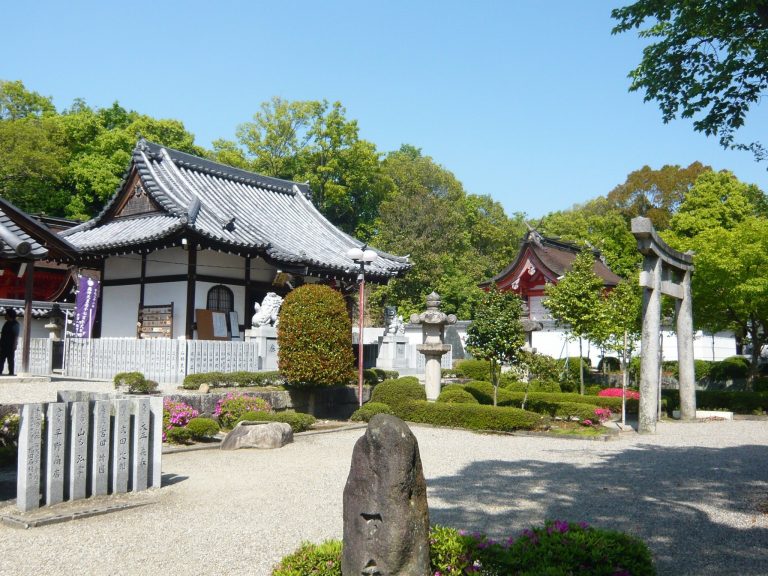
The Eifuku-ji precinct brings together the mausoleum, worship spaces, historic halls, pagodas, a bell tower, subsidiary religious buildings, and a guardian shrine. Its buildings represent several periods of reconstruction from the late sixteenth century through the Edo period, while the central burial mound preserves the physical focus of the temple’s Shotoku tradition.
Prince Shotoku’s mausoleum
Eifuku-ji North Tumulus
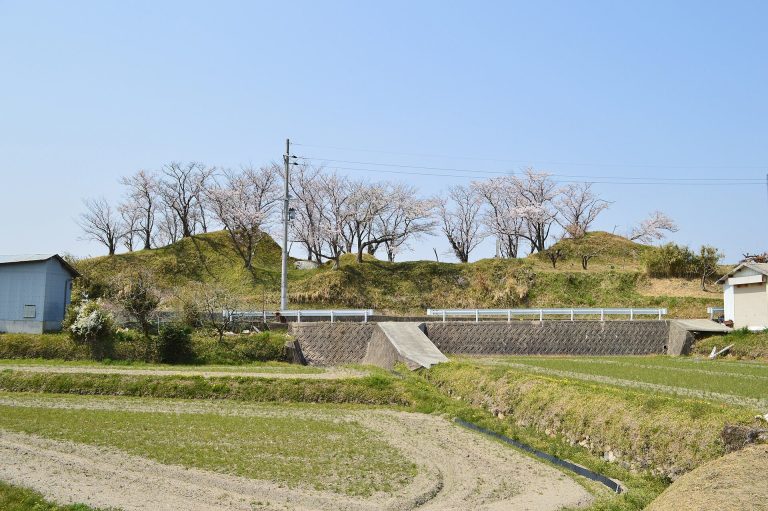
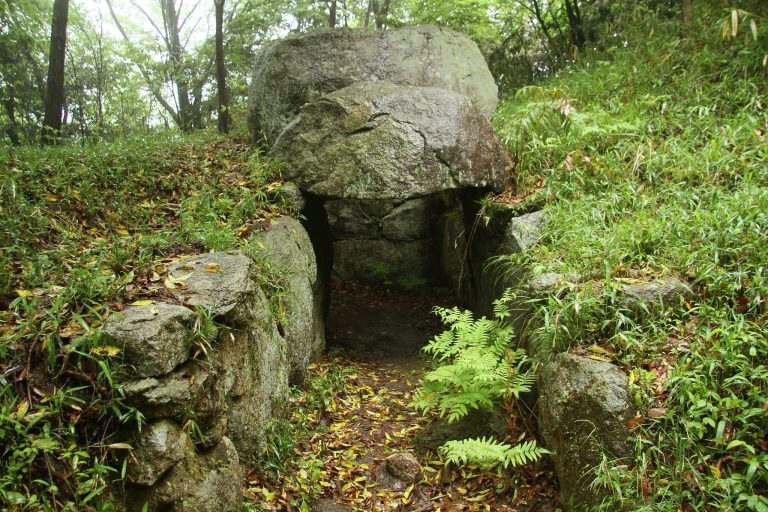
The mausoleum, known as Eifuku-ji North Tumulus, is a circular kofun, or ancient Japanese burial mound, approximately 54.3 meters in diameter and 7.2 meters high. A horizontal stone burial chamber enters from the side of the mound. Tradition holds that it contains three coffins: a central stone coffin for Anahobe no Hashihito, an eastern dry-lacquer coffin for Prince Shotoku, and a western dry-lacquer coffin for Kashiwade no Hokikikimi no Iratsume. Dry-lacquer coffins were formed by hardening layers of cloth with lacquer.
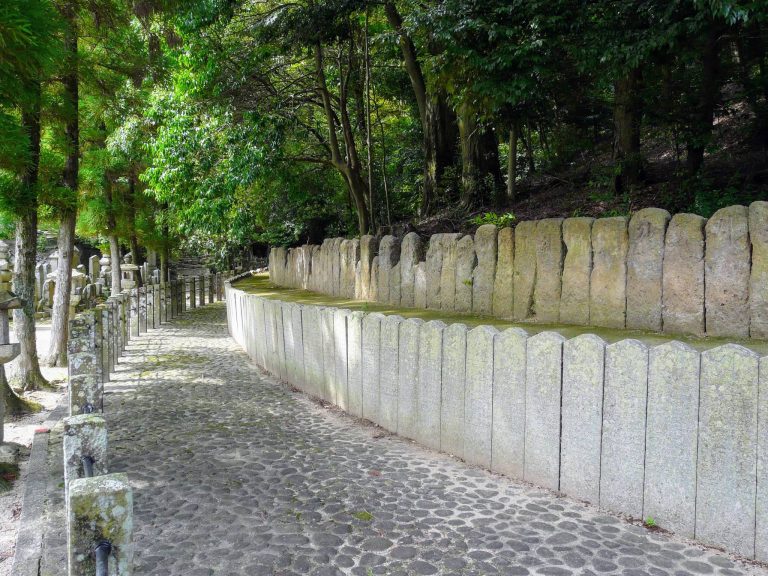
Worshippers could reportedly enter the burial chamber until the Edo period. During the Meiji period, access was restricted, and the entrance was filled with concrete during the 1889 repair and investigation. The coffins were observed at that time, although the human remains were said to have deteriorated completely. Two rows of boundary stones surround the mound. In 2002, the Imperial Household Agency’s Archives and Mausolea Department conserved the stones and excavated three areas at the mound’s foot. The investigation was shown publicly to representatives of archaeological and historical societies on November 14 of that year, and the mound’s actual diameter was suggested to be smaller than 54.3 meters.
Enclosed grove and local traditions
The grove enclosed around the mausoleum is associated with seven local wonders. These traditions say that pine and bamboo do not grow within it, birds do not nest there, and the soil does not collapse after heavy rain. They also say that the number of boundary stones changes whenever they are counted. An inscribed agate stone was traditionally believed to have been discovered in 1054, 430 years after Shotoku’s death, as predicted in one of his writings.
Other traditions connect the grove with Shotoku’s family and burial rites. A camphor tree west of the mound was said to have grown from the pole of the coffin carried by Shotoku during his mother’s funeral. A ninth-century tradition claimed that Shotoku’s body remained warm and supple when inspected, although his clothing had decayed. These accounts form part of the religious and oral traditions surrounding the mausoleum.
Principal worship buildings
Seirei-den
The Seirei-den, also called the Taishi-do, was rebuilt by Toyotomi Hideyori in 1603. It enshrines a statue of Prince Shotoku at the age of sixteen. The single-story building has a tiled irimoya roof, a form that combines a central gable with hipped sides. Its front is three bays wide and measures 7.8 meters, while its five-bay side measures 12.7 meters. A one-bay worship porch projects from the building, and a southern projecting section measures three bays by two bays, approximately 7.5 by 5.3 meters. The entrance hall is listed separately with the building.
Kondo
The Kondo, or main hall, was rebuilt in 1732. It houses the temple’s principal image, a seated Nyoirin Kannon. Fudo Myoo and Aizen Myoo stand as attendant figures. Fudo Myoo and Aizen Myoo are esoteric Buddhist deities commonly represented in ritual temple settings.
Tahoto
The Tahoto was rebuilt in 1652 by Mitani Sankuro, a wealthy merchant from Edo. It is a three-bay pagoda with a tiled roof. The tahoto form has a lower square story and a distinctive rounded upper section.
Jodo Hall and bell tower
The Jodo Hall was rebuilt in 1597 by Ito Hidemori. The bell tower was reconstructed during the Keicho era, probably between 1596 and 1615, although its exact construction date is unknown. Together with the Seirei-den and Tahoto, these buildings represent the reconstruction of the precinct after the destructions of the late medieval and Sengoku periods.
Other precinct buildings
Upper Hall, corridor, and Niten Gate
The Upper Hall and the corridor were built in 1688 on the order of Tokugawa Tsunayoshi by Takagi Masanobu, lord of the Tannan domain. The Niten Gate was constructed under the same commission. These buildings form part of the precinct’s Edo-period architectural group.
Guest Hall and Seiko-myoin
The Guest Hall is traditionally said to have been built during the Tensho era, between 1573 and 1593, using salvaged timbers from Takaya Castle after its fall. The Seiko-myoin subtemple occupies the place where Choshi Maro, a servant of Prince Shotoku, is said to have performed memorial rites for him over a long period.
South Gate and Amitabha hall
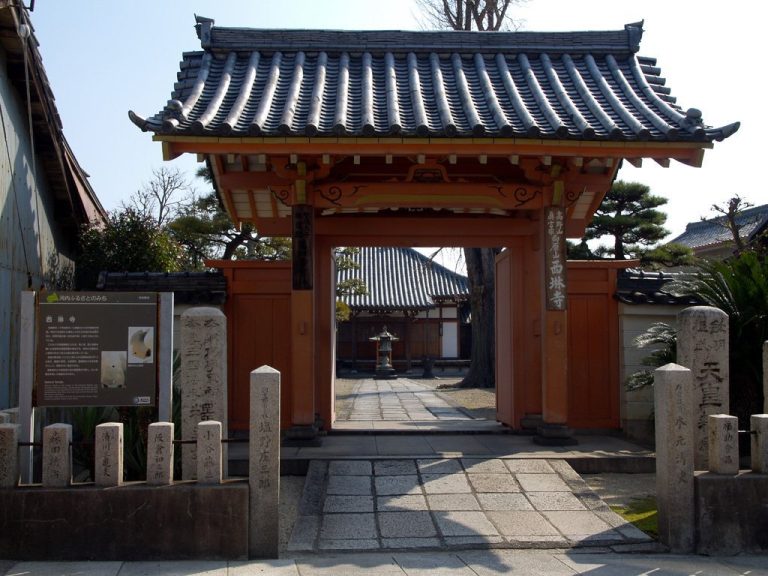
The South Gate was rebuilt in 1958. Its plaque bears the words “Mausoleum of Prince Shotoku,” written by former Prime Minister Kishi Nobusuke. The hall opposite the gate contains a late-Heian-period stone seated image of Amitabha as its principal image.
Sutra Repository and Shinagaoka Shrine
The Sutra Repository is a hexagonal building. The Shinagaoka Shrine serves as the guardian shrine of Eifuku-ji. The precinct also includes the Treasure Repository, monks’ quarters, and a hall associated with the temple’s wider complex.
Kobo Daishi Hall and Great Master Shinran Hall
The Kobo Daishi Hall houses an image traditionally said to have been carved by Kukai while he held a ritual three-pronged vajra. A separate image of Kobo Daishi is also listed within the precinct. The Great Master Shinran Hall was established in 1912 and houses an image traditionally said to have been carved by Shinran when he visited the temple at the age of eighty-eight.
Nembutsu Hall and stone monuments
The Nembutsu Hall is identified as the thirteenth pilgrimage station among forty-eight stations associated with Zenko-ji. A five-ring stone pagoda serves as the tomb of the monk Chuzen, while a three-ring stone pagoda is associated with the mausoleum of Ryonin. A seven-ring stone pagoda commemorates Prince Kuninomiya Kunihiko, a former president of the association supporting devotion to Prince Shotoku, and contains his hair.
A stone five-ring pagoda traditionally regarded as a memorial to Minamoto no Yoritomo stands 2.97 meters high. It was moved in the early Meiji period from the western side of the precinct, formerly the site of Sekito Ritsuin. The garden called Shinanko-en was named by Prince Kuninomiya Kunihiko in 1928.
Related places and spatial traditions
Neighboring Saiho-in, to the south, is traditionally regarded as Japan’s earliest convent and is said to enshrine the three wet nurses of Prince Shotoku. Nanrin-ji, farther south on the extension of the line between the mausoleum and the South Gate, is traditionally said to have served as Eifuku-ji’s four-season lecture hall.
The temple’s association with Shotoku’s life also extends to Tachibana-dera and Ikaruga-dera in Taishi, Hyogo. These three places, including Eifuku-ji, are said to lie on a straight line. Within Eifuku-ji itself, the mausoleum, worship halls, subsidiary buildings, and commemorative monuments preserve the many layers of religious tradition that accumulated around Prince Shotoku’s tomb.