Saint-Vincent Church of Carcassonne: A Gothic Parish Church
Site at a Glance
- Popularity
- Medium
- Country
- France
- Primary era
- Medieval
- Eras represented
- Medieval, Early Modern
- Civilizations
- French
- Site type
- Religious
- Remains
- Church
On this page16 sections
History
Saint-Vincent Church of Carcassonne is a Catholic church in the Bastide Saint-Louis, a planned town on the river’s left bank in France. Its construction is dated to 1269, in the Languedocian Gothic tradition of southern France. Dedicated to Saint Vincent of Huesca, an early Christian martyr, the church is affiliated with the Diocese of Carcassonne and Narbonne and associated with the parish of Sainte-Marie-Reine-en-Pays-de-Carcassonne.
Medieval parish and rebuilding
Before the new town was established, a church dedicated to Saint Vincent stood north of Carcassonne’s Cité, its historic fortified upper town. Saint Michael’s church served the area to the south. Both churches were demolished in 1240 during reprisals after Raimond II Trencavel, a member of Carcassonne’s ruling family, failed in an attempt to retake the Cité.
In 1247, Louis IX, king of France, ordered a town to be built on the river’s left bank. The new town’s northern parish was assigned to Saint Vincent and its southern parish to Saint Michael, continuing the earlier division. The new Saint-Vincent church soon proved too small and was probably built of temporary materials. In 1308, Philip IV authorized the purchase of four houses to make room for an enlargement or, more likely, a replacement. Work began at the west, with the porch and nave preceding the choir. Building the nave took about 60 years, and the choir was completed in the late fourteenth century.
Later use and modern history
During the sixteenth century, the tower served as a lookout. Cannon fire damaged it during the Wars of Religion, the conflicts between Catholics and Protestants in France, and it was later repaired. In 1794, the church became a foundry for artillery carriages. At the population’s request, it returned to religious use on 26 August 1795.
Restoration began in 1871. In 1905, during an inventory of church property under the French law separating church and state, parishioners and the parish priest, Father Peyre, resisted the officials. After they forced the door with an axe, parishioners who had spent the night inside held a silent protest, and the inventory was suspended. The church belongs to the City of Carcassonne and was classified as a historic monument in 1907. A major restoration campaign began in the twenty-first century.
Remains
Plan and interior structure
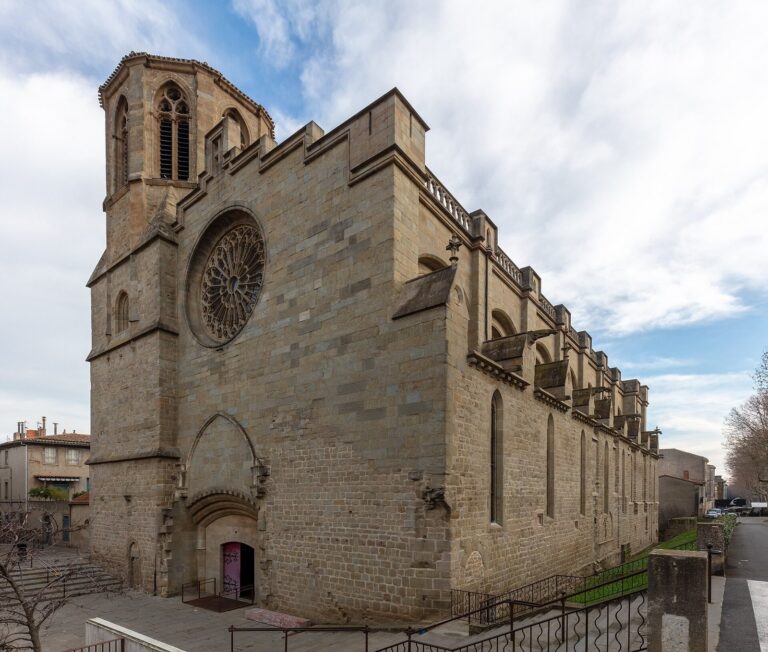
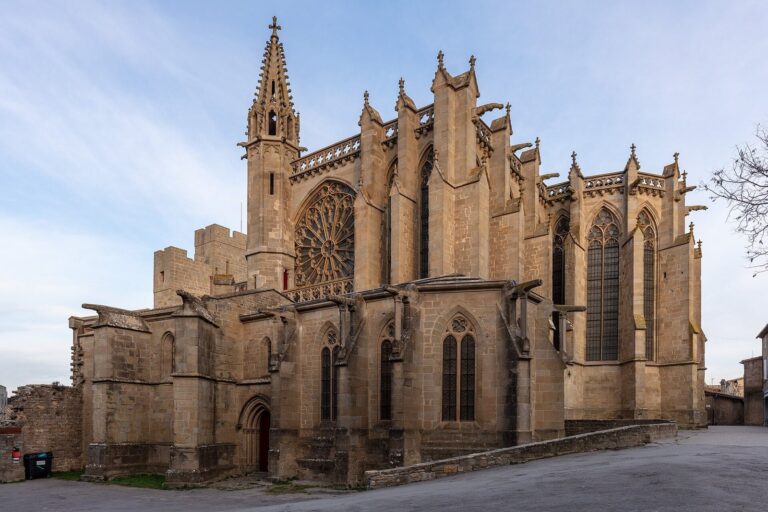
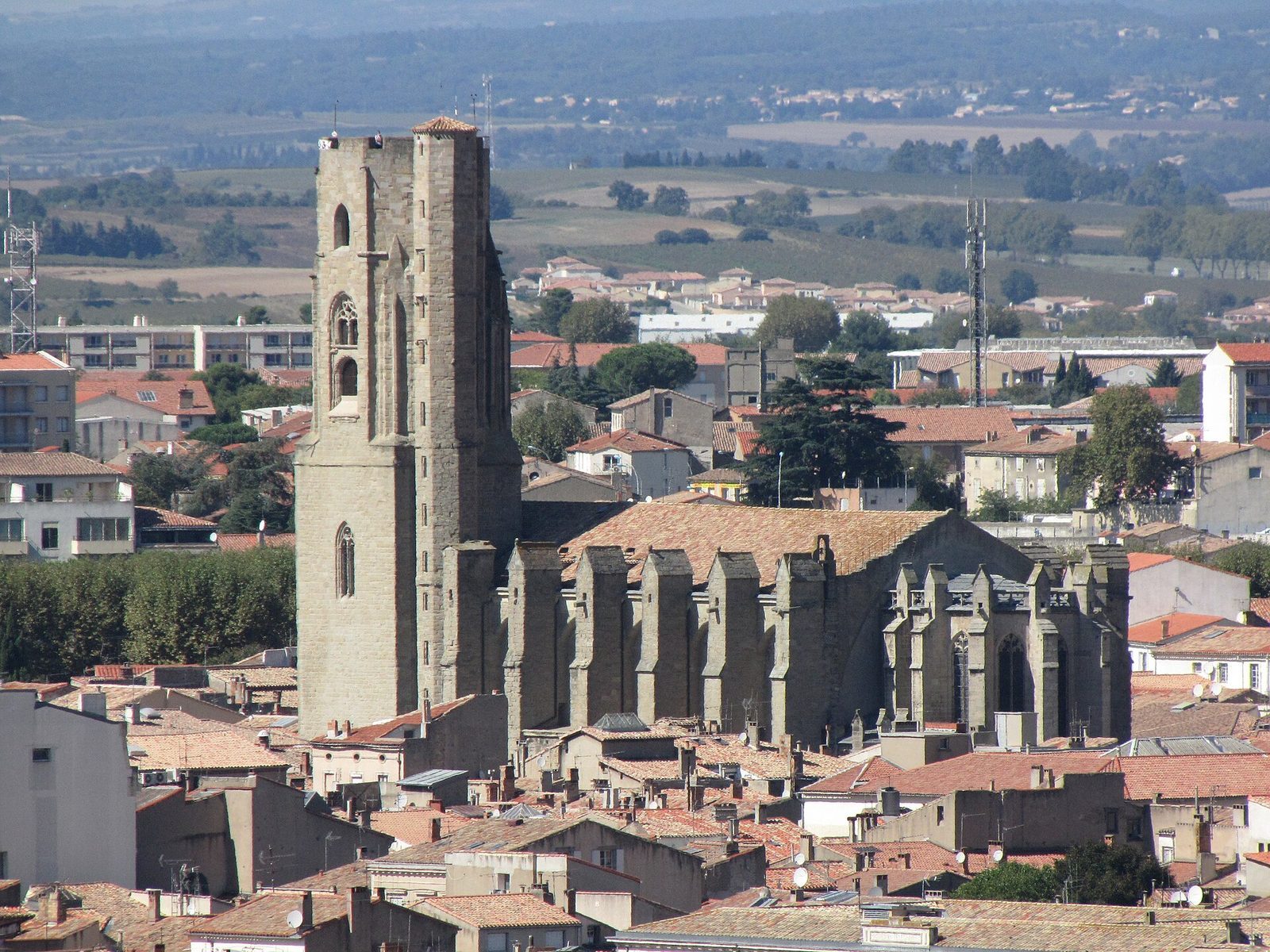
The church has a single nave, with six side chapels on the north and seven on the south. At the east end, a nine-sided main apse is flanked by two smaller, seven-sided apses. This arrangement also appears at Carcassonne’s Saint-Michel Cathedral. The building measures 62.5 metres long and 30.5 metres wide; its interior measures 56.6 by 27 metres.
Nave and chapels
The nave is 37.8 metres long and 20.15 metres wide, with a vault about 25 metres above the floor. Carved keystones and capitals mark its first four bays as work from the first half of the fourteenth century. The last two bays belong to the second half of that century and introduce more elaborate flamboyant decoration, an ornate form of late Gothic design. The side chapels retain their original vaults.
The nave was first roofed with exposed timber supported by transverse arches, which divide the space and carry the roof. A gallery was added in 1737, followed by vaulting over the gallery and nave. This work required the church to close for a year in 1753.
Choir and eastern apses
The choir measures 10 metres by 10 metres. Its apses and the sacristies date to the fifteenth century but follow the earlier fourteenth-century plan. Five windows with elaborate late Gothic stonework light the main apse. The choir retains its original vaults.
West entrance and tower
Portal and façade
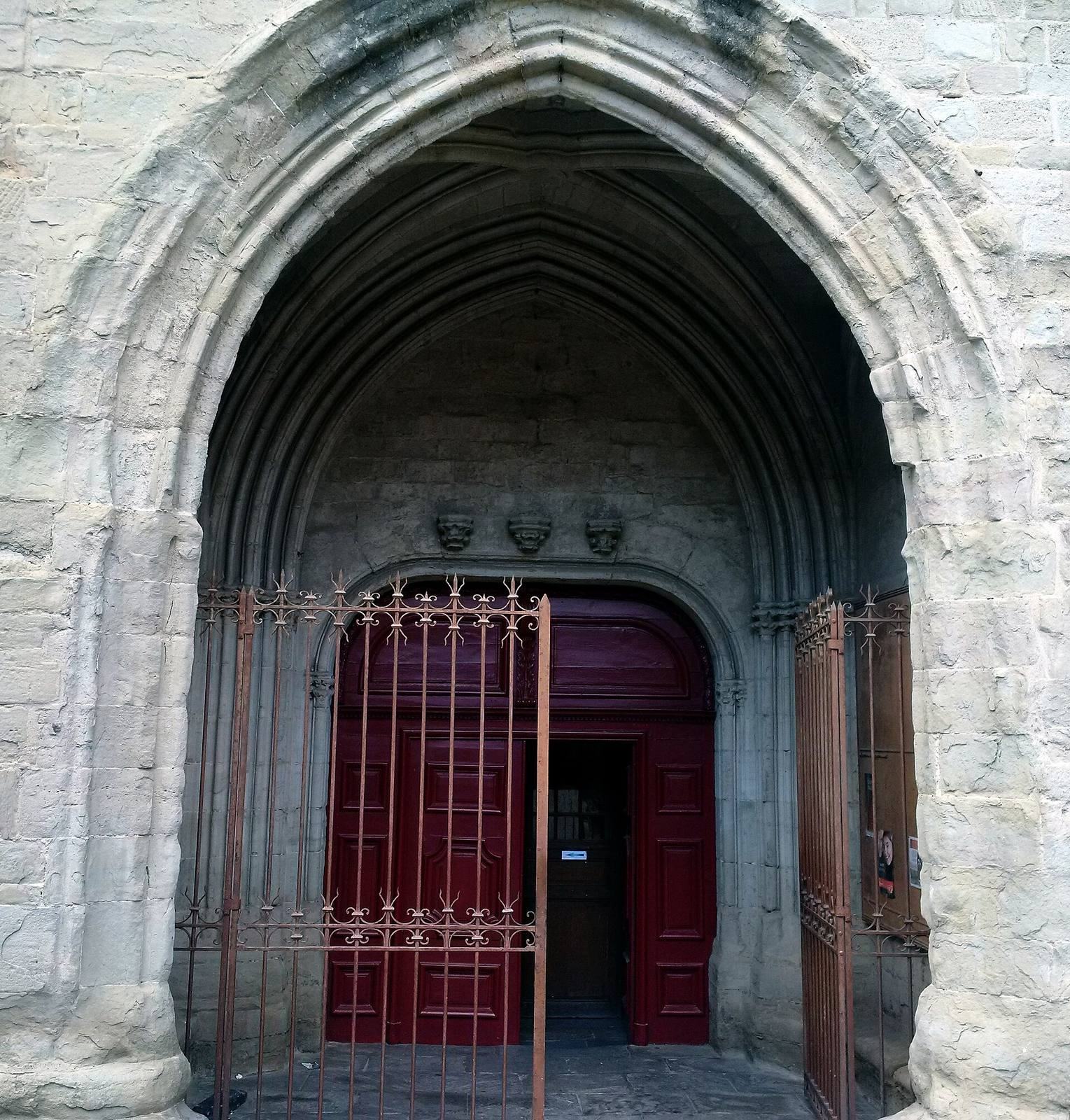
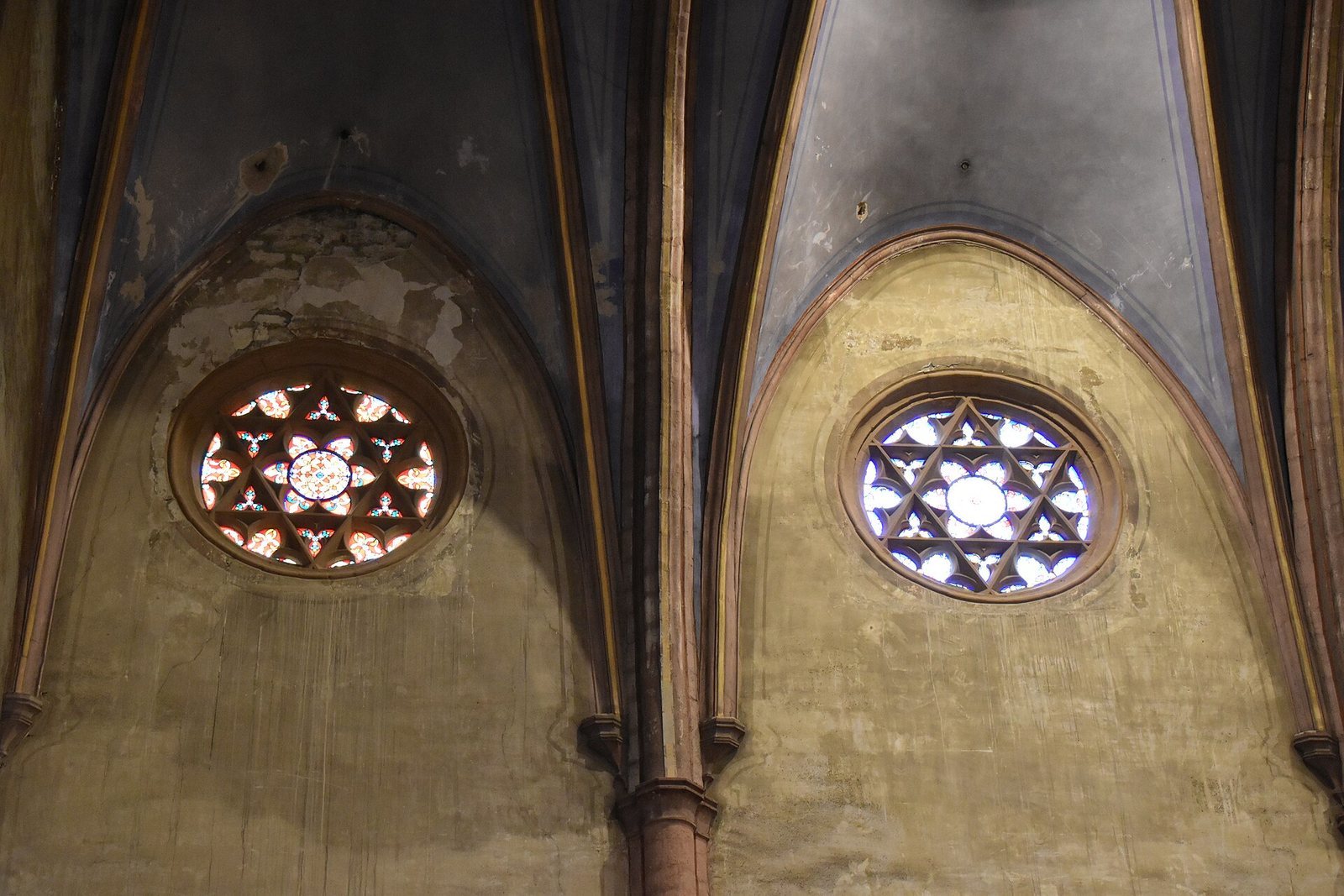
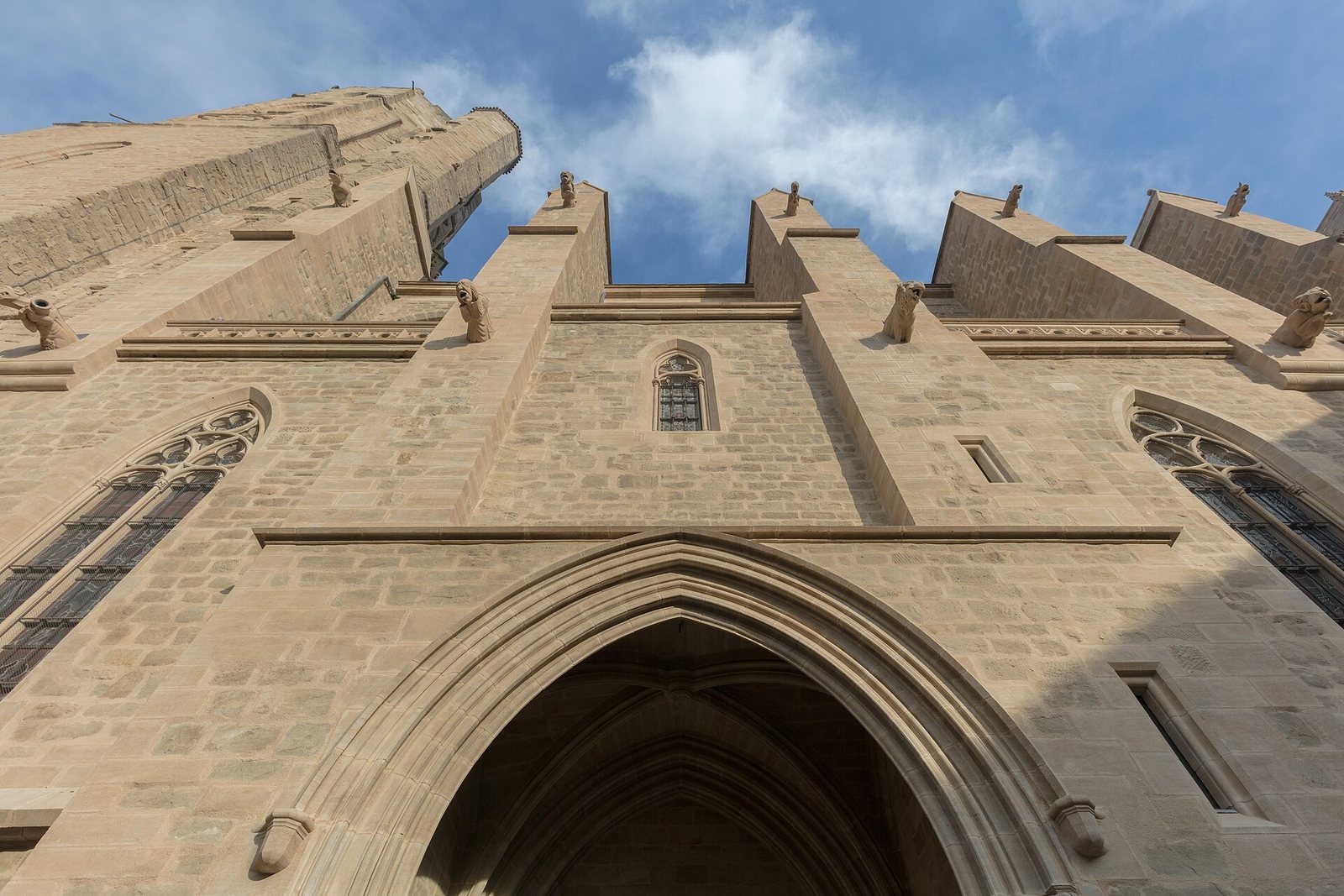
The western façade dates to the 1320s. Its monumental entrance is crowned by a large gable with radiating ornament. Four full-length statues beneath canopies portray Saint Vincent, two apostles, and Saint Louis, the name by which Louis IX was also known. The statues were moved into the entrance vestibule in 1956. The western rose window measures 4.5 metres across.
Bell tower
The tower rises 54 metres and has a square base with an octagonal upper form. Its two lower, square-plan levels date to the second quarter of the fourteenth century; a date of 1327 is recorded in the second chamber. The upper levels and a separate turret supported by projecting stone brackets at the northeast corner were added in the first half of the fifteenth century. The tower contains 232 steps.
Carillon
The tower’s carillon, a set of bells played as a musical instrument, now has 54 bells and ranks tenth nationally. The installation had seven bells in 1710; these were melted down to produce a 17-bell carillon in 1773. One bell, Andrène, had André Beraud, a cloth merchant and churchwarden, as its godfather in tribute to his nephew, the poet André Chénier, who spent seven years of his youth in Carcassonne.
Furnishings and artworks
Altar, pulpit, and sculpture
The high altar and pulpit are made of polychrome marble. The pulpit dates to 1773. A monumental lectern and a wooden statue of Saint Vincent, both from the seventeenth century, came from the workshop of sculptor Jean-Jacques Melair.
Paintings
Nine paintings by Jacques Gamelin are visible in the church. Four, painted around 1778, depict the Finding of the True Cross. Pierre Subleyras’s Communion of Saint Jerome hangs above the north door, while Nicolas Mignard’s Christ on the Cross between the Virgin and Saint John is above the south entrance.
Organ
The church’s organ was commissioned in 1737 from Toulouse organ builder Christophe Moucherel and has since been restored with the city’s support. Its case has five towers topped by statues of two large musician angels and a central Saint Vincent. Carved musical instruments, including a flute, lute, and tambourine, decorate the bases on either side of the keyboard.
Commemorative panel
Parishioners made a commemorative panel from fragments of the door that officials forced open during the 1905 inventory protest.