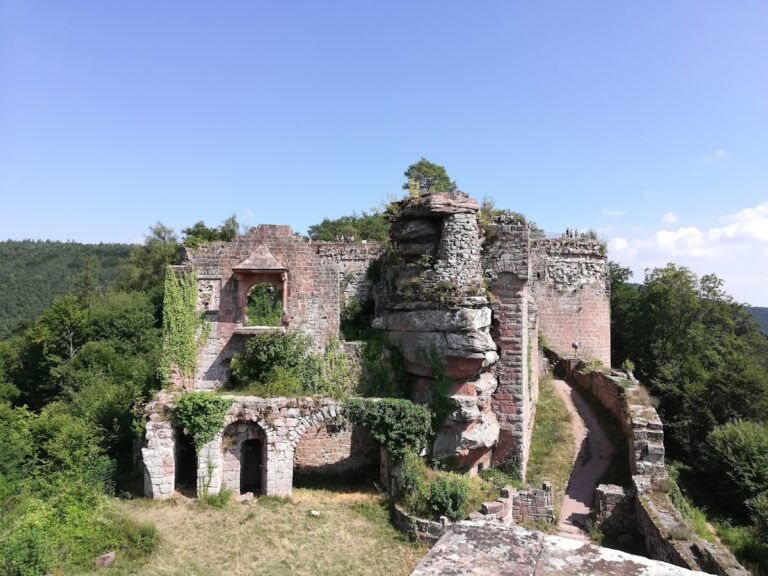
Scharfenberg Castle: A Hohenstaufen Rock Castle in Germany


Site at a Glance
- Rating
- 4.4
- Popularity
- Low
- Country
- Germany
- Primary era
- Medieval
- External website
- Open
- Eras represented
- Medieval
- Civilizations
- Holy Roman Empire
- Site type
- Military
- Remains
- Castle
On this page7 sections
History
Scharfenberg Castle, also known as Münz, is a medieval rock castle above Annweiler in Germany, in the municipality of Leinsweiler, Rhineland-Palatinate. Built during approximately 1100–1150 under Conrad III, a Hohenstaufen king, it probably began as a state prison. The castle later formed part of the Trifels Group with Trifels and Anebos, a group of medieval castle sites above the Queich valley.
Hohenstaufen origins and medieval ownership
The castle was constructed during the Hohenstaufen period, the era associated especially with the dynasty’s twelfth- and thirteenth-century rule. Its name came from the later Scharfenberg ministeriales family. Ministeriales were service nobles who performed administrative, military, and estate-management duties for rulers or ecclesiastical institutions.
In the early thirteenth century, Scharfenberg became the family seat of Conrad III of Scharfenberg, a German churchman and political official who served as Bishop of Speyer and Chancellor of the Holy Roman Empire. This Conrad III was distinct from the Hohenstaufen king under whom the castle had been built. The Holy Roman Empire was the medieval political and religious empire whose institutions included the imperial chancellery.
The name Münz and the destruction of the castle
The popular name Münz has often been associated with Annweiler’s privilege to mint coins, granted with its town rights in 1219. The idea that coins were struck at the castle is considered impractical because of its isolated position and distance from Annweiler. Münz is more probably derived from the Latin munitio, meaning “fortress” or “stronghold.”
Scharfenberg Castle was destroyed during the Peasants’ War in 1525, a broad uprising in the German lands against aspects of lordly and ecclesiastical authority. It has remained a ruin since that destruction. The castle is now classified as a protected monument zone, and extensive safety and conservation work was carried out on behalf of the state of Rhineland-Palatinate between March 2021 and October 2024.
Remains
Hilltop setting and castle layout
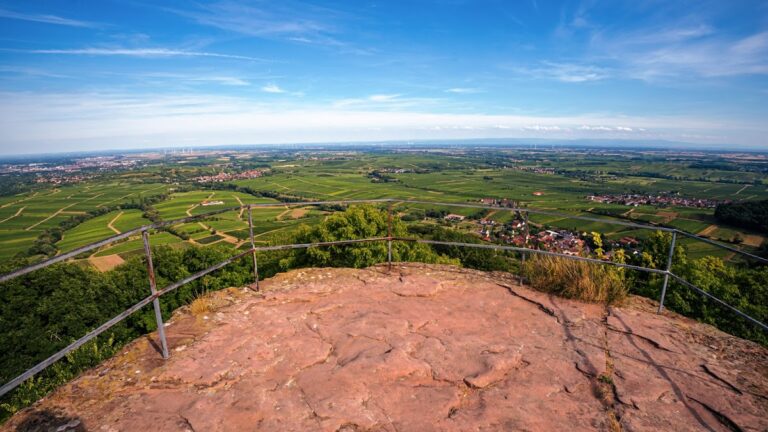
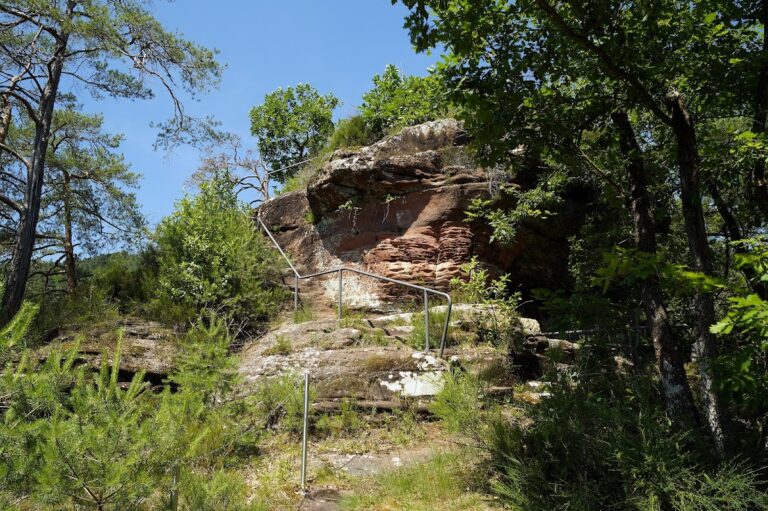
Scharfenberg is a hilltop rock castle at approximately 477 metres above sea level, on the rocky southeastern summit of the two-peaked Scharfenberg. The summit rises to about 485 metres and has the rounded rock form characteristic of the Wasgau region. The castle group occupies the heights above the Queich valley, where Scharfenberg stands with Trifels and Anebos. Münzfels and Fensterfels lie on the northwestern slope of the castle hill or on the saddle leading towards Anebos.
Upper castle and bergfried
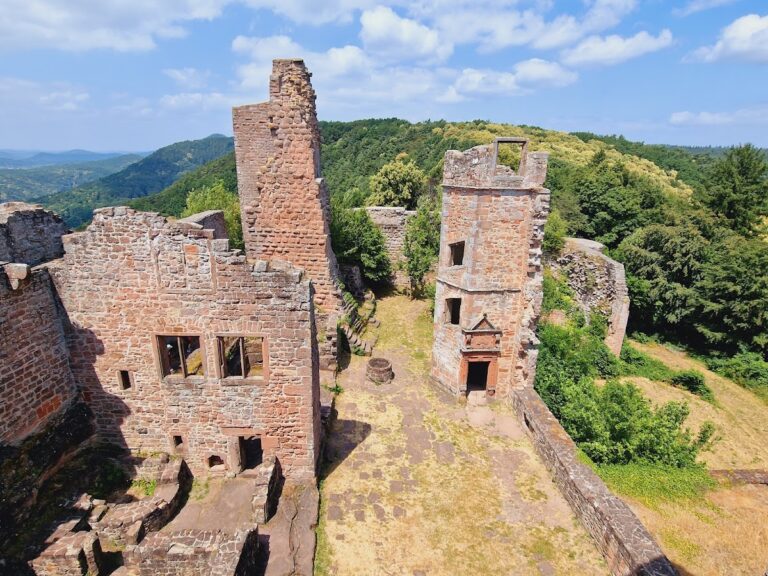
The upper castle contains a highly visible bergfried, the principal defensive tower of a medieval German castle, approximately 20 metres high. Its walls are faced with rusticated ashlar, cut stone with deliberately roughened outer faces, associated with the Hohenstaufen period.
Lower castle defenses
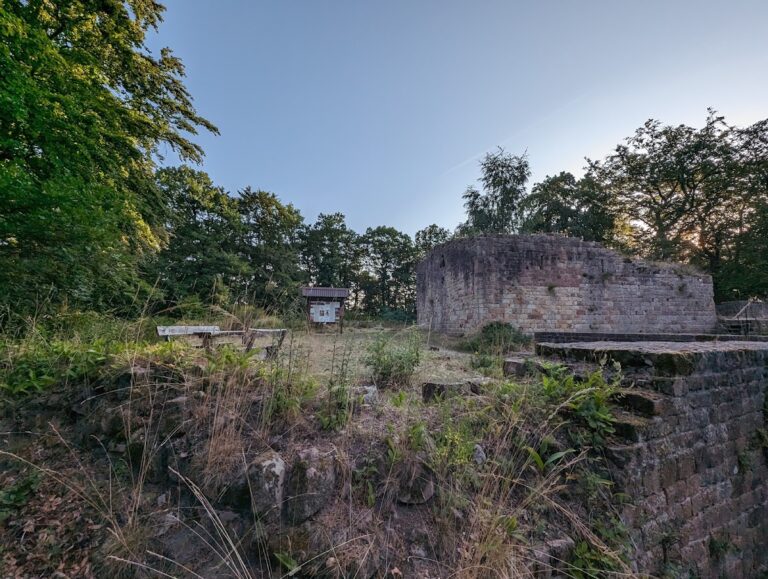
Parts of the well tower and the enceinte, or enclosing defensive wall, survive in the lower castle. Other surviving elements include sections of the defensive walls and a moat, preserving parts of the castle’s fortified perimeter alongside the remains of its towers.