Dominican Monastery of St. Peter Martyr: A Fortified Gothic Monastery in Croatia


Site at a Glance
- Rating
- 4.6
- Popularity
- Low
- Country
- Croatia
- Primary era
- Early Modern
- External website
- Open
- Eras represented
- Early Modern, Modern
- Civilizations
- Venetian
- Site type
- Religious
- Remains
- Fortified Monastery
On this page14 sections
History
The Dominican Monastery of St. Peter Martyr is a fortified Gothic monastery in Stari Grad, Croatia, founded for the Order of Preachers, the Catholic religious order commonly called the Dominicans. Its foundation was authorized by a bull, a formal papal document, issued by Pope Sixtus IV on 7 August 1481. Construction took place during the sixteenth century, while the Church of St. Peter Martyr was completed in 1488.
Foundation and fortification
The monastery was strengthened after the Ottoman fleet attacked Hvar in 1539 and 1571. These assaults led to the construction of a double defensive enclosure with two round corner towers. The fortification works were completed in 1586, giving the religious complex a military character as well as its original ecclesiastical purpose.
Church rebuilding and the Hektorović connection
The church underwent repairs during the sixteenth and seventeenth centuries. In the nineteenth century, it was demolished and replaced by a new church designed by N. Nikolić of Split. The monastery is also closely associated with Petar Hektorović, a sixteenth-century Dalmatian poet and humanist from Hvar. In 1559, he donated stone blocks from the ancient Greek settlement of Pharos to the monastery, and he was later buried in his family mausoleum there.
The monastery houses a museum whose collections range across paleontology, archaeology, and art. A separate section is devoted to Hektorović and includes books and objects from his estate, placing his family’s connection with the complex alongside the monastery’s wider historical collections.
Remains
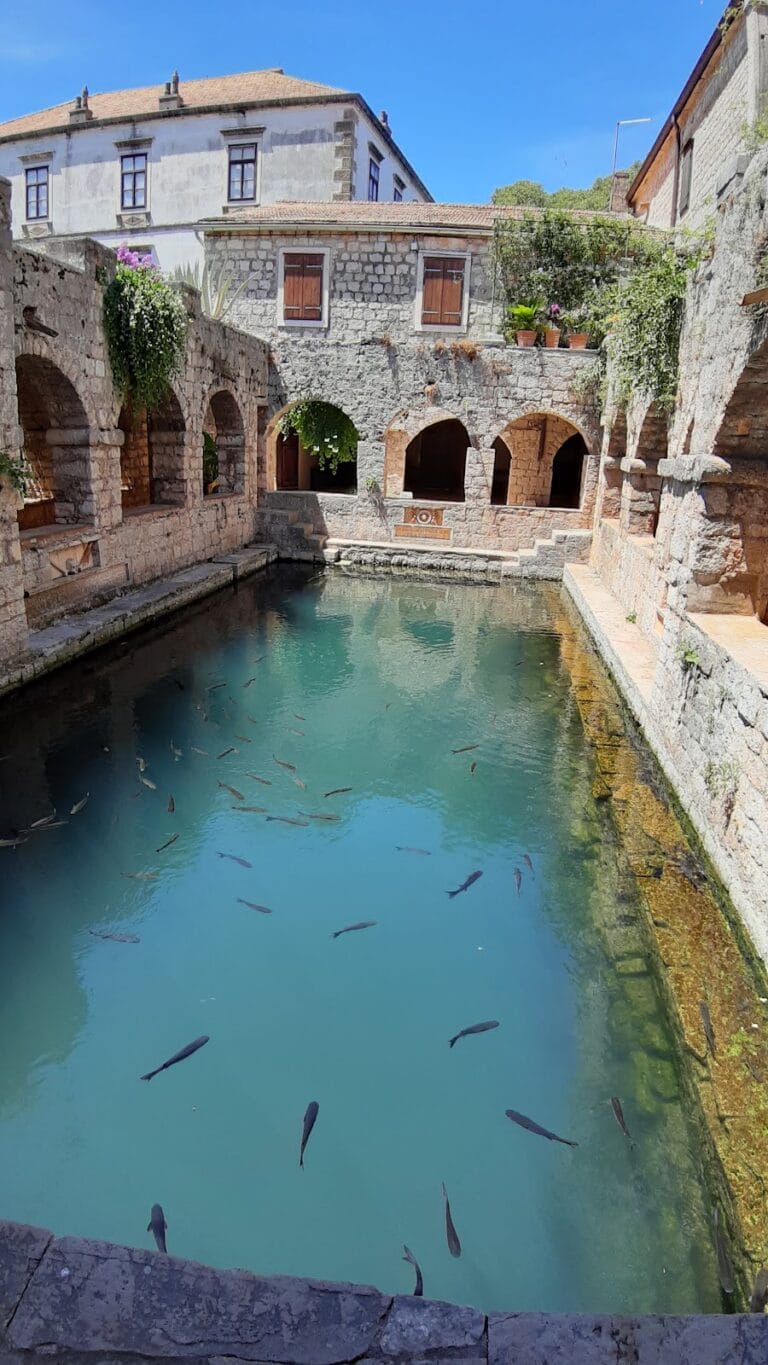
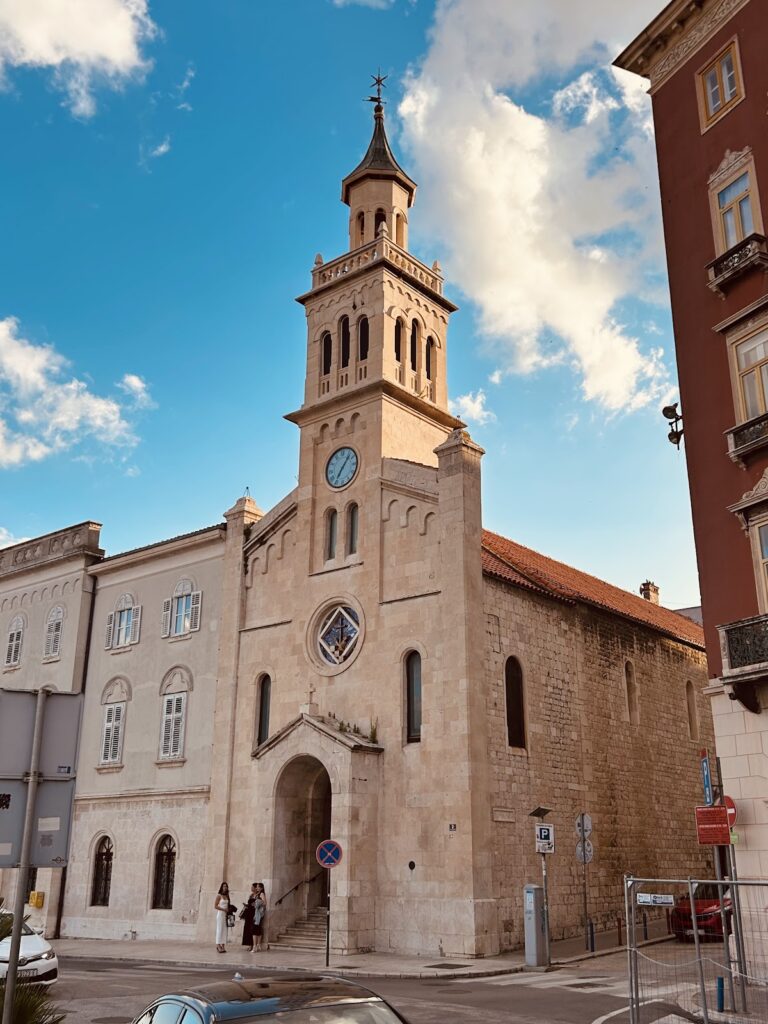
The surviving complex is an enclosed Gothic monastery organized within a double defensive wall, with two round towers at the corners. Its buildings combine religious, commemorative, and defensive functions. Reused stone from ancient Pharos forms the bell tower, linking the monastery’s later construction with the ancient settlement established at Stari Grad on Hvar.
Fortified enclosure
Defensive walls and towers
The double defensive wall encloses the monastery, while two round corner towers reinforce its perimeter. The fortifications belong to the works completed in 1586 after the Ottoman attacks of the sixteenth century. Their surviving arrangement defines the complex as a fortified religious foundation rather than an open monastic group.
Bell tower
The bell tower is built from stone blocks taken from the ruins of Pharos. The reused material preserves a physical connection between the monastery and the ancient Greek settlement beneath and around modern Stari Grad.
Church of St. Peter Martyr
Nineteenth-century church
The present Church of St. Peter Martyr is the nineteenth-century replacement for the earlier church completed in 1488. Its interior painted decoration was created by Ivan Zamala of Zadar. A wooden crucifix dated 1786 remains inside, together with the Rosary altar made by Andrija Bruttapelle, who lived from 1728 to 1782.
Rosary altar painting
The painting on the Rosary altar was made by Andrea Michieli Vicentino in 1606. It shows representatives of the Holy League, a Christian alliance formed against the Ottoman Empire, giving thanks to the Virgin Mary for the alliance’s naval victory at Lepanto in 1571.
Museum collections
Paleontological and archaeological collections
The paleontological collection includes fish fossils, among them specimens of the genus Thrissops. The archaeological holdings include Stone Age finds dated to 7000–3000 BC from the inhabited caves of Markova Spilja and Grapčeva Spilja, as well as material from prehistoric settlements around Dol, Vrbanj, and Dračevica.
Objects from the Greek settlement of the fourth and third centuries BC and the subsequent Roman settlement include inscribed stone fragments, stones bearing votive and funerary motifs, Greek coins, and pottery. Votive objects were offered as acts of devotion or in fulfillment of vows, while funerary objects relate to burial or commemoration.
Early Christian and medieval material
The museum contains material from the Early Christian period, dated to the ninth and tenth centuries. It includes stone fragments from a pre-Romanesque church in Stari Grad, meaning an early medieval church built before Romanesque architecture became widespread, along with ceramic lamps. Medieval Dalmatian coins and jewelry from the fourteenth and fifteenth centuries extend the collection into the later medieval period.
Reliefs, paintings, and crucifixes
Among the preserved works are the original Roman relief of an ancient ship from the bell tower of the Church of St. Stephen I, Pope, and a Gothic relief of the Madonna from the Church of St. Jerome. A separate room contains The Lamentation of Christ by the Italian painter Jacopo Robusti Tintoretto. The painting originally stood in Hektorović’s private chapel, and local tradition identifies Hektorović and his daughter Lucrezia among the figures.
The art collections also include a Baroque crucifix made in 1703 by the Venetian woodcarver Giacomo Piazzetta, who lived from 1640 to 1705. It is regarded as the most beautiful Baroque crucifix in Dalmatia. Hektorović’s family mausoleum lies within the monastery and bears the Latin description Mausoleum sive sepulcrum, meaning “mausoleum or tomb.”