Dōjō-ji Temple: A Historic Tendai Buddhist Temple in Wakayama


Site at a Glance
- Rating
- 4.2
- Popularity
- Medium
- Country
- Japan
- Primary era
- Medieval
- External website
- Open
- Eras represented
- Classical, Medieval, Early Modern
- Civilizations
- Ashikaga shogunate, Tokugawa, Yamato
- Site type
- Religious
- Remains
- Temple
On this page13 sections
History
Dōjō-ji Temple is a Tendai Buddhist temple in Hidakagawa, Japan, whose traditions place its foundation in 701 during the early eighth century. Its mountain name is Amanezan, and its principal deity is Senju Kannon, the thousand-armed form of Kannon, the Buddhist bodhisattva of compassion. The temple’s early history is connected with Emperor Monmu, the monk Gien, and a builder from the Ki clan, although the traditional foundation accounts cannot be fully verified. Excavation confirms that a temple stood on the site by the beginning of the eighth century.
Foundation and early development
One foundation tradition describes the temple as an imperial project requested by Emperor Monmu. Another says that the emperor established it at the request of his wife, Fujiwara no Miyako, who was the mother of Emperor Shomu. Miyako’s place in the story is closely linked to the legend of the “Long-Haired Princess.” According to this tradition, she was born to a fishing family at Kuama-no-Sato, in the area of present-day Gobō. After prayers to Hachiman brought a daughter who initially had no hair, her mother found a small golden Kannon image beneath the sea. The village’s fishing prosperity returned, and Kannon appeared to Miyako in a dream before her hair began to grow.
The legend continues with a bird carrying one of Miyako’s hairs to the eaves of Fujiwara no Fuhito’s mansion in Nara. Fuhito, a powerful statesman of the early eighth-century imperial administration, discovered the hair, found Miyako, and adopted her. She became known as Fujiwara no Miyako, later the empress of Emperor Monmu and the mother of Emperor Shomu. Unable to forget her home and the Kannon image, she asked for a temple to be built for it, and the resulting temple was identified with Dōjō-ji.
Versions of the story differ in detail. Some name the bird as a swallow rather than a sparrow and describe Miyako’s parents as village headmen. An illustrated biography gives a different account of the area’s original nine settlers, presents Miyako as one of them, says she had hair from birth, and states that she found and carried the golden Senju Kannon image in her hair.
Schools and institutional prosperity
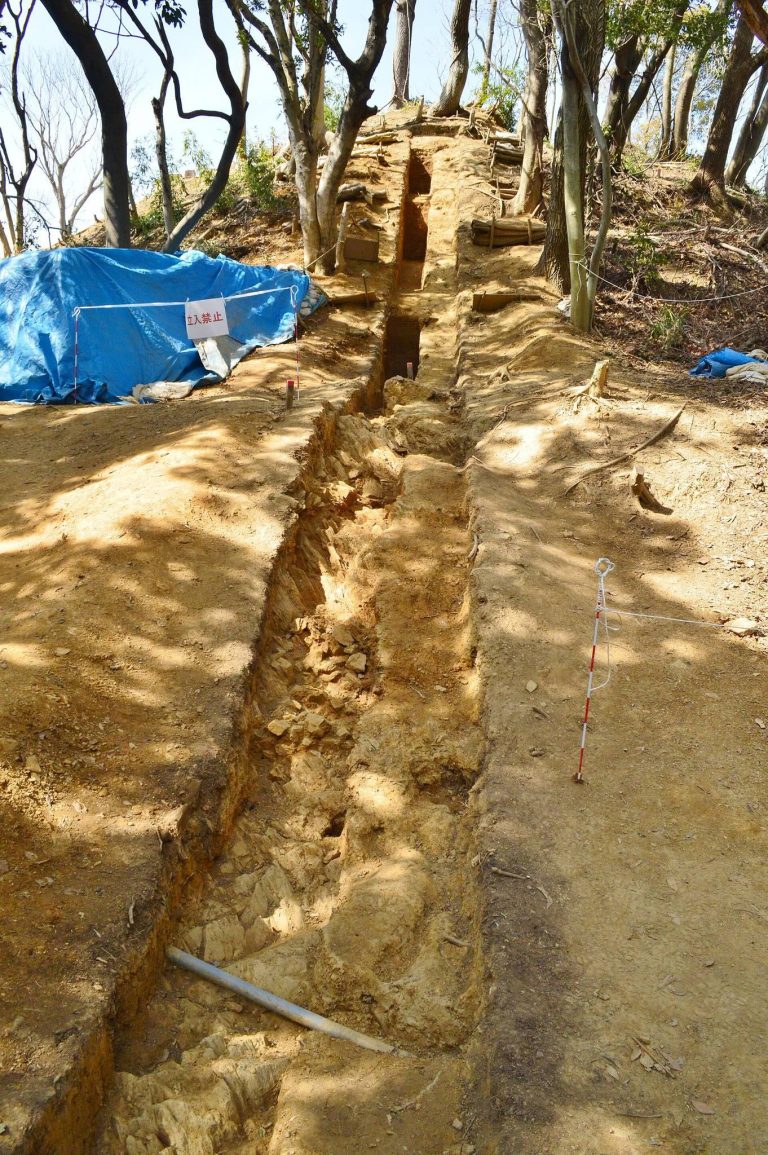
Dōjō-ji was initially affiliated with the Hosso school of Japanese Buddhism and later with Shingon. It joined the Tendai school in 1652. Investigations carried out in several phases since 1978 revealed an eighth-century temple complex. Roof tiles place the temple’s existence in the early eighth century, while the completed arrangement had taken the form of a Kanzeonji-style plan by the middle of that century. This plan placed a pagoda and a main hall opposite one another inside a cloistered courtyard. The Middle Gate and cloisters were completed around 800.
During the early and middle Heian period, from the late eighth to the late twelfth century, the temple held a large body of Buddhist sculpture and is thought to have reached the height of its institutional prosperity. The present Main Hall was completed in 1357, and a second temple bell was made two years later.
Destruction and rebuilding
Dōjō-ji declined after the medieval period and was largely destroyed in 1585, when Toyotomi Hideyoshi conquered Kii Province. The Main Hall survived, while the other buildings were burned and the second bell was taken. A document from 1588 states that the Main Hall and a guardian Shinto shrine were the remaining buildings.
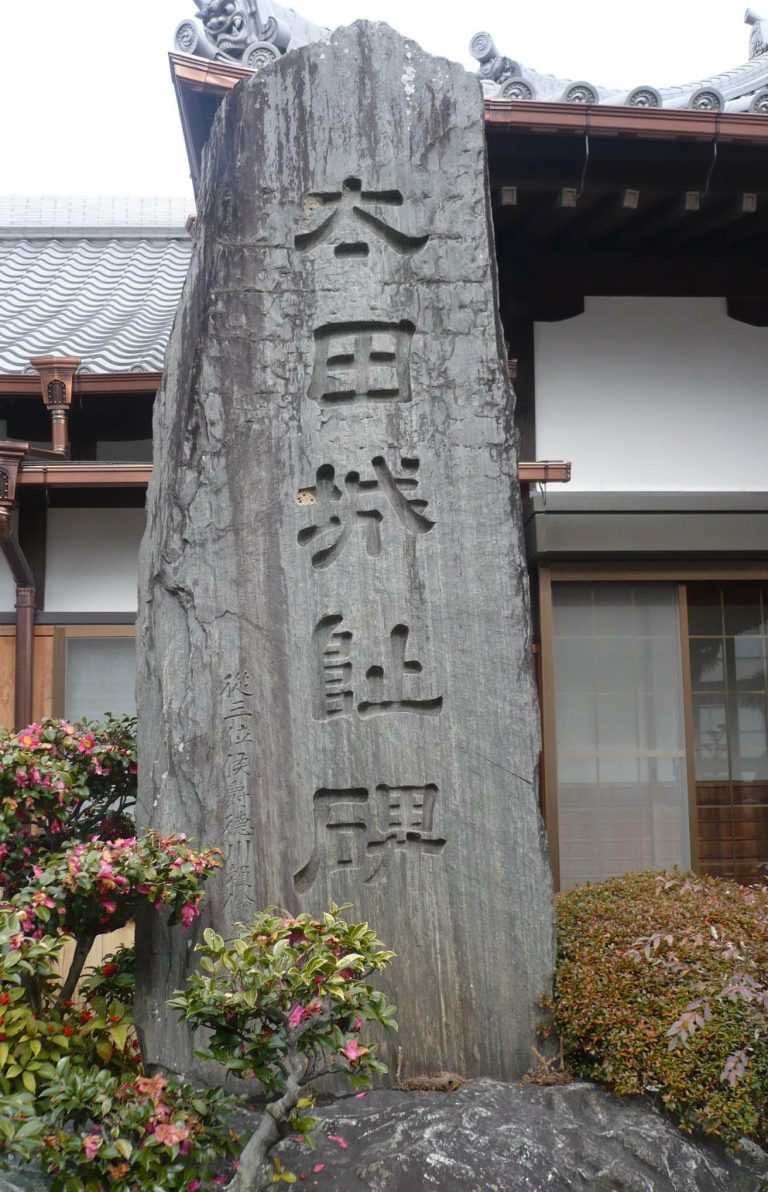
In 1655, Tokugawa Yorinobu, lord of Kishū Domain, financed repairs that included replacing the Main Hall’s roof. The Niomon and other buildings were restored or rebuilt gradually during the early-modern period, including the three-storey pagoda. The precincts were designated a National Historic Site of Japan in 2013. The Main Hall, Niomon, and illustrated Dōjō-ji Engi scrolls are Important Cultural Properties, while the Senju Kannon and two associated bodhisattva statues are National Treasures.
Legends and religious traditions
Dōjō-ji is also associated with the story of Anchin and Kiyohime. In this legend, the monk Anchin is pursued and destroyed by Kiyohime after she transforms into a serpent. The tale appears in a Heian-period collection of Buddhist miracle stories and later became the subject of Noh, Kabuki, and Bunraku performances. These include the Noh play Dōjōji and the Kabuki work Musume Dōjōji. The temple’s Engi Hall presents the story through illustrated-scroll narration and explanatory preaching.
Dōjō-ji is the fifth pilgrimage temple of the New Saigoku Thirty-Three Kannon Pilgrimage. It is also included in the Tokai-Kinki Jizo Pilgrimage and in the Sacred Sites and Pilgrimage Routes of Japan.
Remains
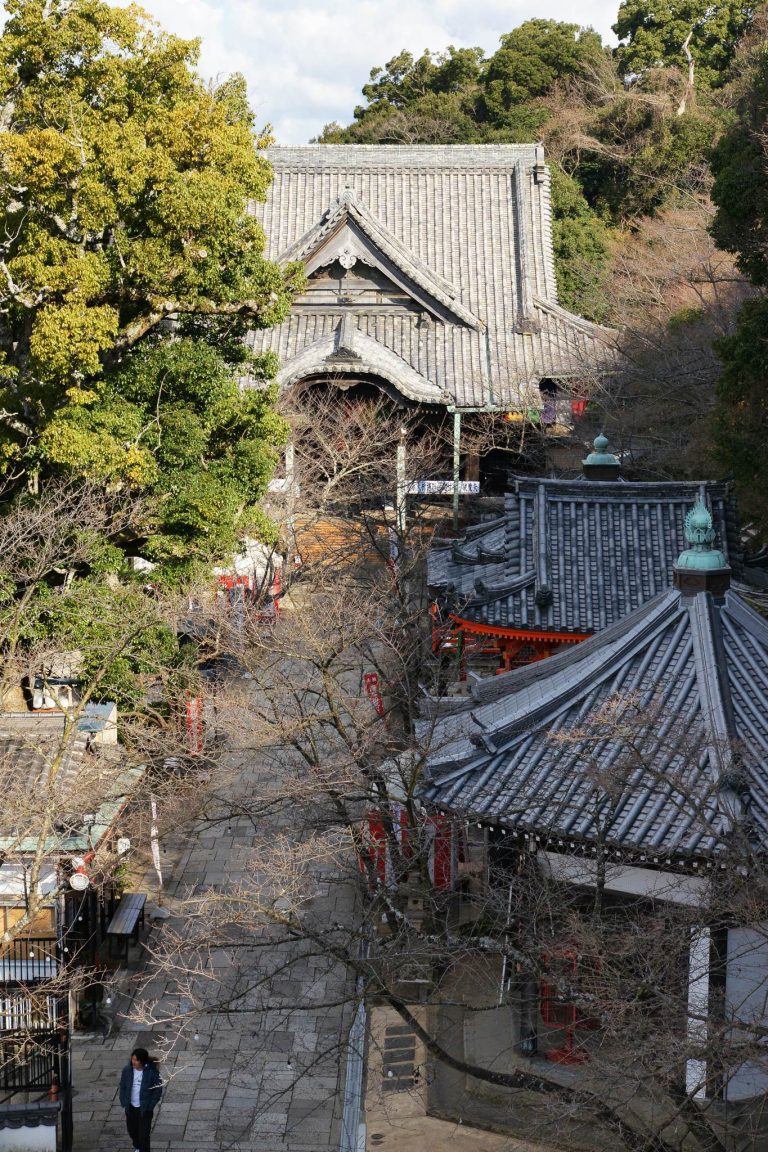
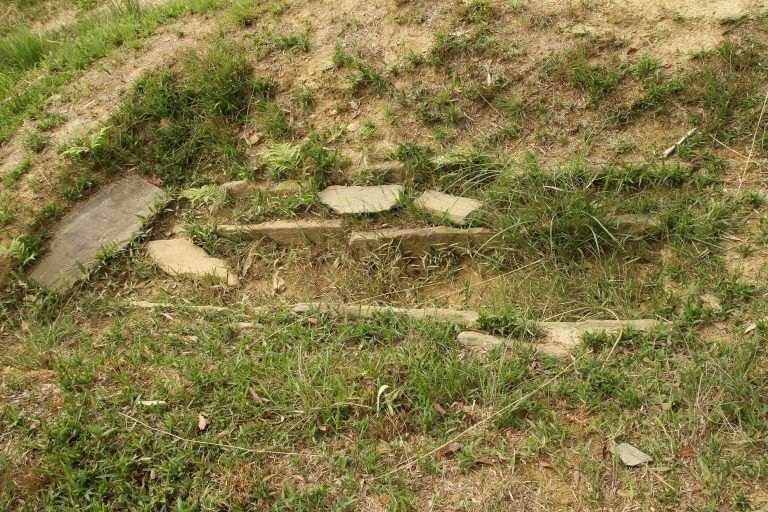
The surviving precincts combine the foundations of an eighth-century Buddhist complex with buildings dating from the fourteenth through eighteenth centuries. Excavation revealed the positions of the Nara-period Main Hall, pagoda, Middle Gate, Lecture Hall, and cloisters. The cloisters ran from both sides of the Middle Gate, enclosed the central precinct in a rectangular space, and reached the sides of the Lecture Hall.
Eighth-century temple plan
In the mature eighth-century arrangement, the pagoda stood on the east and the Main Hall on the west within the cloistered courtyard. The present Niomon, three-storey pagoda, and Main Hall occupy, respectively, the former Middle Gate area, the pagoda site, and the position of the Lecture Hall. The earliest arrangement probably began with a central Buddhist hall in the place later occupied by the Lecture Hall, with the pagoda and Main Hall added afterward.
Medieval and early-modern buildings
Main Hall
The Main Hall is a single-storey, tiled-roof building completed in 1357. It follows the irimoya-zukuri form, whose roof combines a hipped section with gabled ends, and has a seven-by-five-bay plan. A bay is the structural interval between supporting pillars. The building has eight pillars across the front and six across the rear. Before its dismantling and repair, it housed two Senju Kannon images, one facing south and the other north.
Niomon and three-storey pagoda
The Niomon is a three-bay, single-door gate in romon form, a gate with an upper storey, and has an irimoya-style tiled roof. Built in 1694, it is approached from the south by a long stairway. The three-storey pagoda was erected in 1763 near Anchin-zuka, the mound traditionally identified as Anchin’s burial place.
Other precinct buildings
The Shoin dates from 1702. The Enma Hall, also called the Hall of the Ten Kings, is one of the named buildings in the precincts. To the northwest stands the Goma Hall, a ritual building associated with Shingon fire rites. The grounds also contain a three-shrine guardian Shinto sanctuary and a bell tower, along with two other precinct features whose functions are unspecified.
Engi Hall
The building containing the Dōjō-ji Engi Hall stands to the southwest. It is associated with observances concerning Anchin and Kiyohime and with presentations of the temple’s illustrated history. A serpent-form representation of Kiyohime is also identified among the precinct features.
Sculpture and illustrated records
A Senju Kannon discovered during the Main Hall’s dismantling and repair in 1985 is a Nara-period work. The temple also preserves a Nara-period wooden-core, dry-lacquer Senju Kannon, a Heian-period Eleven-Headed Kannon, a Heian-period Bishamonten, and wooden statues of the Four Heavenly Kings.
The National Treasure group consists of a wooden standing Senju Kannon and two wooden standing bodhisattvas traditionally identified as Nikko and Gakko. The Nikko and Gakko figures date from the Heian period and represent bodhisattvas associated with sunlight and moonlight. Other surviving works include a seated Shaka Nyorai Triad from the Nanbokucho period.
The Dōjō-ji Engi comprises two Muromachi-period painted handscrolls on paper depicting the temple’s foundation legend. Illustrated-scroll explanations of the Anchin and Kiyohime story continue as part of the temple’s ritual and interpretive presentation.