Mitsujō Kofun: A Kofun-Period Burial Cluster in Japan

Site at a Glance
- Rating
- 4.2
- Popularity
- Low
- Country
- Japan
- Primary era
- Classical
- External website
- Open
- Eras represented
- Classical, Medieval
- Civilizations
- Yamato
- Site type
- Burial
- Remains
- Necropolis
On this page6 sections
History
Mitsujō Kofun is a cluster of three Kofun-period burial mounds in Japan, located in Higashihiroshima on the southern edge of the Saijō Basin. Built during the era when large earthen burial mounds were constructed across Japan, the group occupies the tip of a hill extending northward from Yawata-yama. No. 1 Kofun, the principal mound, was probably built in the first half of the fifth century, during the middle Kofun period, and an analysis of excavated Sue ware dated its construction to AD 412.
The three burial phases
No. 2 Kofun was constructed slightly before No. 1, probably also in the first half of the fifth century. No. 3 Kofun followed in the first half of the sixth century, during the late Kofun period. Together, the mounds show that the burial area continued to be used across more than one phase of the Kofun period.
No. 1 Kofun is regarded as a chief burial mound representing the Aki region during the middle Kofun period. One interpretation connects it with the Aki provincial chieftaincy described in the Kokuzō Honki section of the Sendai Kuji Hongi, a medieval Japanese historical text concerning hereditary provincial chieftains. This proposed identification remains a theory rather than an established attribution.
Investigation and preservation
An excavation took place in 1951, with its results reported in 1954. Further archaeological investigations were undertaken from fiscal years 1987 to 1991 in connection with a preservation and improvement project, and the complete report was published in 2004. The three mounds were designated collectively as a National Historic Site on June 3, 1982, and the protected area was expanded on January 29, 2001.
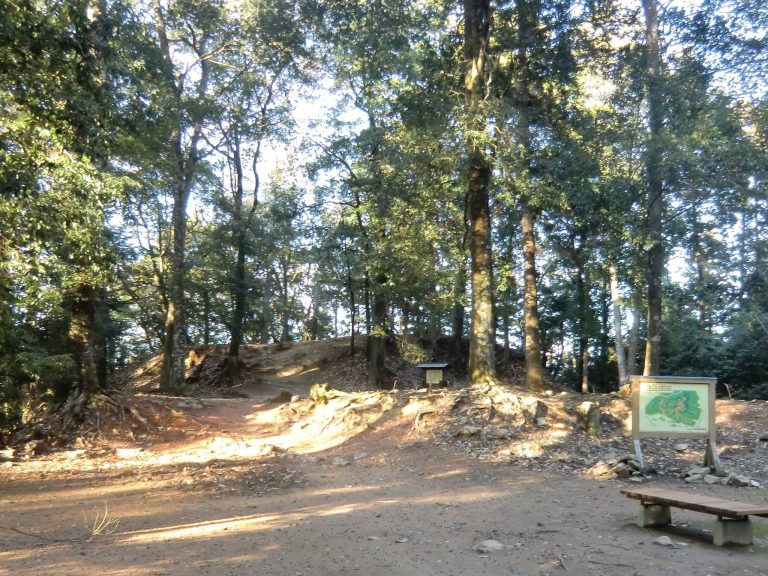
Preservation and restoration work continued from fiscal years 1990 to 1993, followed by preservation repairs in fiscal year 2018. The restored remains are maintained as Mitsujō Neighborhood Park.
Remains
No. 1 Kofun
No. 1 is a keyhole-shaped mound, with a circular rear section joined to a squarish front section. It measures approximately 92 meters in length, making it the largest kofun in Hiroshima Prefecture. The front section faces east-northeast, and the mound rises in three tiers. Its rear circular section is about 62 meters in diameter and 13 meters high, while the front section is approximately 66 meters wide. Its plan has been interpreted as possibly resembling that of Tsukuriyama Kofun in Okayama Prefecture.
Stone surfacing covered the mound, which also carried rows of cylindrical haniwa, clay objects placed on or around burial mounds. Other haniwa represented houses, lids, chickens, waterfowl, shields, quivers, helmets, and short cuirasses. Approximately 1,800 haniwa were used across the mound. Projecting platforms stood at both corners where the front and rear sections meet, and Sue ware, a high-fired Kofun-period pottery, together with Haji ware, a lower-fired earthenware tradition, was found in these areas. A dry moat approximately one meter deep surrounded the mound.
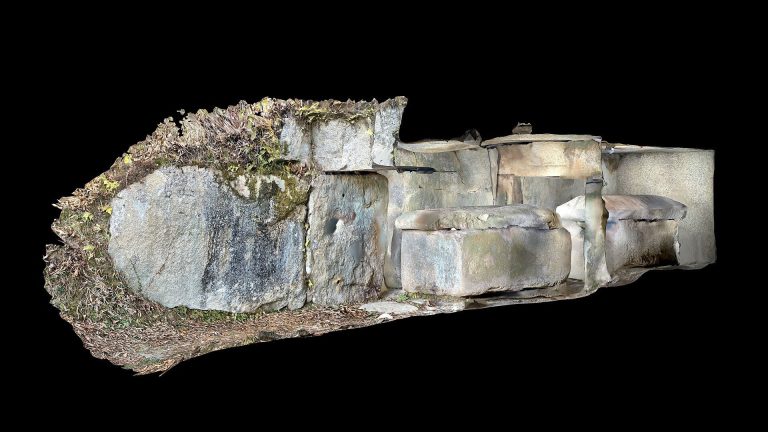
Three box-shaped stone coffins were placed at the top of the rear section. Burial Facilities 1 and 2 had an unusual double construction: stones were arranged around each coffin to create an outer stone chamber, which was then covered with lid stones. Burial Facility 3 was a standard stone-coffin burial and had a pit outside the coffin for depositing grave goods.
Burial Facility 1 contained human remains, 18 beads, a bronze mirror, and two iron swords. Burial Facility 2 held human remains, four beads, four combs, a bronze bracelet, an iron sword, two small iron knives, and an iron fitting. Burial Facility 3 contained five beads, two iron swords, an iron spearhead, and 80 iron arrowheads.
No. 2 and No. 3 Kofun
No. 2 is a round mound west of No. 1, measuring approximately 25 meters in diameter and four meters in height. It had stone surfacing but no identified haniwa. A single box-shaped stone coffin occupied the summit. The coffin was lost at an early stage, so its details are unknown.
No. 3 lies west of No. 2, within the ditch separating that mound from the southern hill. It is an oval mound approximately eight meters along its major axis, four meters along its minor axis, and one meter high. Its box-shaped stone coffin measures about 1.5 meters in length and between 0.2 and 0.5 meters in width. The site has been restored through the preservation works carried out across the mound cluster.