Digne Cathedral: A Gothic and Neo-Gothic Cathedral in France


Site at a Glance
- Rating
- 4.4
- Popularity
- Low
- Country
- France
- Primary era
- Medieval
- External website
- Open
- Eras represented
- Medieval, Early Modern, Modern
- Civilizations
- French
- Site type
- Religious
- Remains
- Cathedral
On this page10 sections
History
Digne Cathedral is a Roman Catholic cathedral in Digne-les-Bains, France, dedicated to Saint Jerome and built between 1490 and 1500 in Gothic form. It is the seat of the Diocese of Digne, Riez and Sisteron and one of the town’s two cathedrals. Saint Jerome was a fourth-century Christian scholar and translator best known for producing the Latin Vulgate Bible.
The medieval episcopal seat
Digne may have been an episcopal seat from the fourth century, although this early status is presented as a tradition. During the medieval period, the town was divided between an elevated castle quarter and a settlement around it. The earlier cathedral, Notre-Dame-du-Bourg, was a thirteenth-century late Romanesque building. As the town developed, it became too small and increasingly marginal to the main centre of settlement.
Construction on Rochas hill
From the sixteenth century onward, the cathedral on Rochas hill replaced Notre-Dame-du-Bourg as the town’s principal episcopal seat. Antoine de Guiramand, bishop of Digne from 1479, promoted the new building as population moved toward a higher, safer, and more defensible location near the local castle. Construction took place between 1490 and 1500 under Antoine Brollion, a master mason from Barcelonnette. The original plan contained a central nave of four bays with aisles, while chapels were added along the aisles during the seventeenth century.
Nineteenth-century transformation
Between 1846 and 1862, the diocesan architect Antoine-Nicolas Bailly substantially altered the cathedral. He extended the west end by adding another bay and redesigned the main façade in a style inspired by thirteenth-century Gothic architecture. In 1853, the artistic blacksmith Pierre Boulanger made the ironwork and door hinges for the west façade.
The building was classified as a French historic monument by an order dated 30 October 1906. On 31 July 1962, it became a co-cathedral, meaning that it shares the seat or title of a bishop with another cathedral. The large gallery organ was built by Cavaillé-Coll in 1865 and restored by Simon in 1994. Its instrumental section has been protected since 20 October 1976.
Remains
Digne Cathedral stands in the heart of Digne-les-Bains on Rochas hill. It is a three-aisled church combining Gothic and Neo-Gothic forms. The central nave rises above the side aisles but has no independent upper lighting. The surviving building brings together the fifteenth-century structure, seventeenth-century chapel additions, and the enlarged west end created during the nineteenth-century remodelling.
Exterior and west façade
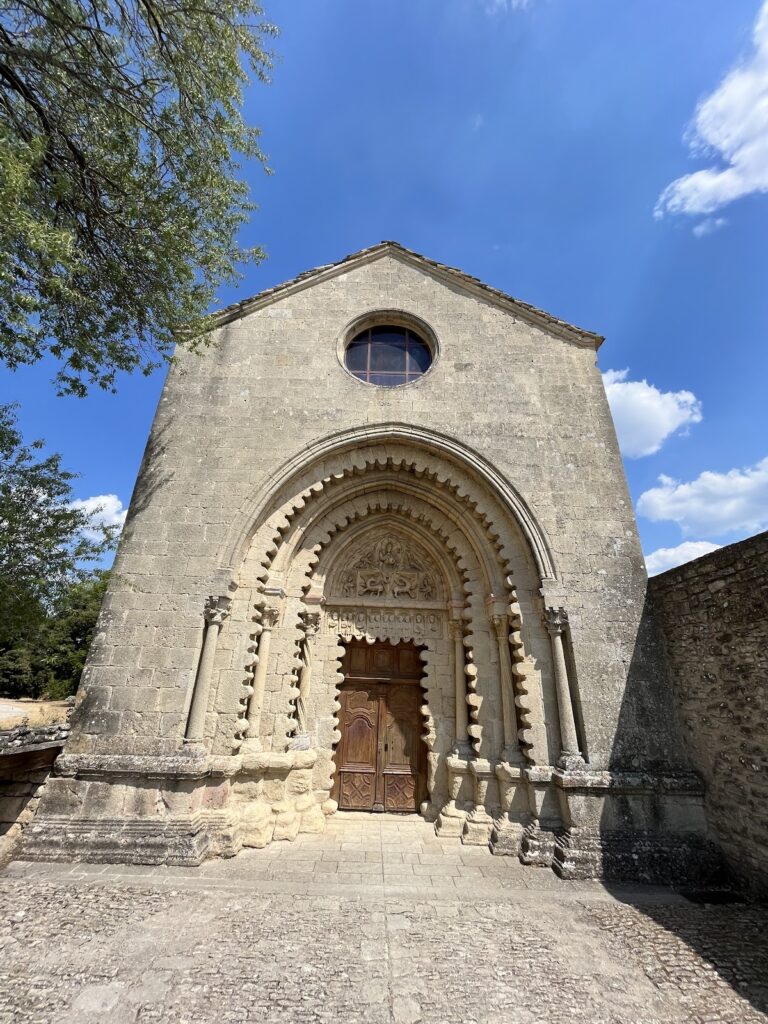
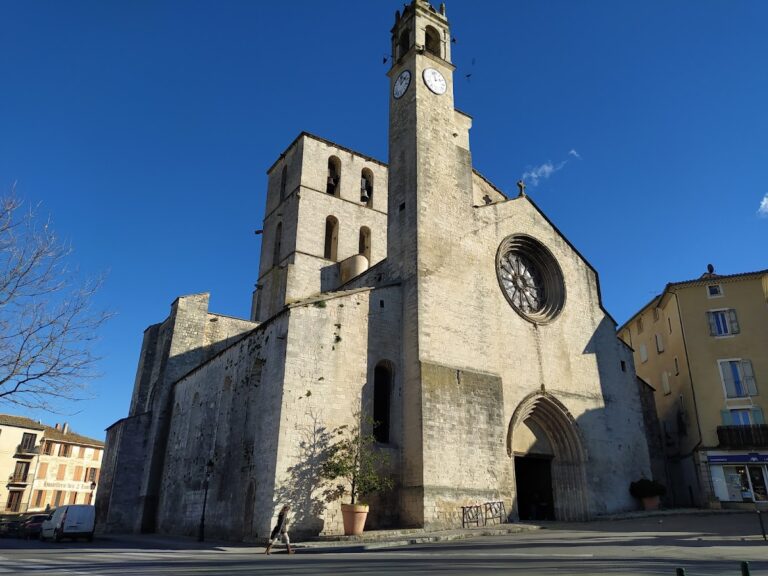
The cathedral’s visible stonework is precisely cut, while the tower is built mainly of rubble masonry with dressed stone at its corners. It ends in a wrought-iron bell cage of a type characteristic of the region. The façade includes a rose window, a portal with ornamental iron hinges, a campanile, and a small bell turret. Its tympanum shows Christ as Judge of the World within a mandorla, an almond-shaped enclosure signifying divine glory, supported by the four symbols of the Evangelists. A statue of Saint Jerome stands on the trumeau, the central pier dividing the portal entrance, and a statue of Pierre Gassendi is also associated with the cathedral. The bell dates from 1618.
Interior architecture
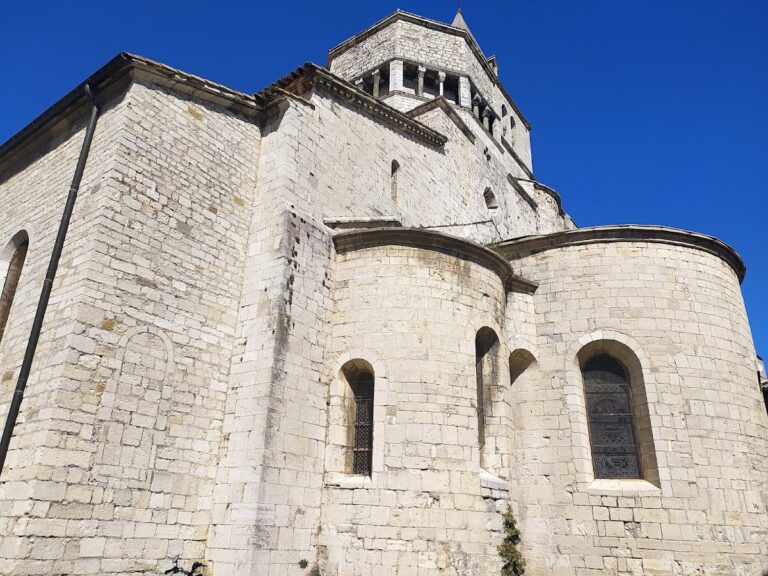
The polygonal apse has pointed-arch windows without tracery, while the side-aisle windows contain tracery influenced by the early Renaissance. The entire interior is plastered and covered with painted patterns representing masonry joints. Round piers without capitals support the transverse arches and ribs of the vaults. Chapels opened along the north side during the seventeenth century.
Organs and furnishings
Gallery organ
The large gallery organ stands behind the façade in a Neo-Gothic case. Built by Cavaillé-Coll in 1865, it has 21 stops distributed across two manuals and a pedalboard. Its key and stop actions are mechanical, and its instrumental section has been protected since 1976.
Stained glass and church furnishings
The cathedral’s stained glass dates entirely from the nineteenth century. Its furnishings include numerous reliquaries and other church objects, as well as a choir organ among the protected movable furnishings.
Nearby sites