Our Lady of the Assumption Cathedral, Lamego: A Roman Catholic Cathedral in Portugal


Site at a Glance
- Rating
- 4.6
- Popularity
- Medium
- Country
- Portugal
- Primary era
- Early Modern
- Eras represented
- Medieval, Early Modern
- Civilizations
- Portuguese
- Site type
- Religious
- Remains
- Cathedral
On this page9 sections
History
Our Lady of the Assumption Cathedral, also known as Lamego Cathedral, is a Roman Catholic cathedral in Lamego, Portugal, founded in 1129 in the Gothic and Renaissance historical tradition that shaped its later development. It follows the Roman or Latin rite, the principal liturgical tradition of the Roman Catholic Church, and serves as the seat of the Diocese of Lamego.
Medieval diocesan foundations
The Diocese of Lamego may have originated around 570, when bishops are recorded in the area. It continued in some form during the Islamic-Moorish occupation of the Iberian Peninsula. After Ferdinand I of León, a medieval Christian king whose campaigns expanded Christian rule in northern Iberia, reconquered northern Portugal in 1057, the diocese continued de facto. King Alfonso I of Portugal, also called Afonso Henriques and the first king of Portugal, formally re-established it in 1143, four years after Portuguese independence.
The cathedral was founded in 1129, during the period surrounding the diocese’s re-establishment. Its surviving square bell tower belongs to this earlier medieval phase and preserves a physical connection with the institution’s renewed Christian foundation.
Early modern transformation
The cathedral was fundamentally altered during the sixteenth century, when Late Gothic and Renaissance forms reshaped the building. Further changes followed in the eighteenth century, giving the cathedral a combination of medieval survival, Renaissance clarity, and Baroque decoration.
Diocesan status
On 30 September 1881, Pope Leo XIII’s bull Gravissimum made the Diocese of Lamego a suffragan diocese of the Archdiocese of Braga. A suffragan diocese operates under the ecclesiastical supervision of a metropolitan archdiocese, placing Lamego within Braga’s wider church structure.
Remains
Cathedral structure and exterior
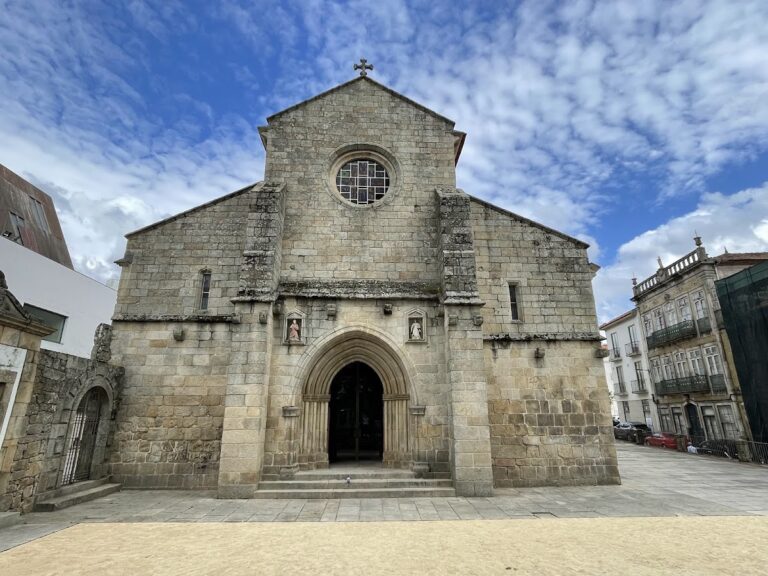
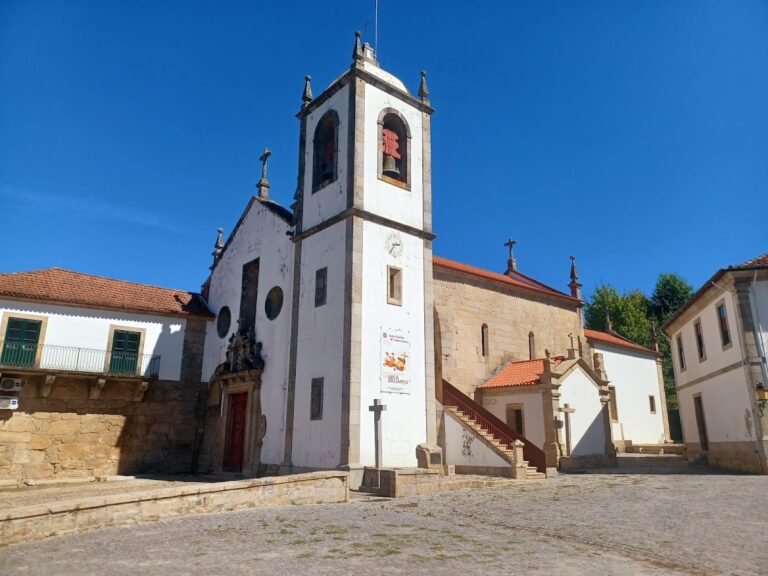
The cathedral is arranged as a three-aisled building with a straight eastern termination rather than an apse. Its exterior presents a predominantly Gothic appearance, while the interior follows the linearity and clarity associated with Renaissance design. The square medieval bell tower remains standing, and a square-plan Baroque lantern tower rises above the crossing. The lantern tower, a raised structure with openings that admits light over the central crossing, marks the later transformation of the building.
The portal jambs carry small human figures, fantastical creatures, and vegetal foliage. Above them, the tracery of the large western window already displays Renaissance forms. The side-aisle windows are particularly notable for their resemblance to those of the Pantheon, the ancient Roman temple in Rome.
Renaissance cloister
On the north side stands a Renaissance cloister, a covered passage arranged around an open courtyard. Built between 1523 and 1564, it is partly two-storeyed and rests on supports with octagonal cross-sections. Some of its capitals probably belonged to an earlier Gothic cloister. A large quatrefoil-shaped fountain basin occupies the center of the courtyard.
Baroque interior
In 1738, the Italian-born artist Nicolau Nasoni was commissioned to create ceiling frescoes depicting subjects from the Old Testament. The extent of his personal execution remains uncertain because members of his workshop may have carried out part of the work. The cathedral also contains three Baroque altars, while its altar retables and pulpit belong to the same period. Two organs were installed in the choir in 1753.
Setting
The cathedral stands a few metres outside Lamego’s old town. The old town lies approximately 500 metres above sea level and just under one kilometre west of the Balsemão River, placing the cathedral within the historic urban setting of Lamego.