Dharmarajika Stupa: A Buddhist Reliquary Monument at Taxila
Site at a Glance
- Rating
- 4.5
- Popularity
- Low
- Country
- Pakistan
- Primary era
- Classical
- Eras represented
- Classical, Medieval
- Civilizations
- Kushan, Mauryan, Scythian
- Site type
- Religious
- Remains
- Stupa
On this page16 sections
History
Dharmarajika Stupa is a Buddhist stupa near the ancient city of Sirkap in Taxila, Pakistan. Its earliest religious monument may date to the 3rd century BCE, while the principal stupa was re-established during the Kushan period in the 2nd century CE. The stupa and the monastic complex around it form part of the Ruins of Taxila, inscribed on the UNESCO World Heritage List in 1980 under criteria iii and iv.
Early Buddhist monument
The site’s first major religious foundation is traditionally associated with Ashoka, the Mauryan emperor remembered for supporting the spread of Buddhism across South Asia. According to this tradition, Ashoka built an earlier stupa over relics of the Buddha. Coins of the Indo-Greek period, dating to the 2nd century BCE, show that a Buddhist monument existed at Dharmarajika by that time at the latest.
The later main stupa was established during the Kushan period, an era of political and cultural development in Gandhara during the early centuries CE. It was intended to house Buddha relics, possibly transferred from earlier monuments. This rebuilding represented a distinct phase from the earlier stupa traditionally attributed to Ashoka.
Expansion and abandonment
Activity at the complex slowed under Sasanian rule. The Sasanians governed parts of the Persian Empire and controlled sections of the region during late antiquity. Large-scale construction resumed during the late Kushan and Kidarite periods, when additional stupas and monasteries were built around the principal monument.
Buddhist texts connect Dharmarajika with the use of frankincense in religious services and describe its surfaces as paved with colourful glass tiles. The name is traditionally explained through Dharmaraja, an epithet of the Buddha meaning “Lord of Law.” It may also refer to the title used by Ashoka. The popular name Chir Tope, meaning “Scarred Hill,” reflects the monument’s damaged condition.
The White Huns, a Central Asian power whose invasions affected Gandhara in the 5th century CE, devastated the complex. Dharmarajika was subsequently abandoned. Later Hun rulers, including Mihirakula, were remembered in Buddhist traditions for persecuting Buddhists in the region. During Mihirakula’s reign, more than a thousand Buddhist monasteries across Gandhara are said to have been destroyed.
Excavation and interpretation
Sir John Marshall excavated Dharmarajika in 1913, when the monument had already been looted several times and badly damaged. He identified a large ancient trench that appears to have been dug to reach and remove valuable relics. By 1934, excavation had revealed enough of the complex to establish its overall scale.
Human skeletons found in an open area immediately south of the stupa may belong to monks killed during the White Hun invasion, although that interpretation remains uncertain. In 2016, two bone relics from Dharmarajika were sent to Sri Lanka for a month and displayed at shrines in Polonnaruwa, Colombo, Kandy, and Anuradhapura.
Remains
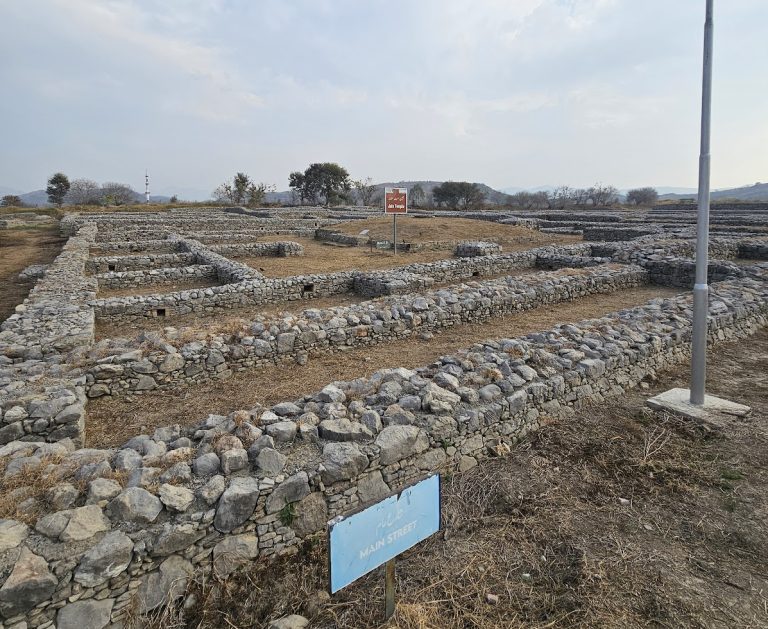
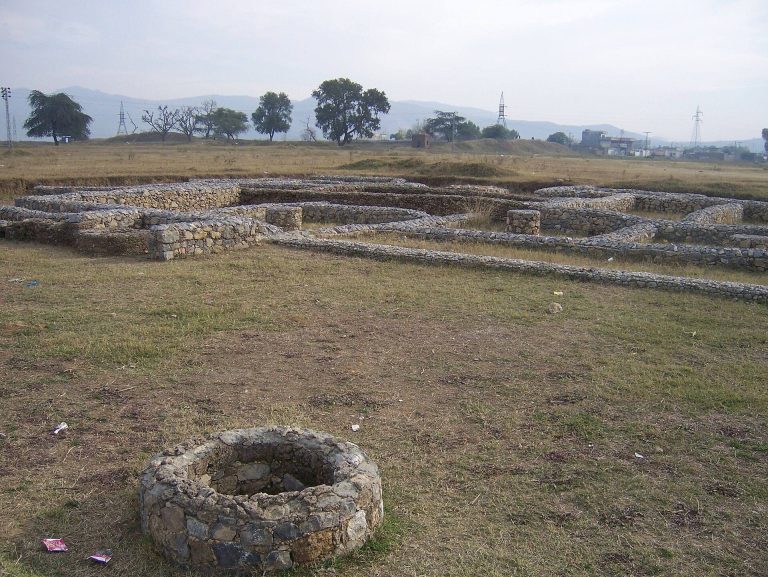
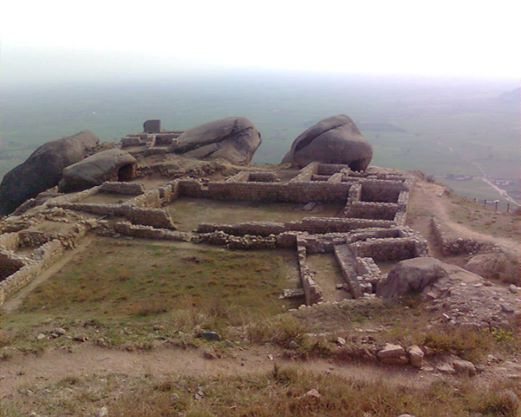
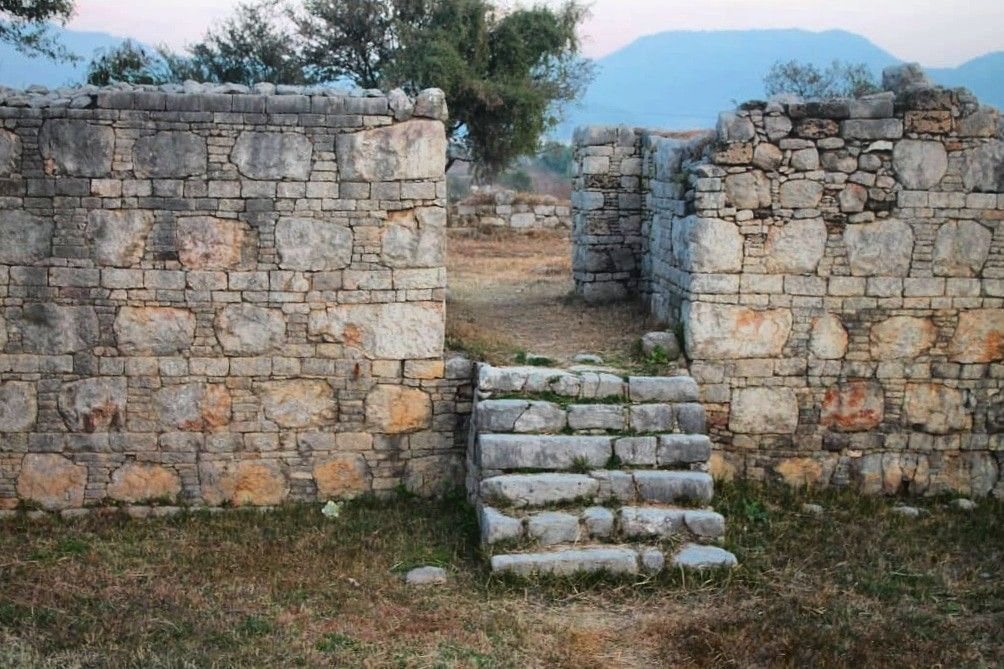
Dharmarajika lies approximately one kilometre outside Sirkap, a position associated with the principle that monasteries should be neither too close to nor too far from towns. The site is organized around a large central stupa, processional avenues, smaller reliquary monuments, shrines, and monastic quarters. Three distinct masonry types in the surrounding buildings indicate construction during different periods.
Central stupa and sacred approaches
Main stupa
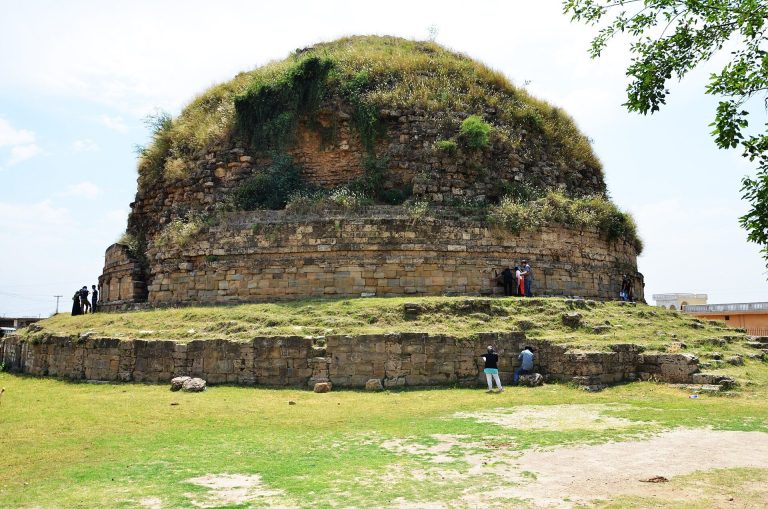
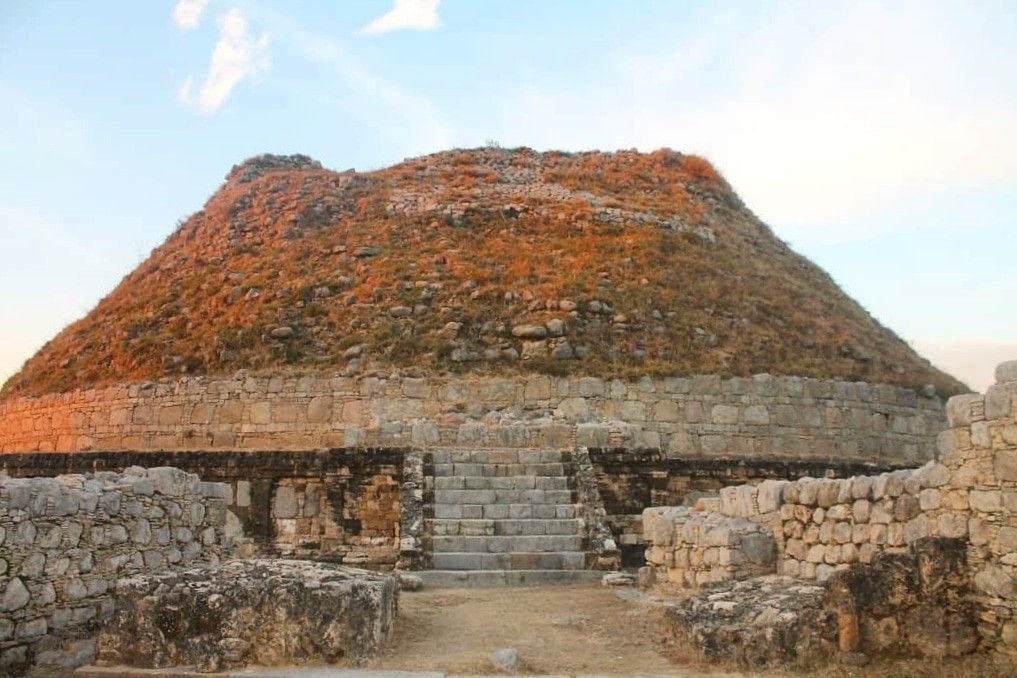
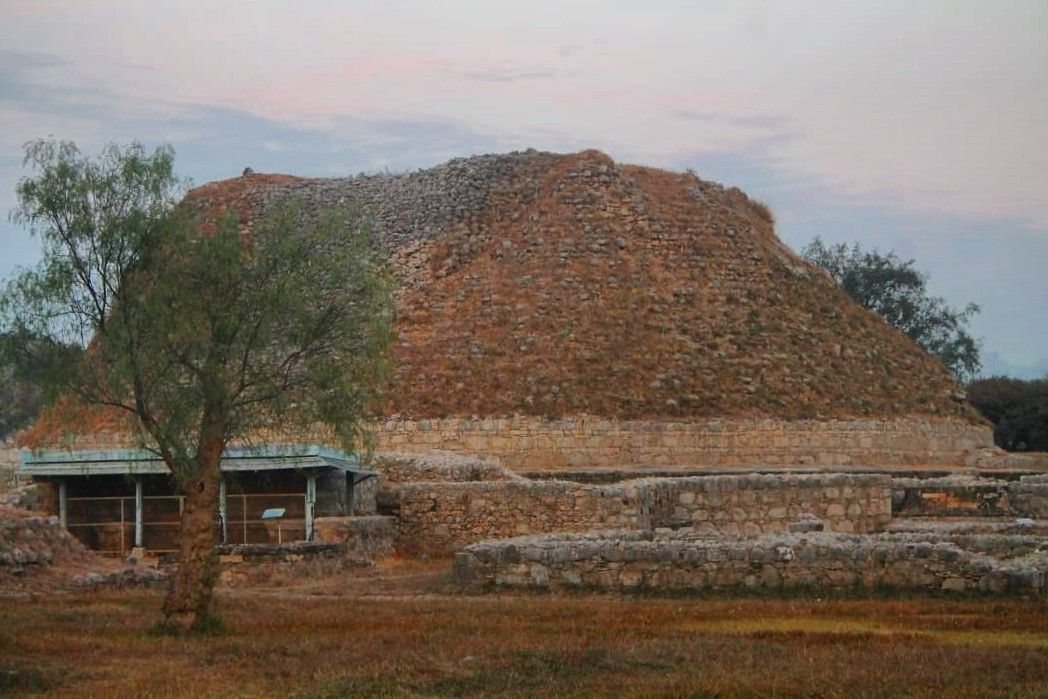
Dharmarajika is the largest stupa in the Taxila region. A passage for pradakshina, the ritual practice of walking clockwise around a sacred monument, encircles the central mound. Its large anda, the hemispherical mound of a stupa, is damaged, while the medhi, or raised base, remains largely intact. The mound was constructed from ashlar stone. A harmika, the small railing-like structure formerly placed above the mound, originally completed the upper part of the monument.
Earlier core and surrounding stupas
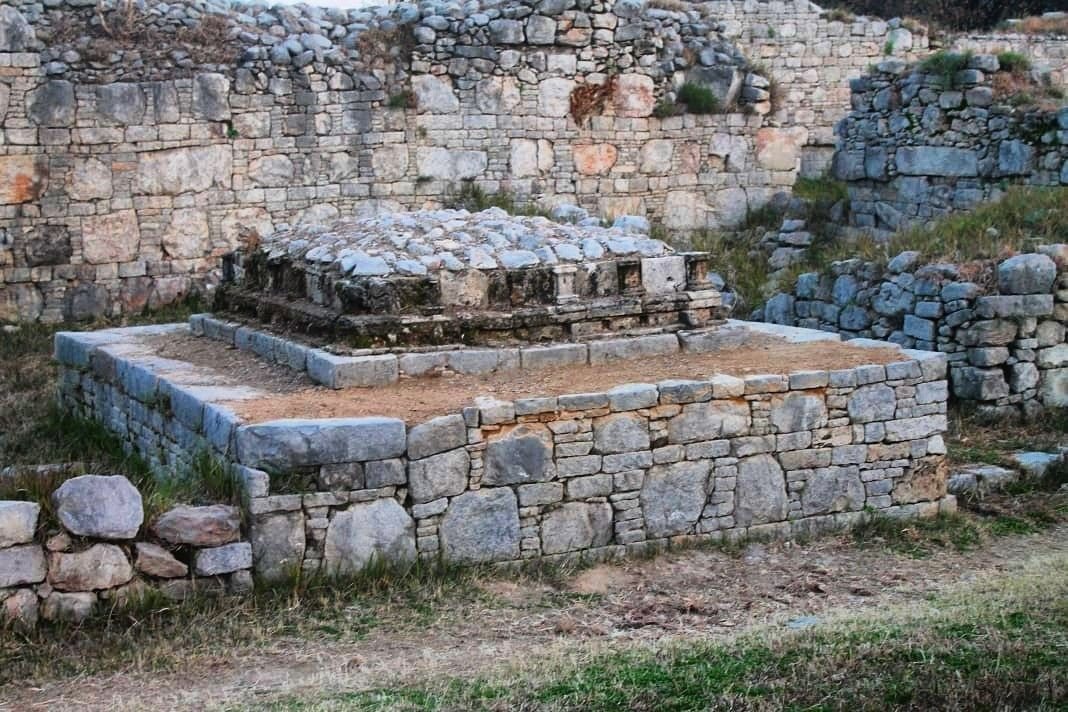
Smaller stupas are distributed irregularly around an earlier core stupa. The core monument had a plastered circumambulatory path decorated with shell bangles arranged in geometric patterns and probably possessed four gateways aligned with the cardinal directions.
A circular group of smaller stupas was added around the main monument roughly two centuries after its construction. These may have formed a single building project supported by one patron. Other stupas were erected in the northern part of the complex during the Indo-Scythian period by different donors. Unlike the communal constructions at Sanchi, the monuments around Dharmarajika were individually sponsored.
Processional avenues and Building H
The southern gateway was initially regarded as the principal entrance. After four smaller stupas, designated G7, G8, S7, and Q1, were built west of the main monument, the western side probably became the preferred entrance for those performing circumambulation. Later construction around the Eastern Avenue shifted the preferred route toward the eastern side.
The northern stupas formed the Northern Avenue, a processional corridor containing small shrines with devotional images. These images may have been placed at the edge of the complex because conservative religious groups were hesitant to adopt imagery fully in religious practice. Visitors approaching from Sirkap probably passed through Building H before entering the principal sacred area. The large building openly displayed relics that visitors may have venerated before proceeding to the main stupa.
Monastic quarters
Early cells and northern monastery
The earliest monastic cells near the stupa were arranged in rows of rooms with verandahs. About three centuries after the stupa’s construction, this arrangement was replaced by monastic quarters surrounding quadrangles immediately north, northeast, and east of the monument.
The northern monastery contained two courtyards, each organized around a large stupa. The smaller eastern courtyard is believed to have accommodated 13 monks.
Monastery G
Monastery G, directly west of the main stupa, contained at least 50 monastic cells and a stupa. Its scale suggests that it may have had more than one storey.
Monastery M and the southern stupas
Monastery M stood in the extreme northwestern part of the complex. It contained a small courtyard with its own stupa and was connected to a long residential monastery oriented approximately from north to south.
Two stupas, designated E1 and E2, stood at the southern edge of the long residential monastery. E1 was built inside an existing cell. The more elaborate E2 included a small circumambulatory passage. Their position and form indicate that neither was probably intended for public access.
Relics, inscriptions, and archaeological finds
Inscribed silver casket
A silver casket bearing a silver inscription was recovered from the chapel of the stupa. Written in Kharosthi, an ancient script widely used in Gandhara and the adjoining northwestern regions of South Asia, the inscription states that Urusaka of Noacha placed Buddha bone relics in his chapel at Dharmarajika in 78 CE.
Reliquaries and trade connections
Eighteen reliquary vessels were recovered from smaller stupas surrounding the main monument. Their deposits included a vessel enclosing a cylindrical piece of gold, gold jewellery, precious stones, lapis lazuli from Afghanistan, pearls, and shells. These materials reflect the long-distance trade networks connected with Taxila.
Several coins of the Indo-Greek ruler Zoilos II were found beneath the foundation of a stupa dating to the 1st century BCE. Indo-Greek rulers governed parts of the region after the Hellenistic expansion into South Asia, and the coins provide evidence for the varied political and commercial connections represented at Dharmarajika.