Bhir Mound: An Early City of Taxila
Site at a Glance
- Rating
- 4.2
- Popularity
- Low
- Country
- Pakistan
- Primary era
- Iron Age
- Eras represented
- Iron Age, Classical
- Civilizations
- Gandharan
- Site type
- City
On this page6 sections
History
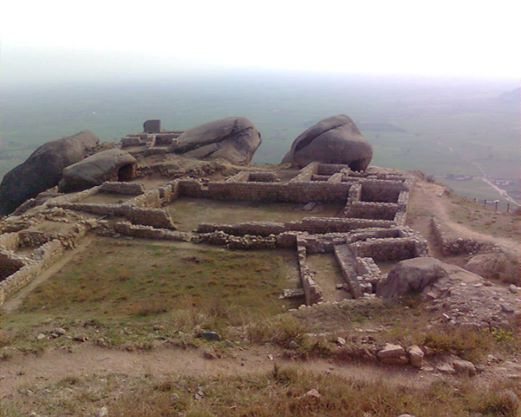
Bhir Mound is an ancient urban settlement at Taxila in Pakistan, associated with the Gandhara cultural tradition and occupied from approximately 800–525 BC into the early Hellenistic period. It is regarded as the second historically identified city of Taxila, following the settlement at Hathial Mound and preceding the later cities of Sirkap and Sirsukh.
Early settlement and changing rule
The earliest occupation belongs to a period represented partly by layers containing grooved Red Burnished Ware, a pottery type with a smoothed and polished red surface. A possible second phase dates to the late sixth and fifth centuries BC. The settlement continued into the early Hellenistic period before being abandoned around the first century BC.
Bhir Mound has been associated with both the Achaemenid and Indo-Greek periods. The Achaemenid Empire was the Persian imperial state that ruled much of western and central Asia before the conquests of Alexander the Great. John Marshall proposed that Darius I founded Taxila as the capital of the Achaemenid province, or satrapy, of Hindush. A satrapy was an administrative province of the empire. That interpretation is now considered doubtful because current dating places the beginnings of Bhir Mound before 525 BC, while some scholars also question whether Taxila ever belonged to the Achaemenid Empire.
Alexander the Great conquered the region in 326 BC. Ambhi, the ruler of Taxila, surrendered and offered Alexander a force that included soldiers mounted on elephants. In 316 BC, Chandragupta Maurya, founder of the Mauryan dynasty, conquered Punjab. Taxila then lost its independence and became a provincial capital, while continuing as a center of administration, education, and trade.
Under Chandragupta’s grandson Ashoka, Buddhism became important in Taxila and the first monks settled there. Ashoka is said to have resided at Taxila while serving as his father’s vice-king. In 184 BC, Greek forces from the Bactrian kingdom invaded Gandhara and Punjab again. Demetrius I of Bactria, a Greek ruler of the Hellenistic state in Central Asia, subsequently resided in Taxila.
Excavation and interpretation
Sir John Marshall excavated the ruins from 1913 to 1925, followed by Sir Mortimer Wheeler in 1944–1945 and Mohammad Sharif in 1966–1967. Further excavations were conducted by Bahadur Khan from 1998 to 2000 and by Ashraf and Mahmud-al-Hassan in 2002.
Marshall had expected to find a Greek city at Taxila, but his interpretation of Bhir Mound was later criticized because limited stratigraphic recording and incomplete pottery publication restricted chronological analysis. Stratigraphy is the study of archaeological layers and their sequence of deposition. Wheeler’s excavation results were never published, while Sharif’s more closely controlled work provides a foundation for modern assessments of the site’s chronology.
The ruins of Bhir Mound form part of the Taxila UNESCO World Heritage Site, which was inscribed in 1980 under criteria iii and iv. This international designation recognizes cultural sites judged to have outstanding universal value within a framework of recognition and protection.
Remains
Urban layout
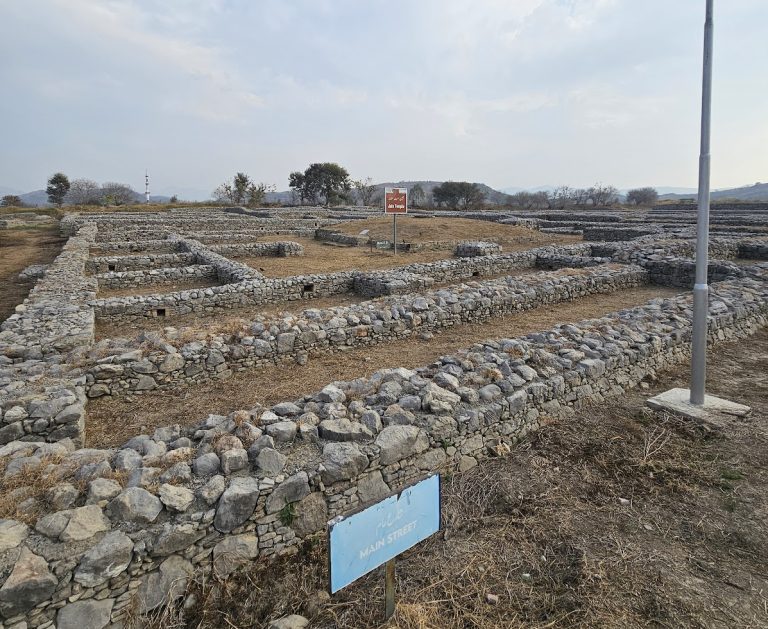
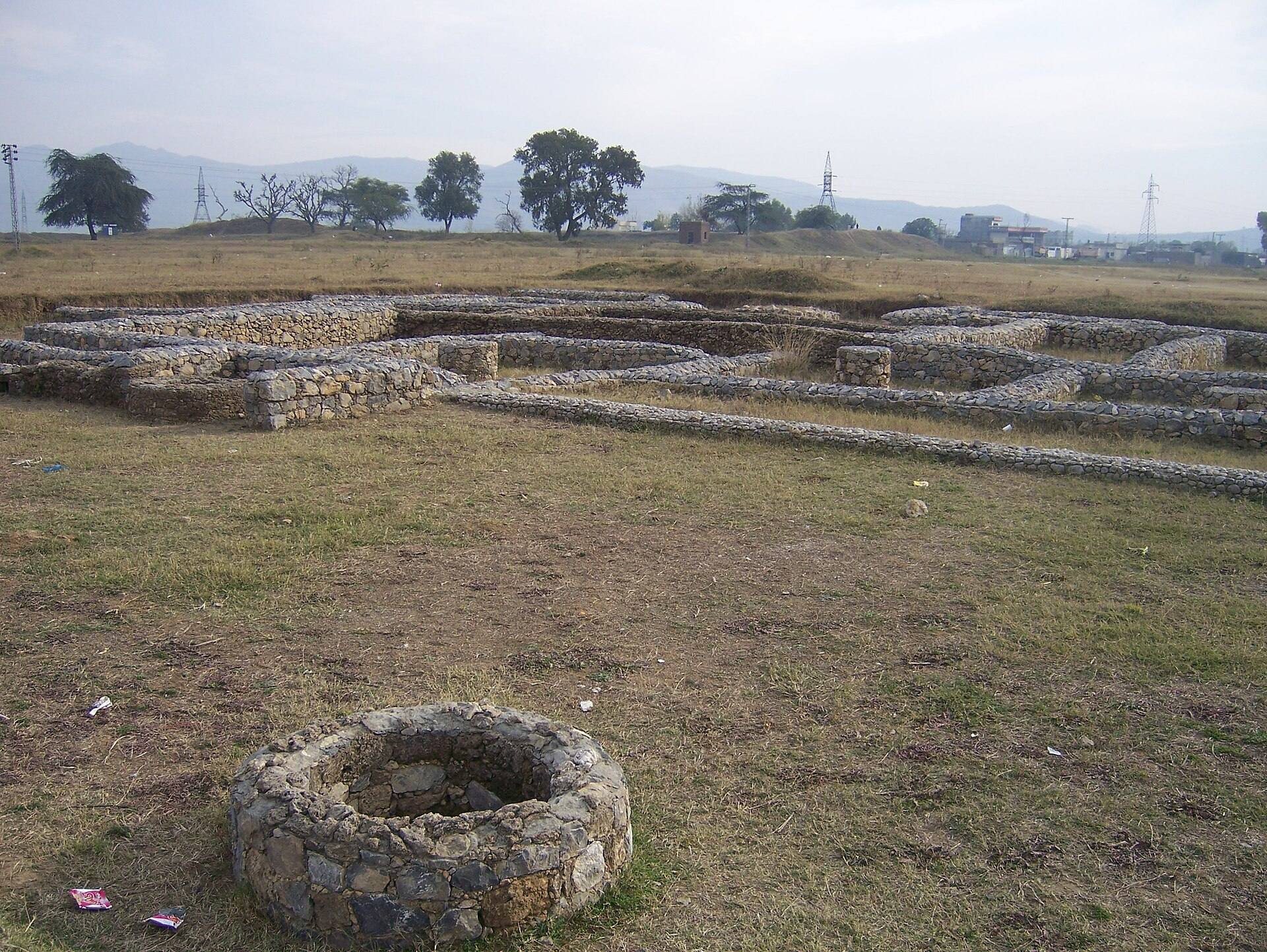
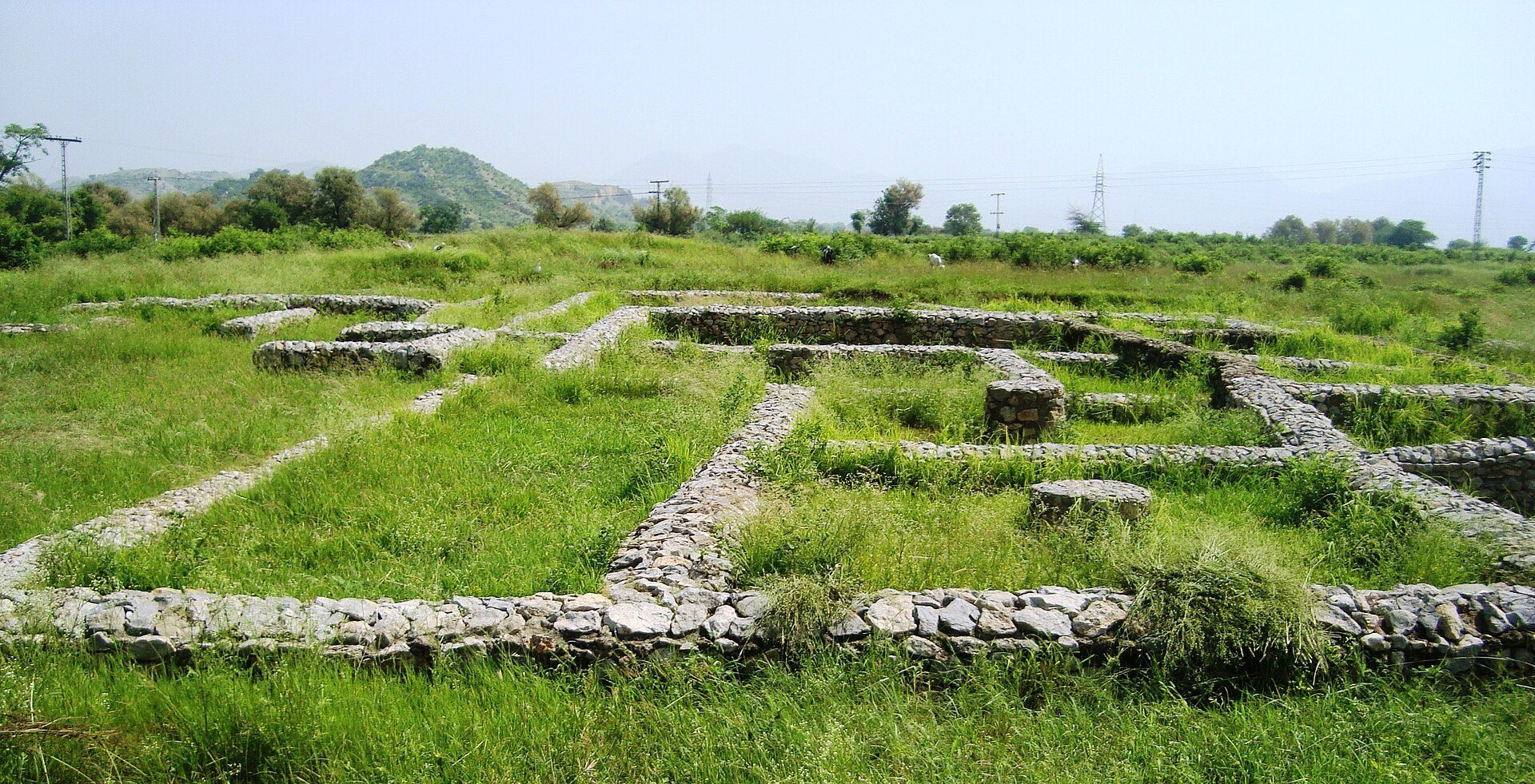
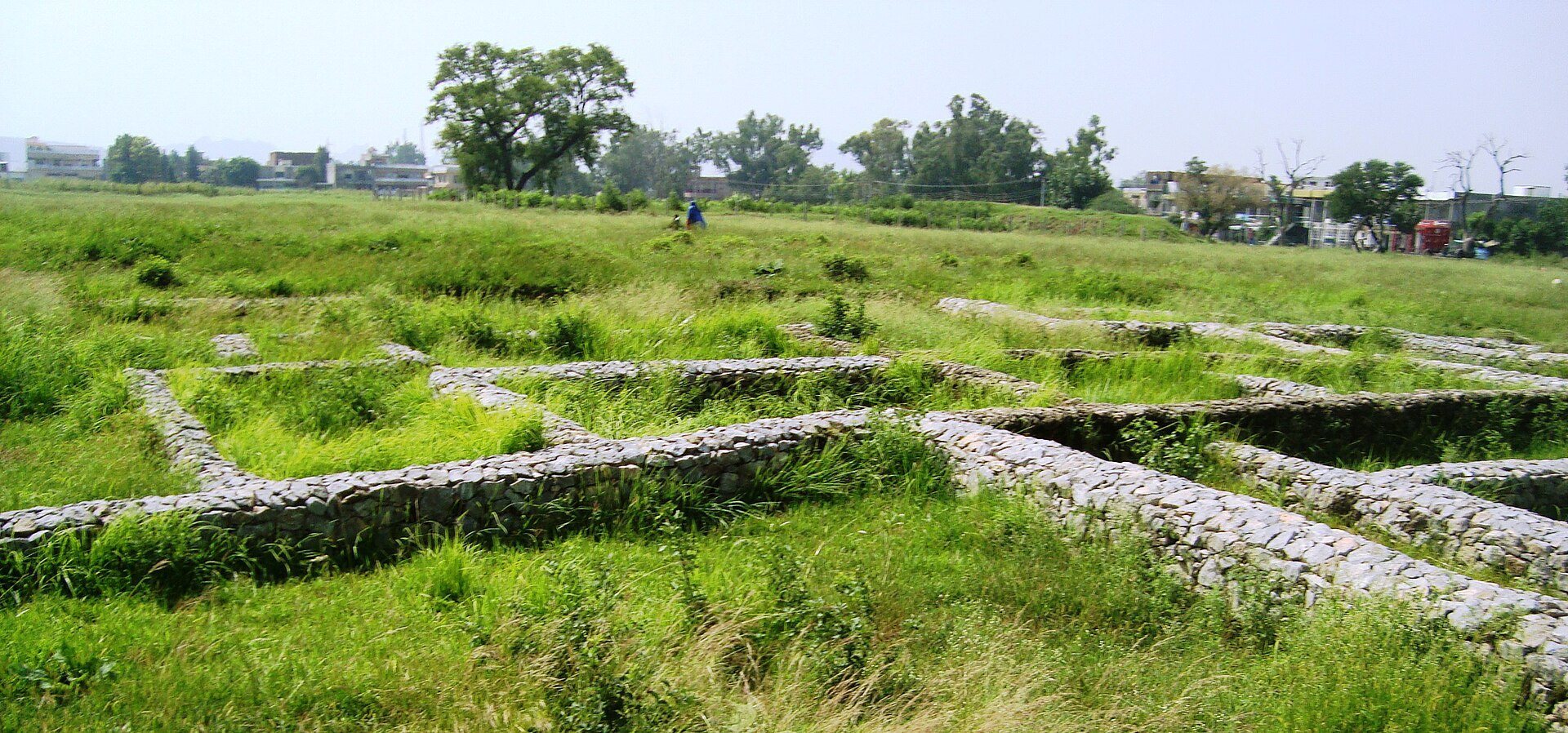
The urban ruins cover an irregular area approximately 1 kilometer from north to south and about 600 meters from east to west. Narrow streets and highly irregular house plans indicate little deliberate urban planning. Most streets follow similarly irregular layouts rather than a regular grid.
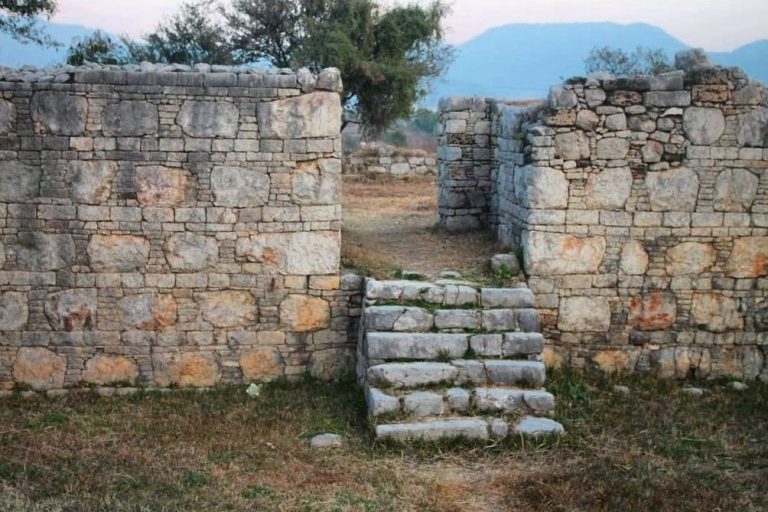
Houses were organized around open internal courtyards and had no windows opening directly to the exterior. Each courtyard was surrounded by approximately 15 to 20 rooms. Water conduits are also among the surviving features of the settlement.
Coins and material evidence
A coin hoard from Bhir Mound contained Achaemenid and Greek currency, including fifth-century siglos-type coins, a standard silver coin of the Achaemenid monetary system. It also contained large quantities of Gandharan bent-bar punch-marked coins. These early coins were made by striking symbols into pieces of metal, rather than by using a single engraved die. Modern numismatists regard the Gandharan bent-bar coins as precursors of Indian punch-marked coins.
Some coins resemble local issues struck in Kabul and pieces from the Chaman Hazouri hoard. Coins of Philip III and Alexander the Great were found at the site, along with many other Indian punch-marked coins. Finds from the 1924–1945 excavations also included Mauryan coins issued in 248 BC, providing evidence for monetary circulation at Bhir Mound and across the wider region.