Taxila: Ancient Gandharan Capital and Centre of Learning in Pakistan
Site at a Glance
- Popularity
- Very High
- Country
- Pakistan
- Primary era
- Iron Age
- Eras represented
- Stone Age, Bronze Age, Iron Age, Classical, Early Modern, Modern
- Civilizations
- British, Gandharan, Indo-Greek, Indus Valley, Kushan, Mauryan, Mughal
- Site type
- City
On this page20 sections
History
The ancient city of Taxila lies in present-day Pakistan, where its earliest major settlement developed at Hathial around 1000 BCE. Earlier communities had occupied the valley, but the city that emerged in the first millennium BCE became a capital of Gandhara, an ancient kingdom in northwestern South Asia, and a participant in regional trade.
Early settlement and Gandharan city
By about 900 BCE, Taxila was linked through exchange with nearby Pushkalavati. Its name is also associated with the older form Takshashila. A traditional account credits Bharata, the brother of Rama, with founding the city and naming it for his son Taksha. The Ramayana further says that Bharata made Taksha ruler of Taxila and another son, Pushkala, ruler of Pushkalavati.
Literary traditions connect Taxila with learning and epic history. Vedic texts place the philosopher Uddalaka Aruni’s journey to Gandhara around the seventh century BCE, while later Buddhist texts say that Aruni and his son Svetaketu studied at Taxila. Panini’s fourth-century BCE grammar, the Ashtadhyayi, is among the earliest texts to name the city. In a Mahabharata tradition, King Janamejaya held a snake sacrifice at Taxila, where Vaishampayana first recited the epic; Parikshit is also said to have been enthroned there. Buddhist Jataka stories describe Taxila as Gandhara’s capital and a celebrated place of study.
Persian, Macedonian and Mauryan rule
The Achaemenid Persian Empire probably controlled Taxila from the sixth to the fourth centuries BCE. The city may have served as the capital of the province of Hindush. In 516 BCE, Darius I campaigned east and spent the winter of 516–515 BCE in Gandhara before moving toward the Indus Valley. Persian authority in the region continued for more than a century.
In 326 BCE, Alexander the Great entered Taxila without a battle after its ruler, Ambhi, submitted. Alexander kept Ambhi in office as a satrap, or provincial governor. The city welcomed Alexander, who made sacrifices there and held athletic and horse-riding contests. After Alexander’s death in 323 BCE, the region fell within the sphere of his successor Seleucus I Nicator.
Chandragupta Maurya took Taxila in the decades after Alexander’s departure. Following a war between the Seleucid and Mauryan empires, the city and surrounding lands were formally incorporated into the Mauryan Empire around 303 BCE. Buddhist traditions associate Chandragupta’s adviser Chanakya with Taxila. Under Chandragupta’s grandson Ashoka, the city became an important centre of Buddhist learning, although a revolt also took place there during Ashoka’s reign.
Taxila’s position on the Royal Road connected the Mauryan capital at Pataliputra with Peshawar and Pushkalavati. The route, later associated with the Grand Trunk Road, also linked with roads through Kashmir, Bactria and Kapisa toward Central Asia.
Indo-Greek and later kingdoms
In the second century BCE, Indo-Greek rulers, who governed Greek-founded states in South Asia, established a new capital at Sirkap across the river from the earlier city. Antialcidas may have ruled from Taxila around 100 BCE. When Greek authority weakened, local trade guilds gained considerable independence and issued much of the city’s coinage. Around 90 BCE, the Indo-Scythian ruler Maues overthrew Taxila’s last Greek king. Azilises, another Indo-Scythian ruler, operated one of his three mints there. Coins from the mint, dated broadly to the first century BCE or first century CE, carry Greek and Kharosthi, an ancient script of northwestern South Asia.
Gondophares, who founded the Indo-Parthian kingdom, captured Taxila around 20 BCE and made it his capital. An early Christian tradition says that the apostle Thomas visited Gondophares IV around 46 CE, possibly at Taxila.
An inscription dated to 76 CE places Taxila under Kushan rule after Kujula Kadphises had taken it from the Parthians. Kanishka, a major Kushan ruler, founded Sirsukh as a new settlement. Taxila’s trade included silk, sandalwood, horses, cotton, silverware, pearls and spices. Sanskrit literature also remembered it as a cultural centre and a militarized frontier city.
Late antique decline
By the mid-fourth century CE, Gupta influence had reached eastern Gandhara, and a Gupta military base was established at Taxila. Sasanian coins found in the area point to some form of Persian control as well. The city’s teaching tradition remained active around 400 CE, when the Chinese Buddhist pilgrim Faxian visited.
The Kidarites, a Central Asian dynasty, invaded around 450 CE but were repelled by the Gupta emperor Skandagupta. Taxila did not recover, probably because Hunnic power in the region and the breakdown of trade weakened it. Around 470 CE, the White Huns and Alchon Huns, Central Asian peoples who invaded parts of South Asia, devastated Buddhist monasteries and stupas, or Buddhist mound-shaped religious monuments. From about 500 to 540 CE, the Hunnic ruler Mihirakula oversaw further destruction of Buddhist sites and monasteries, as well as some Hindu temples in the northwestern subcontinent.
When the Chinese Buddhist pilgrim Xuanzang visited in 630 CE, he found Taxila largely desolate and partly ruined, with only a few monks remaining. He described its kingdom as dependent on Kashmir and noted an earlier relationship with Kapisa. Later Islamic geographers connected the wider region with the Odi Shahi dynasty before the Ghaznavid conquest. Whether the place called al-Usaifan was the kingdom of Taxila remains uncertain.
Religious traditions and learning
Buddhist and Jain traditions gave the city additional sacred associations. Faxian interpreted Taxila’s name as meaning “cut-off head” and linked the Sirkap area with a Jataka story in which the Buddha, in a previous life, gave his head to a hungry lion. In the nineteenth century, the area was also called Baburkhana, meaning “House of the Tiger,” in reference to this story.
Jain tradition connects the region with Rishabhanatha, regarded as the first Tirthankara, a Jain spiritual teacher who shows the way to liberation, and his son Bahubali. It says that Rishabhanatha visited as a monk and that Bahubali consecrated his footprints and established a throne and a wheel of religious law above them. The Jain text Mahanishith Sutra calls Taxila “Dharmachakra Bhumi” and describes the Dharmachakra pilgrimage place as the abode of Chandraprabha, another Tirthankara. Jain tradition also credits Emperor Samprati with building the Kunala shrine in honour of his father and extending the area travelled by Jain monks.
Jain accounts place about 500 temples in Taxila during the second or third century CE, when many followers of the faith were said to live there. One tradition recounts a severe plague and says that it subsided after the Jain teacher Manadevasuri directed the recitation of the Laghu Shanti Stava. Another Jain account relates that the merchant Javad Shah took an image of Rishabhanatha from Taxila and installed it at a principal shrine at Shatrunjaya.
Taxila drew students for centuries BCE and continued to attract them until the city’s fifth-century decline. Teaching covered Vedic study, Buddhism, law, medicine, military science and the eighteen arts, including archery, hunting and knowledge of elephants. Students came from places such as Kashi, Kosala and Magadha and included princes, nobles, merchants, tailors and fishermen. Many began specialist study at about sixteen, after earlier instruction at home or in ashrams, religious teaching communities. Study in a speciality commonly lasted about eight years. Teachers generally taught independently, often in their own homes, rather than following a central curriculum. Poor students could receive food and lodging in return for household work, and students usually offered their teacher a modest gift at the end. Formal examinations, graduation ceremonies and written degrees were not customary, so whether Taxila was a university in the modern sense remains uncertain.
Rediscovery and conservation
Alexander Cunningham identified the lost city in 1863–64. He investigated differences between distances given by Pliny and travel itineraries left by Chinese pilgrims, which placed the journey from the Indus at three days rather than two. His work at Shah-dheri supported the identification. John Marshall led extensive excavations at Taxila for about twenty years from 1913.
UNESCO inscribed Taxila as a World Heritage Site in 1980. The property brings together settlements and monuments that illustrate more than five centuries of urban development in the Indian subcontinent. A proposed stadium threatened Bhir Mound in 1998, but the project was shelved. In 2010, the Global Heritage Fund warned of risks from weak management, development pressure, looting and conflict; substantial conservation work followed. In 2026, UNESCO warned that unauthorized rebuilding at Mohra Moradu and Sirkap could lead to Taxila’s inclusion on the List of World Heritage in Danger and said delisting was possible. Allegations that original walls had been replaced with cement raised concerns about the work’s compatibility with conservation standards.
Remains
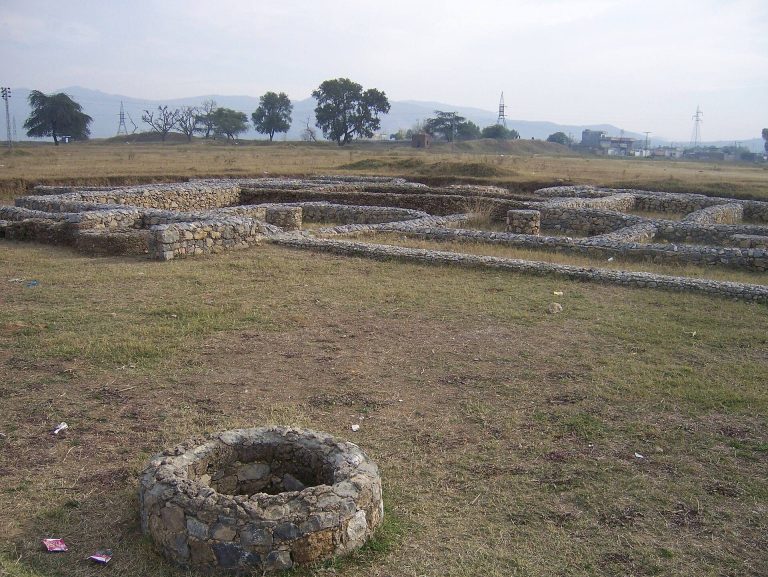
Taxila’s archaeological landscape contains four major settlements distributed across three locations, along with prehistoric mounds and religious and civic monuments. Hathial and Bhir Mound occupy the earliest settlement area, while Sirkap and Sirsukh preserve later fortified urban forms. The wider remains include Buddhist stupas and monasteries, a cave, a mosque, tombs and other groups of buildings.
Early settlements
Sarai Khola
About two kilometres southwest of Taxila Museum, Sarai Khola preserves occupation dating from the late fourth to early third millennium BCE. Finds include polished stone tools shaped like axes and adzes, blades made from chert, a hard stone, and highly polished pottery. Some vessels were formed using woven baskets, with a clay mixture applied to the outside. Later deposits include red polished pottery and more wheel-made wares of the Kot Diji style, an early regional ceramic tradition. Radiocarbon dates place this later phase from the middle or later third millennium into the early second millennium BCE. The wider area includes Neolithic remains dated to about 3360 BCE and Early Harappan material dated to about 2900–2600 BCE.
Hathial
Pottery fragments at Hathial range in date from the late second millennium to the sixth century BCE. The settlement forms part of the earliest major phase in Taxila’s urban history.
Bhir Mound
Beside Hathial, Bhir Mound preserves occupation from around the sixth century BCE. Its finds include grooved red polished pottery.
Fortified settlements
Sirkap
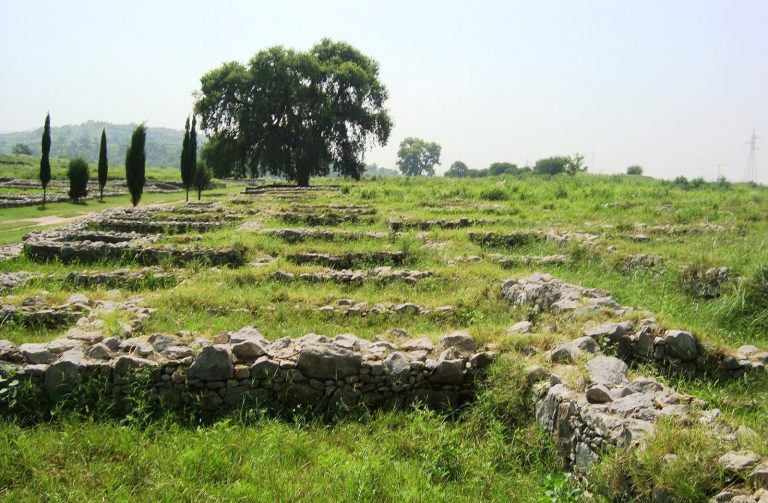
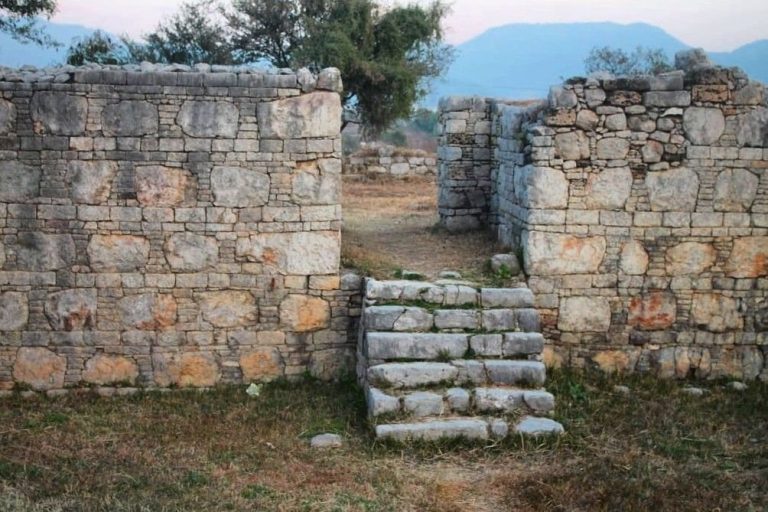
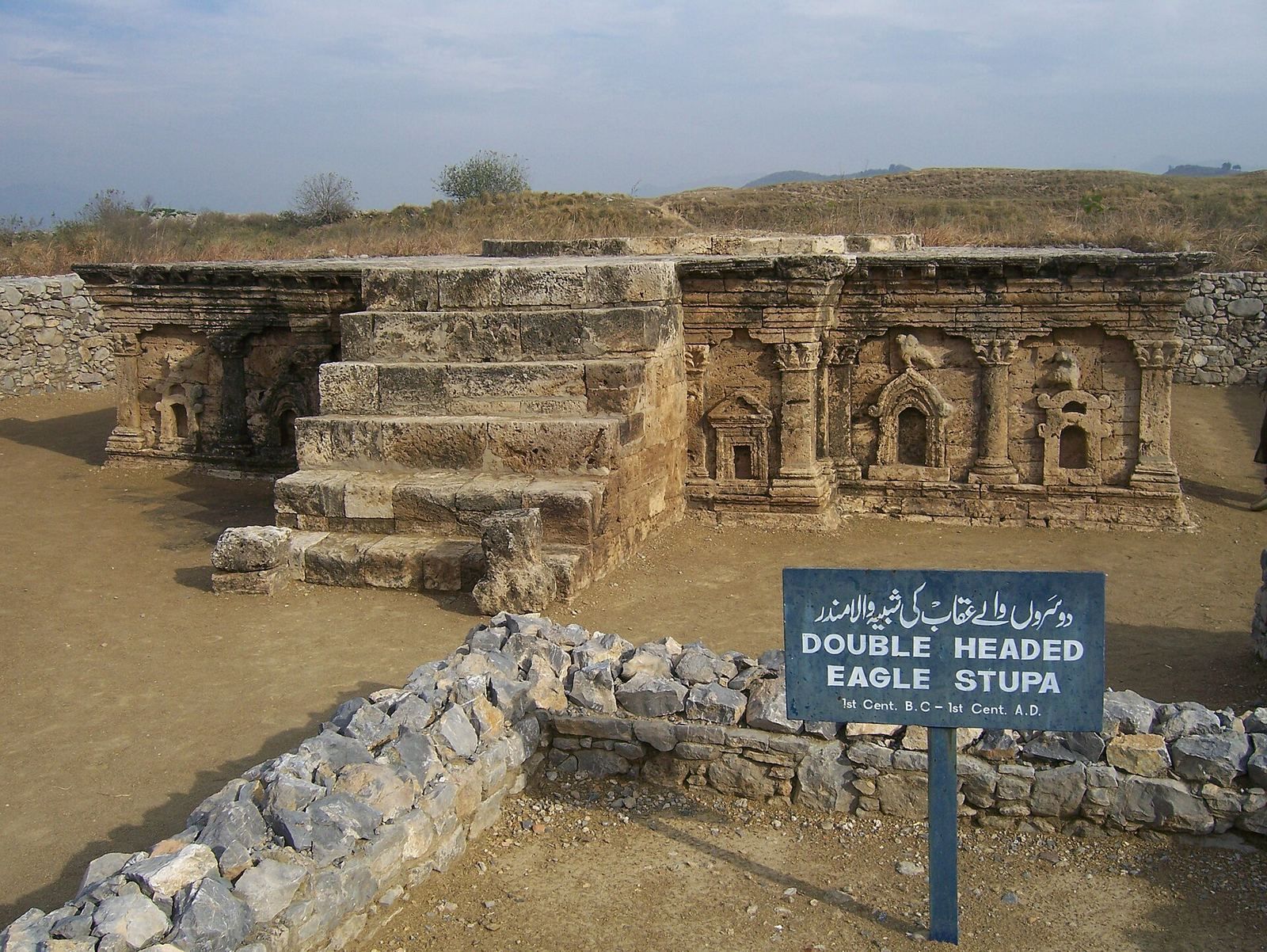
Sirkap is a fortified city laid out on a symmetrical plan, with a main road bordered by small and large temples. In blocks F and G, John Marshall identified temples as Jain on the basis of architectural similarities to Kankali Tila at Mathura. Block G, on the right-hand side of the main road, contained large buildings alongside small temples that worshippers could enter. The base of the Sirkap Stupa is ornamented with representations of Hindu, Buddhist and Greek temple fronts.
Sirsukh
Sirsukh preserves the remains of a fortified settlement founded under Kushan rulers. It represents the latest of Taxila’s ancient urban phases.
Buddhist monuments and collections
Stupas and monasteries
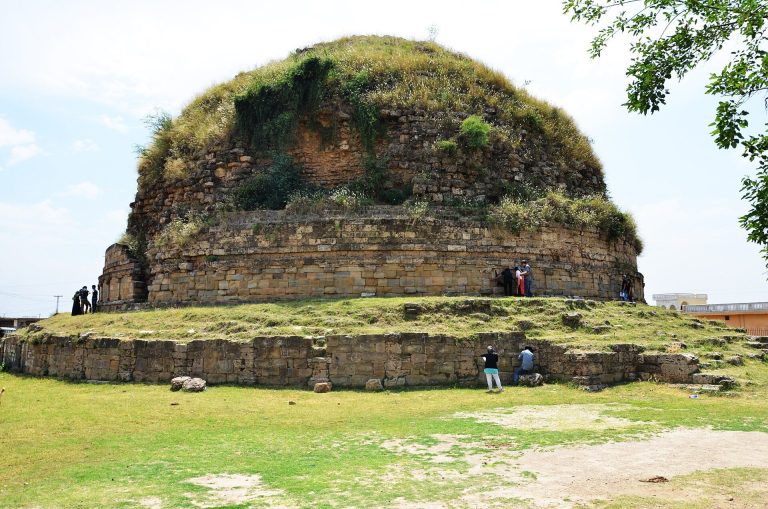
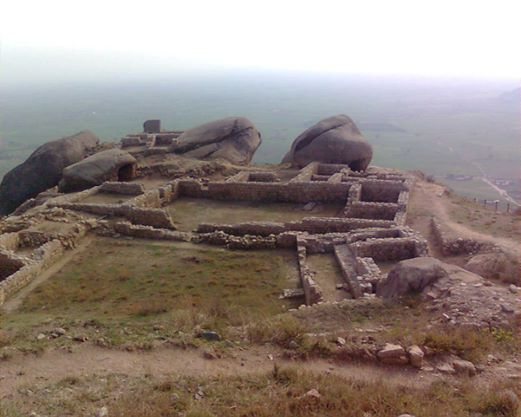
Taxila’s Buddhist remains include the Dharmarajika, Kunala, Jaulian, Mohra Moradu and Pippala stupas and monasteries. Other named monuments include the Lalchak and Badalpur stupas and remains around the Bhallar Stupa. Together, these sites form a broad group of religious buildings across the archaeological landscape.
Shah-dheri
The excavated remains around Shah-dheri include a fortified city with 55 stupas, 28 monasteries and nine temples. Two of the stupas were described as matching the Great Manikyala Stupa in size.
Sculpture and reliquaries
Taxila Museum holds an extensive collection of Buddhist stone sculpture in the Gandhara style, dating from the first to the seventh centuries CE. Much of it came from excavations in Taxila Valley, particularly Marshall’s work, while other pieces came from excavations elsewhere in Gandhara, donations or seizures by police and customs authorities. A Buddhist reliquary, a container for sacred remains, and its contents from Jaulian are held at the British Museum.
Other archaeological components
Other named remains include Khanpur Cave, the Khader Mohra (Akhuri) site, the Kalawan group of buildings, the Giri complex, the Jandial complex, Lalchak mounds, and the Giri Mosque and tombs. The landscape also preserves Mughal gardens and sections of the historic Grand Trunk Road. The Nicholson Obelisk commemorates John Nicholson, who died during the 1857 uprising. The Margala hill range lies south of Taxila Valley.