Dar al-Magana: The Marinid Water Clock House in Fes
Site at a Glance
- Rating
- 3.9
- Popularity
- Very Low
- Country
- Morocco
- Primary era
- Medieval
- Eras represented
- Medieval
- Civilizations
- Marinid
- Site type
- Infrastructure
On this page7 sections
History
Dar al-Magana is a fourteenth-century water-clock building on Tala’a Kebira Street in Fes, Morocco, constructed under the Marinid dynasty by Sultan Abu Inan Faris. Meaning “House of the Clock,” it served the Bou Inania Madrasa, an Islamic educational institution linked to worship and charitable activity, and its mosque.
The Bou Inania complex
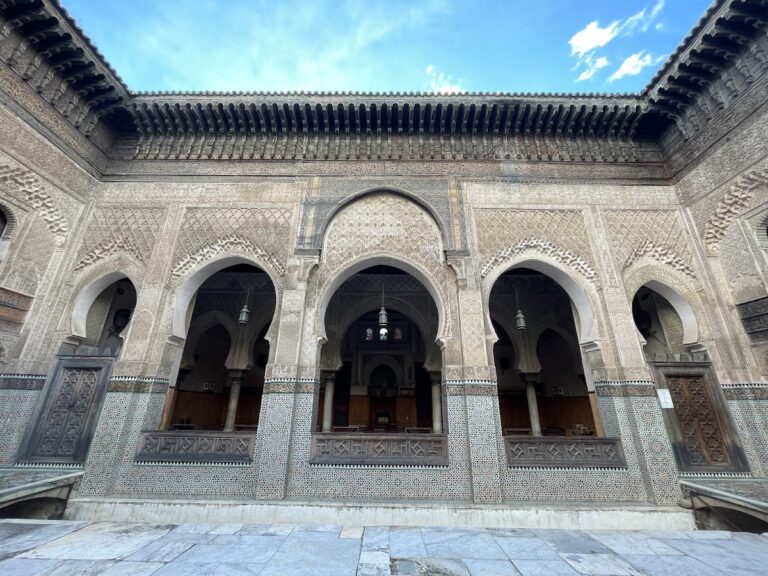
Dar al-Magana formed part of a larger charitable complex centered on the Bou Inania Madrasa. The madrasa’s foundation inscription states that construction began on December 28, 1350, and ended in 1355. Abu Inan Faris, a Marinid ruler and patron of the complex, commissioned the building during Fes’s period as a major political, religious, and scholarly center.
Completion of the clock
The water clock was completed on May 6, 1357, according to the Fes chronicler al-Jazna’i. Its designer was Abu al-Hassan ibn Ali Ahmed el-Tlemsani, a muwaqqit, or specialist responsible for determining and regulating the times of daily Islamic prayers. The mechanism may have drawn on principles used in a water clock built in 1317 for the prayer-time chamber of the Qarawiyyin Mosque by the Marinid ruler Abu Said.
A popular tradition identifies Dar al-Magana as the former residence of Maimonides, the medieval Jewish philosopher, legal scholar, and physician. This association gave the building the occasional name “House of Maimonides,” but the attribution remains legendary rather than established history.
Decline and restoration
The clock has been out of operation for generations, and the loss of knowledge about its exact operation has complicated efforts to repair it. Since 2004, the brass bowls have been removed during attempts to repair or reconstruct the mechanism. ADER-Fes, a foundation concerned with restoring monuments in Fes, has managed the project, which has not yet restored the clock to operation. The building’s structure and facade were restored in the early 2000s.
Remains
Building and facade
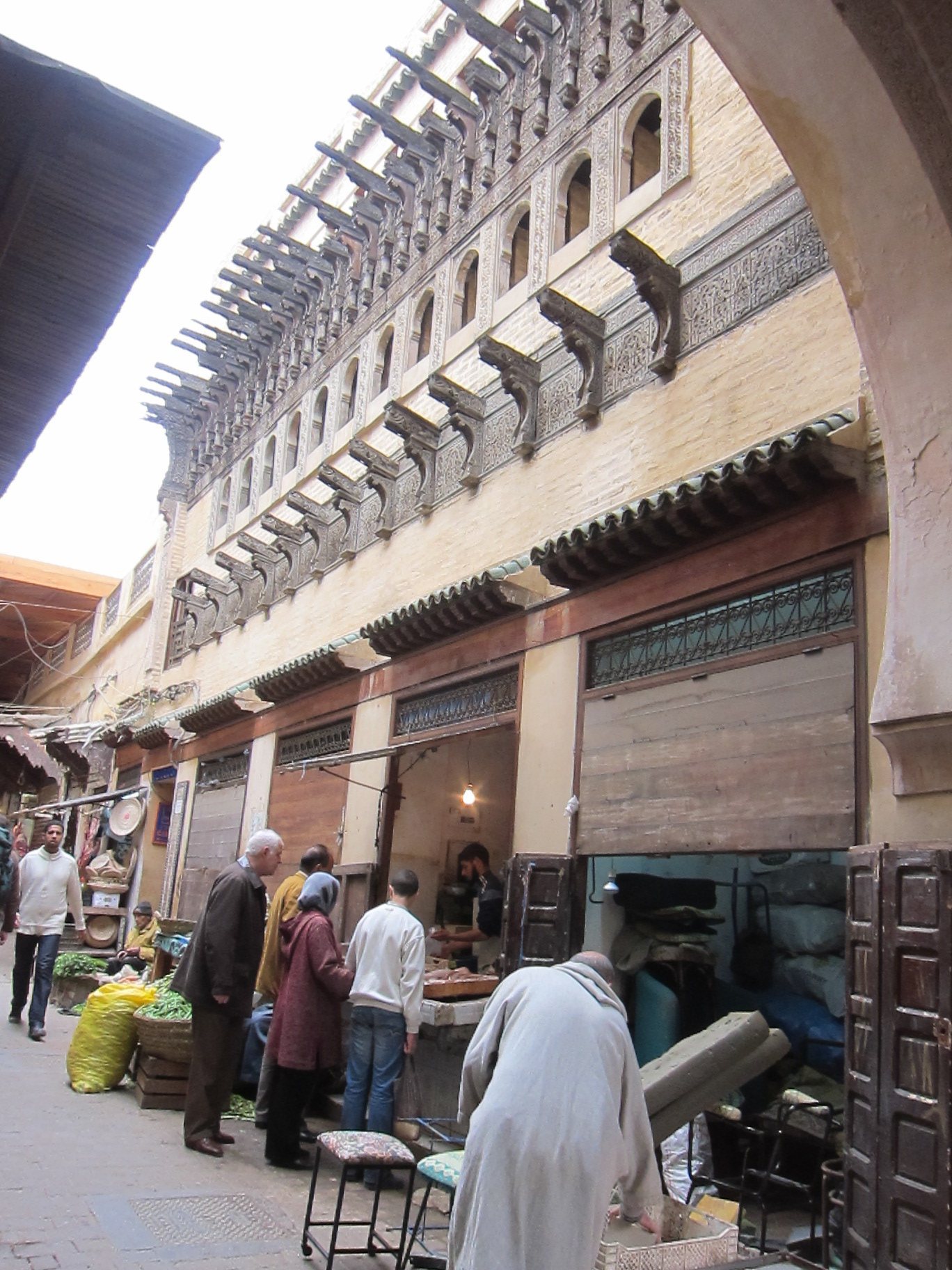
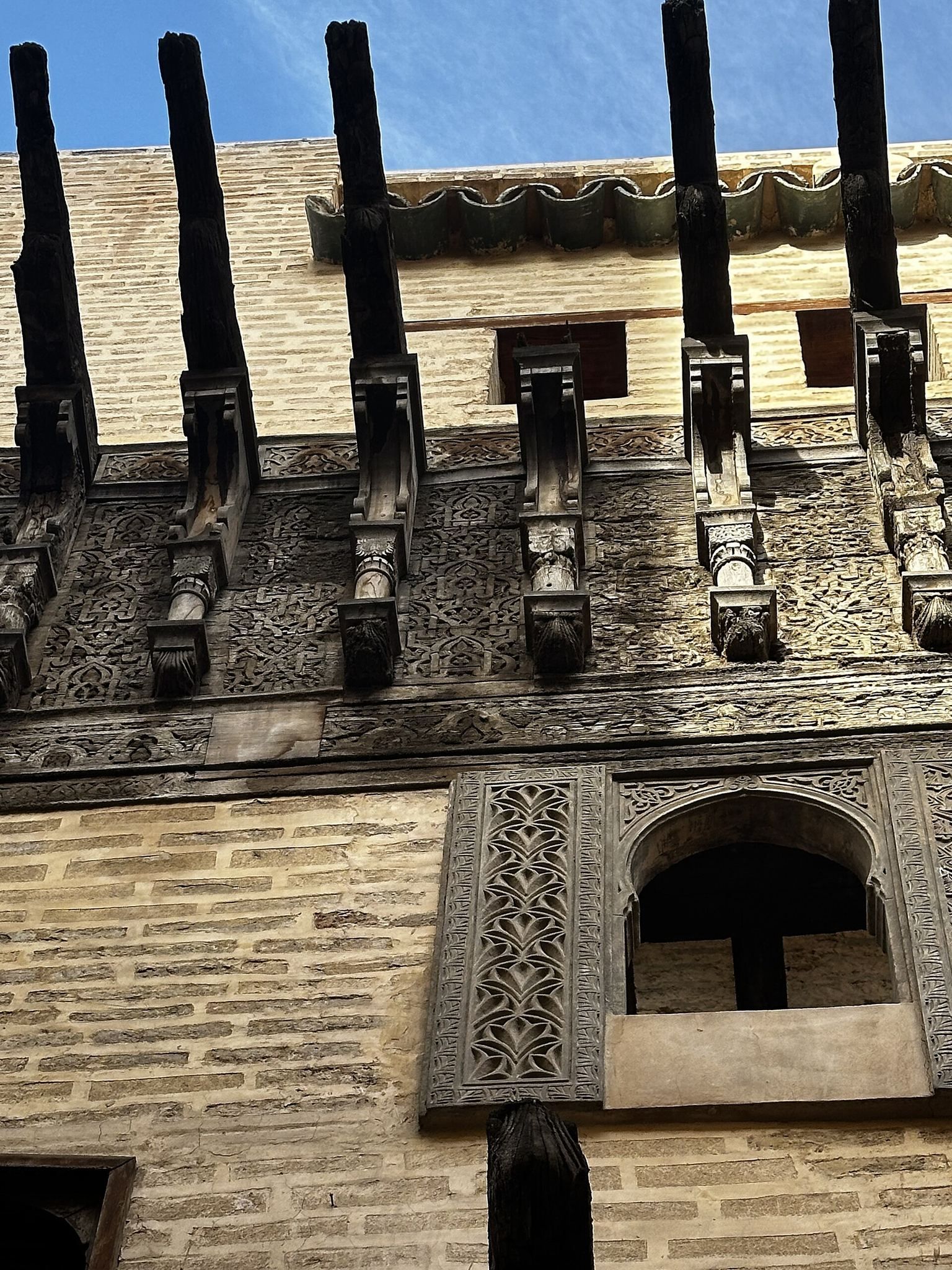
Dar al-Magana stands opposite the Bou Inania Madrasa on Tala’a Kebira Street. Its facade is arranged around twelve windows and platforms associated with the clock. Carved stucco frames the windows, while projecting wooden rafters and corbels support a small roof over the openings. The wood carries carved arabesque designs, consisting of flowing plant-like forms, together with epigraphic decoration formed from ornamental inscriptions. The rafters resemble those of the Bou Inania Madrasa.
Water-clock mechanism
The clock used twelve doors, each paired with a platform carrying a brass bowl. Behind the doors, a small cart probably moved from left to right to keep the mechanism in motion. A rope connected one end of the cart to a suspended weight, while another rope linked it to a weight floating on the surface of a regularly drained water reservoir. At each hour, one door opened and a metal ball fell into its brass bowl, providing the clock’s visible hourly signal.