Maristan of Sidi Frej: A Historic Hospital in Fez
Site at a Glance
- Rating
- 4.7
- Popularity
- Very Low
- Country
- Morocco
- Primary era
- Modern
- Eras represented
- Medieval, Modern
- Civilizations
- Marinid
- Site type
- Economic
- Remains
- Market
On this page9 sections
History
Maristan of Sidi Frej is a historic Muslim hospital in Fez, Morocco, founded by the Marinid sultan Abu Yaqub Yusuf al-Nasir in 1286 and built in a Marinid style influenced by Andalusian design. A maristan, from the Persian term bimaristan, was a hospital or “house of the sick.” The institution was regarded as Fez’s oldest, most famous, and most important maristan, as well as one of Morocco’s leading establishments of its kind.
Foundation and administration
The maristan was supported through habous or waqf endowments, charitable foundations whose revenues were permanently assigned to public or religious purposes. Its income also came from state contributions, donations, gifts, and alms. These resources financed construction, maintenance, and preservation. The administration included a superintendent assisted by a secretary, while a separate endowment official monitored expenditure. Doctors, assistants, guards, cooks, and a jurist also worked at the institution.
Two Marinid superintendents are known by name. Abu Faris Abd al-Aziz ibn Muhammad al-Qarawi held the position before his death in 1350. Muhammad ibn Qasim ibn Abi Bakr al-Qurashi al-Malaqi, born in 1303 and deceased in 1356, was recorded as superintendent in May 1353, although another tradition identifies him with the maristan in Marrakesh.
The institution was restored during the reign of the Marinid sultan Abu al-Hasan and improved further under his successor, Abu Inan. Abu Inan is also said to have brought the Andalusian physician Faraj al-Khazraji to Fez to strengthen the maristan. Faraj later managed it, repaired and enlarged its facilities, and introduced a resident musical ensemble.
Medical and charitable functions
At first, the maristan offered several forms of treatment, including care for eye diseases, psychiatric conditions, broken bones and other injuries, and animal illnesses. From about the fifteenth century, its work gradually focused on people with mental illnesses. It increasingly also acted as a hospice, providing food and shelter for poor people, the mentally ill, and others living at the margins of society.
Psychiatric care included Andalusian musical performances held weekly or twice a week, particularly in connection with Fridays. The performances continued into the twentieth century. Patients received separate garments for daytime and nighttime use. Calming methods used in maristans elsewhere in the Islamic world included aromas and water, and these formed part of the wider therapeutic setting associated with such institutions.
The maristan also distributed food and clothing to poor, elderly, and needy people. Its officials paid for washing, shrouding, and proper burial for poor people and for foreign or unidentified dead. The building served as the headquarters of the town criers and housed a lost-and-found office. It also contained the office and tribunal of the mohtasib, a public-order magistrate responsible for markets, public conduct, and related civic matters. This office was present there by at least the beginning of the twentieth century.
One distinctive charitable service concerned injured or sick storks, and possibly cranes. Birds brought to the maristan could receive treatment, while those that died were buried there. Donations and bequests helped support this work.
Decline, destruction, and succession
The institution’s decline was linked to the Marinid sultan Abu Said Uthman, who appropriated, pledged, and sold its endowments and property to finance the army and wars. He died before restoring the diverted funds, and the loss of charitable income contributed to the maristan’s deterioration. By the nineteenth century, its decline was pronounced and became worse under colonial rule.
Hasan al-Wazzan, the North African diplomat and travel writer later known in Europe as Leo Africanus, worked at the maristan for two years as a secretary or legal notary in the late fifteenth or early sixteenth century. He recorded patients, equipment, and food entering and leaving the institution, and described declining services that included confinement, restraint, and occasional mistreatment of patients. By the final period of the old maristan, patients were reportedly treated in conditions resembling imprisonment.
The institution continued operating until a fire in 1944 destroyed it and caused part of the building to collapse. Some accounts give 1943 as its final year. A successor maristan was established near Bab al-Khokha in 1949 and reopened at a different location in 1951 under the French colonial authorities. Patients from the old institution were transferred there, and the new establishment was designed around modern Western psychiatric theories. Its creation may also have helped colonial authorities present their rule as respectful of local Muslim traditions and institutions.
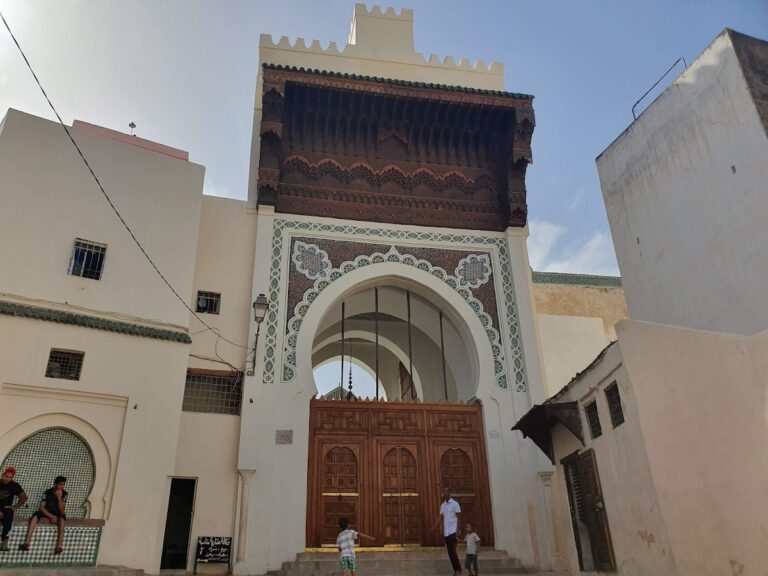
After a modern psychiatric hospital was established in Fez, the former maristan was transferred to public administration in 1978. Proposals in 2018 called for restoration and conversion of the site into a medical-services center, but they do not establish that the conversion took place. The former maristan forms part of the historic medina of Fez, a UNESCO World Heritage site. In 1993, the Moroccan Society for the History of Medicine placed a commemorative plaque at the entrance.
The institution may have influenced similar establishments in Morocco, the Maghreb, and Spain. One proposed connection associates the experience of the cleric Gilbert Jofre during a visit to Fez with the founding of an asylum for mentally ill people in Valencia in 1410, but this remains a possibility rather than a certain historical link.
Remains
Layout and surviving complex
Main maristan
The original maristan stood in the center of the old city, between Tala’a Kebira Street and the Zawiya of Moulay Idris II, near Nejjarine Square and between the Attarine and Henna markets. It was approximately 100 metres from the Qarawiyyin Mosque and University. The two-storey building followed Marinid architecture influenced by Andalusian design. A white enclosing wall surrounded the complex, and a tall entrance covered with iron was opened only infrequently.
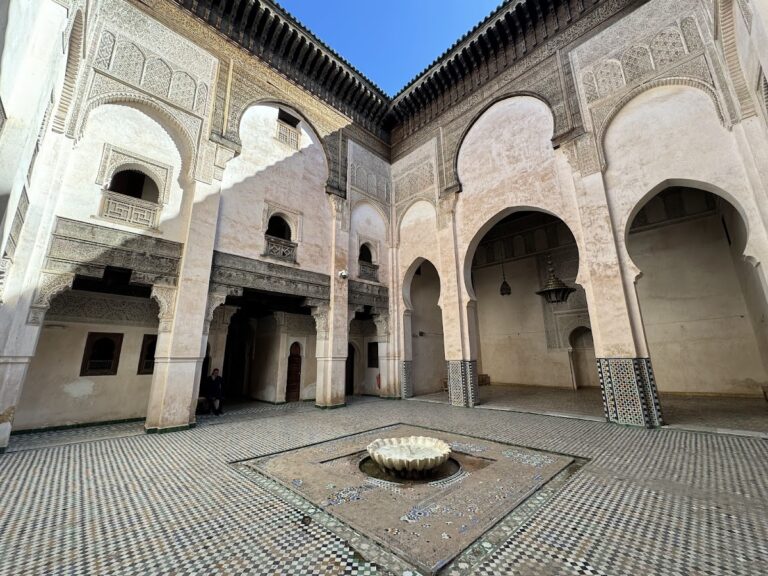
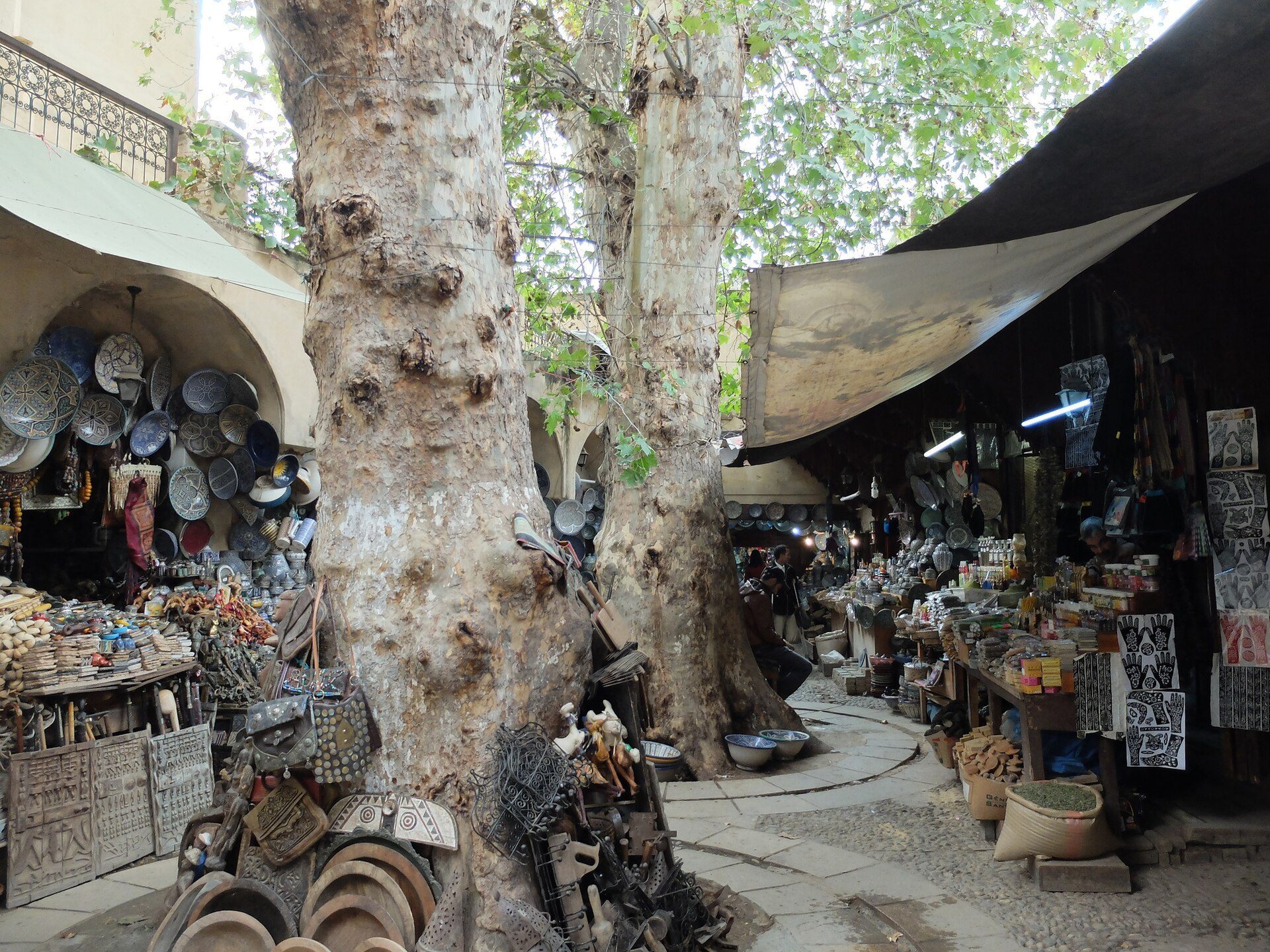
The ground floor contained 18 small rooms for male patients. The upper floor held rooms for female patients, with one account giving 22 rooms and another 12. The discrepancy remains unresolved. A central garden with two old trees occupied the middle of the complex. Patients used it for walking, and it also hosted the weekly Andalusian musical performances. The garden was additionally associated with the treatment and burial of birds.
Post-fire building
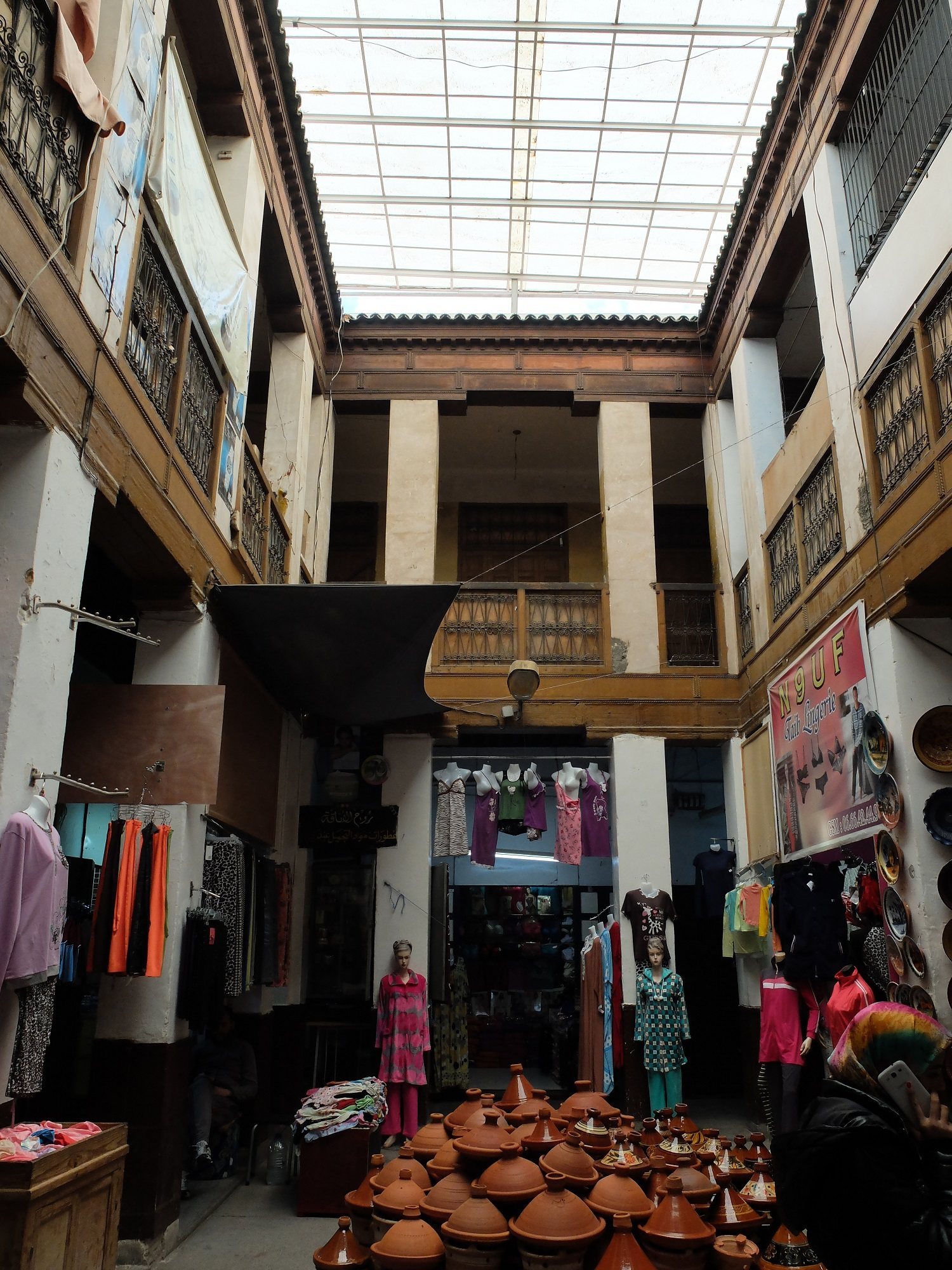
After the fire and collapse of 1944, the original site was rebuilt or reorganized as a funduq– or qaysariyya-type building. A funduq was a caravanserai-like urban structure used for lodging, storage, workshops, or commerce, while a qaysariyya was a planned commercial complex or market building. The mosque was retained. The present building contains shops selling clothing and household furnishings, while former maristan rooms are used for selling pottery and henna.
Fountain of Sidi Frej
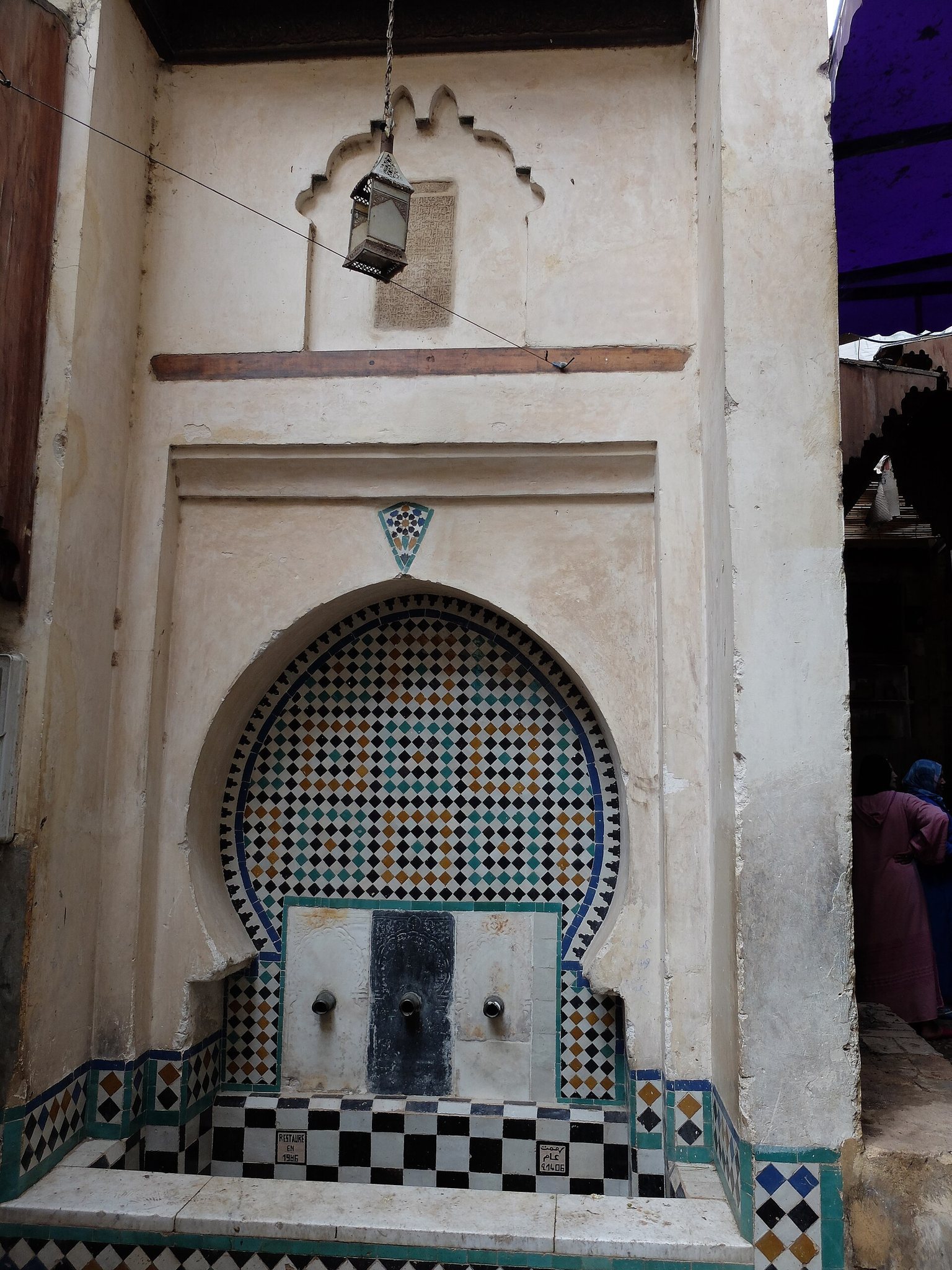
The public street fountain known as the Fountain of Sidi Frej stands near the former maristan and the Henna Souk. Its back wall is covered with zellij, a Moroccan mosaic technique using small hand-cut glazed tiles, and framed by a pointed horseshoe arch within a rectangular border. Small black-and-white marble panels with carved arch motifs are set into the tiled area above the water basin. Above this decorated zone is a mostly plain surface containing a small blind arch with a double-pointed lambrequin profile. A simple wooden canopy surmounts the structure and carries an Arabic inscription repeating a blessing.
Inside the small blind arch, a rectangular marble panel preserves the fountain’s original foundation inscription. It praises Abd al-Haqq II, the last Marinid sultan, and states that construction was supervised by his vizier Abu Zakariya Yahya ibn Ziyan al-Wattasi. The inscription gives the completion date as 11 November 1436.
The fountain was restored in 1679. Its original inscription and small marble ornaments remain, while the wooden canopy dates from that restoration. Further restoration included work marked by French and Arabic date inscriptions from 1986. Some carved stucco decoration believed to have covered the fountain has been lost.
The fountain and nearby square also preserve the setting associated with the maristan’s name. The western side of the complex opened onto a small public square historically known as Souq al-Henna, or the Henna Market, which was distinguished by trees at its center. A gate called Bab al-Faraj separated the nearby Attarine and Henna markets and is one proposed source of the name Sidi Frej.