Citadelle de Bitche: A French Fortress in Lorraine


Site at a Glance
- Rating
- 4.5
- Popularity
- Medium
- Country
- France
- Primary era
- Early Modern
- External website
- Open
- Eras represented
- Early Modern, Modern
- Civilizations
- French, German
- Site type
- Military
- Remains
- Citadel
On this page15 sections
History
Citadelle de Bitche is a French fortress above Bitche, France, rebuilt in the eighteenth century on a strategically important sandstone promontory. Its modern form originated in the Vauban period, with major construction from 1683 to 1697, and its defenses were strengthened during the eighteenth century. The site controlled routes connecting the Rhine with Lorraine and Alsace with the Palatinate, giving Bitche an important place in the military history of the former Duchy of Lorraine.
Medieval lordship and castle
The first known reference to Bitche appears in a letter from the middle of the twelfth century. Duke Matthew I of Lorraine instructed the Count of Saarwerden to respect the boundaries and inhabitants of the Lordship of Bitche. A document from the late twelfth century mentions Bitis castrum, or Bitche Castle, and gives Frederick of Lorraine the title “Lord of Bitche.”
Tradition associated an earlier castle, called Altbitsch, with the Schlossberg near Lemberg, but that identification remains uncertain and the site may instead have been a hunting lodge. A further lodge apparently stood on the promontory occupied by the present citadel. A second castle was probably built there in the late thirteenth century by a count of Zweibrücken, who later made Bitche Castle his principal residence.
The Lordship of Bitche was separated from the rest of Lorraine by the territories of the Counts of Zweibrücken. It was also the duchy’s only territory within the German-speaking area. In treaties concluded in 1297 and 1302, Eberhard II exchanged lands with Duke Frederick III of Lorraine and received Bitche Castle and its lordship as a fief. The lordship remained within the political framework of the Holy Roman Empire, a long-lasting union of territories in central Europe, until the early sixteenth century.
From Zweibrücken-Bitsch to France
The castle and lordship passed through the Zweibrücken-Bitsch succession. After Reinhard of Bitche died in 1531, disputes between his sons allowed Lorraine to intervene. Amélie of Bitche, daughter of Simon Wecker and wife of Philippe of Limange, sold the lands of Bitche to Duke Charles II of Lorraine for 50,000 écus. In 1563, Count Jacques of Bitche demolished houses at the foot of the rocky promontory and built defensive walls in opposition to payments demanded by the dukes of Lorraine. He died without direct heirs in 1570, ending the line of the Counts of Zweibrücken-Bitsch.
The castle suffered partial destruction during the German Peasants’ War. Swedish forces failed to occupy the fortress in 1632. France first occupied the Duchy of Lorraine in 1633, and in 1634 Marshal de Humières captured Bitche after a ten-day siege ordered by Cardinal Richelieu.
When Louis XIV incorporated Bitche after the Treaty of Nijmegen in 1679–1680, the former castle stood in ruins. After Marshal Turenne emphasized the site’s military value, Louis XIV commissioned Vauban, the king’s principal military engineer, to transform the rock into a fortress. Construction lasted from 1683 to 1697 and cost France 2,500,000 gold livres.
The new fortress was dismantled in 1698 under the Treaty of Ryswick, which ended the Nine Years’ War and returned Bitche to Leopold I, Duke of Lorraine. A regiment from Flanders demolished the recent works between autumn 1697 and summer 1698. France returned a garrison after the War of the Spanish Succession began in 1701 and provisionally rebuilt the defenses, but the garrison withdrew after the Treaty of Rastatt in 1714, leading to another demolition.
Eighteenth-century reconstruction
Agreements of 1735 and 1736 transferred Lorraine and Bar from Duke Francis Stephen of Lorraine to Stanislaus I Leszczyński, the exiled King of Poland and father-in-law of Louis XV. In 1738, Louis XV authorized Bitche’s return to the French frontier-defense system. Reconstruction began under Marshal de Bournay and continued under Count de Bombelles after Bournay’s death in 1740. Bombelles began work in 1741, and Austrian-backed mercenaries approaching Bitche in 1744 were repelled.
The rebuilding retained Vauban’s basic plan while adding stronger works under Louis de Cormontaigne, an eighteenth-century French military engineer. Major fortification work continued until 1765, when the esplanade at the foot of the glacis was arranged. A plaque at the entrance records the completion phase under Louis XV. Bitche was not subsequently overcome by military assault.
Revolutionary and nineteenth-century warfare
During the First Coalition War, the 1792–1797 conflict between revolutionary France and European powers opposed to it, Prussian forces attempted a surprise attack on the night of 17 February 1793. The assault failed with heavy losses. A model showing Bitche as it appeared in 1794 was later produced and is now displayed in the citadel museum.
The citadel also protected the Haguenau–Falck-Hargarten railway, completed in late 1869, as well as the surrounding road network. During the Franco-Prussian War, it endured a siege of about 230 days under Louis-Casimir Teyssier. A Bavarian force numbering up to 7,000 men attacked the position, and the citadel was bombarded for ten days, from 11 to 21 September 1870.
Teyssier continued the defense after the armistice and the preliminary Treaty of Versailles because he had received no official evacuation order. On 23 March 1871, he and Colonel Kohlermann agreed on an honorable withdrawal. The French garrison left on 25 March with its weapons and flags and received military honors. The bombardment had destroyed the above-ground buildings on the plateau except for the chapel and damaged many houses in Bitche. The siege caused 19 Bavarian deaths and 62 wounded, four Prussian deaths during a reconnaissance ride, and 93 French deaths in Bitche’s hospitals, along with an uncertain number of French deaths inside the fortress.
After the war, Bitche became part of the Reichsland Alsace-Lorraine, an imperial German territory administered directly by the German Empire from 1871 to 1918. German military authorities modernized the fortress between 1871 and 1900 as a railway-blocking fort and stationed a Prussian garrison there. The citadel escaped fighting during the First World War but suffered American artillery damage in 1944–1945 during the Second World War.
Protection and museum use
Citadelle de Bitche and its underground passages have been protected as historic monuments since 1979. The former defensive installation now operates as a history museum, preserving the military development of the site and interpreting its role in the conflicts that shaped Lorraine.
Remains
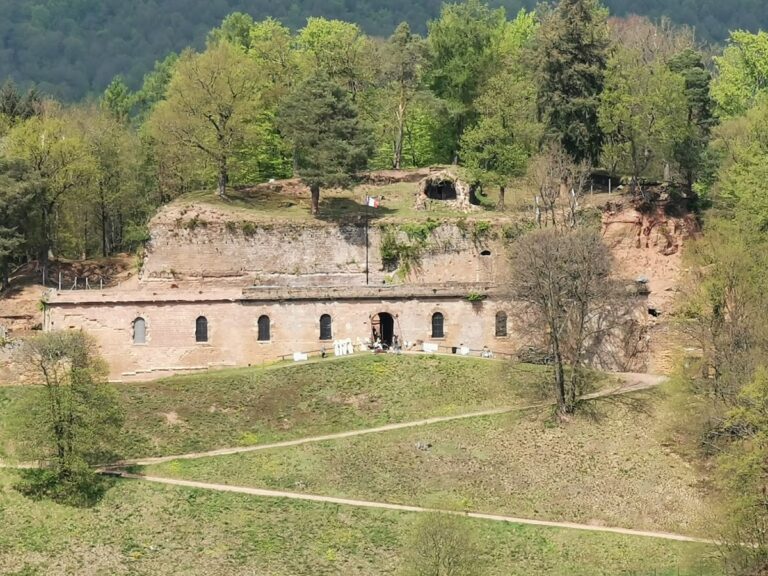
The citadel occupies a sandstone plateau about 300 metres long and between approximately 30 and 60 metres wide. Its highest point reaches 365 metres above sea level, about 80 metres above Bitche. Steep sides overlook several valleys and the northern Vosges. Until the nineteenth century, ponds and marshes extended around the rock, making it difficult for an enemy to bring heavy siege equipment into position.
Plateau and defensive works
Natural rock and main fortress
The upper rock was levelled into three sections: a larger central plateau, the northeastern Great Head, and the southwestern Small Head. Ravines divide the two outer sections from the center. Vauban’s plan used these natural levels to support several tiers of artillery positions. The main fortress was protected by four bastions, projecting platforms that allowed fire along the flanks, while detached defenses occupied the two outer sections.
Detached defenses and entrance
A western lunette, a detached angular fortification, stands on the Small Head, while an eastern hornwork, an advanced work projecting through two outward-facing arms, occupies the Great Head. Access crosses a large ramp and drawbridge before passing through a postern, a small fortified entrance. The main gate has a triangular pediment bearing the French royal arms with three fleurs-de-lis above a construction inscription dated 1754. Advanced defenses added between 1755 and 1760 strengthened the earlier arrangement, and the esplanade at the foot of the glacis, a sloping area intended to expose attackers to defensive fire, was laid out in 1765.
Underground complex and military buildings
Passages, casemates, and storage areas
Long underground passages, casemates, or fortified chambers, and large halls were cut into the sandstone. Until the twentieth century, these spaces offered protected accommodation in separate areas for officers, non-commissioned officers, and enlisted men. They also contained rooms for essential fortress infrastructure. The surviving underground complex forms part of the museum and includes an audiovisual and sensory route explaining the history of the fortress.
Chapel and water reservoir
St. Sebastian’s Chapel, built in the Baroque style around 1750, is the oldest building on the upper plateau. A reservoir holding 450 cubic metres of water lies beneath it. The chapel survived the bombardment of 1870–1871, when the other above-ground buildings on the plateau were ruined.
Barracks and command buildings
Two garrison barracks were constructed after 1871, and the fortress command headquarters stands opposite the chapel. Cormontaigne’s works also included barracks, quarters for engineering officers and the governor, artillery magazines and powder stores, guardhouses, and defenses associated with the glacis. The citadel retains these advanced works, chapel, guardhouse buildings, powder-storage facilities, and parts of the underground complex despite the damage of 1870–1871 and 1944–1945.
Collections and later additions
The museum displays a model of Bitche as it appeared in 1794. Three bells were cast at the citadel in May 2006 from copper and tin. The largest weighs 63 kilograms and bears the arms of Bitche and Commander Teyssier; the other two weigh 40 and 20 kilograms. The largest was intended for hand ringing, while the two smaller bells were intended to join a surviving period bell for hourly ringing. A carillon was planned in connection with the chapel’s restoration in 2007.
A Peace Garden lies between the citadel and the town and forms part of the Gardens without Borders network.
Nearby sites