Fort Saint-Sébastien: A Nineteenth-Century Defensive Bastion at Bitche


Site at a Glance
- Rating
- 4.2
- Popularity
- Very Low
- Country
- France
- Primary era
- Modern
- Eras represented
- Modern
- Civilizations
- French
- Site type
- Military
- Remains
- Fort
On this page11 sections
History
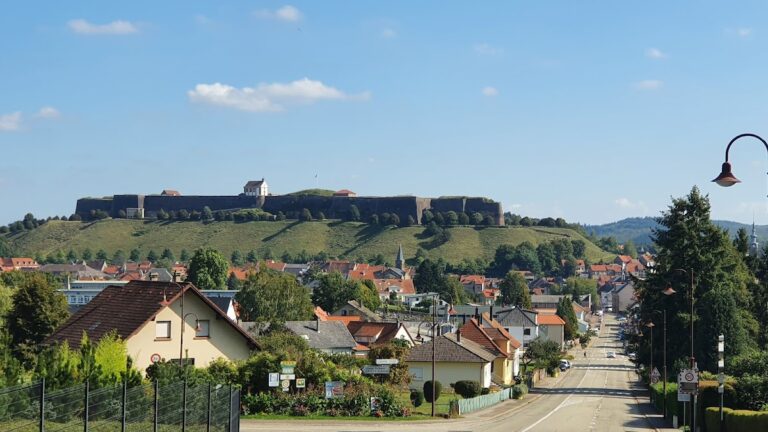
Fort Saint-Sébastien is a French nineteenth-century fortification in Bitche, France, built between 1846 and 1852 to secure the northern approach to the Citadel of Bitche. It formed the principal bastion of a new defensive enclosure and was intended to prevent an enemy from taking Roche Percée hill or firing on the stronghold from the surrounding heights.
Planning a New Fortified Camp
The project emerged from efforts to strengthen Bitche during the reign of Louis-Philippe, King of the French from 1830 to 1848. In 1844, General Schneider persuaded the Fortifications Committee to consider a new defensive enclosure for a fortified camp. Schneider, who came from Sarre-Union, represented the Sarreguemines arrondissement in parliament and had previously served as Minister of War. His proposed position between the castle and Kindelberg was rejected.
The committee instead adopted a design by Michel Bizot, a chief of battalion in the engineering corps who had been born in Bitche in 1795. Bizot proposed placing the fortified camp to the northwest, where it could also enclose the town. His earlier work included projects for the defensive enclosure of Strasbourg in 1837 and for the enclosure of the valley at Belfort.
Construction and Military Role
Construction of the Roche Percée fort, also known as Bastion No. 7 or Fort Saint-Sébastien, began in 1846. Work continued during the Second Republic, the French regime that followed the July Monarchy from 1848 to 1852, and ended in 1852, when the Second Empire began under Napoleon III. The fort became part of a new enclosure containing nine bastions.
A ministerial decree issued on 28 February 1850 classified Bitche as a first-class fortified place, a French administrative and military category for fortresses of the highest rank. The fortification works were completed in 1857. Fort Saint-Sébastien was the most important bastion in the new system and served as the fortified stronghold’s final resistance point.
During the siege of Bitche in 1870 and 1871, the fort helped prevent an approach to the town from the north. A fortified camp at its foot housed approximately 1,000 soldiers for nine months. After the Franco-Prussian War, the fortress lost strategic value because Bitche was no longer close to the frontier. German authorities declassified the fort in 1880, as its defenses were no longer suited to rifled artillery, whose grooved barrels improved range and accuracy.
Abandonment and Later Preservation
Fort Saint-Sébastien had a service life of about thirty years. Its construction cost slightly more than 320,000 francs, exceeding the original estimate of 190,000 francs, and provided employment for people from the surrounding region. After the ditch was abandoned, many residents of Bitche, with the agreement of the town authorities, removed stones for use in houses and garden walls. In recent years, the association Les Amis du Fort, working with the municipality, has sought to revive the site.
Remains
Fort Saint-Sébastien has a pentagonal plan and occupied Bastion No. 7 in the new defensive enclosure. It faced the Citadel of Bitche and the area now used as the town’s football ground. Its defenses combined a deep ditch, raised earthworks, artillery positions, and a fortified connection with the castle.
Fortifications and Defensive Works
Pentagonal Fort and Castle Link
A rampart connected the fort to the castle. Two small bastions with protected chambers for weapons or troops flanked this link. The arrangement made the fort part of a wider defensive system rather than an isolated structure, while its position gave it control over the northern approaches to the stronghold.
Ditch and Earthworks
Before the first ramparts were built, a ditch approximately 10 metres deep and between 15 and 20 metres wide was excavated around the fort. Three small bastions protected it. Some of the earthworks used material removed from the ditch, and the spoil was carried in small wagons running on rails.
Cavalier and Artillery Position
The fort’s cavalier, a raised artillery position above the lower defenses, allowed guns to sweep the entire valley of the Ramstein mill and reach far toward the Ochsenmühle. This elevated position supported the fort’s role in protecting the stronghold from fire directed from the surrounding heights.
Camp and Surrounding Ground
Fortified Camp
The ground between the fort and the citadel served as an exercise area. A fortified camp was established below the fort on the site now used as a sports ground. During the siege of 1870 and 1871, this camp accommodated approximately 1,000 soldiers for nine months.
Nearby sites