Cismar Abbey: A Benedictine Monastery in Germany
Site at a Glance
- Popularity
- Medium
- Country
- Germany
- Primary era
- Medieval
- Eras represented
- Medieval, Modern
- Civilizations
- German, Holy Roman Empire
- Site type
- Religious
- Remains
- Monastery
On this page12 sections
History
Cismar Abbey was a Benedictine monastery in Cismar, now part of Grömitz, Germany. Its community moved there in 1245 and the abbey was dissolved in 1561. The monastery’s Brick Gothic buildings served a community that held extensive estates and made Cismar an important pilgrimage destination.
From Lübeck to Cismar
The community began at the Monastery of St John in Lübeck. After the bishop’s seat moved there from Oldenburg in 1177, Bishop Heinrich I of Brussels brought Benedictine monks from Brunswick and consecrated a monastery for them. Probably during Abbot Johann I’s tenure, daughters and widows of Lübeck’s wealthy urban elite were also admitted as nuns. Their presence prompted complaints: church law did not permit monks and nuns to share a monastery, and the monks struggled to follow their religious rule.
A plan to move the community from Lübeck to Cismar was under discussion by 1230 at the latest. A document dated 25 October 1231 records Count Adolf IV of Holstein’s order to transfer it to Cicimeresthorp, in Wagria, the historical peninsula and region of eastern Holstein. The proposed move led to a dispute over its legal standing that lasted until March 1256. It was a relocation of the existing monastery, not the creation of a new institution. Abbot Johann I and some of the community moved in 1245 and began rebuilding at Cismar.
The move was supported by the monastery’s growing interests in Wagria. The community had acquired land there while still based in Lübeck, and in 1237 Adolf IV sold the village of Cismar to the Monastery of St John. The monks subsequently contributed to the development of the region and organized extensive relief for the poor.
Estates, community, and religious ties
Cismar’s wealth grew through pious endowments, relic donations, and purchases of property and income rights. By 1325 the abbey held a harbor in front of the monastery, 22 complete villages and two partial villages nearby, 12 mills, lakes, and fishponds. Its mills included two at Cismar and one at Dammhusen, west of Wismar, while its estates reached into Lauenburg and Mecklenburg. Between 1303 and 1321 it bought ten more properties west and east of Wismar, in addition to its villages of Krempin and Schmakentin. By 1318 it had acquired three farmsteads from Wismar councillor Johannes de Crkow, in Vogtsgrube, now Claus-Jesup-Straße; by 1321 it also held parts of, and entire villages on, the island of Poel.
The abbey’s authority extended beyond its lands and income. Almost all its Holstein holdings gave it powers over serious and lesser legal cases. In 1322 it acquired neighboring Grömitz from the lords of Westensee, and Count John III of Holstein granted it the right of patronage over the local church. That church became part of the abbey around 1400.
The monastic community remained modest in size. A record from 1325 names Abbot Wiprecht, Prior Johann II, and 18 monks; another lists Abbot Johann VIII and 16 monks in 1328, and a 1346 document names Abbot Johann XI with 13 monks. A record from 1361 notes deaths among the community during the plague.
Cismar also maintained religious ties with other institutions. It had nine recorded confraternity agreements, spiritual bonds between communities that included mutual prayers and commemoration; two predated the move. The abbey renewed an agreement with St Giles’ Monastery in Brunswick in 1283 and made one with the Ratzeburg cathedral chapter in 1290. Its most important agreement was with Stolpe Abbey in Pomerania, concluded on 9 October 1301. A friendship treaty with Bordesholm Abbey, dated 1 October 1389, gave Cismar’s community precedence.
For a time, Cismar monks also managed the spiritual and economic affairs of the Benedictine nunnery at Preetz. Since no other male Benedictine monastery stood in the diocese of Lübeck, Cismar’s abbot held senior spiritual authority alongside the bishop and appointed Preetz’s provost, the senior cleric responsible for administering the institution. Cismar monk Konrad served in that role from 1275 to 1285, when the abbey church at Preetz was built. Hermann Kulpin held the post for one year from 1491, but was considered unable to manage the institution’s extensive finances.
Hardship and disputes with the bishop
The plague years around 1350 damaged the abbey’s income and estates. As tenants died, fled, or withheld payments, land went uncultivated. The monastery began expanding its holdings again late in the fourteenth century, but fifteenth-century fighting between Danish kings and Holstein counts brought further losses. During Eric of Pomerania’s incursion into Wagria, the abbey and its property were ravaged. Plague and warfare also reduced both pilgrimages and income from land. On 23 May 1432, the abbey asked Pope Eugene IV for support with its maintenance.
Cismar’s relationship with the bishop of Lübeck was also strained. In the first half of the fifteenth century, the abbey sought exemption from the bishop’s authority at the Council of Basel, a major church council concerned with governance and reform. On 1 June 1436, the council upheld Bishop Johannes Schele’s petition against Abbot Thomas Lunow. It ruled that the monastery was subject in every respect to the Prince-Bishopric of Lübeck, a territory ruled by its bishop as a temporal prince, and owed it obedience. The bishop could not remove Lunow because the monks supported him. The abbot had not been consecrated by the bishop or his representative, and relations with the bishop’s seat remained poor.
Pilgrimage, reform, and the Reformation
More than 800 relics and a sacred spring on the monastery grounds drew pilgrims and provided substantial income. Relics are objects or remains venerated for their association with a sacred person or event. Cismar’s collection included a drop of Christ’s blood and a thorn from his crown, the latter given to the bishop of Lübeck by Heinrich II.
In 1449 the community joined the Bursfelde Congregation, a Benedictine reform association that sought stronger observance of the monastic rule. Bishop Arnold Westphal of Lübeck consented on 8 October 1451. Cismar was one of the congregation’s six original members. Later records list 25 monks in 1502 and 21 in 1513. In 1502, Cardinal Raymund Peraudi, bishop of Gurk and papal legate, granted the abbey a jubilee indulgence, a remission of spiritual punishment for sin associated with a religious jubilee. Abbot Walter Vechel was repeatedly appointed by Pope Alexander VI in 1498 to visit and reform the Benedictine monasteries of Dobbertin and Rühn in Mecklenburg.
The Lutheran Reformation weakened Cismar’s pilgrimage role when the bishop of Lübeck rejected the authenticity of its relics. On 9 March 1542, a regional assembly at Rendsburg adopted a Lutheran church order, and Bishop Nikolaus Sachow visited the monastery that year. In the territorial division of 1544, Cismar passed to Duke Adolf of Schleswig-Holstein-Gottorp, who appointed Joachim von Rantzau as local administrator.
Dissolution and later use
The community continued for a time under the new rulers. The last known document issued by Abbot Augustinus dates to 20 December 1559, and Duke Adolf approved the abbot’s decision only on 2 December 1560. The abbey was abandoned around 1560, and its dissolution was completed in 1561. The transition appears to have involved neither flight nor expulsion: Augustinus was probably elderly, and the community submitted without resistance.
On 28 January 1561, Benedikt von Ahlefeldt became local administrator, and the former monastic territory was reorganized as an administrative district. The Gottorp dukes took over the property and converted the abbey into a castle with an estate farm. It was administered as the Gottorp princely district of Cismar and, from 1773, as a territorial district. The abbey church became Lutheran. Johannes Stricker, Cismar’s first Protestant pastor, was installed in autumn 1561; Andreas Grote had already received a lifetime right of residence at the patronage church in Grömitz in 1559.
The abbey library was first moved to Gottorf Castle and, after 1712, to the Danish Royal Library in Copenhagen. Its collection there still includes 110 identifiable Latin manuscripts and 149 books printed before 1501 that came from Cismar. The complex later served secular purposes including as a barn, an administrator’s residence, a refugee hostel, a youth hostel, and a school. It was used to store the University of Kiel Library during the Second World War. Extensive restoration and expansion began in 1982, and since 1987 the abbey has served as a cultural center and a branch of the Schleswig-Holstein State Museums, including for summer art exhibitions.
Remains
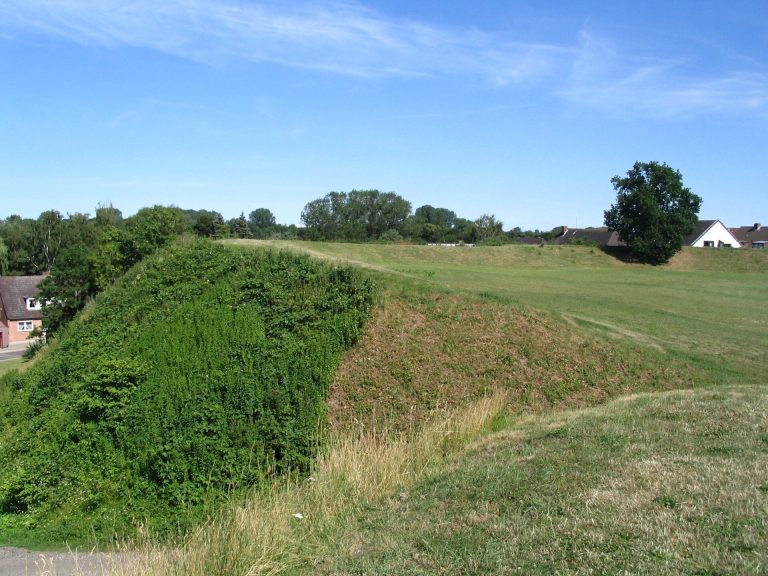
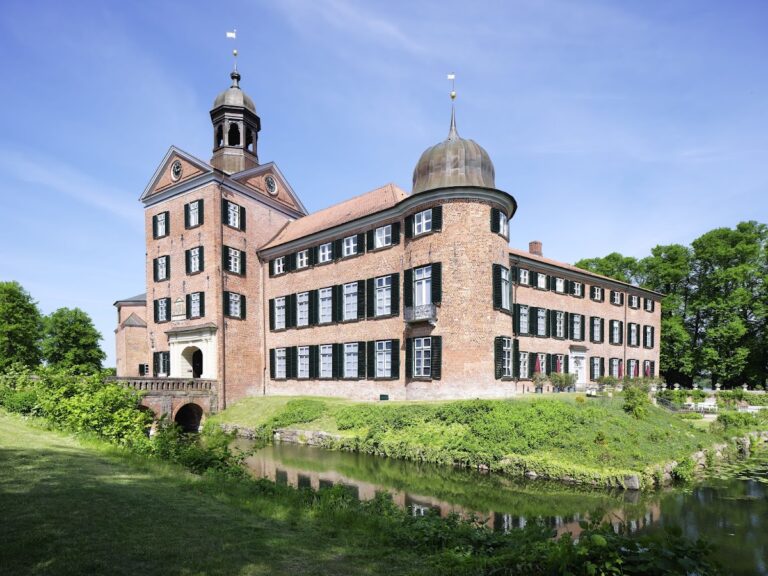
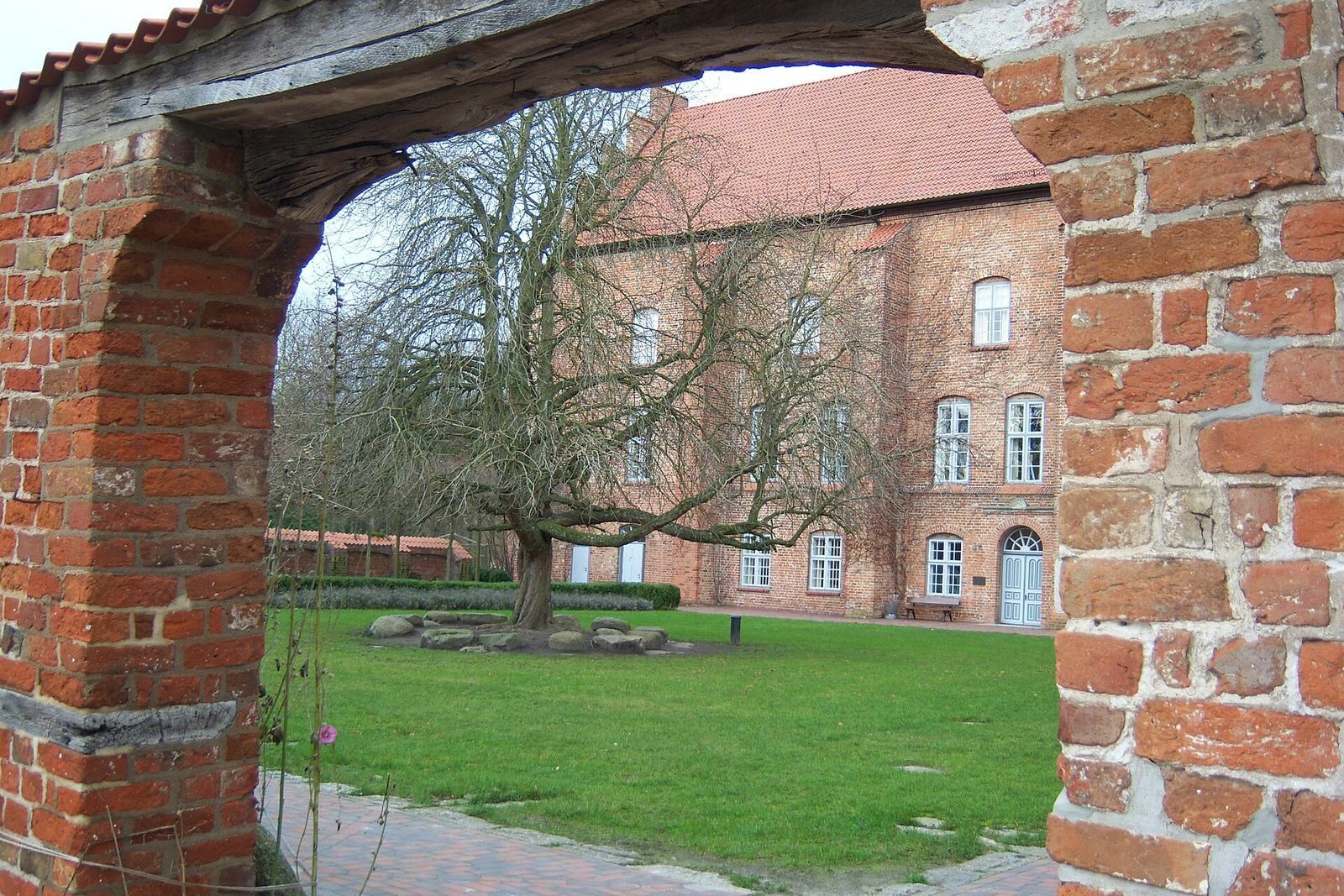
The Brick Gothic complex is organized around a square courtyard, with the church and monastic buildings forming its principal groups. A water-filled moat and earthworks surround the enclosure.
The church and its furnishings
Church building
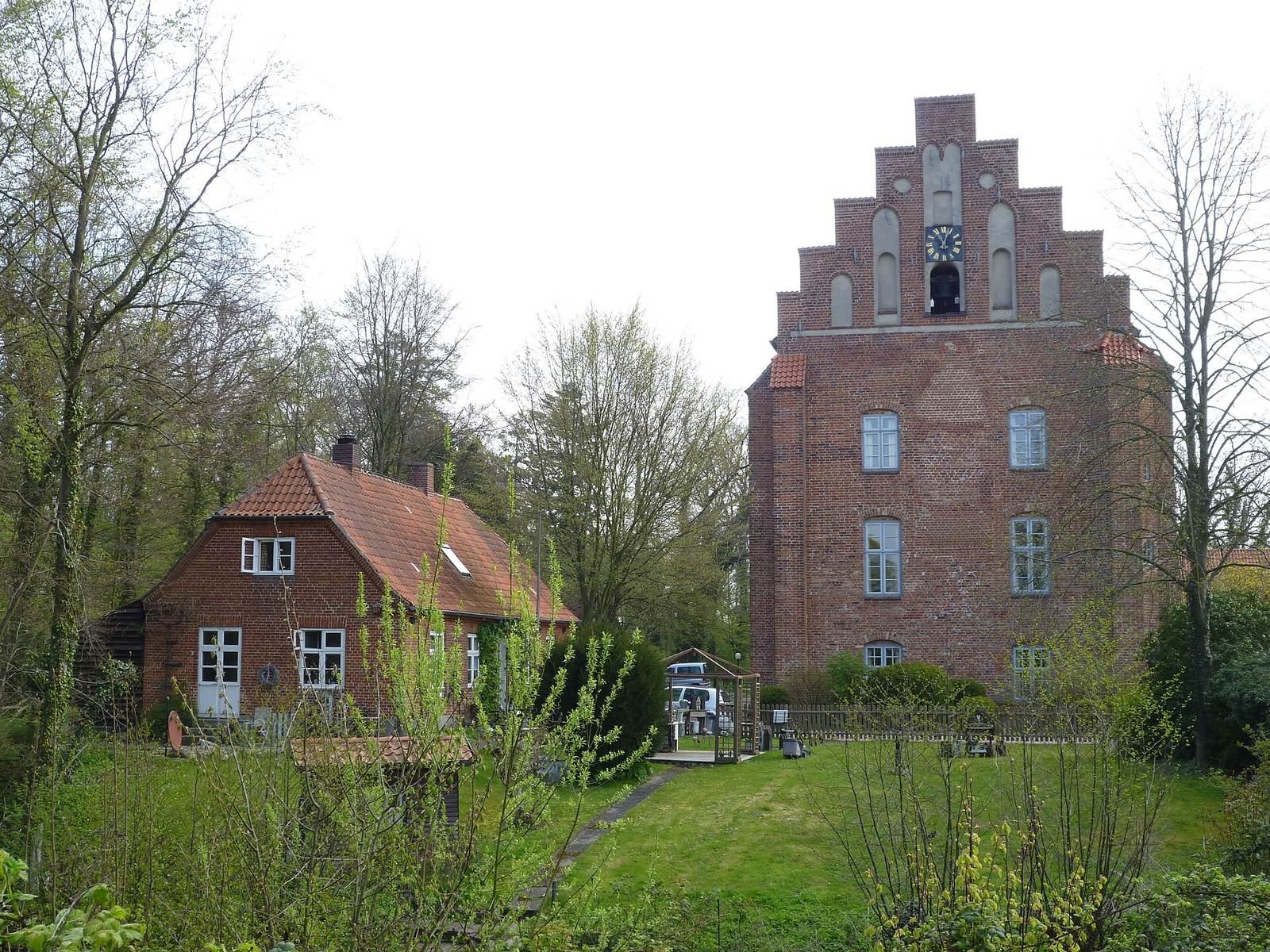
The church is a tall, vaulted, single-nave building measuring 62 metres in total length. Its choir ends in a many-sided form, with restrained, monumental features characteristic of early Lübeck Gothic. The first monastic church was probably built around 1245. Between 1260 and 1300 it was extended eastward by two bays to form the choir. In the fourteenth century, the original four-bay western section was redesigned, and a broad rood screen, a partition separating the choir from the monks’ section, divided the two areas. The west façade has a stepped gable, and alterations converted a large part of the church to residential use.
Carved high altarpiece
A three-winged carved altarpiece was installed in the choir between 1310 and 1320 to display the abbey’s relic collection. Five deep niches in its central section contain 15 panels depicting events from the life of Jesus. The right wing shows episodes from the life of Benedict of Nursia, the sixth-century monk whose Rule shaped Western monasticism; the left depicts the legend of John the Evangelist, the Christian figure associated with the Gospel of John and the monastery’s patron. Some figures probably date to around 1250. The shallow wooden carvings retain their original paint. The work is attributed to the workshop responsible for the choir stalls in Lübeck Cathedral and was probably made by Hermann Walther von Kolberg and his workshop. It is considered the oldest known carved altarpiece.
Memorial slab
A grave slab dated 1473 for Heinrich von Hachede, a councillor of Lübeck, is set into a brick pier on the church’s south side.
Monastic buildings and enclosure
One-storey buildings border the courtyard to the east and south. Stone markers trace the cloister, the covered passage around a monastery courtyard, while visible points where arches begin and projecting stone supports indicate parts of its structure. Part of the refectory, the community’s dining hall, survives. The western lay section was separated from the church and remodelled as the local administrator’s residence.