San Sebastiano de’ Bini: A Florentine Pilgrim Hospital and Oratory
Site at a Glance
- Popularity
- Low
- Country
- Italy
- Primary era
- Early Modern
- Eras represented
- Medieval, Early Modern
- Civilizations
- Grand Duchy of Tuscany, Republic of Florence
- Site type
- Religious
- Remains
- Chapel
On this page13 sections
History
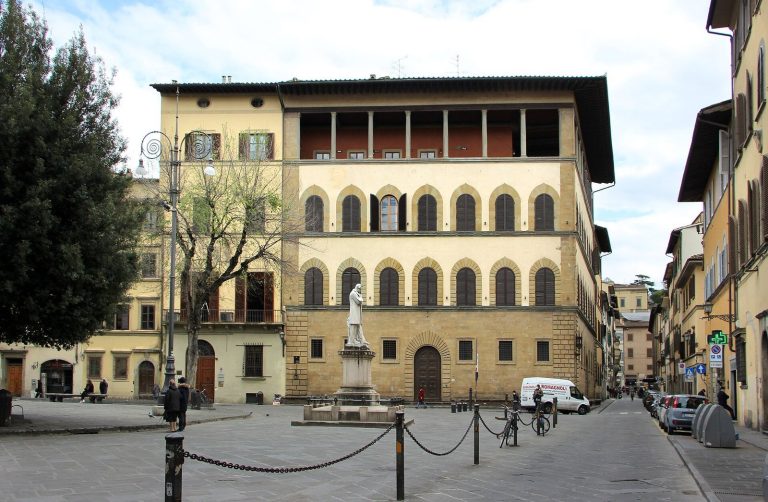
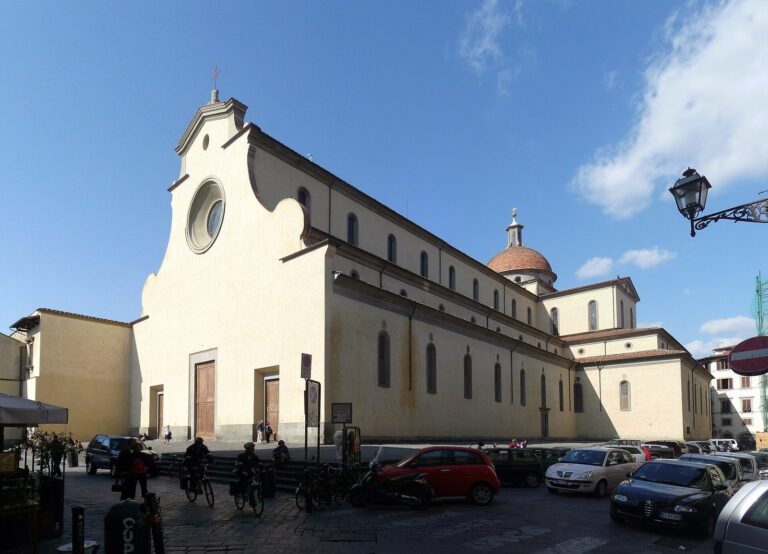
San Sebastiano de’ Bini is a former Roman Catholic oratory, or small chapel for worship, in Florence, Italy. Its history began around 1290 with a hospital established here for pilgrims travelling to and from Rome. The hospital served as Florence’s branch of Rome’s Hospital of Santo Spirito in Saxia and was one of several institutions along routes now known as Via Senese and Via Romana. Florentine benefactor Folco Portinari provided for its foundation in his will. The hospital’s oratory belonged to the parish of San Felice in Piazza.
The hospital and the Bini family
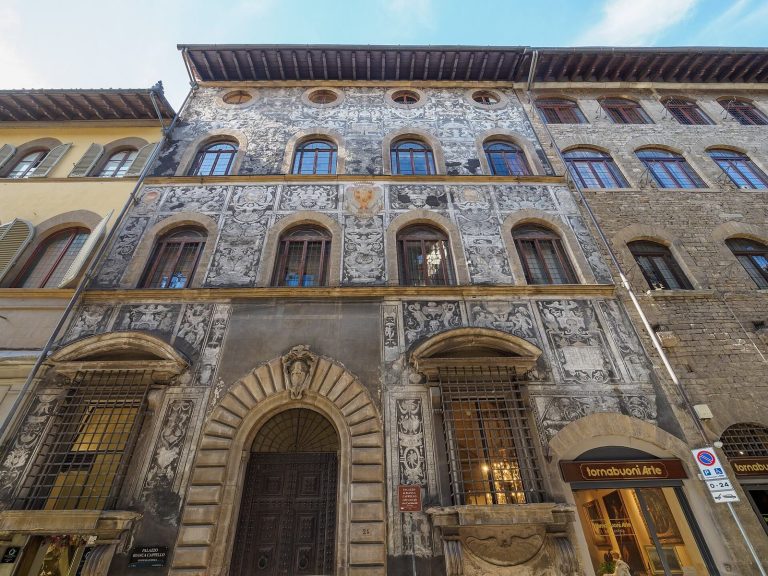
The Bini family, which owned numerous nearby houses, enlarged the oratory. Renovations to its façade and interior took place in 1490, and a choir had been created by 1525. The oratory was dedicated to Saint Sebastian, an early Christian martyr regarded as a protector of people afflicted by plague.
A demolition is dated to 1 January 1563, but the oratory’s later use makes it unclear what was demolished. In 1594, the building hosted the Congregation of Christian Doctrine, organized by Blessed Ippolito Galantini, a Florentine priest known for teaching Catholic doctrine. The congregation later moved to Via Palazzuolo and became known as the Vanchetoni, a nickname associated with members’ silent walks beneath their hoods, bent forward as they went.
Religious associations and changing use
In 1613, at the initiative of Pietro Bini, the Confraternity of Santa Maria dell’Impruneta, also called the Confraternity of the Bini, was established at the oratory. A confraternity is a voluntary association formed for religious devotion or charitable work. From 1632, the group was affiliated with the Oratorians, a religious congregation founded by Saint Philip Neri.
The Carthusians, a Catholic monastic order devoted to contemplative religious life, took possession of the oratory in 1744. It became a hospice in 1774 and was suppressed in 1808, during the Napoleonic secularization of religious institutions in Florence.
Neglect, alteration, and restoration
During the nineteenth and twentieth centuries, periods of neglect alternated with renewed care. Much of the art collection was dispersed, and the interior underwent substantial changes. The oratory was deconsecrated in the 1950s and used for storage. In 1996, after a prolonged restoration initiated by parish priest Gianfranco Rolfi, later additions were removed and the premises restored. Work to recover artworks formerly held there began at the same time.
Remains
Building and layout
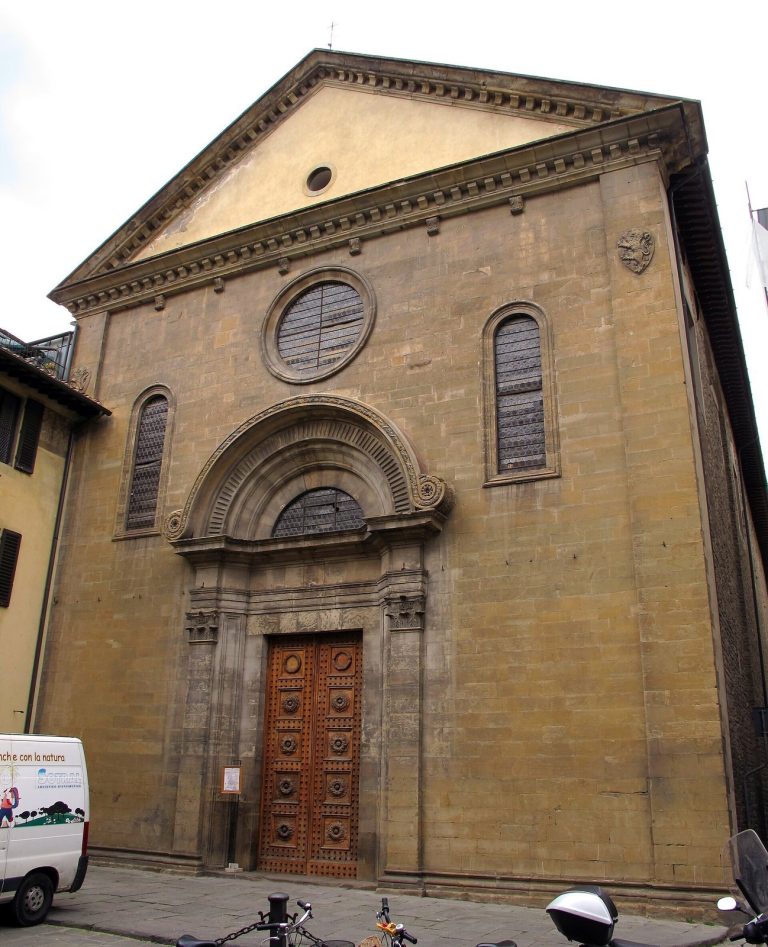
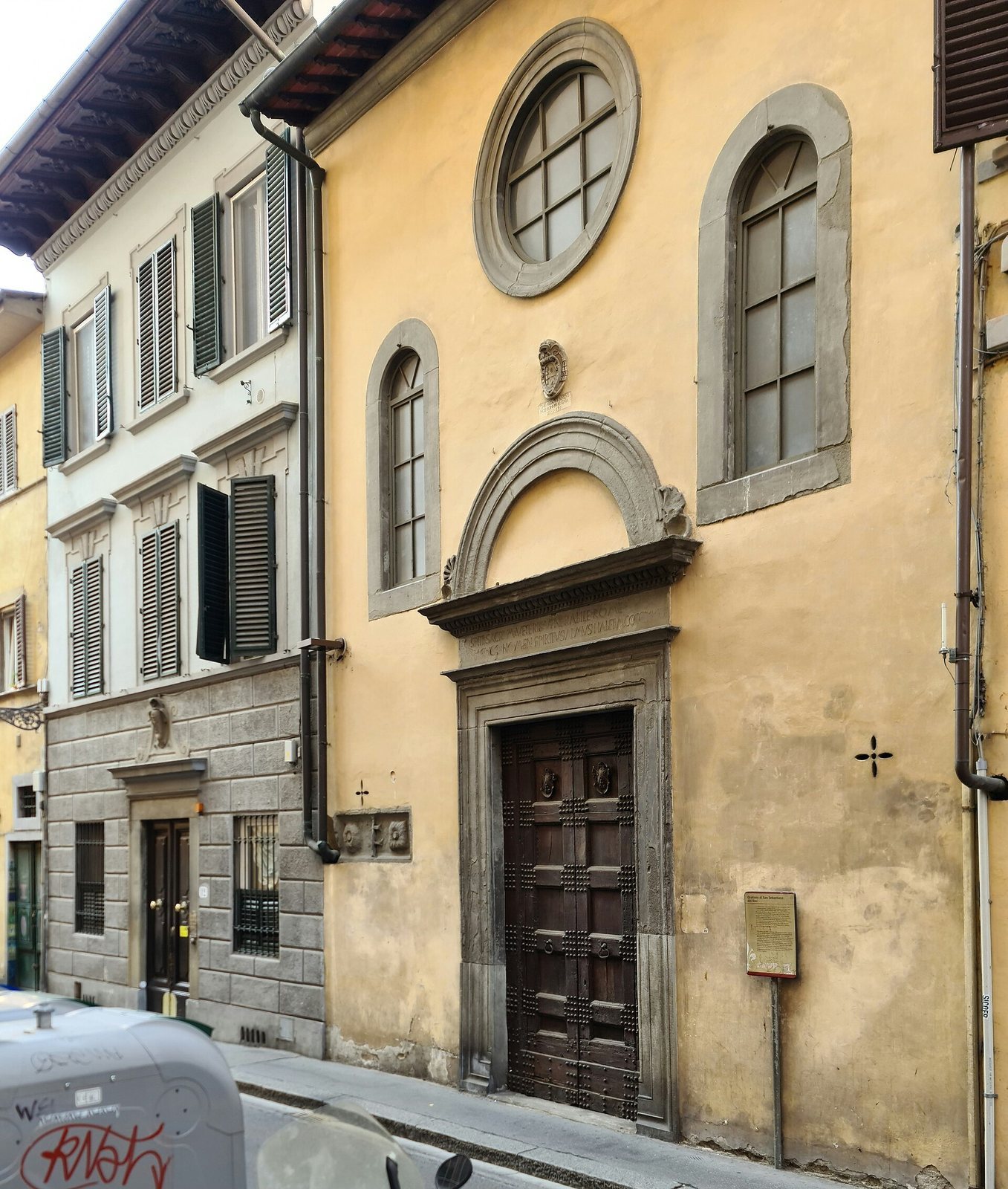
The building is arranged around a single nave opening onto a raised sanctuary, with two side rooms connected to the nave. Inside, white plaster contrasts with grey sandstone details, while the street-facing façade centers on an arched entrance.
Façade
The façade has a central arched doorway, two high windows, and a circular opening between the windows. A Bini family coat of arms appears on the portal. On the façade’s right side, a thirteenth-century coat of arms signaled a willingness to help pilgrims.
Nave and sanctuary
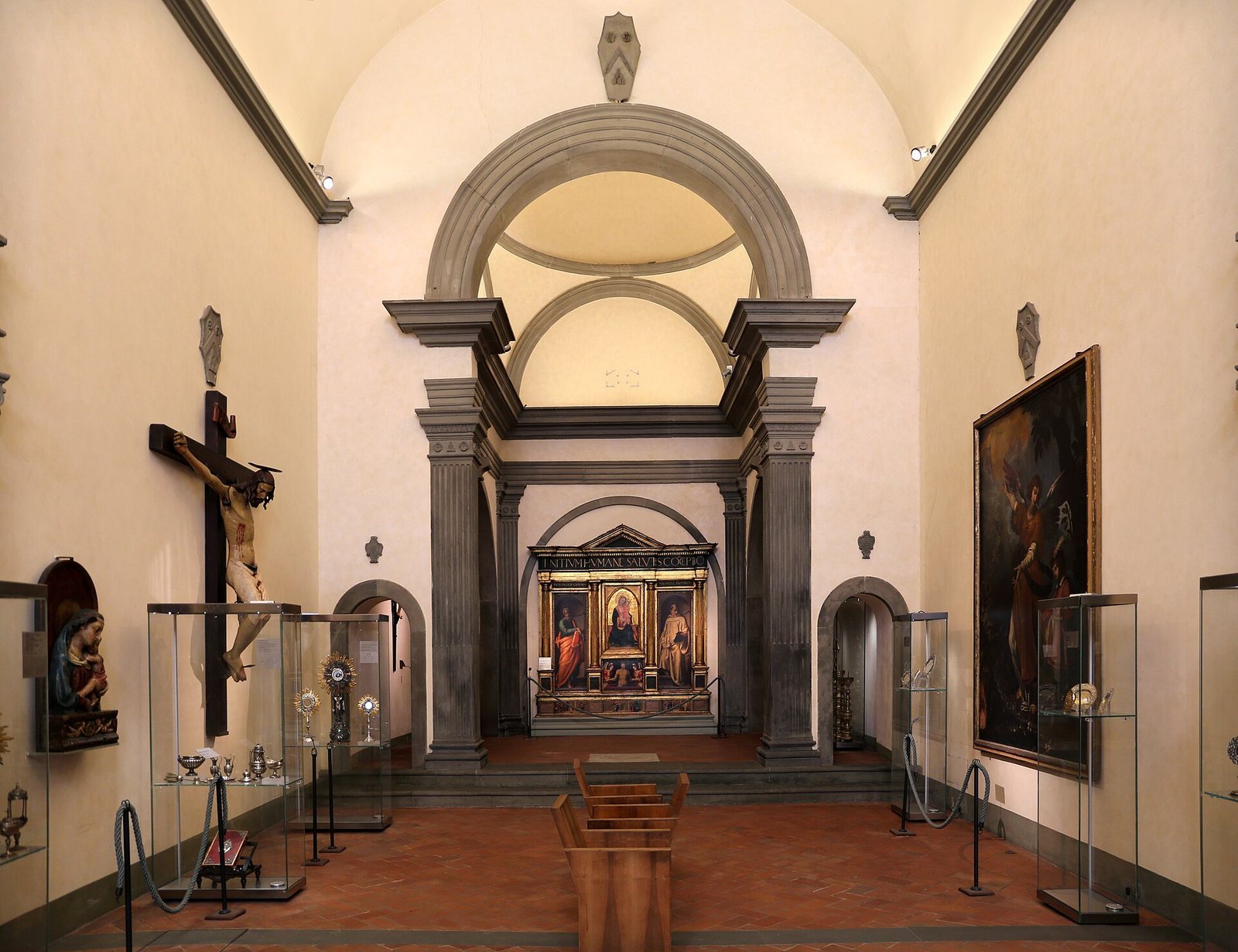
A barrel vault, or continuous curved ceiling, covers the nave. Two steps lead up to the presbytery, the raised area around the altar, which ends in a small domed sanctuary. Arched doorways connect two side rooms to the nave. Grey sandstone marks where the vault begins, frames the arch into the sanctuary, and forms the supports and horizontal bands at the two side altars, as well as the frames around doors and windows. The presbytery was created by Florentine architect and woodcarver Baccio d’Agnolo. Bini coats of arms, showing a chevron, two roses, and a six-peaked mound, appear on the walls and at the tops of supports.
Paintings, sculpture, and furnishings
Apse altarpiece
The apse holds an altarpiece assembled from works of different dates and by different artists. Its wooden frame, made by Baccio d’Agnolo, is shaped like a Renaissance temple, with a horizontal top and triangular pediment supported by grooved half-columns. An inscription on a floor tomb slab, now barely legible, records that Bernardo di Pietro Bini commissioned the frame between 1520 and 1525. The central painting is a Madonna of Humility, showing Mary seated low, often on the ground, by Rossello di Jacopo Franchi. Paintings of the apostle Saint Peter and Saint Bernard of Clairvaux by Pier Francesco Foschi flank it. A Pietà, showing Mary mourning the dead Christ, lies beneath. The lower tier, called a predella, comprises three panels by the Master of Serumido, a local painter chiefly active in Oltrarno: the Martyrdom of Saint Peter of Verona, the Annunciation, and the Apparition of the Virgin to Saint Bernard. Saint Peter of Verona was a Dominican friar and martyr. The Madonna of Humility was stolen in 1931 and recovered in 1971 by art historian Antonio Paolucci.
Nave paintings and sculpture
A fifteenth-century wall painting on the nave’s right side shows the Crucifixion with the apostle John and Mary Magdalene, a follower of Jesus. In a niche opposite, a wooden statue of Saint Sebastian by Leonardo del Tasso was painted in several colors by Filippino Lippi. Panels depicting Saint John the Evangelist and Mary Magdalene flank the statue. They came from another altar and are by a follower of Botticelli, possibly Arcangelo di Jacopo del Sellaio. A seventeenth-century painted sky with an angel, attributed to Giovanni Bilivert, joins this group. Bilivert also painted the Guardian Angel, commissioned by Pietro Bini in 1626.
Crucifixes and devotional furnishings
On the nave’s left wall is a painted wooden crucifix attributed to sculptor Baccio da Montelupo. Beside it, a gilded and painted plaster relief of the Madonna and Child comes from the workshop of Lorenzo Ghiberti and formed part of the oratory’s original furnishings. A larger wooden crucifix hangs opposite the entrance. It has been attributed either to a sculptor working in the tradition of Donatello’s crucifix at Santa Croce, with a proposed date around 1425–1430, or to an unidentified master close in style and date to works by Donatello and Brunelleschi, suggesting a date around 1405–1415. Restoration in 2002 removed its dark varnish and revealed the quality of the work.
Church silver
Objects used in worship include silverware made in Florence and Tuscany between the seventeenth and twentieth centuries. They came from the parishes of San Pier Gattolino and San Felice in Piazza.