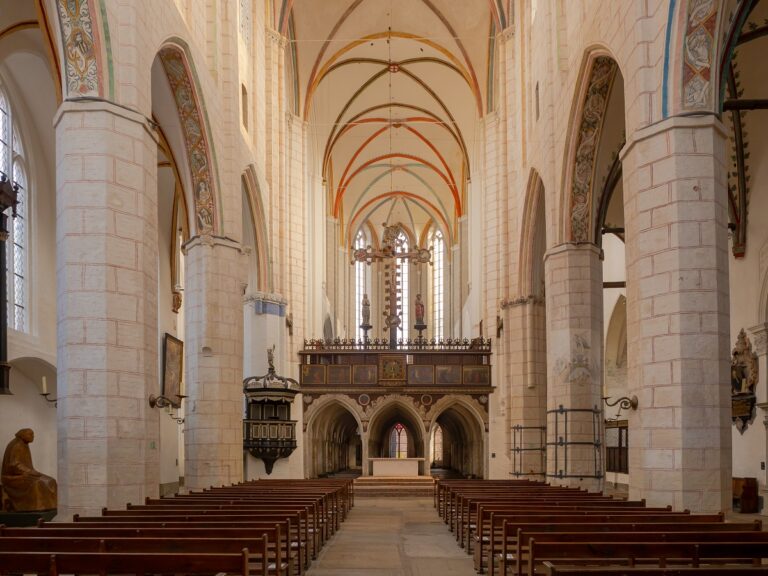
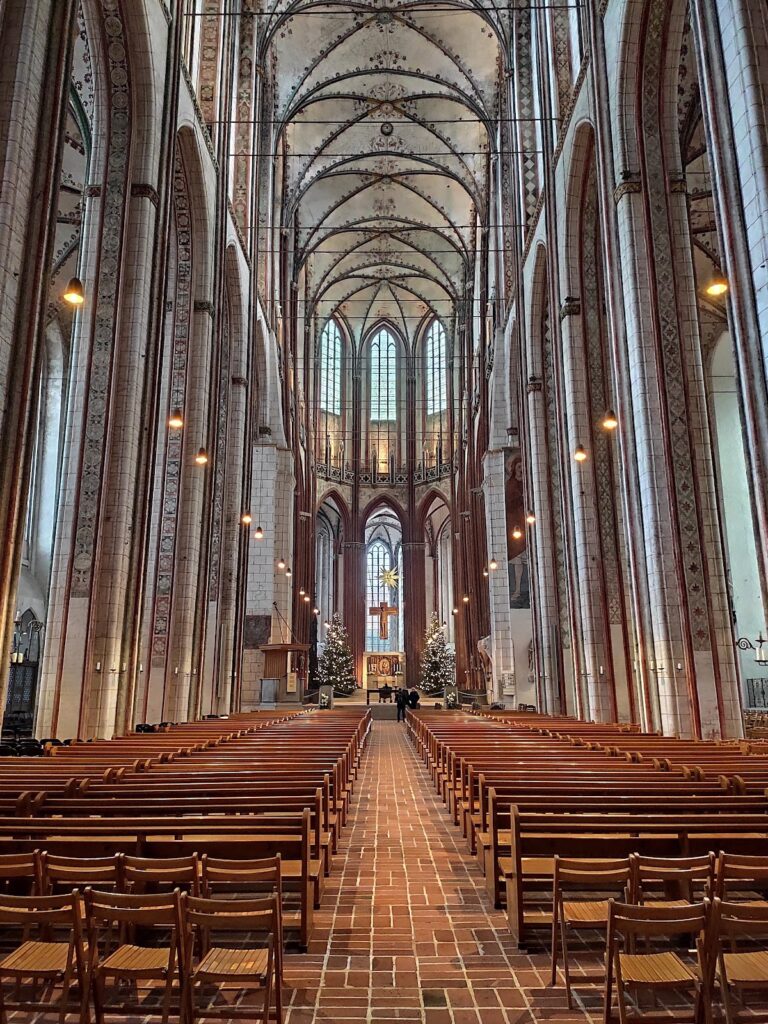
St. Lorenz: Evangelical Lutheran Church in Travemünde


Site at a Glance
- Rating
- 4.5
- Popularity
- Low
- Country
- Germany
- Primary era
- Early Modern
- External website
- Open
- Eras represented
- Medieval, Early Modern, Modern
- Civilizations
- Holy Roman Empire
- Site type
- Religious
- Remains
- Church
On this page21 sections
History
St. Lorenz is an Evangelical Lutheran church in Travemünde, a district of Lübeck, Germany. Dedicated to Saint Lawrence, the third-century Christian deacon and martyr, it was rebuilt from the 1540s during the Reformation, the sixteenth-century movement that divided Western Christianity and established Protestant churches including the Evangelical Lutheran tradition.
Medieval origins and destruction
The church is indirectly mentioned in a papal document of 11 May 1235. Pope Gregory IX, head of the Roman Catholic Church from 1227 to 1241, commissioned clergy from Schwerin to mediate a dispute between Lübeck Bishop John I and the city of Lübeck. St. Lorenz is explicitly recorded in 1259.
The medieval building was Gothic. A town fire destroyed it in 1522, following the reported destruction of its predecessor in a thirteenth-century fire. Only small parts of the Gothic church survive on the northern and eastern sides of the chancel, the area reserved for the altar and clergy.
Rebuilding and later development
Travemünde was destroyed during the Count’s Feud in 1534, a conflict that caused major damage to the town. The present church was then built from the 1540s on the foundations of its predecessor. A bell tower followed in 1605 and 1606, while its octagonal upper stage and spire were completed between 1619 and 1621. A document deposited at the tower’s completion in 1620 described it as higher and more beautiful than the tower destroyed with almost the entire town by a fire on Saint John’s Eve about a century earlier.
Until the second half of the nineteenth century, St. Lorenz was legally a filial church, meaning a subordinate church linked administratively to a principal church, Lübeck’s St. Mary’s Church. The chief pastor of St. Mary’s consequently also served as chief pastor of St. Lorenz. The resident pastor traditionally held the title Archdeacon, while the second preacher was known as the Deacon.
War damage and conservation
During the Second World War, the church bells were confiscated and stored at the Hamburg bell cemetery. They returned to St. Lorenz on 12 December 1947. A major renovation in 1990 uncovered and restored a painted ceiling hidden above a suspended ceiling. In 1991, the organ was moved to the redesigned west gallery after its original position beside the chancel had proved unsuitable acoustically and visually. St. Lorenz is included in Lübeck’s list of protected architectural monuments.
Remains
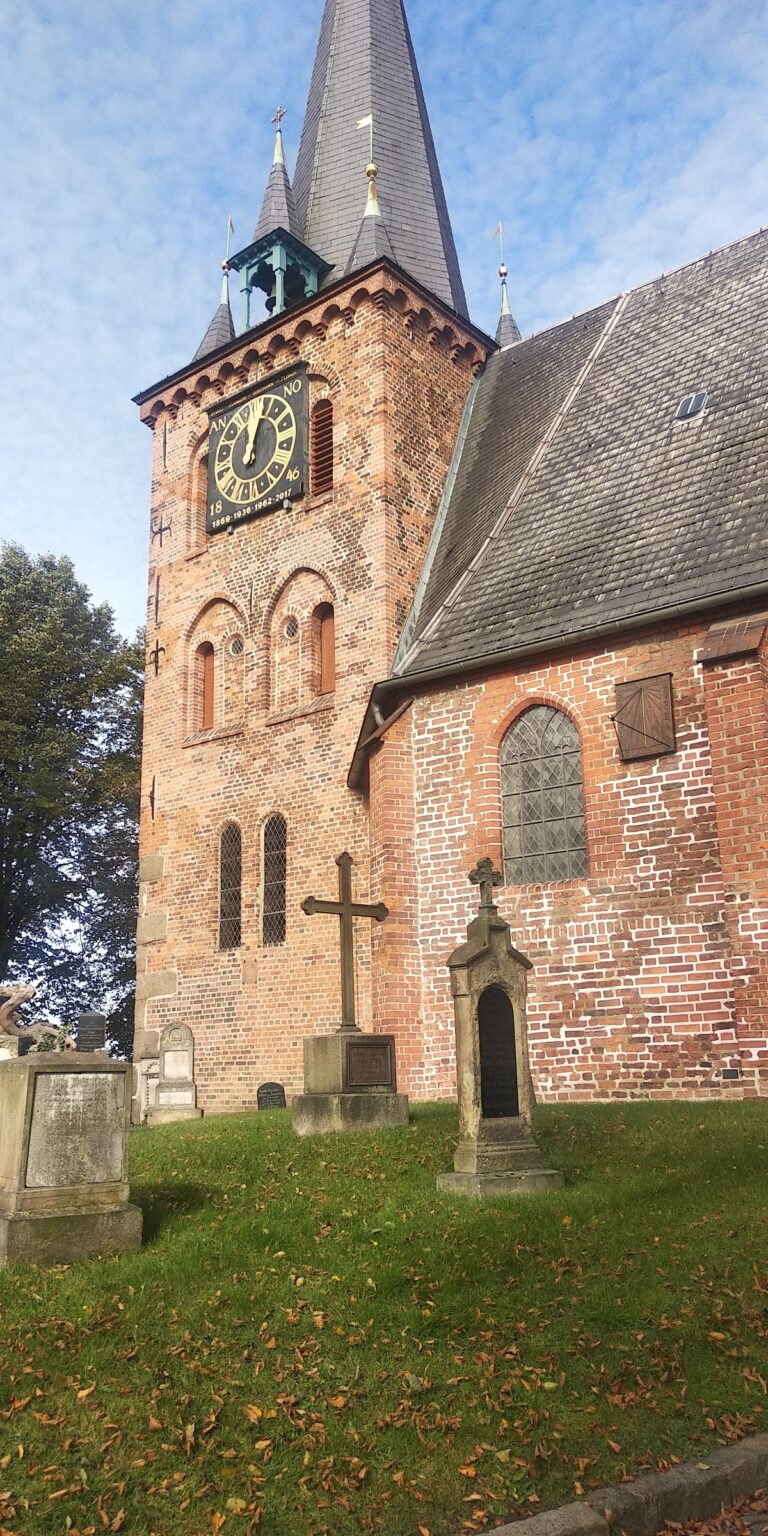
St. Lorenz survives as a single-nave brick church, with extensions attached to the chancel. These additions contain the sacristy, a room for vestments and worship equipment, and a former mortuary chamber. Inside, painted ceilings and wall paintings, historic sculpture, an altar, a pulpit, memorials, and an organ preserve evidence of the church’s medieval and post-Reformation development.
Building and painted decoration
Chancel extensions
The extensions beside the chancel contain the sacristy and former mortuary chamber. Together with the single nave and brick construction, they form the principal surviving architectural arrangement of the church.
Painted coffered ceiling
A painted coffered ceiling remains in its original condition. It had been concealed by a suspended ceiling until the 1990 renovation, when it was uncovered and restored. The church also contains valuable wall paintings.
Cross and sculpture
Triumphal cross
The triumphal cross, a large crucifix traditionally placed between the nave and chancel, combines a late Gothic corpus from the last quarter of the fifteenth century with a board cross bearing painted symbols of the Evangelists from the predecessor church. After the renovation, it was returned to its presumed original liturgical position.
Saint George sculpture
A late Gothic wooden sculpture of Saint George with the dragon stands in the tower entrance hall. Dated to around 1510 and attributed to the workshop of Henning von der Heyde, it came from the Saint George hospital near Travemünde, demolished around 1970. Its former polychromy, the use of several colors on a sculpture or architectural surface, has been lost.
Altar and pulpit
Baroque altar
The Baroque altar was donated in 1723 by Anna Magdalena Schröder, a cousin of the long-serving pastor Johann Hermann Siricius. The Lübeck master Hieronymus Jakob Hassenberg carved it, and its mensa, the top slab of an altar, incorporates a fourteenth-century Gothic tomb slab from Bodenwerder.
Pulpit
The pulpit dates from 1735 and is decorated with richly carved ornament, adding a later Baroque furnishing to the church interior.
Funerary monuments
Floor tombstones and Gladow epitaph
Old tombstones are set into the church floor, with the oldest dating from 1404. The epitaphs and paintings belong to Christian funerary culture and, with two exceptions, commemorate clergy who served at St. Lorenz during the Baroque period. The oldest epitaph is the Renaissance-style Gladow monument of 1583, which depicts the Resurrection of Christ with the donor kneeling beside it.
Steinmetz epitaph
The two-storey Steinmetz epitaph of 1663 retains Renaissance features. Its lower central section contains an oil painting on wood by Johannes Dietzius, showing the donor family kneeling in a landscape. A smaller depiction of a burial appears above it, while the monument also includes a statuette of the Risen Christ and allegories of faith, love, hope, and justice.
Organ and bells
Organ
Rudolf von Beckerath Orgelbau built the organ in 1966. It was first installed on the southern side of the chancel. In 1991, the Hinrich Otto Paschen organ workshop moved it to the west gallery, gave its exterior a form influenced by the former 1642 Stellwagen organ, adapted it to the church’s dominant Baroque style, and enlarged it by two stops. An organ stop is a separately controlled set of pipes or related sound-producing ranks.
Bell ensemble
The bell ensemble comprises three bells. The largest weighs 1,195 kilograms, sounds the pitch e′, and was cast in 1711 by Conradt Kleymann. A bell weighing 886 kilograms sounds f′ and was cast in Lübeck in 1673 by Albert Benningk. The smallest weighs 117 kilograms, sounds e″, and was cast in Lübeck in 1604 by Reinholt Benninck. Benningk and Benninck belonged to the same bell-founding family, whose surname was spelled in different ways over time.
Churchyard graves
The churchyard contains four protected graves dating from the 1830s. They include the grave cross of Johann Hermann von Duhn, a Lübeck councillor and Travemünde town captain who died in 1837.