Wangels LA 69: A Funnel Beaker Megalithic Tomb in Germany
Site at a Glance
- Popularity
- Low
- Country
- Germany
- Primary era
- Stone Age
- Eras represented
- Stone Age
- Civilizations
- Unclassified
- Site type
- Burial
- Remains
- Burial Mound
On this page12 sections
History
Wangels LA 69 is a megalithic tomb in Wangels, Germany. Associated with the Funnel Beaker culture, a Neolithic farming culture of northern Europe, it was built during the later part of the fourth millennium BCE and remained in use for burial until about 1900 BCE. Its repeated use suggests local importance, and the sequence of interments indicates that earlier burials were treated with respect. The site’s importance is assessed as regional. Passage graves, megalithic tombs reached through a passage, may have served family or clan groups, but that possibility cannot be confirmed for Wangels.
Construction and burial phases
The seven archaeological phases begin with evidence of activity before the tomb was built. Phase 1, dated to 3640–3360 cal BCE, is represented by a dark layer beneath the later chamber and traces of ploughing. Phase 2, from 3360–3280 cal BCE, marks the construction of the burial monument. In phase 3, dated to 3280–3120 cal BCE, the mound was extended and a stone boundary added. Three short-lived samples from the extension produced calibrated ranges of 3321–3018, 3336–3105 and 3333–3101 BCE.
Later phases brought further burials. Phase 4, assigned to 3120–3100 cal BCE, includes a separate burial north of the main feature. A direct sample from that grave gave a date of 3330–3095 BCE, while a model incorporating its position among the archaeological layers places it later, in 3120–3100 cal BCE. Individual burials were uncommon near the end of the fourth millennium BCE, so this grave has been interpreted as an early indication of the later development of individual-grave societies. Phase 5, dated to 3120–3000 cal BCE, is the earliest burial phase identified through pottery and includes the placement of burnt flint. Pottery identifies further burial activity in phases 6 and 7, from 3000 to about 1900 cal BCE.
Cultural connections and modern investigation
Pottery associated with the Globular Amphora culture, named for its rounded amphora vessels, connects Wangels to cultural influences beyond the region. This Neolithic culture extended across parts of central and eastern Europe; finds in southern Schleswig-Holstein and the Danish islands lie at the northwestern edge of its known distribution. Their presence at Wangels may reflect movement of people and the widening of exchange networks in the late fourth millennium BCE.
The site was entered in a Schleswig-Holstein archaeological survey in 1962 and classified as destroyed. A ground-penetrating radar survey in 2010 preceded four excavation campaigns between 2012 and 2014. The work, carried out within the German Research Foundation’s Priority Programme 1400 on early monument building and social differentiation, clarified the monument’s sequence and assessed damage to its chamber. Survey signals were interpreted as marking the mound’s construction to the northwest and the burial chamber to the southeast. The excavation and the chamber’s surviving contents have made Wangels valuable for research into construction, burial phases and prehistoric ritual. Further analyses took place within Collaborative Research Centre 1266.
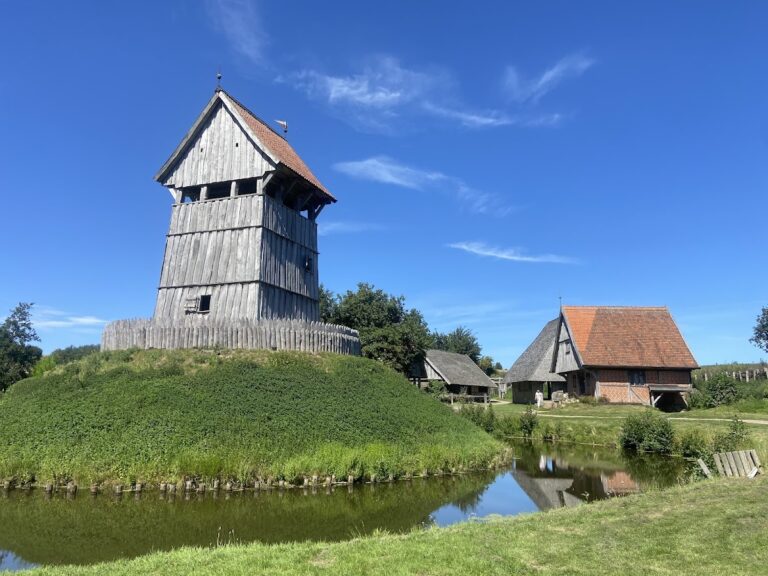
In 2015, Kiel University’s Institute of Prehistoric and Early History and Arche Wader built a reconstruction outside the university’s Audimax for the university’s 350th anniversary. It was still standing during the 2021–22 winter semester.
Remains
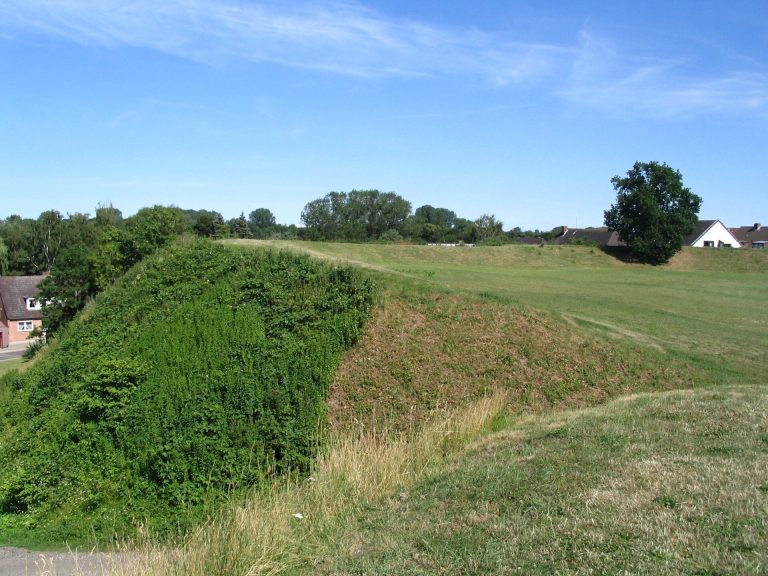
The tomb stands on a natural rise and centers on an oval earth mound built in stages around a stone burial chamber. The mound measured about 43 metres long and 16 metres wide, reaching up to 1.6 metres in height. Three other Neolithic burial monuments lay within 500 metres, and Bronze Age burial mounds were noted within two kilometres.
Burial architecture
Mound and stone boundary
The first mound covered the area around the chamber in the southeast. A later extension transformed the initially rounded feature into a long barrow and was associated with a grave built up with stones. Layers of turf sods formed part of the mound. Excavation at its edges indicated a slightly trapezoidal stone row, about 32 metres long and 9–12 metres wide, enclosing roughly 300 square metres. Small stones survive along the boundary; larger stones are inferred from comparisons with other monuments. A funnel-shaped cut, stone fragments, iron pieces interpreted as parts of a hammer and chisel, and channels made by blasting point to stone removal, probably in the nineteenth century.
Chamber and passage
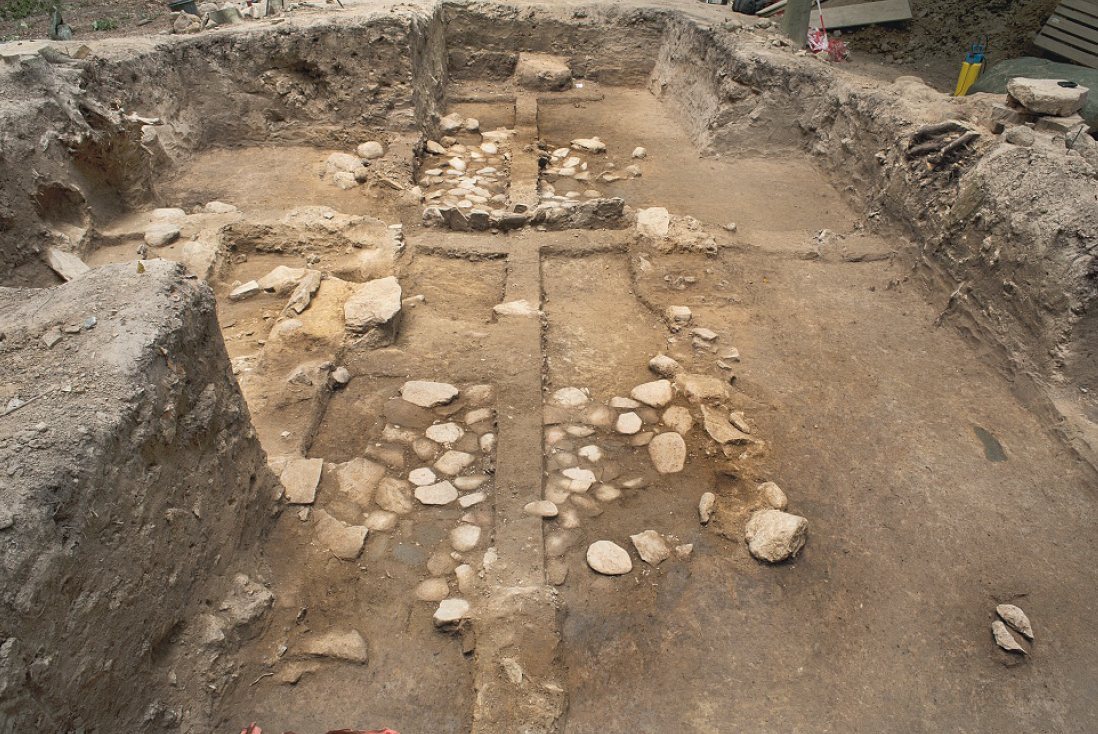
The chamber is a Holstein-type form, a regional style of megalithic burial chamber found particularly in southern Schleswig-Holstein. About six metres long, it has a rectangular plan with rounded short ends and was originally formed from 13 large stones carried by glaciers. Two supporting stones survive; soil discolorations helped excavators reconstruct the positions of the others. Four further stones marked the entrance. The passage measured about two metres long and between 0.7 and one metre wide. A threshold slab marked the entrance to the chamber, and a possible blocking stone was found nearby.
Stone paving covered the two outer zones of the chamber floor, while compacted clay formed the central area. Upright slabs separated the northern paved section from the clay. Burnt flint lay over the floor. Beneath one surviving chamber stone, a pit held a complete ceramic vessel, interpreted as an offering made during construction.
Burial features and earlier land use
Within the later mound extension, excavators found a packing of as many as six stacked stones. Beneath it, a long oval soil discoloration was interpreted as a burial feature in the northern part of the monument. Beside the chamber, plough marks point to earlier agricultural activity. Pollen evidence links them to Early Neolithic settlement and farming, supporting the interpretation that the land had been cultivated before the tomb was built rather than ploughed as part of a ritual.
Objects and deposits
Flint and stone tools
The excavations recovered 1,635 flint artefacts weighing 204.4 kilograms. These included 1,515 flakes weighing 150.2 kilograms; 47 had been modified, among them 23 transverse arrowheads, along with drills and scrapers. The collection also contained 51 blades and 69 cores. Three flint axe blades came from the chamber: two have thick butts and thin blades, while the third has both a thick butt and a thick blade. Their broad typological date ranges are about 3500–2250 BCE and 3200–1700 BCE, respectively.
Two flint daggers were also recovered. One cannot be classified more precisely. The other is a handle fragment with a diamond-shaped cross-section, which may belong either to a thick flint point dated to about 3500–3000 BCE or to a Type III flint dagger dated to about 2100–1900 BCE. A basalt double-axe battle axe, dated to about 3300–3000 BCE, belongs to type DII in a classification of double-axe forms and is also known as an Amazon axe.
Amber and pottery
The excavated amber collection comprises 69 objects, including 21 tubular pendants and 13 beads shaped like double axes. Pottery remains include 1,435 sherds weighing 137.4 kilograms, with 74 percent recovered from the chamber floor and the burnt-flint layer. From 590 distinctive rim and body sherds, weighing seven kilograms, at least 38 vessel units could be reconstructed. Together with ten complete and nine nearly complete vessels, these indicate at least 57 vessels in the chamber. Identified forms include 19 conical-rim vessels, 19 cylindrical-rim vessels, six funnel-rim vessels, six Globular Amphorae and one giant beaker. Many examples of the first three forms have decoration characteristic of the Middle Neolithic, a period called the Late Neolithic in central German terminology.
Object deposits and pottery residues
Nine concentrations of objects were interpreted as deposits. Deposit 4 lay between the middle and northern parts of the chamber, beside the upright slabs. It contained nine vessels assigned to phase 5, several vessels possibly belonging to earlier phases 2–3, and a Globular Amphora from phase 6. Other objects in the deposit included a flint axe blade, a dagger fragment, blades, transverse arrowheads and amber pendants.
Residue analysis of pottery associated with the Funnel Beaker culture identified fats from large mammals, probably cattle. The Globular Amphorae held plant oil, probably from sea buckthorn. These results indicate the use of cattle products, including meat and milk, in the burial context. At the contemporary settlement of Oldenburg-Dannau LA 77, pottery was used mainly for plant foods such as emmer, while cattle bones show that cattle were kept.