Vår Frue Church: A Medieval Parish Church in Trondheim


Site at a Glance
- Rating
- 4.5
- Popularity
- Low
- Country
- Norway
- Primary era
- Medieval
- External website
- Open
- Eras represented
- Medieval, Early Modern
- Civilizations
- Danish, Norwegian
- Site type
- Religious
- Remains
- Church
On this page8 sections
History
Vår Frue Church is a medieval parish church in Trondheim, Norway, built as a Catholic church and dedicated to Mary, the mother of Jesus. Its foundation and consecration belong to the twelfth century, while construction is also placed around 1200, although its precise date is uncertain. The church combines Romanesque and Gothic architectural features and remains an active parish church in the Church of Norway.
Medieval origins and changing use
The church was originally known as Mariakirken, meaning St. Mary’s Church, and has been called Vår Frue Church since the fifteenth century. Its medieval design is associated with Bjørn Sigvardsson. The building served as a Catholic institution until the Protestant Reformation, after which it became an Evangelical Lutheran parish church. Today it belongs to Nidaros og Vår Frue Parish in the Diocese of Nidaros, the Church of Norway diocese centered on Trondheim.
Vår Frue Church stands in Trondheim’s central Midtbyen district, a few blocks north of Nidaros Cathedral. It is one of the city’s two surviving medieval churches, together with the cathedral. The church marked its 800th anniversary in 2007, reflecting the long continuity of its religious use.
Fires, rebuilding, and enlargement
A major fire in 1651 destroyed about 90 percent of Trondheim’s buildings and left only the church walls standing. Some furnishings were saved, and gifts made it possible to rebuild and redecorate the church. Further fires affected the building in 1681 and 1708. In 1686, the nave was extended westward, creating much of the church’s present length.
A substantial renovation followed between 1739 and 1742. During the eighteenth century, the interior gradually received Baroque and Rococo decoration. The west end gained a new flat-roofed tower during the renovation, and its roof was replaced in 1779 by a pyramid-shaped form carrying a new spire.
Public role and modern restoration
In 1814, Vår Frue Church served as an election church for the elections to the Norwegian Constituent Assembly, the body that drafted the Constitution of Norway. Its later history included a major restoration led by the architect Christian Christie in the 1880s. That work removed much of the Baroque and Rococo interior and simplified the decoration in an effort to recover aspects of the church’s medieval appearance.
Architect John Egil Tverdahl led another refurbishment from 1957 to 1959, and the church was fully restored by 2007. In 2004, the Norwegian Directorate for Cultural Heritage placed Vår Frue Church among twelve large churches considered to have national value, bringing increased state protection. It also has automatic protection as a Norwegian cultural-heritage church.
Remains
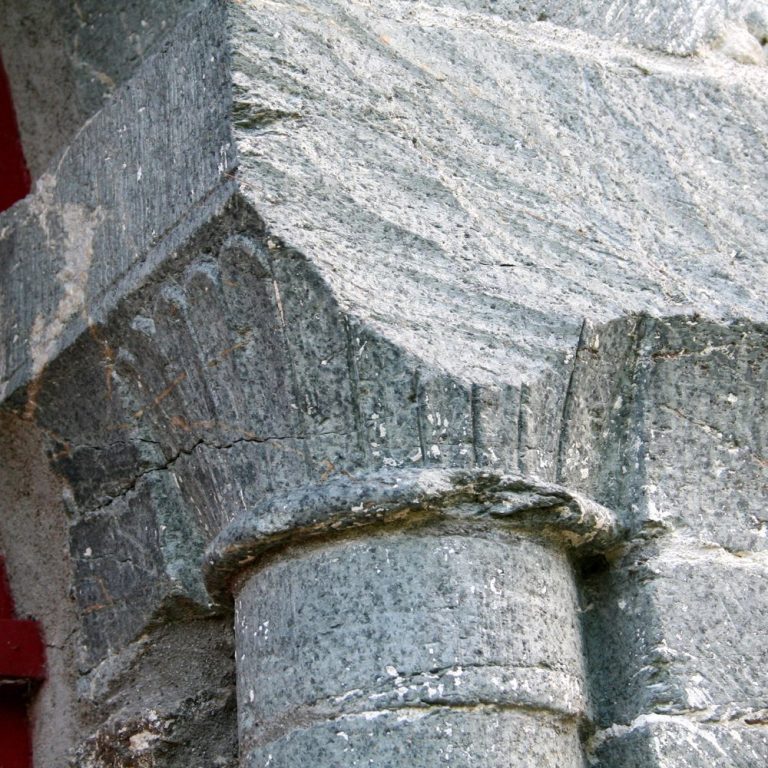
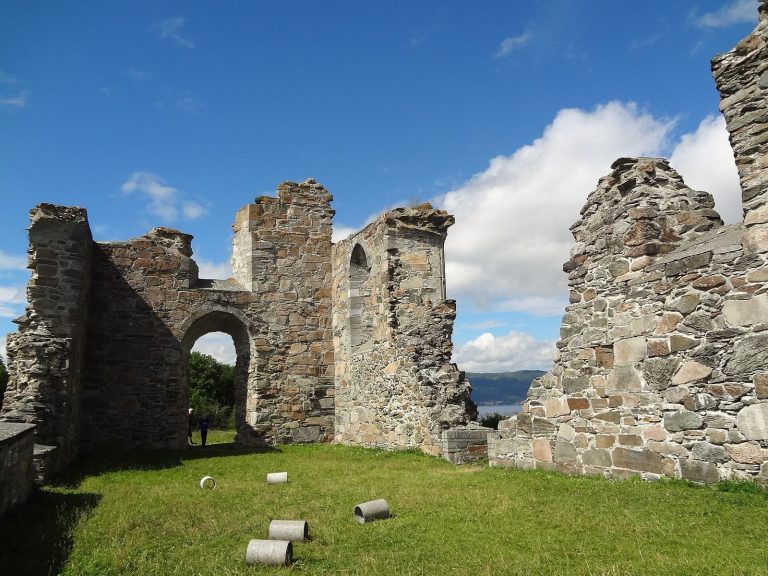
Vår Frue Church is a gray stone long church, meaning that its nave extends along a main axis toward the choir. Its architecture combines the heavy masonry and rounded forms associated with Romanesque building with Gothic features and later Neo-Gothic motifs. The walls are built of stone masonry that includes green schist and soapstone. The eastern masonry belongs to the original medieval structure and remains relatively well preserved.
Medieval core and westward extension
The present eastern part of the nave and the choir correspond to the surviving medieval section. The westward nave extension of 1686 brought the church to a total length of 64 metres. This arrangement preserves the relationship between the older eastern fabric and the later addition, while the stone construction gives the building its unified external character.
Tower and exterior masonry
The tower at the west end dates from the 1739–1742 renovation. It was first built with a flat roof, then altered in 1779 when a pyramid-shaped roof and new spire were added. During the 1957–1959 refurbishment, the whitewashed exterior was removed and the outer masonry was knocked back to expose its cobblestone surface. This treatment recreated an appearance associated with the medieval period.
Interior furnishings
The church’s altarpiece was carved for Nidaros Cathedral by Heinrich Kühnemann between 1742 and 1744. J. N. Schavenius painted it, while Jonas Granberg carved its figures. The altarpiece was transferred to Vår Frue Church in 1837, where it forms part of the building’s later interior history.
The pulpit dates from 1771 and was restored during the 1957–1959 refurbishment. A baptismal font dating from 1898 also survives. Together with the medieval stonework, the westward extension, tower, and later furnishings, these elements reflect the church’s changing fabric and continued use as a parish church accommodating several hundred worshippers.