Church of St. John the Baptist in Buczek: A Late-Gothic Parish Church in Poland


Site at a Glance
- Rating
- 4.5
- Popularity
- Low
- Country
- Poland
- Primary era
- Medieval
- External website
- Open
- Eras represented
- Medieval, Early Modern
- Civilizations
- Kingdom of Poland, Polish–Lithuanian Commonwealth
- Site type
- Religious
- Remains
- Church
On this page9 sections
History
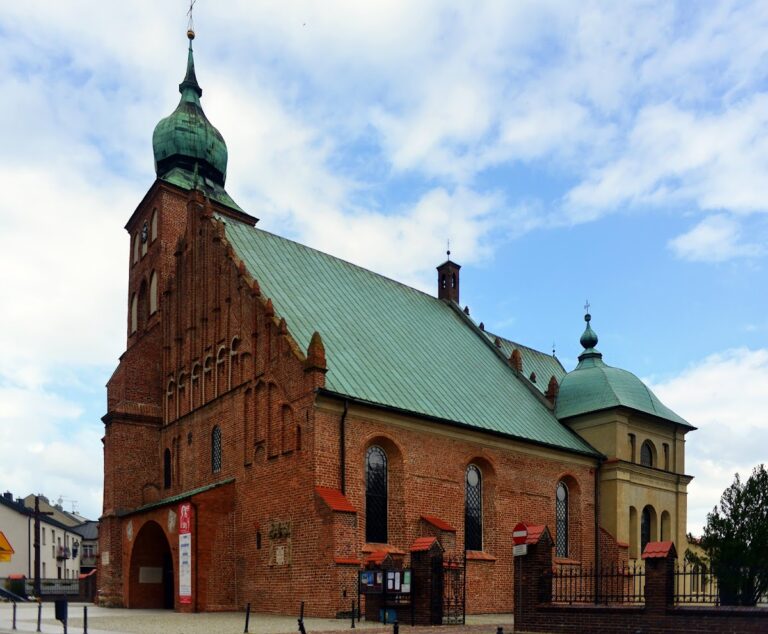
The Church of St. John the Baptist in Buczek is a Roman Catholic parish church in Poland, completed in the fifteenth century as a late-Gothic brick building. It belongs to the Zelów Deanery, a grouping of neighboring parishes, within the Archdiocese of Łódź, a major Roman Catholic diocese headed by an archbishop.
Foundation and Alterations
The Buczkowski family, owners of the surrounding estate, founded the church. Members of the family were buried beneath the presbytery, the part of a church reserved for the principal altar and clergy. The brick building was altered several times, including an extension of the nave.
During the seventeenth century, two late-Renaissance square chapels were added. The Walewski Chapel was built on the south side and the Gomuliński Chapel on the north. These additions changed the church while preserving its role as the parish church of Buczek.
Renovation and Commemoration
A major renovation took place between 1978 and 1980 through the efforts of parish priest Z. Wujak. A commemorative plaque describes the work as an homage to Our Lady of Jasna Góra, a title of the Virgin Mary associated with the revered icon at the Jasna Góra Monastery in Częstochowa, on the six-hundredth anniversary linked with 1382–1982. The plaque also commemorates Pope John Paul II and Cardinal Stefan Wyszyński, the Primate of Poland during the communist period.
The church appears in the heritage register under entries dated 18 August 1949 and 20 July 1967. Another plaque commemorates Father Stefan Skowroński, parish priest from 1939 to 1941, who was arrested by Nazi occupiers in Buczek. Other priests from the parish who died during the Second World War are commemorated as well.
Remains
Building and Exterior
The church has an oriented layout, following the traditional longitudinal arrangement associated with an eastward-facing sanctuary. It consists of a single nave and a narrower rectangular presbytery. The main roof is gabled, while the roofs over the chapels are tent-shaped. Buttresses strengthen the eastern wall, which is crowned by a triangular gable and a bell turret, a small roof structure that shelters a church bell.
A four-sided tower rises on the axis of the facade and becomes octagonal in its upper section. The windows have semicircular heads. One window in the presbytery has the date 1712 carved on its frame. A sacristy is attached to the north side of the presbytery and to the eastern side of a chapel, and a porch stands on its eastern side.
Chapels
Walewski Chapel
The south Walewski Chapel is a late-Renaissance square structure covered by an octagonal dome. Curved triangular supports called pendentives form the transition between the chapel space and the dome. The chapel contains an image dedicated to Saint Anne, and its polychrome ceiling presents the eight invocations of the Litany of Loreto, a Roman Catholic prayer addressed to the Virgin Mary, as if carried by angels.
Gomuliński Chapel
The north Gomuliński Chapel has a flat ceiling and contains an image dedicated to the Holy Trinity, the Christian doctrine of one God in three persons: the Father, the Son, and the Holy Spirit.
Altars, Pulpit, and Memorials
The main altar dates from 1620. It contains an image of the Madonna and Child, an image of Saint Anthony of Padua with the Child above it, and an early-seventeenth-century scene of Christ’s Baptism in the Jordan in its crowning section. The two side altars were made in the eighteenth century and contain seventeenth-century images of Saint Andrew and Saint Joseph with the Child.
The pulpit was made at the beginning of the eighteenth century. Nineteenth- and twentieth-century memorial plaques are mounted on the church walls, including those dedicated to Zdzisław Walewski, Zygmunt Colonna-Walewski and Anigeta née Tarnowska-Walewska, and Przemysław Colonna-Walewski and Emilia née Zagórowska.