Church in Retschow: A Late-Medieval Gothic Village Church in Germany


Site at a Glance
- Rating
- 4.2
- Popularity
- Very Low
- Country
- Germany
- Primary era
- Medieval
- External website
- Open
- Eras represented
- Medieval, Early Modern
- Civilizations
- Holy Roman Empire
- Site type
- Religious
- Remains
- Church
On this page8 sections
History
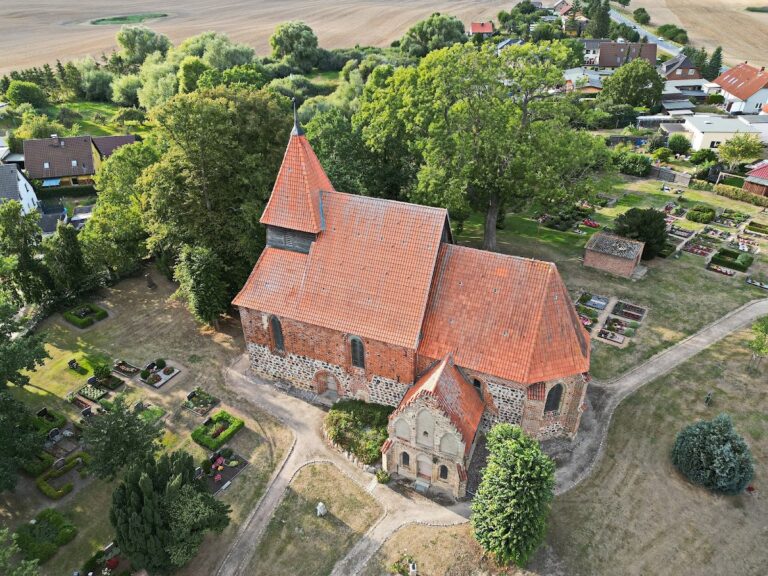
The Church in Retschow is a late-medieval Gothic village church in Germany. Both the church and the village were first recorded in 1233, while Retschow entered the possession of Doberan Monastery on 18 June 1358. The building remains associated with the parish of Steffenshagen-Retschow, within the Bad Doberan church region and the Rostock provostship of the Evangelical Lutheran Church in Northern Germany.
From Doberan Monastery to the Sovereign Domain
Doberan Monastery was a medieval monastic institution whose possessions were transferred to secular territorial administration when the monastery was secularized on 7 March 1552. After this change, Retschow became part of the sovereign domain. The church consequently preserves evidence of a religious landscape shaped first by monastic ownership and later by the reorganization of church and territorial institutions.
Reformation and Later Alterations
The Reformation, the sixteenth-century movement that transformed Christian institutions and worship in northern Europe, provides the setting for changes to the church interior. Its medieval frescoes were probably covered with white paint during this period. Some of the paintings have been uncovered in recent decades, allowing parts of the earlier decorative program to be seen again.
The pulpit was made in 1565 and was later moved into the church interior for safety. Its former position, to the left of the entrance to the north sacristy, can still be recognized from the fresh paint at that location. The choir stalls date from 1659 and incorporate medieval remains. A projecting wooden west tower was added in 1653, and the church’s small bell dates from 1443.
Structural Problems and Conservation
The church later developed serious structural problems when its foundations were undermined and the building began to subside. A support association founded in 2008 has collected donations and raised substantial funds for restoration. The north and south sacristies have been secured, so external bracing is no longer needed there. The eastern chancel termination still requires restoration; its octagonal form makes emergency external support difficult to install.
Remains
Gothic Church and West Tower
The building is a single-nave Gothic church reinforced with piers. A one-bay choir leads to an eastern termination formed by a divided octagon, while sacristies project from the north and south sides. The west end carries a projecting wooden tower built in 1653. The small bell inside dates from 1443 and bears the mark of Rickert of Mönchhagen, its founder.
Altarpiece and Pulpit
The church contains a rare late-fifteenth-century carved altarpiece with two transformations, or changing display sides. Its gilded and painted festival side has a central shrine showing the Coronation of Mary. The transverse divisions include Jesus, several saints, and an unidentified bishop. The outer wings show the Twelve Apostles, including Andrew, recognized by the cross in the lower central area on the right.
The first transformation, displayed at Easter, presents eight scenes from the Passion, beginning with the Last Supper and ending with the Crucifixion. The second, used during the Christmas season, shows the Mass of Saint Gregory, the Holy Kinship, the sacramental mill, and the Annunciation. The Mass of Saint Gregory represents a vision of Christ appearing to Pope Gregory the Great during Mass. The Holy Kinship depicts the extended family of Mary and Jesus, while the sacramental mill uses grain processed into flour as an image of the Eucharist. Only the sacramental mill and the Holy Kinship have been restored. The other images have been secured but remain in relatively poor condition.
The 1565 pulpit has four figured sides with the Evangelists John, Luke, Mark, and Matthew, the traditionally recognized authors of the Christian Gospels. Its fifth side is undecorated because it was concealed by the north wall until 1969.
Medieval Frescoes
The interior was originally covered with frescoes. On the south wall, the painted sequence concerns the life of Mary. It includes the Birth of Jesus at the bottom, the Presentation in the Temple, the Death and Assumption of Mary, the twelve-year-old Jesus in the Temple, and the Coronation of Mary in the upper third.
The north wall presents Jesus as the Judge of the World with two swords. An angel leads the righteous on the left, while the devil leads the wicked on the right. Above the organ gallery, additional frescoes dating to approximately 1400 show the Annunciation on the left and Adam and Eve on the right, accompanied by smaller images of saints. These paintings, together with the altarpiece and later furnishings, preserve several layers of the church’s medieval and early modern interior history.