Church of Saint Wenceslaus in Prague-Prosek: A Romanesque Parish Church


Site at a Glance
- Rating
- 4.6
- Popularity
- Low
- Country
- Czechia
- Primary era
- Medieval
- External website
- Open
- Eras represented
- Medieval, Early Modern, Modern
- Civilizations
- Duchy of Bohemia, Habsburg, Holy Roman Empire, Kingdom of Bohemia
- Site type
- Religious
- Remains
- Basilica
On this page11 sections
History
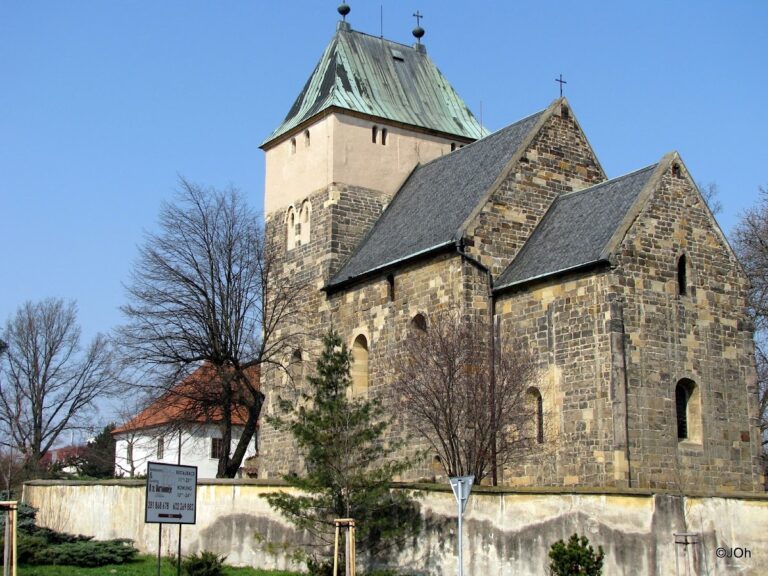
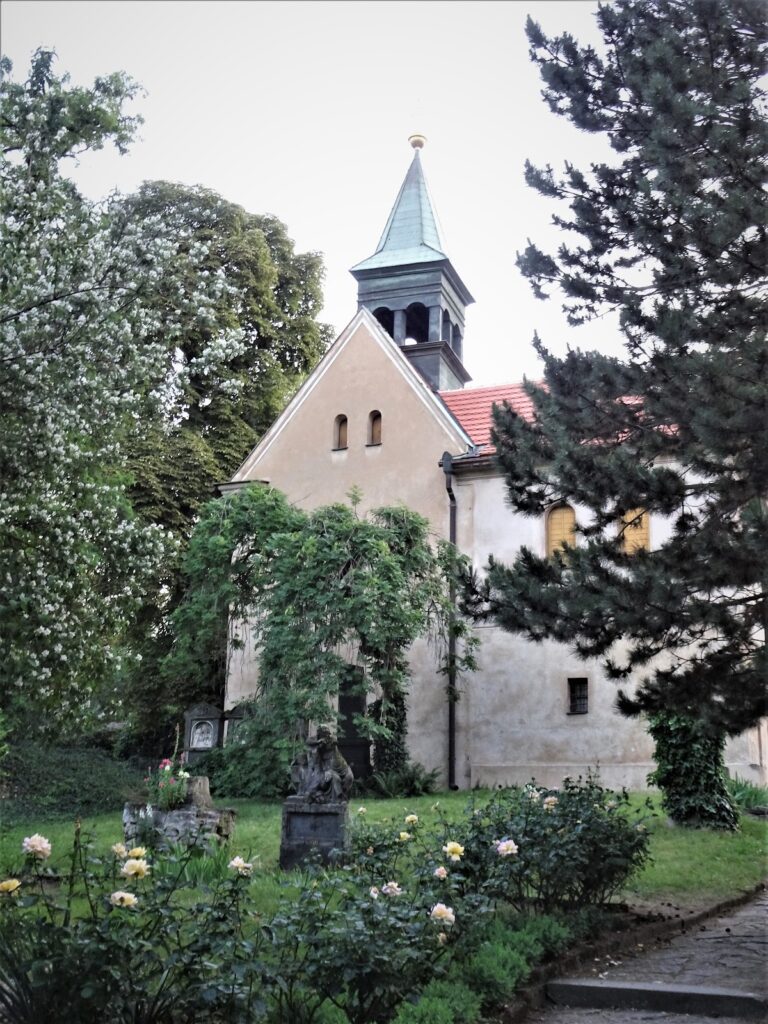
The Church of Saint Wenceslaus in Prague-Prosek is a Roman Catholic parish church in Czechia, built as a Romanesque three-aisled basilica around the turn of the eleventh and twelfth centuries. It is regarded as Prosek’s oldest architectural monument and belongs to the Archdiocese of Prague within the Czech ecclesiastical province. The church stands at the boundary between a plateau and the slope of the Rokytka valley, at a location associated with an important prehistoric-route crossroads in northeastern Prague.
Origins and medieval development
The church’s exact foundation date remains uncertain. Written records that place it among vineyards in 1115 or 1168 are thirteenth-century forgeries. The Dalimil Chronicle refers to Prosek in 1090, while the more reliable chronicler Jarloch mentioned the area in 1179. Building-historical investigations place the church’s origin around the turn of the eleventh and twelfth centuries. Anežka Merhautová dated the original Romanesque basilica to around 1170 and associated its western portal with alterations around 1200.
Later tradition attributed the foundation to Duke Boleslav II, who was said to have seen Saint Wenceslaus, the tenth-century duke of Bohemia and principal patron saint of the Czech lands, in a dream while travelling from Stará Boleslav to Prague. Another legend placed the foundation in 970 and connected it with the funeral procession carrying the murdered duke’s remains from Stará Boleslav to Prague Castle. The route associated with Wenceslaus’s life and burial became the traditional Saint Wenceslaus pilgrimage route. It was also linked with the Palladium of the Czech Lands, a small copper devotional medallion traditionally associated with the saint and regarded as a protective religious symbol of Bohemia.
The first documented alteration to the building took place in the early thirteenth century. A parish, then described as a plebania, a medieval parish organization administered by a priest, is recorded from 1311, and the names of its priests survive from 1356. Around 1420, the church was partly destroyed during the Hussite conflicts, the religious and political upheaval associated with the reform movement of Jan Hus. It subsequently came under Utraquist administration, the moderate Hussite branch. Repairs in the 1470s introduced Gothic alterations to the originally Romanesque building.
War damage and restoration
After the Catholic Church regained control, the church became a filial church subordinate to the parish of Saint Martin in the Wall. It was later burned during the Thirty Years’ War, a major European conflict that brought extensive military and religious disruption. Prague Archbishop and Cardinal Arnošt Vojtěch z Harrachu ordered the restoration of damaged Prague churches, including the Prosek church, in a charter dated 9 May 1667. The order responded to damage caused by the Hussite disturbances and Swedish incursions, which had placed the building at risk of becoming a ruin.
The parish was re-established in 1675, with responsibility extending to the Church of the Beheading of Saint John the Baptist in Dolní Chabry and the Church of Saint Paul beyond the Poříčí Gate. Augustin Salát, formerly an administrator in Hostouň, became its first parish priest and died on 18 May 1679 at the age of thirty-nine.
Parish history and the surrounding cemetery
In 1929, the parish was elevated to a deanery, an administrative grouping of parishes directed by a dean. It retained that status until 30 June 1994. Josef Beran, who later became Archbishop of Prague, served as a chaplain in the parish from 1 January to 31 August 1914. Other chaplains included Miloslav Máša and Jiří Huber.
The cemetery surrounding the church became overcrowded after smallpox and cholera epidemics in 1872 and 1873. The dead of Libeň, Střížkov, Prosek, and Vysočany were buried there, and these communities were expected to establish a new cemetery even as burials continued. After the older cemetery closed, burials began at the new Prosek cemetery on Čakovická Street. The churchyard still contains the tomb of the Frey von Freyenfels family, the grave of philosopher František Čupr, the grave of racing and works driver Josef Žák, and the grave of the Czech-Polish writer Honorata z Wiśniowských Zapová, a friend of Karel Havlíček Borovský.
Repair campaigns included a general restoration in 1937 and work on the coverings of all three roofs in 1938. Since 1990, municipal authorities in Prague 9 have supported the Saint Wenceslaus pilgrimage. The church also hosts religious and other concerts, including the annual September series “Nine Times with the Ninth,” devoted to orchestral and chamber music. In 2010, three stone Madonna statues were installed beside the eastern cemetery wall, together with landscaping around the church.
Remains
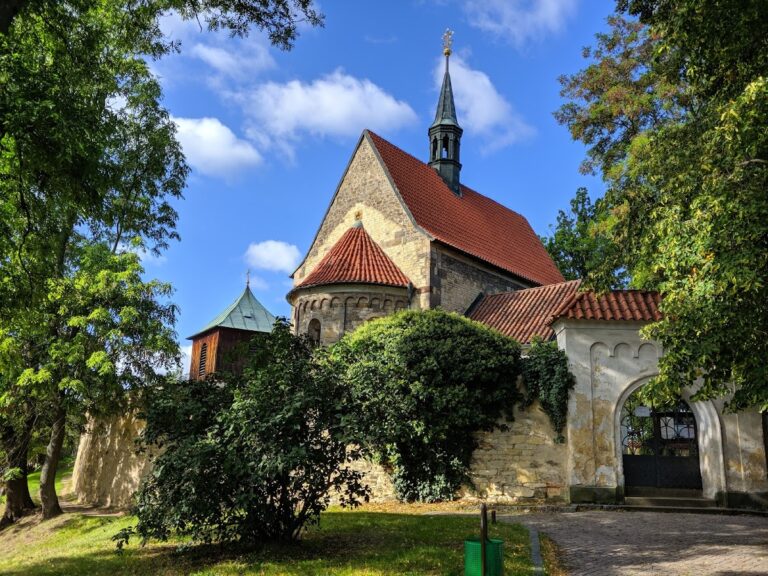
The surviving church is a Romanesque columned basilica built from ashlar marlstone masonry, a calcareous building stone containing substantial clay. Its three aisles each terminate in an eastern apse, a space at the end of a church that is usually semicircular or polygonal. The building retains Romanesque fabric, later medieval and early modern additions, and evidence of repeated repairs that altered its form over several centuries.
The church building
Romanesque core and medieval decoration
Fragments of wall paintings dating from around 1200 survive within the Romanesque structure. Remains in the south aisle were supplemented by modern repainting. The southern cornice retains a Romanesque small-arch frieze. Beneath an onion-shaped turret, the main nave contains a ribbed-net vault from the end of the fifteenth century, associated with the Gothic alterations made during repairs in the 1470s.
Later additions and interior furnishings
A Renaissance vestibule was added in 1572, followed by an additional porch in 1579. A square tower was built above the chancel, the part of the church surrounding the main altar, in 1712, replacing the former roof turret. The tower was altered in 1770 and again during the nineteenth and twentieth centuries. The 1770 works also added a sacristy behind the altar and enlarged the windows. Because these changes weakened the building’s stability, a freestanding bell tower was erected in the adjacent cemetery in 1783. Further alterations followed in 1790, and a clock was installed on the church tower in 1874.
The 1931 rebuilding lowered the roofs over the side aisles, reopened Romanesque windows in the main nave, and added a new sacristy on the north side. The high altar bears The Apparition of Saint Wenceslaus, painted by the Jesuit artist Ignác Raab in the mid-eighteenth century. A tin baptismal font carries an inscription dated 1622, while two painted epitaphs, memorial inscriptions for deceased people, date from 1628.
Cemetery and associated buildings
Cemetery entrances and Madonna statues
The old cemetery entrance retains a Baroque portal from 1770. A second entrance, built in 1930, has a wrought-iron grille. Beside the eastern cemetery wall stand three natural-stone Madonna statues installed in 2010. They are made of marble, sandstone, and granite, and were created by the sculptor Zuzana Čížková.
Baroque rectory
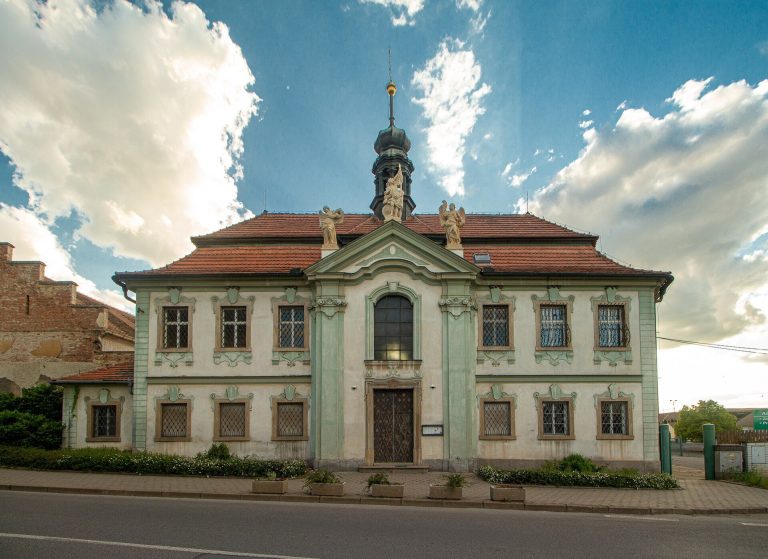
A Baroque rectory stands opposite the church. It was designed around 1715, probably by Jan Blažej Aichl, and forms part of the surviving group of historic buildings associated with the parish.